


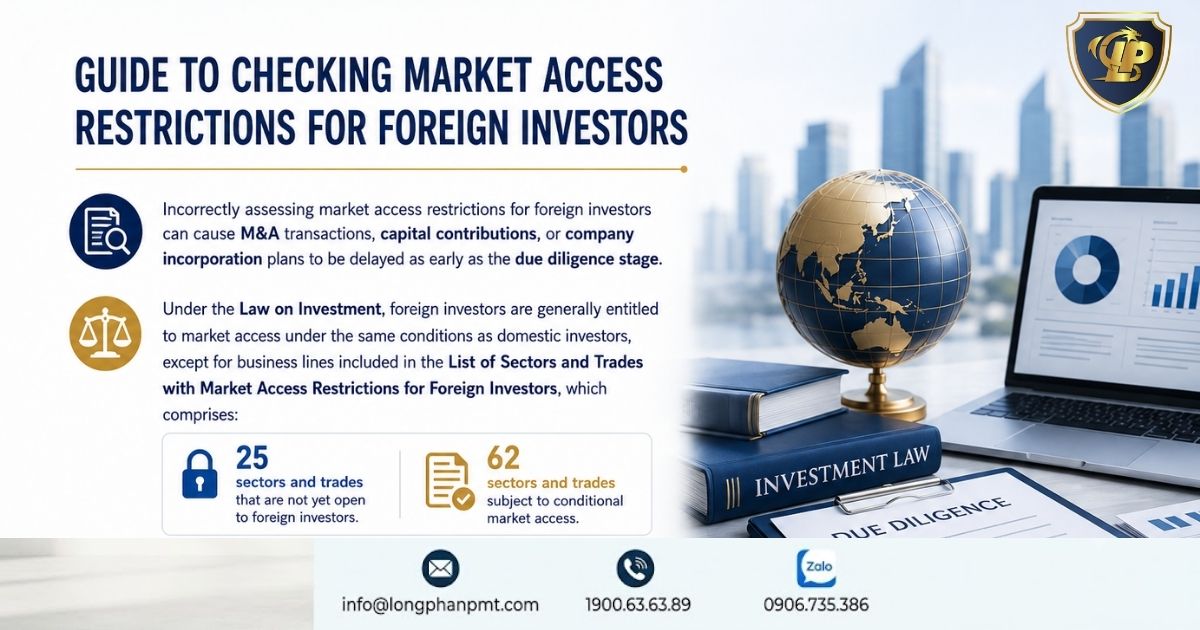
Restrictions for Foreign Investors must be assessed accurately before M&A deals, capital contributions, or company establishment plans proceed, as errors may delay transactions from the due diligence stage. Under the Law on Investment, foreign investors generally access the market on the same basis as domestic investors, except for sectors listed as restricted or conditionally accessible. Businesses should not rely only on VSIC codes, but must also review sector-specific rules and applicable investment treaties. Long Phan Consulting supports pre-transaction assessment to identify eligibility risks and structure suitable investment options.
Key legal notes:
The entry restrictions listed under the negative list function as the primary statutory filter that international boards and corporate acquisition teams must clear before establishing a local footprint, infusing capital, or executing M&A deals in Vietnam. For executive boards and transaction teams, this initial mapping defines the precise boundaries of permissible investments, prohibited sectors, and structural conditions that must be fulfilled to maintain regulatory compliance.
The category of business lines completely closed to foreign market access constitutes an absolute statutory barrier for international investors. Executing corporate transactions within these restricted zones exposes foreign firms to immediate administrative rejections or forced corporate dissolutions by licensing authorities.
Key prohibited fields under this restrictive classification include:
This restrictive framework incorporates 25 explicit business sectors that remain entirely unopened to global capital. Pursuant to Clause 2, Article 17 of Decree No. 96/2026/NĐ-CP, foreign investors are strictly prohibited from conducting any commercial or investment activities within these designated fields.
The category of conditional market access sectors does not constitute an absolute regulatory barrier. However, international corporate entities are only permitted to operate within these industries provided they satisfy and maintain explicit statutory criteria throughout their entire operational life cycle.
The primary compliance parameters requiring exhaustive pre-transaction audits include:
Section B of Appendix I of Decree No. 96/2026/NĐ-CP explicitly structures 62 conditional fields, which encompass high-value sectors such as real estate development, commercial banking, insurance underwriting, telecommunications, private education, and international tourism. Pursuant to Clause 3, Article 17 of Decree No. 96/2026/NĐ-CP, foreign investors may participate in these sectors subject to full, ongoing compliance with all applicable statutory filters. Failing to preserve these legal thresholds exposes the enterprise to immediate administrative suspensions or total business revocations, turning compliance into a permanent operational risk rather than a simple initial licensing step.
Regulatory entry barriers apply to more than just direct cross-border filings initiated by overseas entities. Local corporations that are backed by foreign capital are also subject to identical market access conditions whenever they execute secondary investments, spin-offs, or downstream corporate acquisitions within Vietnam.
| Corporate Ownership Structure | Statutory Legal Implication |
| Foreign investors hold more than 50% of the total charter capital | The entity must strictly satisfy market access conditions equivalent to a direct foreign investor. |
| An economic organization matching the above threshold holds more than 50% of the target’s charter capital | The downstream entity is treated as a foreign investor and remains subject to the market access negative list. |
| Foreign investors and foreign-controlled entities concurrently hold a combined stake exceeding 50% | The corporate structure triggers mandatory pre-deal audits and regulatory clearances before completing investments or M&A transactions. |
This 50% charter capital threshold serves as the critical control point when configuring corporate investment structures in Vietnam. This cross-border capital control mechanism is explicitly governed by Points a, b, and c, Clause 1, Article 20 of the Law on Investment 2025.
For dual citizens holding both Vietnamese and foreign passports, modern statutory frameworks permit the individual to voluntarily elect whether to operate under the legal status of a domestic investor or a foreign investor. This explicit right of selection is officially recognized under Clause 2, Article 16 of Decree No. 96/2026/NĐ-CP.
Auditing an enterprise’s market access alignment must extend far beyond a basic cross-reference of registered business names or industrial classifications. For an international investor, the verified compliance output must accurately reflect the practical nature of commercial activities, the project’s strategic milestones, the targeted charter capital structures, and active international investment treaties.
The foundational step requires translating actual commercial activities into formal domestic industrial categories. Licensing authorities evaluate corporate applications based on the operational substance and target objectives of the project, rather than generic corporate descriptions or marketing nomenclature.
When configuring this administrative mapping, management must execute the following verifications:
Any structural mismatch between the assigned VSIC codes and actual commercial operations will trigger mandatory administrative explanations, forced dossier modifications, or immediate rejections during M&A applications. This represents a frequent compliance failure when corporate transaction teams rely entirely on raw classification codes without auditing the actual scope of localized business operations.
Once the appropriate industrial codes are locked, investors must cross-reference them against the official Negative List for Market Access. The analytical focus must extend beyond basic investment permission to determine precise equity ceilings and permitted incorporation models.
This regulatory assessment requires a dual-track validation:
These regulatory parameters serve as the definitive legal framework for structuring local equity acquisitions, share purchases, or greenfield corporate setups. Pursuant to Clause 3, Article 8 of the Law on Investment 2025, mandated market access conditions explicitly encompass the authorized charter capital ownership ratio, the permitted investment forms, the physical scope of operations, investor financial capacity, domestic partner qualifications, and supplementary criteria enforced by specialized statutes.
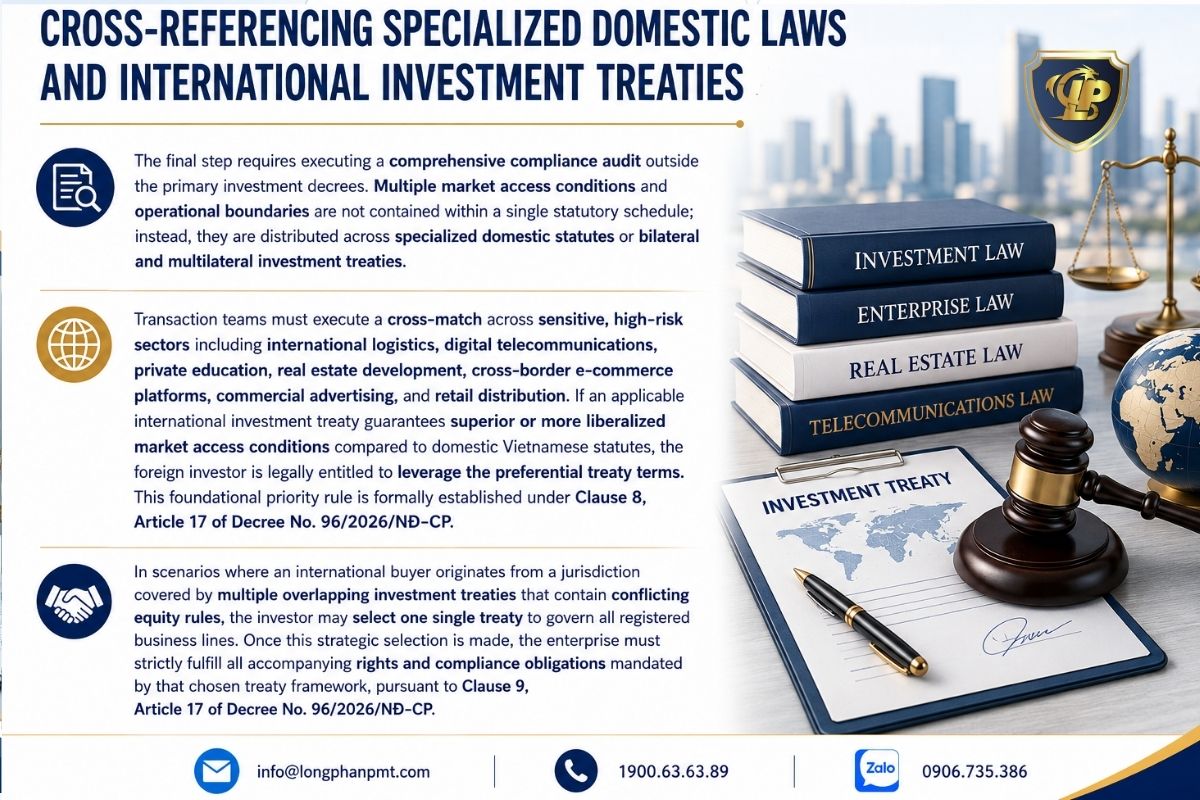
The final step requires executing a comprehensive compliance audit outside the primary investment decrees. Multiple market access conditions and operational boundaries are not contained within a single statutory schedule; instead, they are distributed across specialized domestic statutes or bilateral and multilateral investment treaties.
Transaction teams must execute a cross-match across sensitive, high-risk sectors including international logistics, digital telecommunications, private education, real estate development, cross-border e-commerce platforms, commercial advertising, and retail distribution. If an applicable international investment treaty guarantees superior or more liberalized market access conditions compared to domestic Vietnamese statutes, the foreign investor is legally entitled to leverage the preferential treaty terms. This foundational priority rule is formally established under Clause 8, Article 17 of Decree No. 96/2026/NĐ-CP.
In scenarios where an international buyer originates from a jurisdiction covered by multiple overlapping investment treaties that contain conflicting equity rules, the investor may select one single treaty to govern all registered business lines. Once this strategic selection is made, the enterprise must strictly fulfill all accompanying rights and compliance obligations mandated by that chosen treaty framework, pursuant to Clause 9, Article 17 of Decree No. 96/2026/NĐ-CP.
The entry barriers embedded within the market access negative list generate regulatory risks that extend far beyond initial market-entry licensing. Serious operational liabilities frequently surface when an active enterprise expands its business lines, restructures its internal capital percentages, acquires multi-sector targets, or adjusts its core project objectives post-incorporation.
The presence of unutilized or inactive registered business lines represents a prevalent compliance risk when acquiring local Vietnamese companies. Even if a target company maintains no active commercial operations within a registered field, those dormant classifications remain part of the company’s official public record and will be fully scrutinized by regulators whenever a foreign buyer attempts a corporate equity acquisition or share purchase.
To secure a compliant transaction workflow, buyers should compel the target entity to execute a pre-deal clean-up through the following sequential steps:
Cleaning the corporate registry prior to formal filing significantly reduces the risk of triggering unexpected mandatory Capital Contribution and Share Acquisition Approval procedures. This proactive structural adjustment also serves as a critical compliance foundation when drafting condition-precedent clauses within Share Purchase Agreements (SPAs).
For foreign-invested firms operating across diverse commercial sectors, regulatory exposure does not stem from individual business units independently. Instead, liabilities are driven by how statutory conditions accumulate across the entire corporate framework. A single registered sector that enforces rigid foreign capital caps will drag the entire corporate investment structure into a heightened level of administrative oversight.
Foreign investors executing projects or conducting commercial operations across multiple industries listed on the negative list must concurrently fulfill every single market access condition applicable to all of those registered sectors, pursuant to Clause 6, Article 17 of Decree No. 96/2026/NĐ-CP.
Furthermore, if overlapping international investment treaties mandate conflicting foreign equity caps across the company’s registered business lines, the total authorized foreign equity allocation must not exceed the lowest maximum ownership ceiling enforced among those restricted sectors. This restrictive priority rule is explicitly governed by Point d, Clause 10, Article 17 of Decree No. 96/2026/NĐ-CP.
Consequently, M&A transaction teams must never compute permissible foreign ownership room solely based on a target company’s primary or highest-grossing commercial division. A rigorous, exhaustive audit of the entire registered corporate asset portfolio, project goals, and international treaty commitments is a mandatory prerequisite before finalizing equity transaction percentages.
Active foreign-invested economic organizations that operate lawfully are granted statutory protections when state market access policies change. However, these preservation rights do not grant an absolute, unrestricted freedom to modify corporate structures, add secondary business lines, or execute equity re-allocations without undergoing a fresh regulatory evaluation.
| Factual Legal Scenario | Strategic Compliance Realization |
| Active conditions within an issued IRC are superior to newly enacted state restrictions | The enterprise is legally entitled to maintain its preferential operational conditions pursuant to Clause 9, Article 52 of the Law on Investment 2025. |
| The corporate equity transaction was legally finalized prior to the enforcement of new restrictions | The company is granted absolute non-retroactivity exemptions for that completed transaction pursuant to Clause 1 and Clause 2, Article 104 of Decree No. 96/2026/NĐ-CP. |
| The enterprise executes project adjustments, appends new sectors, or enters a new M&A deal post-enactment | The corporation must strictly satisfy the current, active market access conditions for all newly proposed modifications. |
| A conditional business sector is officially abolished by modern statutory amendments | The operating entity may continue utilizing its issued permits, certificates, or professional credentials until their stated expiration dates pursuant to Clause 15, Article 52 of the Law on Investment 2025. |
Whenever an enterprise scales its operations or acquires local project assets, the investment registration authority restricts its compliance review to the specific new elements being adjusted, as governed by Clause 3, Article 104 of Decree No. 96/2026/NĐ-CP.
The optimal corporate strategy requires establishing a clear legal line between grandfathered operational rights and newly proposed modifications that require fresh due diligence. Failing to isolate these structural components frequently leads management to miscalculate the true boundaries of their protected investment rights.
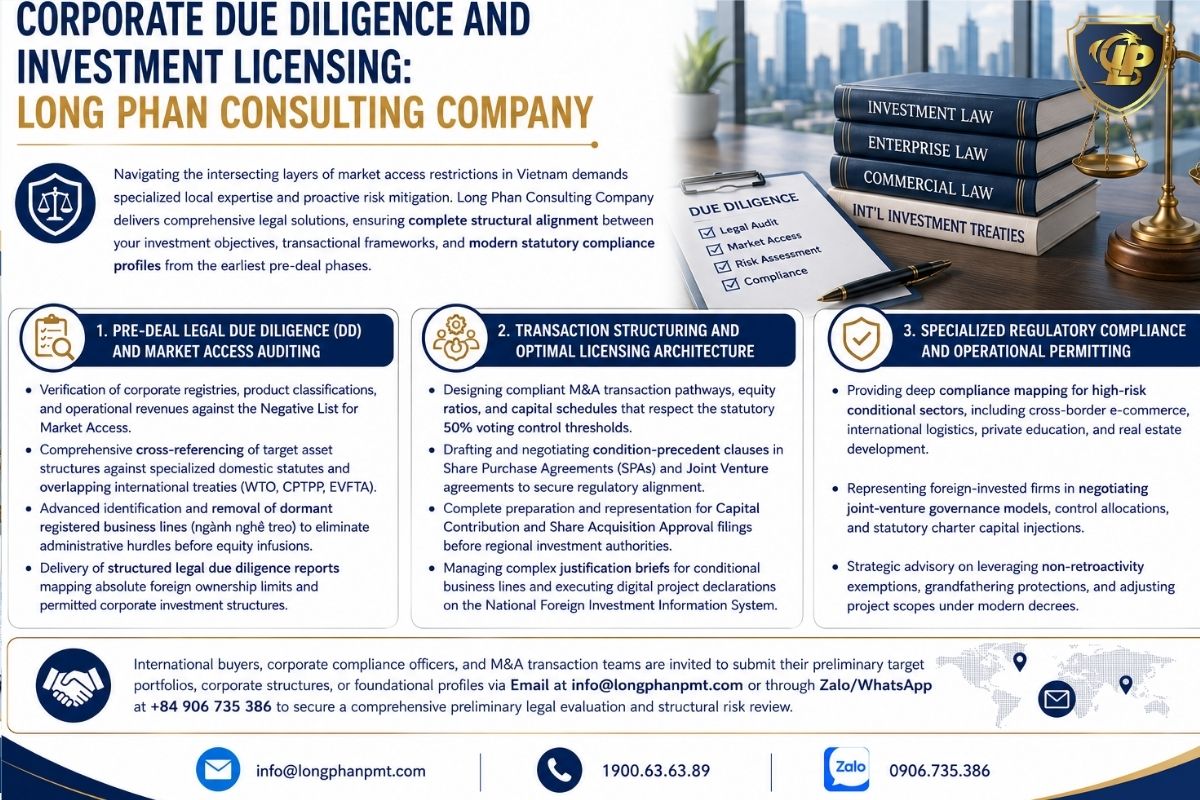
Navigating the intersecting layers of market access restrictions in Vietnam demands specialized local expertise and proactive risk mitigation. Long Phan Consulting Company delivers comprehensive legal solutions, ensuring complete structural alignment between your investment objectives, transactional frameworks, and modern statutory compliance profiles from the earliest pre-deal phases.
International buyers, corporate compliance officers, and M&A transaction teams are invited to submit their preliminary target portfolios, corporate structures, or foundational profiles via Email at info@longphanpmt.com or through Zalo/WhatsApp at +84 906 735 386 to secure a comprehensive preliminary legal evaluation and structural risk review.
The application of restrictions on foreign investors often gives rise to many complications beyond the scope of normal research, especially in M&A transactions, diversified investments, and cases where there are discrepancies between specialized laws and international investment treaties. The following situations are critical control points that management, the M&A team, and the legal department need to review before making investment decisions.
Yes. Foreign investors have market access like domestic investors if the business sector is not on the List of sectors restricted for foreign investors. This principle is established in Clause 1, Article 17 of Decree No. 96/2026/ND-CP and Clause 1, Article 8 of the 2025 Investment Law.
Yes. Economic organizations with foreign investors holding more than 50% of the charter capital, when investing in establishing other economic organizations or carrying out M&A, must meet the market access conditions as foreign investors. This regulation is stipulated in point a, clause 1, Article 20 of the 2025 Investment Law and clause 1, Article 16 of Decree No. 96/2026/ND-CP.
Multi-sector enterprises must simultaneously meet all the conditions of all sectors on the List of Restricted Market Access. For investment activities in multiple sectors, foreign investors must comply with the principle of cumulative conditions as stipulated in Clause 6, Article 17 of Decree No. 96/2026/ND-CP.
Businesses must apply the lowest limit. If multiple business sectors have different foreign ownership ratio restrictions under international investment treaties, the total foreign investor ownership ratio must not exceed the lowest limit specified in point d, clause 10, Article 17 of Decree No. 96/2026/ND-CP.
Yes. Foreign investors are entitled to market access conditions under international investment treaties if those treaties provide more favorable conditions than Vietnamese law. This priority principle is stipulated in Clause 8, Article 17 of Decree No. 96/2026/ND-CP. In cases falling within the scope of multiple international treaties, the investor may choose one treaty for consistent application, as stipulated in Clause 9, Article 17 of Decree No. 96/2026/ND-CP.
Not in all cases. Foreign-invested economic organizations can continue to apply the more favorable market access conditions recorded on their Investment Registration Certificates under Clause 9, Article 52 of the 2025 Investment Law. However, when expanding a project, adding business lines, or carrying out new M&A, the enterprise must meet the current market access conditions under Clause 3, Article 104 of Decree No. 96/2026/ND-CP.
Vietnamese citizens who also hold foreign citizenship have the right to choose whether to apply market access conditions as domestic or foreign investors. This right is stipulated in Clause 2, Article 16 of Decree No. 96/2026/ND-CP. Once they have chosen the status of a domestic investor, they are not allowed to exercise the rights and obligations reserved exclusively for foreign investors.
Navigating the modern layout of the Vietnam market access negative list demands exhaustive, multi-layered alignment across domestic business classifications, aggregate foreign equity limits, specialized ministerial codes, and overlapping international treaties. Retaining dormant registered business lines, miscalculating ownership ceilings for multi-sector targets, or bypassing mandatory capital approvals creates severe operational hazards that can derail transaction timelines and trigger punitive state enforcement. To insulate your corporate capital allocations and secure clean pre-deal clearances under modern investment decrees, corporate executives should contact our advisory hotline at 1900636389 to secure dedicated regulatory support from Long Phan Consulting Company.
📚 This article is provided with professional consultation based on the following legal framework:


