


Long Phan Consulting frequently receives questions from sellers on Facebook, TikTok Shop, and Shopee about whether online sales without business registration are subject to penalties, and how severe those penalties are. This is an independent administrative violation, separate from tax obligations. Sellers may face penalties simultaneously if they fail to register a household business or enterprise, fail to notify their sales website, and fail to declare taxes on time. The article below sets out the applicable legal grounds by article and clause so that online shop owners can accurately assess their risk and complete proper Business Registration.
Legal Notes:
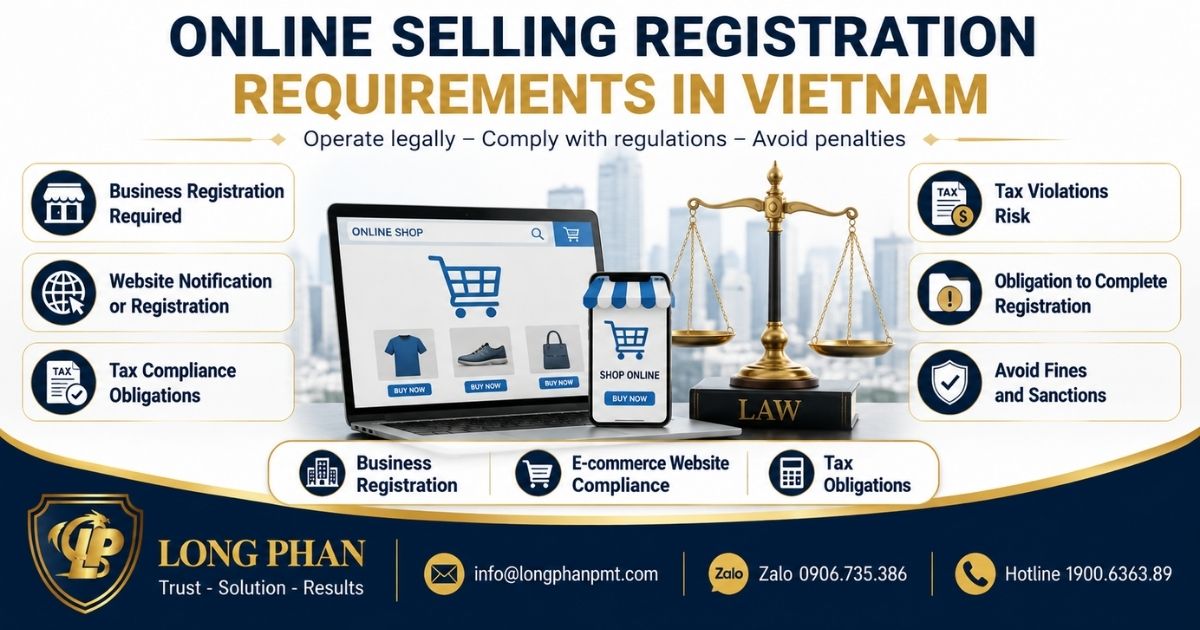
Penalties are divided into three independent categories: failure to register a business, failure to notify or register a sales website or application, and tax violations where revenue has arisen. Competent authorities may penalize multiple violations simultaneously in a single decision if a seller breaches several obligations at once.
Individuals or household members who sell online on a regular basis without registering a household business, where registration is required by law, are subject to a fine of VND 5,000,000 to VND 10,000,000. A remedial measure requiring household business registration also applies.
Legal basis: Point c, Clause 1, Article 62 of Decree No. 122/2021/ND-CP, governing administrative penalties in the planning and investment sector. This fine applies directly to individuals and households, and it is not doubled for organizations, because a household business can only be registered by an individual or a household member.
A seller may organize online business operations at a scale and structure equivalent to an enterprise, meaning regular staff, warehousing, and organized cash flow. If such a seller does not register an enterprise, the fine is VND 50,000,000 to VND 100,000,000 for organizations. Individual violators bear one-half of that fine, that is, VND 25,000,000 to VND 50,000,000.
Legal basis: Point a, Clause 4, Article 46 of Decree No. 122/2021/ND-CP. The individual/organization fine level is determined under Clause 2, Article 4 of the same Decree. The remedial measure requiring enterprise registration follows Clause 5, Article 46 of the same Decree. Decree No. 288/2026/ND-CP, effective from July 21, 2026, only adds Point c to Clause 4, Article 46 on failure to declare beneficial owners when establishing an enterprise. It does not change the fine for the unregistered operation described above.
A sales website or application with an online ordering function must be notified to the Ministry of Industry and Trade before selling goods or providing services to consumers. If the seller establishes an e-commerce trading floor or a website providing e-commerce services, the website owner must register rather than merely notify.
Legal basis: Point a, Clause 3 and Point a, Clause 4, Article 62 of Decree No. 98/2020/ND-CP, as amended by Clause 33, Article 3 of Decree No. 17/2022/ND-CP. Decree No. 24/2025/ND-CP only removes an explanatory phrase in Point a, Clause 1, Article 62, and does not change the fines under Clauses 3 and 4.
Where online sales generate taxable revenue that is not declared, or is declared incorrectly, the seller also faces separate tax penalties in parallel with the business registration penalties.
Legal basis: Articles 16 and 17 of Decree No. 125/2020/ND-CP on administrative penalties for tax and invoice violations, as amended and supplemented by Decree No. 310/2025/ND-CP. For revenue generated through e-commerce trading floors or digital platforms with a payment function, the platform operator must withhold, declare, and pay value-added tax and personal income tax on the seller’s behalf. This follows Decree No. 117/2025/ND-CP, effective from July 1, 2025. Sellers need only self-declare the portion of revenue not withheld at source.
>>>See more: Business Registration Consultancy Service

Correctly identifying the authority for dossier submission and the authority handling violations helps avoid misdirected filings and processing delays, especially now that the two-tier local government model has operated since July 1, 2025.
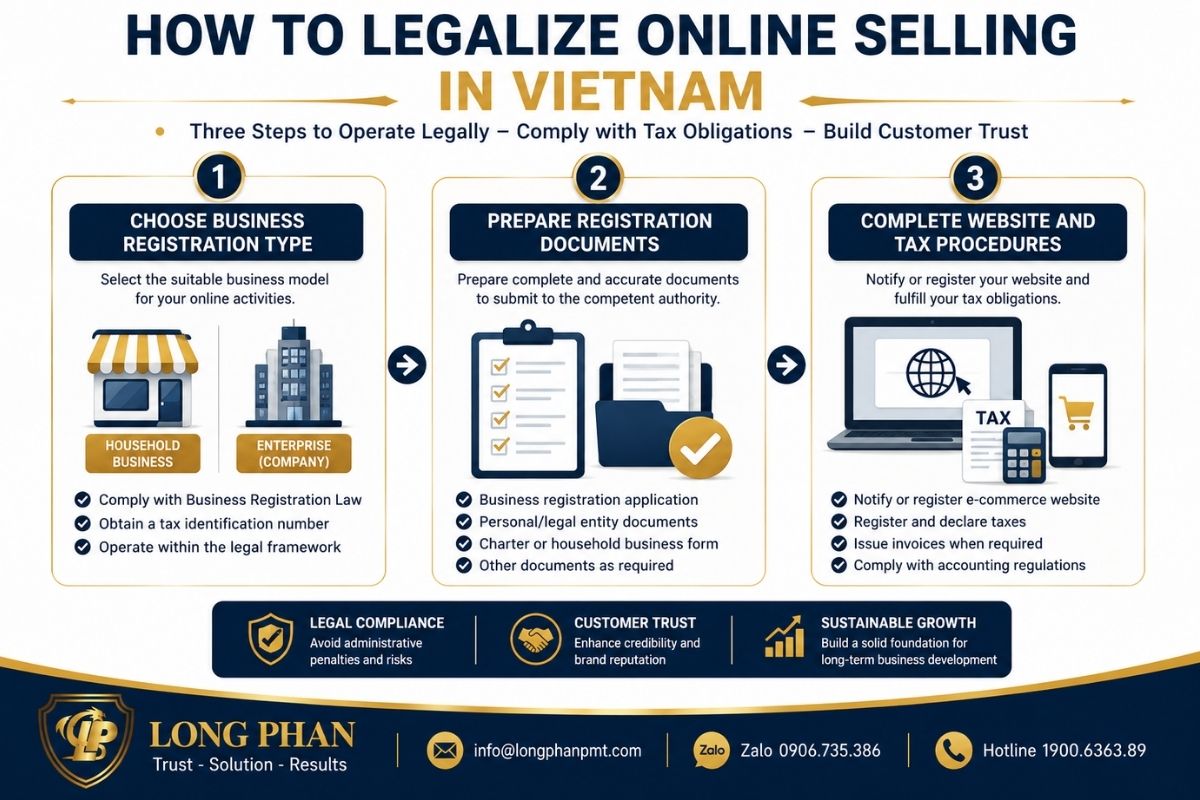
The three steps below help sellers resolve compliance proactively before an inspection, avoiding multiple simultaneous fines.
Compare the household business model and the enterprise model based on sales scale, number of business locations, number of employees, and the need to issue VAT invoices to corporate customers.
The household business registration dossier follows Articles 98 and 99 of Decree No. 168/2025/ND-CP, filed online through the National Business Registration Portal or in person at the commune-level business registration authority. For enterprise registration, the dossier is filed with the provincial-level business registration authority under the Department of Finance.
Complete the notification or registration of the sales website or application with the Ministry of Industry and Trade if the seller operates a separate sales channel outside e-commerce trading floors. At the same time, register a tax code. Declare taxes under the platform operator’s source-withholding mechanism under Decree No. 117/2025/ND-CP for revenue through the platform, or self-declare for revenue from direct sales outside the platform.
Choosing the wrong registration form is a common cause of conversion costs and exposure to late-registration penalties. The table below compares the three categories against the key decision criteria.
| Criteria | Exempt from Business Registration | Individual Household Business | Enterprise |
| Who it applies to | Small-scale, low-income, irregular sales without a fixed location | Individuals/households selling regularly with a stable location or sales channel | Organizations selling at large scale with multiple staff and distribution channels |
| Registration obligation | No registration required | Mandatory registration with the commune-level business registration authority | Mandatory registration with the provincial-level business registration authority |
| Legal liability | Not applicable | Unlimited liability with the entire assets of the household owner | Limited liability within the scope of contributed/charter capital, except for private enterprises |
| Tax obligation | None if the seller qualifies for exemption | VAT and personal income tax based on revenue; exempt if annual revenue is VND 500 million or less | Corporate income tax and VAT under the credit or direct method |
| Ability to issue VAT invoices | No | Yes, under regulations on e-invoices for household businesses | Yes, in full under enterprise invoicing regulations |
Online sales activity may simultaneously fall under the laws on business registration, tax, and e-commerce. Sellers should therefore clearly distinguish each group of obligations, especially when expanding from social media sales to a separate website or application, to avoid multiple violations arising at the same time.
From 2026, household businesses and individual sellers with annual revenue of VND 1 billion or less fall within the threshold not subject to VAT and personal income tax, under regulations amended by Decree No. 141/2026/ND-CP. However, this revenue threshold does not automatically mean exemption from household business registration. Clause 3, Article 82 of Decree No. 168/2025/ND-CP only specifies certain cases exempt from registration.
These include households engaged in agricultural, forestry, fishery, or salt production, street vendors, small-item sellers, itinerant traders, mobile or seasonal businesses, and low-income service providers, except where the business line is a conditional one.
Sellers moving from social media to their own website or e-commerce application must determine their notification or registration obligations to the state management authority. An e-commerce sales website is subject to the notification procedure under Decree No. 52/2013/ND-CP and its guiding and amending documents. Failure to complete the correct procedure may result in an administrative penalty for e-commerce violations.
A single online sales operation may involve several independent groups of obligations, such as household business registration, tax declaration and payment, invoicing and documentation, and procedures for a website or e-commerce application. Where multiple violations occur simultaneously, penalties are determined for each violation under the principles of the law on handling administrative violations, which can significantly increase the total financial liability.
Clause 2, Article 83 of Decree No. 168/2025/ND-CP requires household business founders and household businesses to register, and prohibits operating under the name of a household business without registration. Online sellers should therefore determine whether they qualify for exemption under Clause 3, Article 82, or must complete household business registration before operating.
When the business owner, address, business line, or other registered household business details change, sellers must complete the corresponding change procedure. For websites and e-commerce applications, changes to information already notified or registered must also be updated under sector-specific regulations, so that management records reflect actual operations.
Online sellers must simultaneously comply with regulations on business registration, taxation, and e-commerce. Long Phan Consulting assists sellers in reviewing the appropriate business model and completing the required procedures from the outset to reduce the risk of administrative penalties, tax arrears, or additional documentation requirements during operations.
Clients may send their case documents via email at info@longphanpmt.com or via Zalo at 0906.735.386 for a preliminary assessment.
Below are common questions raised by online sellers regarding business registration obligations and related penalties.
Yes, if the selling activity is conducted regularly and constitutes a stable business activity rather than an occasional sale of personal belongings. Where registration is required but not completed, a fine of VND 5,000,000 to VND 10,000,000 may be imposed under Point c, Clause 1, Article 62 of Decree No. 122/2021/ND-CP.
Yes. Selling through an e-commerce platform does not exempt the seller from registering a household business or enterprise where such registration is required. The seller may only be exempt from separately notifying or registering its own website with the Ministry of Industry and Trade because the platform has already fulfilled that obligation. However, the seller must still complete business registration and fulfill tax obligations arising from the generated revenue.
Current regulations do not prescribe a specific revenue threshold that automatically triggers mandatory household business registration. Instead, the requirement depends on whether the activity is conducted on a regular business basis through a stable location or sales channel. This rule is separate from the personal income tax exemption threshold of VND 500,000,000 per year under the 2025 Law on Personal Income Tax.
Yes. Business registration obligations and tax obligations are two separate categories governed by different regulatory frameworks. Full tax declaration and payment do not eliminate administrative liability for failing to register the establishment of a household business or enterprise under Decree No. 122/2021/ND-CP.
No. The fine of VND 50,000,000 to VND 100,000,000 under Point a, Clause 4, Article 46 of Decree No. 122/2021/ND-CP applies to organizations. An individual committing the same violation is subject to half of that amount, equivalent to VND 25,000,000 to VND 50,000,000, pursuant to Clause 2, Article 4 of the same Decree.
The law does not automatically require the seller to cease operations. However, the violator may be subject to a remedial measure requiring registration of a household business or enterprise within the period specified by the sanctioning authority. Continuing to sell without implementing the remedial measure may be treated as an aggravating factor in a subsequent inspection.
Yes, if the website has an online ordering function. Failure to provide the required notification may result in a fine of VND 10,000,000 to VND 20,000,000 for an individual under Point a, Clause 3, Article 62 of Decree No. 98/2020/ND-CP. If the website operates as an e-commerce marketplace allowing third parties to sell goods, it must be registered rather than merely notified, and higher penalties may apply.
Selling online without business registration may result in penalties across three separate areas: business registration, website or application notification and registration, and tax obligations. The combined penalties may be significantly higher than the initial cost of lawful registration. Sellers should proactively review their business model, determine the appropriate form of registration, and complete the required procedures before an inspection occurs. Long Phan Consulting assists clients in reviewing their dossiers and completing comprehensive registration procedures. Please contact Hotline 1900636389 for direct consultation.
📚 This article has been professionally reviewed based on the following legal documents:


