


Long Phan Consulting has received many client inquiries regarding which cases of land use purpose conversion without permission when carrying out procedures at the Land Registration Office. Under Clause 3, Article 121 of the 2024 Law on Land, if a case does not fall within the 07 categories requiring permission under Clause 1, Article 121, the land user may change the land use purpose without prior approval from a competent State authority. However, “no permission required” does not mean that land change registration procedures, financial obligations, or compliance with approved planning requirements can be disregarded. This article systematizes the current land law provisions, implementation procedures, and common risks to help clients properly handle their dossiers in accordance with applicable regulations.
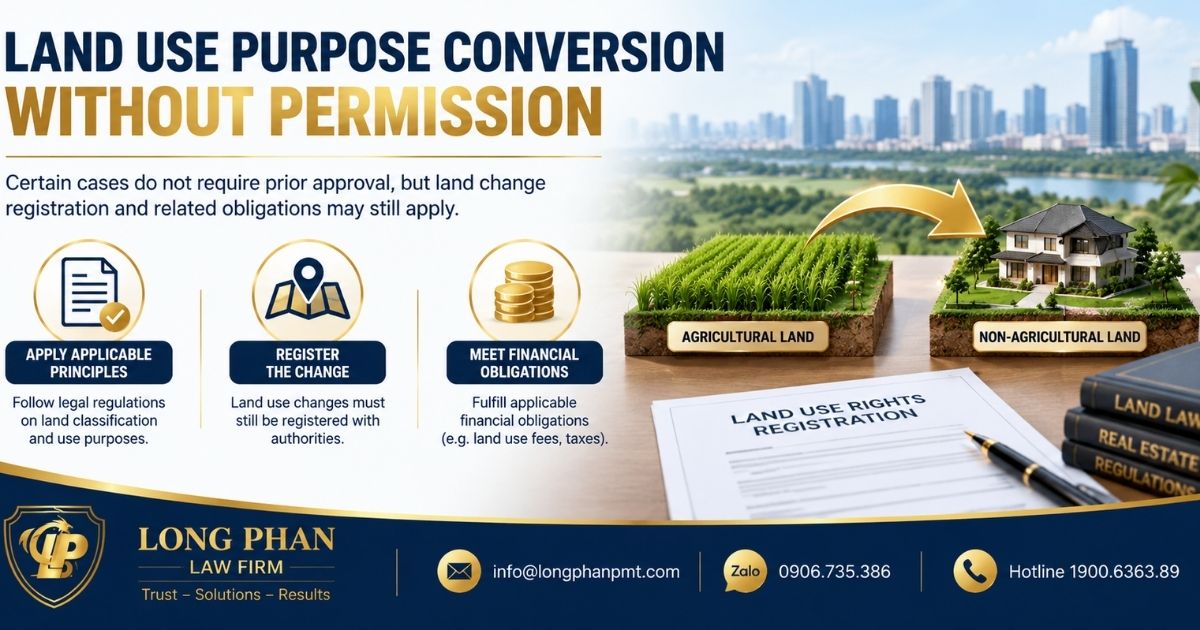
Important Notes:
Before determining whether a specific case of land use purpose conversion without permission, it must be checked against the seven mandatory-permission cases under Clause 1, Article 121 of the 2024 Law On Land. If a case does not fall under any of these points, it is not subject to permission.
Under Points a and b, Clause 1, Article 121 of the 2024 Law On Land, two mandatory-permission cases apply in the agricultural land group:
Point c, Clause 1, Article 121 further requires permission when converting other land types to concentrated livestock farming land for large-scale livestock projects.
Under Points d, đ, e, and g, Clause 1, Article 121 of the 2024 Law On Land, four cases within the non-agricultural land group require permission:
| Point | Case Requiring Permission |
| a | Rice cultivation land, special-use/protection/production forest land → other agricultural land |
| b | Agricultural land → non-agricultural land |
| c | Other land types → concentrated livestock farming land (large-scale project) |
| d | Non-agricultural land allocated without land use fee → allocated with fee/leased land |
| đ | Non-agricultural land other than residential land → residential land |
| e | Public-service/public facility land with commercial use → non-agricultural production/business land |
| g | Non-agricultural production/business land other than commercial/service land → commercial/service land |
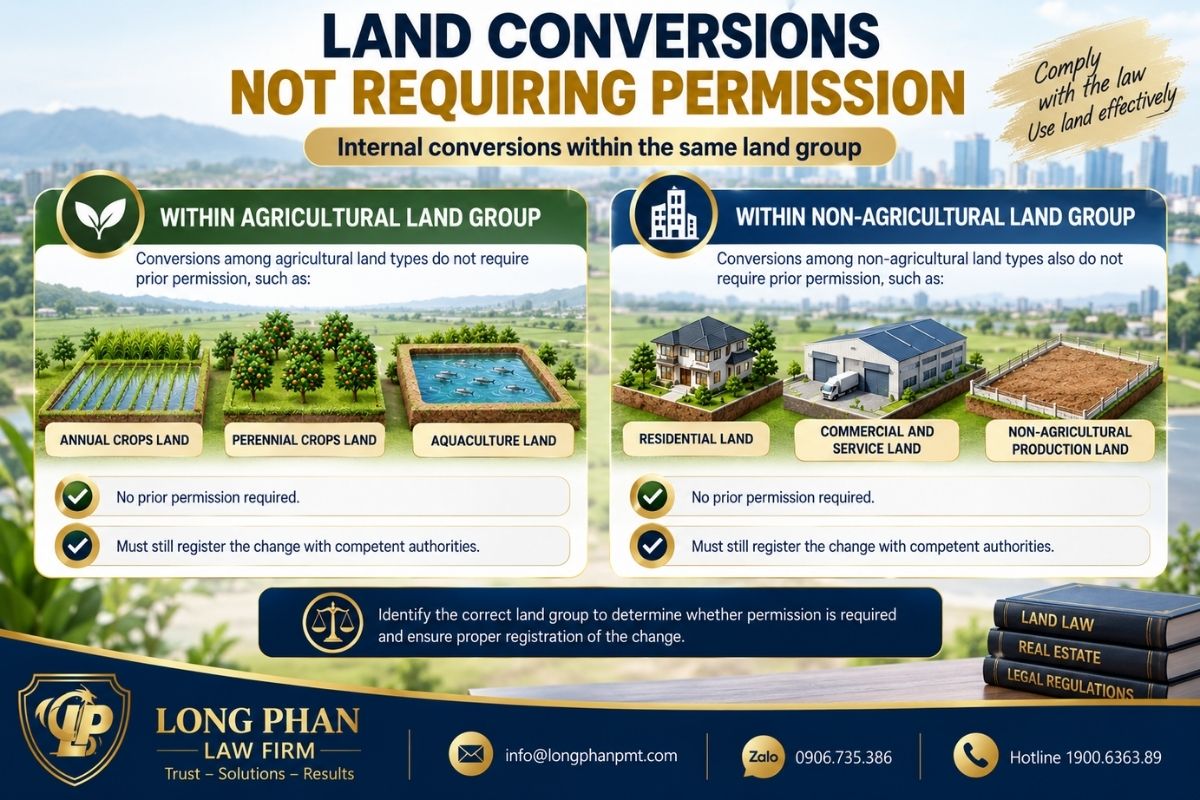
Applying the exclusion principle under Clause 3, Article 121 of the 2024 Law On Land, cases of land use purpose conversion without permission when the conversion does not fall under the seven points above. In practice, this group mainly covers two types of internal conversions below.
| Conversion Group | Example | Permission Required? |
| Internal agricultural land (not rice or forest) | Other annual crop land ↔ aquaculture land, salt-production land, other agricultural land | No |
| Internal non-agricultural land (not residential, not under Points d, đ, e, g) | Conversion among non-agricultural land types other than residential land, not falling under Points d, đ, e, g | No |
| Rice or forest land → other agricultural land | Rice cultivation land → perennial crop land | Yes (Point a) |
| Non-agricultural land other than residential → residential land | Commercial/service land → residential land | Yes (Point đ) |
Under Clause 3, Article 121 of the 2024 Law On Land (excluding Point a, Clause 1), conversion among other annual crop land, aquaculture land, salt-production land, and other agricultural land is not subject to permission. This is because it remains within the agricultural land group and does not involve rice cultivation or forest land.
Under Clause 3, Article 121 of the 2024 Law On Land (excluding Points d, đ, e, g, Clause 1), conversion among non-agricultural land types other than residential land, and not falling under the four mandatory-permission cases, is carried out through the standard land change registration mechanism.
No. For cases where land use purpose conversion without permission, this is the most common misunderstanding leading to incorrectly processed dossiers. “Without permission” only means no approval decision is required from a competent state authority; land users must still complete land change registration and ensure planning compliance.
Under Clause 1, Article 133 of the 2024 Law On Land, land users must register land changes whenever land parcel information changes, including a land use purpose conversion not subject to permission. Failure to register is considered an incomplete land procedure and may result in an administrative penalty, even though the conversion itself is lawful.
Under Article 116 of the 2024 Law On Land, land use planning is one of the grounds the land management authority uses to review and accept land change registration dossiers. Therefore, even without a permission requirement, the conversion must still comply with the district-level land use planning or the approved general/urban zoning plan applicable to the land area.
Following the implementation of the two-tier local government model, Decree No. 151/2025/ND-CP dated 12 June 2025 governs the delineation of authority and decentralization in the land sector. It transfers numerous authorities previously held by district-level People’s Committees and their Chairpersons to commune-level People’s Committee Chairpersons, applicable until before 1 March 2027.
Under Article 5 of Decree No. 151/2025/ND-CP, the commune-level People’s Committee Chairperson now holds many land-related authorities formerly held at the district level. These include recording land prices in permission decisions for conversions under commune-level authority based on the land price list, and issuing land use right certificates for certain cases under the 2024 Law On Land. The commune-level People’s Committee also receives notifications of registered changes from the Land Registration Office after procedures are completed.
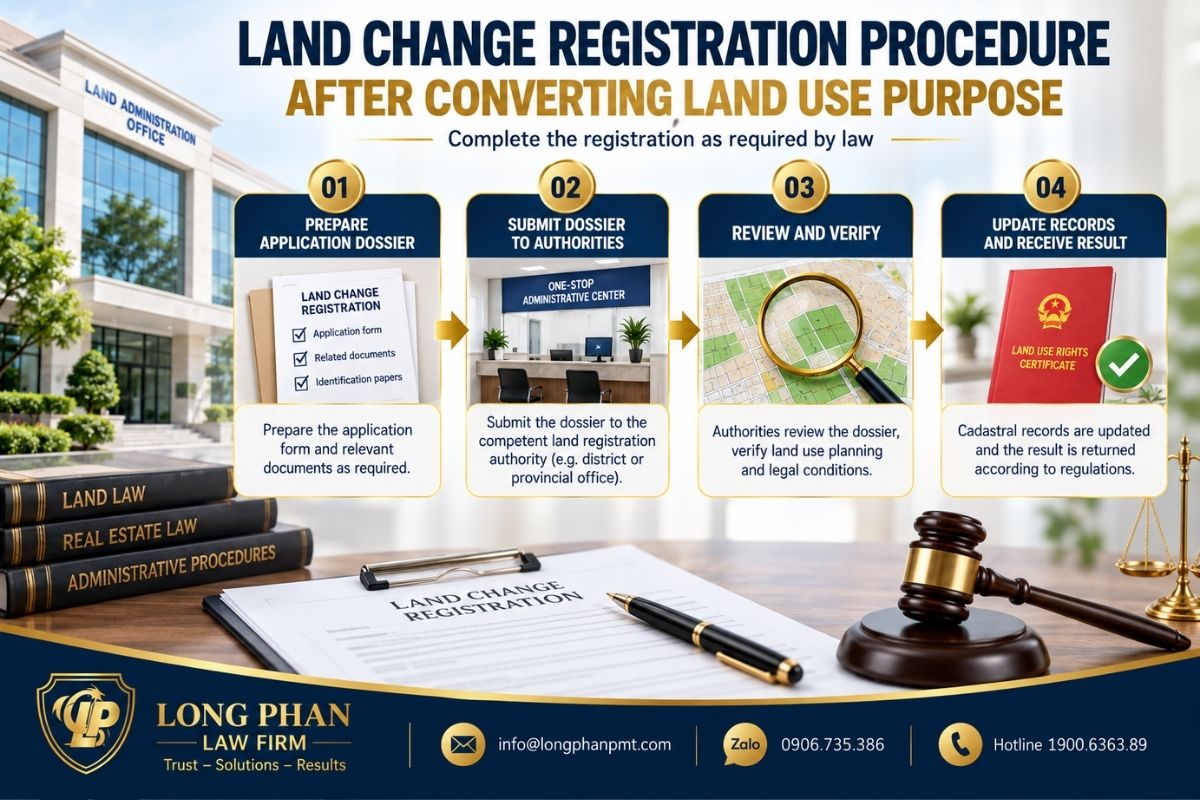
Under Decree No. 101/2024/ND-CP, the Land Registration Office or its branch directly examines dossiers and updates the cadastral map, land inventory book, and land database when a land user converts land use purpose without permission. It also notifies the commune-level People’s Committee of the registered change.
The registration procedure for cases where land use purpose conversion without permission follows Decree No. 101/2024/ND-CP, comprising the steps of submission, review, and data update below.
For cases where land use purpose conversion do not require permission, not every case is exempt from financial obligations. Whether land use fees or land rent apply is determined under Article 156 of the 2024 Law On Land, independent of the permission requirement.
Land users converting land use purpose under Points b, c, d, đ, e, and g, Clause 1, Article 121, must pay land use fees or one-off land rent for the entire lease term. This obligation arises under Clause 1, Article 156 of the 2024 Law On Land. The amount payable is the difference between the land use fee or land rent of the new land type and that of the former land type. Detailed calculation is guided under Decree No. 103/2024/ND-CP dated 30 July 2024 on land use fees and land rent.
Point a, Clause 1, Article 121 covers converting rice cultivation land, special-use forest land, protection forest land, or production forest land to another type of agricultural land. This case is not listed under Clause 1, Article 156 of the 2024 Law On Land. Therefore, internal conversions within the agricultural land group that do not require permission fall outside both Point a and Points b, c, d, đ, e, g. These conversions also do not trigger land use fee or land rent obligations under Article 156.
The three most common mistakes exposing clients to risk when handling land use purpose conversion without permission procedures themselves are:
Decree No. 123/2024/ND-CP dated 4 October 2024 governs administrative penalties in the land sector, as amended by Decree No. 281/2026/ND-CP, effective from 31 August 2026. Under this framework, using land for the wrong purpose or incorrectly converting non-agricultural land use purpose is subject to administrative penalties and remedial measures. Notably, Decree No. 281/2026/ND-CP increased the fining authority of commune-level People’s Committee Chairpersons over individual violations in the land sector. It also expanded the inspection and enforcement authority of the People’s Public Security Force over wrong-purpose land use, significantly raising the risk of detection and enforcement at the grassroots level.
Long Phan Consulting provides comprehensive legal services related to land use purpose conversion without permission, including:
Clients may send their case documents via email at info@longphanpmt.com or via Zalo at 0906.735.386 for a preliminary assessment.
Below are common questions clients raise in practice regarding cases where land use purpose conversion without permission.
No. This is an internal conversion within the agricultural land category and does not involve rice-growing land or forest land, so it does not fall under Point a, Clause 1, Article 121 of the 2024 Law on Land. The land user only needs to carry out land change registration under Clause 1, Article 133 of the 2024 Law on Land.
Yes. Even where the land use purpose conversion may be carried out without permission, the obligation to register the change under Article 133 of the 2024 Law on Land remains mandatory. Failure to register may result in administrative penalties under Decree No. 123/2024/ND-CP, as amended and supplemented by Decree No. 281/2026/ND-CP.
It depends on the specific case. If the conversion falls under Points b, c, d, dd, e, or g of Clause 1, Article 121 of the 2024 Law on Land, land use fees or land rent remain payable under Article 156 of the 2024 Law on Land. By contrast, an internal conversion within agricultural land that does not fall under Point a, Clause 1, Article 121 does not give rise to this obligation.
Under Article 21 of Decree No. 101/2024/ND-CP, land users may choose to submit the dossier to the provincial- or commune-level Single-Window Division, the Land Registration Office, a branch of the Land Registration Office, the National Public Service Portal, or the provincial public service portal.
The land registration authority may refuse to accept the dossier or request amendments because, under Article 116 of the 2024 Law on Land, compliance with approved land use planning and land use plans remains mandatory even where permission from a State authority is not required for the conversion.
The Land Registration Office or its branch remains the authority directly responsible for examining and updating the registered changes. It must also notify the result to the Chairperson of the commune-level People’s Committee in accordance with the delegation of authority under Decree No. 151/2025/ND-CP.
This case does not fall under Points d, dd, e, or g of Clause 1, Article 121 of the 2024 Law on Land because it does not involve residential land, does not involve a change from land allocated without land use fees to land subject to land use fees, and does not involve land for public service facilities or commercial and service land. Therefore, the land user does not need permission and only needs to register the change.
Correctly determining cases where land use purpose conversion without permission requires careful comparison with the 07 cases specified in Clause 1, Article 121 of the 2024 Law on Land. Land users must also comply with land change registration requirements, approved planning requirements, and any financial obligations that may arise under Article 156. Errors at any stage may result in the dossier being returned or administrative penalties under the latest regulations in Decree No. 281/2026/ND-CP. Clients who need assistance reviewing their dossier or carrying out the procedure may contact Long Phan Consulting via Hotline 1900636389 for timely support.
📚 This article has been professionally reviewed based on the following legal documents:


