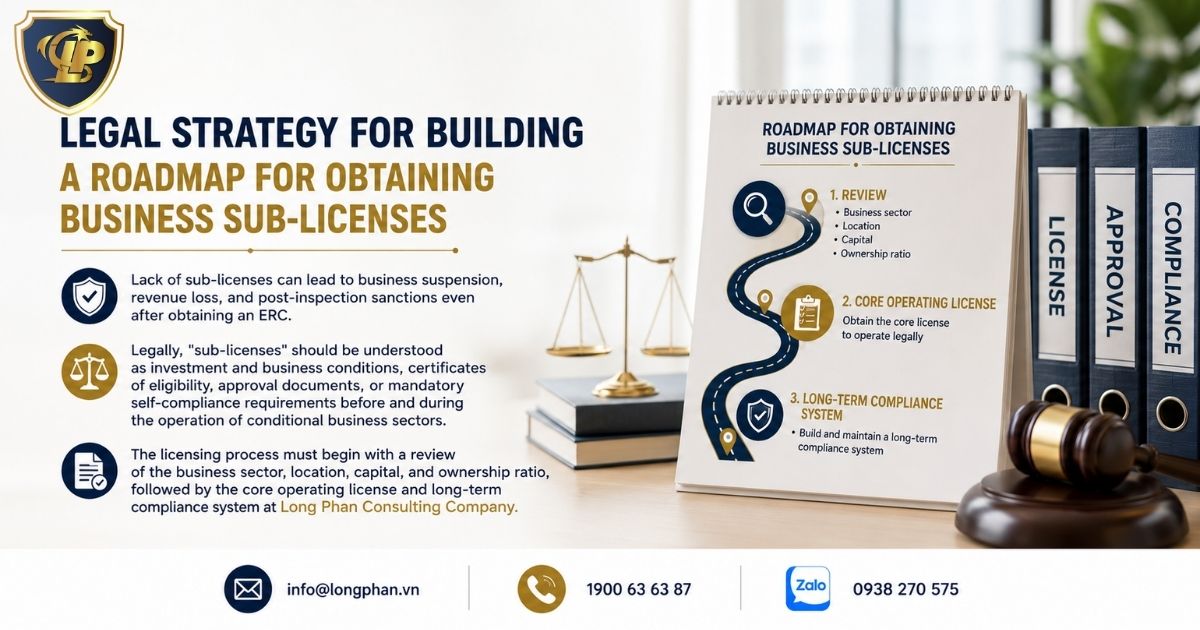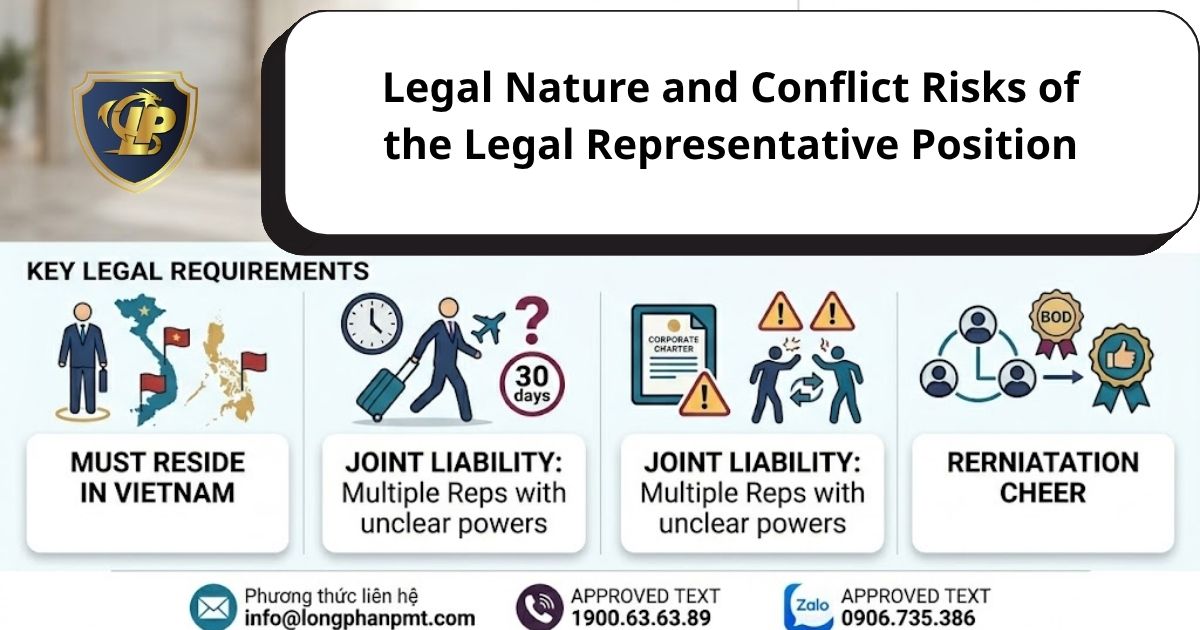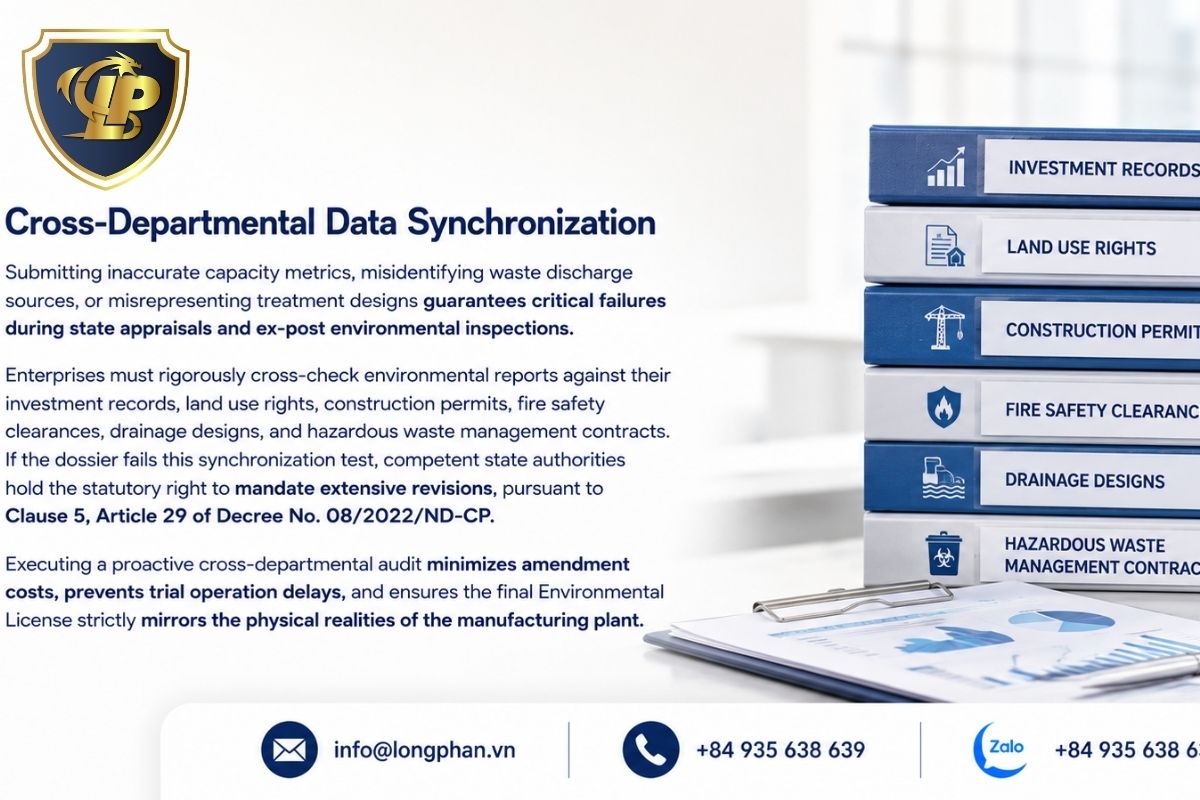

Expanding Its Business Lines without filing a Notice of Changes to Enterprise Registration Contents may disrupt contracts, invoicing, bidding, and investment appraisal procedures. Under the Law on Enterprises and Businesses, an enterprise must notify the business registration authority within 10 days from the date the change decision is issued. It should also review Level-4 business codes, conditional business sectors, sector-specific permits, and IRC amendment obligations for foreign-invested entities. To avoid registering new business lines without meeting operational conditions, enterprises should conduct a prior compliance review with Long Phan Consulting.

Key legal notes:
Enterprises must not treat the expansion of operational scopes as a simple exercise in selecting additional industrial codes. The threshold governance issue is determining whether the prospective activity falls under the category of unconditionally permitted commerce or if it triggers restrictive sector-specific criteria.
Under the core principle of corporate risk management, enterprises retain the right to conduct business in sectors not explicitly prohibited by law. However, they bear a continuous statutory obligation to fulfill and maintain all mandatory investment conditions throughout their operational lifecycle, pursuant to Clause 1, Article 8 of the Law on Enterprises 2020.
Prior to commencing corporate expansion, executives must systematically audit the following regulatory vectors:
Bypassing this compliance audit often results in a scenario where an enterprise achieves nominal registration on paper but remains legally barred from actual commercial execution. This operational gap routinely leads to rejected commercial acceptances, administrative fines, or transactional suspension by corporate partners demanding clean regulatory clearance prior to closing.
Utilizing an incorrect industrial code constitutes a technical error that can stall an entire corporate expansion strategy. Internal legal counsel or corporate accounting departments must meticulously cross-reference actual operational plans with the statutory 4-digit industry codes and explicitly isolate any conditional criteria prior to drafting the dossier.
Pursuant to Clauses 1 and 3, Article 7 of Decree No. 168/2025/NĐ-CP, enterprises must record their business lines in strict accordance with the Vietnam Standard Industrial Classification. For conditional business lines, companies must additionally satisfy all corresponding statutory requirements governed by Clause 1, Article 7 of the Law on Investment 2025 and Appendix IV of Resolution No. 143/2025/QH15.
| Sector Classification | Statutory Regulatory Requirement | Core Representative Examples |
| Standard Sectors | Record the precise 4-digit VSIC code within the statutory amendment notice. | General trading, management consulting, back-office administrative support. |
| Conditional Sectors | Satisfy all specialized investment criteria prior to or during ongoing operations. | Education, commercial transport, logistics, healthcare, food production. |
| Regulated Sectors | Obtain an explicit sector-specific business license or competent authority approval. | E-commerce platforms, real estate, construction, private security services. |
In highly regulated fields like e-commerce or logistics, securing the updated enterprise registration is merely an initial administrative step. Enterprises face a continuous obligation to audit specialized sector rules to verify whether they must register, notify, obtain specialized sub-licenses, or maintain unique operational baselines.
For a foreign-invested enterprise (FIE), expanding corporate business lines is substantially more complex than a standard administrative update to an Enterprise Registration Certificate (ERC). Introducing a new operational sector frequently triggers restrictive market access conditions, caps statutory foreign ownership limits, or mandates a comprehensive restructuring of the underlying investment project objectives.
Foreign market access restrictions must be thoroughly vetted before submitting any regulatory dossiers, particularly when expanding into sensitive sectors such as education, distribution, data centers, real estate, or technology. These specific compliance constraints are strictly governed by Clause 10, Article 3 and Clause 3, Article 8 of the Law on Investment 2025, alongside Clause 1, Article 73 of Decree No. 96/2026/NĐ-CP.
FIE executives must rigorously evaluate the following regulatory parameters:
A critical, recurring corporate error occurs when an FIE updates its business lines on the ERC but fails to analyze the downstream impacts on its IRC. This compliance oversight exposes the company to severe regulatory risks, as the new commercial activities can be legally classified as operating entirely outside the authorized scope of the approved investment project. This vulnerability is especially acute during operational expansions into education, logistics, e-commerce, distribution, or digital data services.
Amending corporate business lines is a formal structural modification to an enterprise’s registration contents that directly impacts outstanding commercial contracts, e-invoicing operations, public procurement bidding, and partner due diligence processes. Enterprises must fully standardize all legal components of their dossier prior to submission to prevent administrative rejections or compulsory amendment demands.
The competent regulatory authorities responsible for receiving and processing these applications are the Provincial Business Registration Offices operating under the Department of Planning and Investment (DPI), or the Industrial Zone Management Boards within their respective statutory jurisdictions. The registration of changes to corporate contents is strictly executed pursuant to Clause 1, Article 18 of Decree No. 168/2025/NĐ-CP.
The regulatory dossier for expanding business lines must accurately reflect internal corporate resolutions and match the precise industrial codes targeted for registration. Utilizing obsolete templates, omitting mandatory meeting minutes, or applying industry codes that do not align with actual operational frameworks will delay contract executions and commercial transactions.
Pursuant to Clause 1, Article 49 of Decree No. 168/2025/NĐ-CP, the corporate notice of change to business lines must contain all mandatory legal instruments. Corporate executives should verify that the application package contains, at minimum, the following documents:
As a critical technical rule, enterprises are no longer legally mandated to affix their corporate seal to the formal application request, meeting minutes, resolutions, or decisions within the business registration dossier. This regulatory simplification is explicitly recognized under Clause 5, Article 4 of Decree No. 168/2025/NĐ-CP, effectively mitigating the risk of administrative delays caused by outdated bureaucratic habits.
Submitting applications through the national portal significantly compresses regulatory processing timelines and provides real-time status tracking. However, the digital dossier must be fully scanned, clearly formatted in PDF, and digitally authenticated by the proper signing authorities.
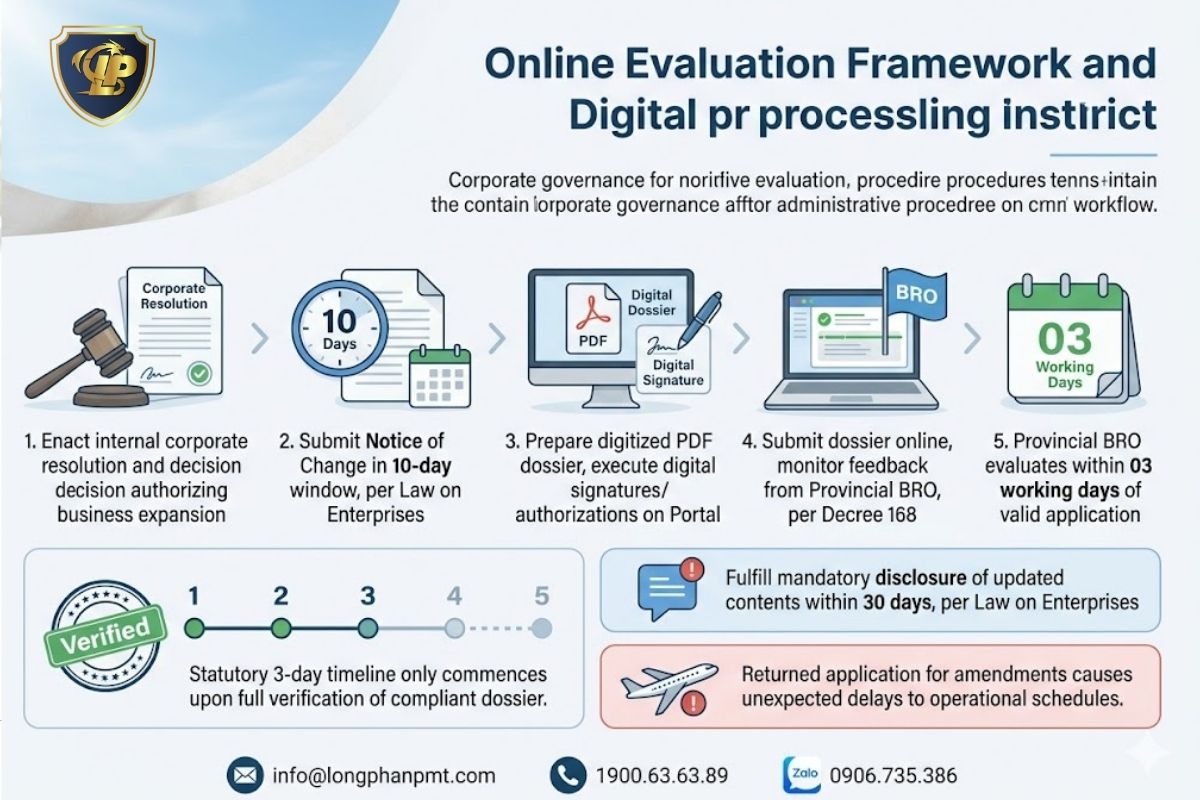
The corporate governance workflow for this administrative procedure must be managed through the following sequential steps:
Executives must understand that the statutory 3-day processing timeline only commences once the dossier is officially verified as fully compliant and valid. If the application is returned with a request for amendments, your broader operational schedules—including contract signatures, e-invoice issuances, public tender participation, or bank credit disbursements—will face unexpected delays.
“Registration” does not mean “authorization to operate.” This is a common mistake when businesses expand their business activities but only update the business lines on their Enterprise Registration Certificate (ERC).
The business registration authority primarily checks the validity of the application for changes, and does not certify that the enterprise has met the specialized requirements for actual operation. If the enterprise does not meet the investment and business conditions, the business registration authority may request the temporary suspension or termination of business in the conditional sector or profession, as stipulated in Clause 1, Article 89 of Decree No. 168/2025/ND-CP.
| Area of expansion | Key professional requirements | Licensing authority |
| Education | Educational institutions must meet the conditions for establishment, permission to operate educational activities, and ensure the conditions regarding curriculum, personnel, and facilities as stipulated in Clause 2, Article 49 of the 2019 Education Law. | Department of Education and Training or competent education management agency |
| Real estate | Real estate businesses must meet the conditions regarding financial capacity, information disclosure, and maintain a minimum equity capital of 20% or 15% depending on the project scale, as stipulated in Clauses 1 and 2 of Article 9 of the 2023 Law on Real Estate Business. | Housing management agency, real estate market and investment authority |
| Medical | Medical examination and treatment facilities must have an operating license and meet the conditions regarding the person responsible for professional matters, scope of expertise, personnel, and facilities as stipulated in Article 49 of the Law on Medical Examination and Treatment 2023. | Department of Health or Ministry of Health, depending on authority. |
| E-commerce, logistics, transportation | Registration, notification, licensing, or compliance with specialized operating requirements may arise. | Ministry of Industry and Trade, Department of Industry and Trade, Department of Transport, or the corresponding specialized agency. |
In the real estate sector, existing businesses also need to be aware of transitional regulations. If they do not yet meet the conditions under the new law, businesses have six months to fulfill those conditions as stipulated in Clause 1, Article 83 of the 2023 Law on Real Estate Business.
Businesses should clearly differentiate between two levels of compliance: updating their business activities on the ERC (Electronic Business Registration Certificate) and obtaining conditional business licenses or approvals from relevant regulatory authorities. Ignoring the second level could lead to operational suspension, rejection of acceptance testing, or disputes with customers and partners.
For a foreign-invested enterprise (FIE), expanding corporate business lines requires a sequential, dual-procedure compliance framework. Executives must not simply update the company’s Enterprise Registration Certificate (ERC) while failing to adjust the accompanying Investment Registration Certificate (IRC).
Material regulatory risks emerge when a new commercial sector modifies the core objectives, investment scale, physical scope, or market access conditions of the existing project. Under these circumstances, enterprises have a strict statutory obligation to evaluate and execute formal investment project amendments, pursuant to Clauses 1 and 2, Article 33 of the Law on Investment 2025.
The corporate governance workflow for this dual-licensing procedure must be implemented across two distinct phases:
Furthermore, long-established FIEs must not assume that historical investment permissions grant an unrestricted right to expand into new fields. If the prospective business lines fall within education, logistics, distribution, digital data services, e-commerce, or real estate, the enterprise must rigorously audit current market access criteria before commencing operations.
A frequent, high-risk error involves successfully updating the ERC while actual commercial operations completely exceed the authorized scope of the underlying investment project. This compliance failure routinely triggers mandatory corporate explanations, freezes downstream sectoral sub-licensing, disrupts cross-border capital remittances, compromises capital calls, and devalues the company during M&A legal due diligence.
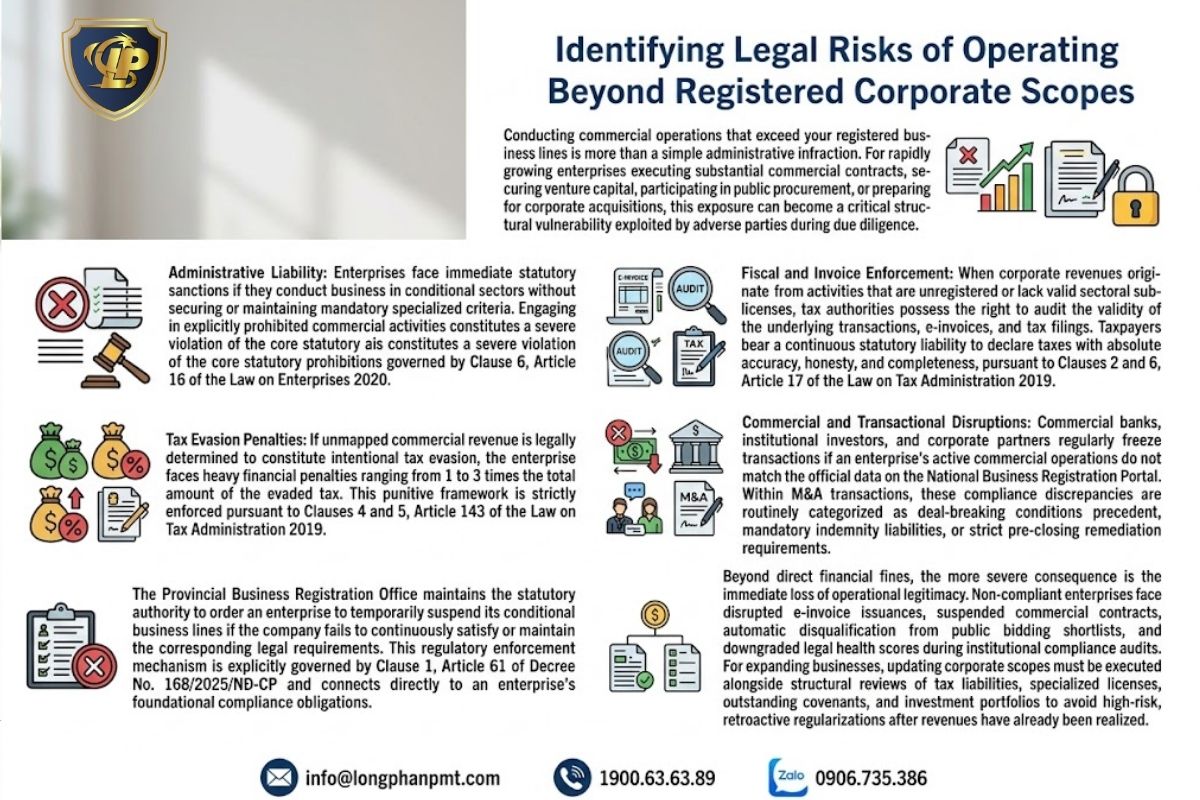
Conducting commercial operations that exceed your registered business lines is more than a simple administrative infraction. For rapidly growing enterprises executing substantial commercial contracts, securing venture capital, participating in public procurement, or preparing for corporate acquisitions, this exposure can become a critical structural vulnerability exploited by adverse parties during due diligence.
The Provincial Business Registration Office maintains the statutory authority to order an enterprise to temporarily suspend its conditional business lines if the company fails to continuously satisfy or maintain the corresponding legal requirements. This regulatory enforcement mechanism is explicitly governed by Clause 1, Article 61 of Decree No. 168/2025/NĐ-CP and connects directly to an enterprise’s foundational compliance obligations.
Corporate executives must recognize and manage four primary categories of legal risk:
Beyond direct financial fines, the more severe consequence is the immediate loss of operational legitimacy. Non-compliant enterprises face disrupted e-invoice issuances, suspended commercial contracts, automatic disqualification from public bidding shortlists, and downgraded legal health scores during institutional compliance audits. For expanding businesses, updating corporate scopes must be executed alongside structural reviews of tax liabilities, specialized licenses, outstanding covenants, and investment portfolios to avoid high-risk, retroactive regularizations after revenues have already been realized.
Expanding business lines involves intricate regulatory layers. For foreign-invested enterprises and high-revenue corporate structures, single technical mismatches in industry codes, sector-specific sub-licenses, or mandatory investment registration certificate amendments can trigger severe compliance liabilities during tax audits, capital calls, or contract executions. Long Phan Consulting Company provides comprehensive, proactive legal solutions to safeguard your market expansion, ensuring strict statutory adherence and strategic risk management for multinational startups, small-to-medium enterprises, and internal legal divisions.
Our senior legal counsel executes the following specialized compliance operations:
Foreign investors are invited to submit their current corporate dossiers via Email at info@longphanpmt.com or through Zalo/WhatsApp at +84 906 735 386 for an immediate, preliminary legal risk evaluation.
The issues that arise when expanding business lines often don’t lie in the application form itself, but rather in the operating conditions after registration. Businesses need to address deadlines, authority, specialized licenses, taxes, and FDI constraints correctly to avoid contract disruptions or investment appraisals.
Businesses must submit a Notice of Change in Business Registration Content within 10 days from the date of the decision to change business lines. The 10-day deadline is mandatory to avoid the risk of the application being deemed outdated when partners, banks, or regulatory agencies check business information. (Clause 2, Article 31 of the 2020 Enterprise Law)
The provincial business registration authority processes applications for changes in business lines within 3 working days from the date of receiving a valid application. The authority to handle these applications rests with the provincial business registration authority under the Department of Finance for enterprises within its jurisdiction, as stipulated in Point a, Clause 1, Article 18 and Clause 2, Article 49 of Decree No. 168/2025/ND-CP.
No, updating the business lines on the Business Registration Certificate does not automatically allow the business to operate if the new business line is a conditional business line. The business can only commence operations when it meets all the conditions for investment and business in the specialized field and must maintain those conditions throughout its operation (Clause 1, Article 8 of the 2020 Enterprise Law).
Yes, foreign-invested economic organizations must check market access conditions before adding new business lines. The review should include the ownership ratio, investment form, partner capacity, and business line limits applicable to foreign investors, as stipulated in Clause 1, Article 73 of Decree No. 96/2026/ND-CP and Clause 3, Article 8 of the 2025 Investment Law.
Foreign direct investment (FDI) enterprises that simultaneously amend their business registration and investment project must first complete the ERC procedure, and only then amend the IRC procedure. This separate procedure helps standardize the enterprise’s documentation before the investment registration authority considers the new project objectives, Clause 2, Article 110 of Decree No. 96/2026/ND-CP.
No, registration documents for changes are not required to have the legal seal affixed to the request document, meeting minutes, resolution, or decision of the owner. This regulation helps businesses reduce formal errors when submitting electronic documents, but the content of the documents must still be within the correct authority and contain the correct components, as stipulated in Clause 5, Article 4 of Decree No. 168/2025/ND-CP.
Businesses may be subject to audits of invoices, revenue, and tax declaration obligations if their business operations do not meet legal requirements. Taxpayers are responsible for accurately, truthfully, and completely declaring taxes; tax evasion may be penalized from 1 to 3 times the amount of tax evaded, as stipulated in Clauses 2 and 6 of Article 17 and Point d, Clause 2 of Article 138 of the 2019 Tax Administration Law.
Successfully expanding business lines in Vietnam requires a coordinated legal approach that bridges the initial Notice of Change to Enterprise Registration Contents with precise 4-digit VSIC codes, mandatory conditional sub-licenses, and dual IRC amendment obligations for foreign-invested enterprises. Corporate executives must move beyond the narrow view of treated registration as a basic ERC update, as overlooked post-licensing conditions create severe downstream liabilities that disrupt tax operations, e-invoice compliance, commercial contracts, public procurement bidding, and M&A legal due diligence. To securely accelerate your administrative processing timelines and verify that your prospective commercial activities are fully compliant before launch, contact our corporate hotline at 1900636389 for an authoritative legal evaluation and custom structuring solutions from Long Phan Consulting Company.
📚 This article is provided with professional consultation based on the following legal framework: