The case of land recovery without compensation is a matter of concern for many citizens when the State recovers land for public purposes or socio-economic development. Understanding the cases where compensation is not granted helps land users proactively protect their legitimate rights, avoid complaints, disputes, and unnecessary losses. At the same time, correctly understanding the regulations contributes to raising awareness of law observance and ensuring fairness and transparency in land recovery and management.
The cases of land recovery without compensation
Cases where the state reclaims land.
The Land Law 2024 (amended by Law No. 43/2024/QH15) stipulates the bases for the State to recover land for specific groups:
National Defense and Security: Recovery for national defense and security purposes (Article 78).
Socio-Economic Development: Recovery for national and public interests (Article 79).
Violations: Recovery due to violations of land law (Article 81).
Termination of Use: Recovery due to termination of land use according to law, voluntary return of land, risk to human life, or inability to continue using the land (Article 82).
Land reclamation cases
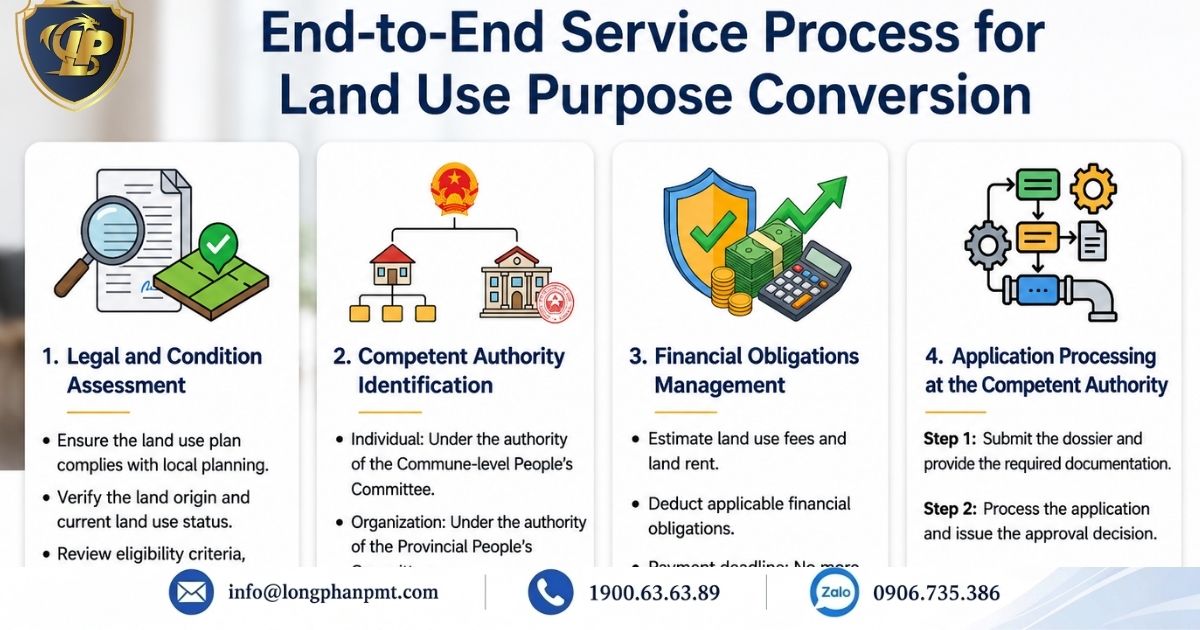
Sequence and procedures for land reclamation
According to the Land Law 2024 and Decree 151/2025/ND-CP:
Step 1: Notice of Land Recovery
Authority: The Chairman of the Commune-level People’s Committee (PC) issues the notice.
Timeline: At least 90 days prior for agricultural land and 180 days prior for non-agricultural land.
Dissemination: Sent to land users/asset owners and posted at the Commune PC headquarters. If unreachable, announcements are made via media (3 consecutive issues/days).
Step 2: Investigation, Survey, Measurement, and Inventory
Process: The Commune PC coordinates with the compensation unit to measure and inventory assets.
Non-cooperation: If the user does not cooperate, the Commune PC Chairman and the Fatherland Front Committee will mobilize and persuade (documented in writing over 15 days). Continued non-compliance leads to a Compulsory Inventory Decision and potential coercion.
Step 3: Establishment of Compensation Plan
Drafting: The plan is drafted and posted publicly for 30 days.
Consultation: Direct meetings are held to gather opinions. If there is disagreement, a dialogue is organized within 60 days.
Step 4: Approval of the Plan
The Chairman of the Commune-level PC approves the plan.
The approved plan is sent to affected persons, detailing compensation amounts and handover schedules.
Step 5: Issuance of Land Recovery Decision The official decision is issued within 10 days of plan approval, resettlement handover, or voluntary agreement.
Step 6: Enforcement (If applicable) Coercion is carried out if the user fails to comply after persuasion and the coercion decision has taken legal effect.
Note: Based on the Law on Organization of Local Government (amended 2025).
Provincial People’s Committee: Decides land recovery for domestic organizations, religious organizations, overseas Vietnamese, foreign organizations, and foreign-invested enterprises.
Chairman of Commune-level People’s Committee:
Decides land recovery for individuals and households for national defense, security, and socio-economic development.
Decides land recovery for violations, termination of use, voluntary return, or risks to human life.
Cases where land users are not compensated when their land is expropriated.
Identifying cases of land recovery without compensation is based directly on the conditions for issuance of the Certificate and the nature of the land being used. According to Article 101 of the Land Law 2024, not all subjects having land recovered are entitled to compensation for the land.
Cases where compensation for land is not provided but compensation for investment costs in the land is provided as stipulated in Clause 1, Article 107 of the Land Law.
Pursuant to Article 107 of the Land Law 2024 and Resolution 254/2025/QH15, the following cases are not compensated for the land but are compensated for the remaining investment costs in the land:
Land allocated by the State without land use levy (except for agricultural land of households/individuals compensated under Article 96).
Land allocated to organizations with land use levy but exempted from it.
Land leased with annual rental payments or one-off rental payments where the rent was exempted.
Land belonging to the agricultural land fund for public purposes managed by the Commune PC.
Land contracted for agricultural/forestry production, aquaculture, or salt making.
Agricultural land area allocated exceeding the prescribed limit.
Land managed by state agencies and organizations is regulated in Article 217 of the Land Law.
According to Article 217 of the Land Law 2024, no compensation is given for:
Land used for public purposes.
River, canal, stream, pond, lake, and lagoon land.
Cemetery and funeral home land.
Special-use forest, protection forest, and production forest land.
Land recovered and assigned to the Land Fund Development Organization or Commune PC for management.
Land returned by foreign diplomatic organizations.
Public agricultural land of the commune.
Unused land.
Land is reclaimed in cases stipulated in Article 81, and Clauses 1 and 2 of Article 82 of the Land Law.
According to Article 81 of the Land Law 2024 and Resolution 254/2025/QH15, no compensation is given for land recovered due to:
Using land for improper purposes and continuing violation after being sanctioned.
Destroying land and continuing violation after being sanctioned.
Land allocated/leased to the wrong subject or without competence.
Illegal transfer or donation of land.
Letting land be encroached upon or occupied.
Failure to fulfill financial obligations to the State.
Leaving agricultural land unused for 12-24 consecutive months (depending on type) and failing to use it after sanctions.
Investment projects not putting land into use for 12 consecutive months or delaying progress by 24 months (plus a 24-month extension period), without force majeure.
According to Article 82 of the Land Law 2024, no compensation is given for:
Organizations allocated land without levy being dissolved or bankrupt.
Individuals dying without heirs.
Land lease term expiring without extension.
Termination of investment projects.
Voluntary return of land.
Other cases as prescribed by the Government.
According to point d, clause 10, Article 3 of Decree 254/2025/QH15, which stipulates the cases in which land compensation is not granted when the State reclaims land as prescribed by the Government.
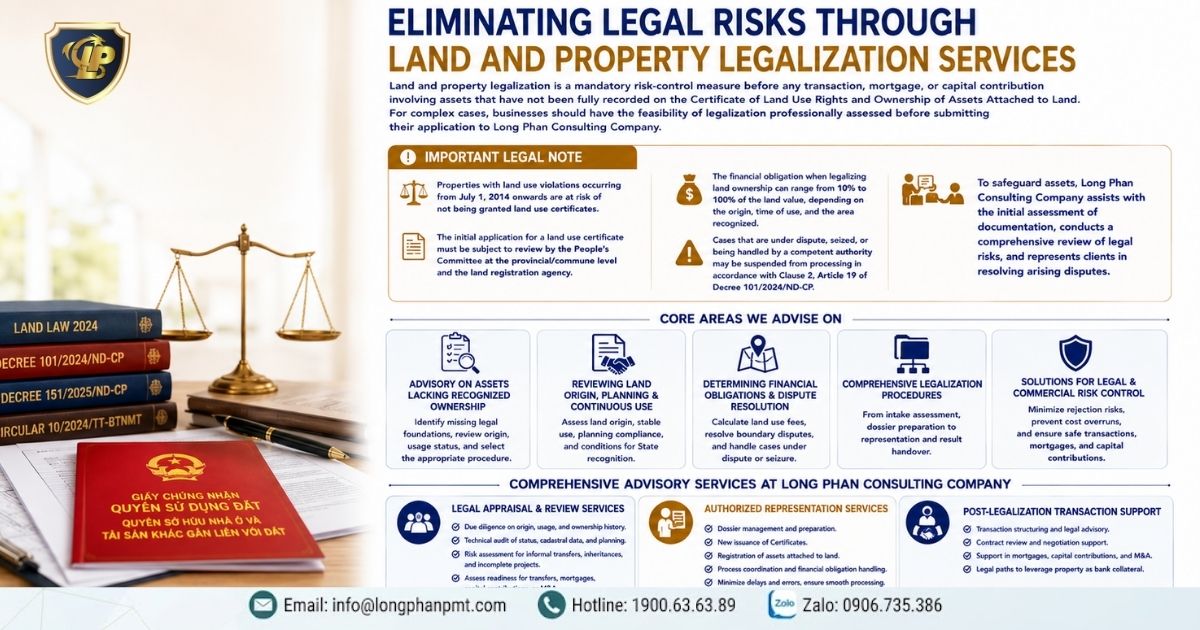
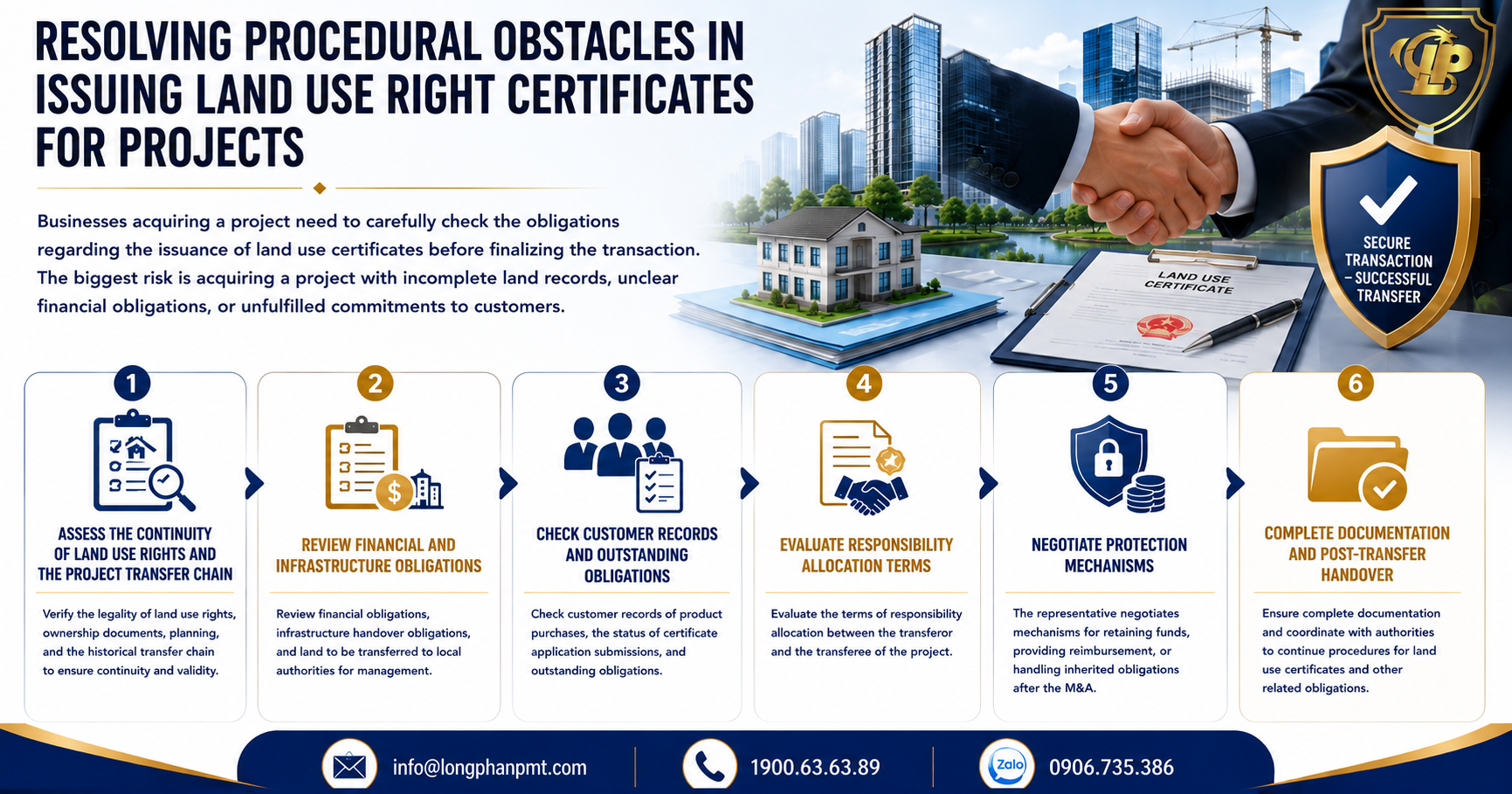
Long Phan Consulting Company provides consulting services on cases of land expropriation without compensation.
Long Phan Consulting Company provides comprehensive advice on compensation, support, and resettlement issues. Our services include:
Case Identification: Determining if your case falls under the “no compensation” category.
Solution Strategy: Advising on solutions when compensation is denied.
Documentation: Drafting documents and preparing dossiers related to land use rights.
Representation: Working with functional agencies on your behalf.
Long Phan Consulting Company provides consulting services on cases of land expropriation without compensation.
Frequently Asked Questions about Cases of Land Expropriation Without Compensation
Below are frequently asked questions regarding cases of land expropriation without compensation; please refer to them:
Will land without a land use certificate (land title) be compensated when it is reclaimed?
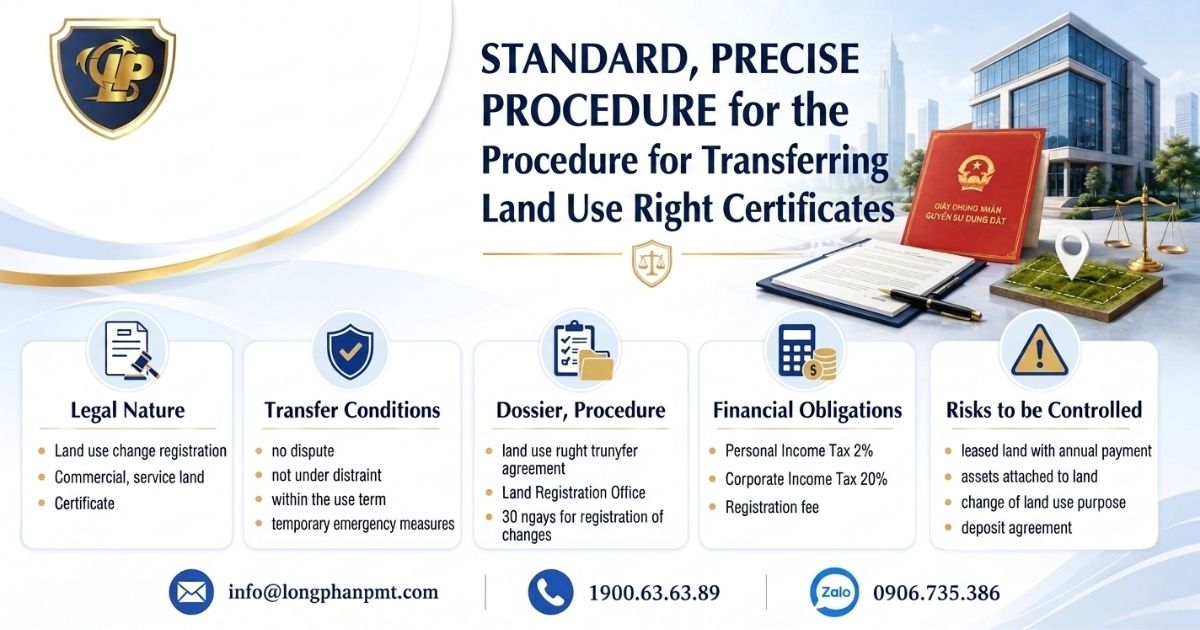
According to Clause 2, Article 95 of the 2024 Land Law, land users without a land ownership certificate are still entitled to compensation. However, they must present other documents proving their land use rights, such as a land allocation decision, a land lease decision, or a decision permitting the change of land use purpose issued by a competent state agency; or possess one of the land use right documents that serve as the basis for granting a land use right certificate and ownership certificate for assets attached to the land as stipulated in Article 137 of the 2024 Land Law.
What costs are included in the remaining land investment costs according to the Land Law?
The remaining investment costs in land, as stipulated in Clause 2, Article 107 of the 2024 Land Law, are as follows:
Land leveling costs;
The cost of land reclamation increases soil fertility, neutralizes acidity and salinity, and prevents erosion and encroachment on land used for agricultural production.
Costs for reinforcing the load-bearing capacity against vibration and subsidence of land used as a production and business site;
Compensation, support, and resettlement funds advanced according to the compensation, support, and resettlement plan approved by the competent authority, but not yet fully deducted from the land use fee or land lease fee payable;
Other related costs have been invested in the land in accordance with its intended use.
Are tenants who pay annual rent entitled to compensation for the land?
No, according to point a, clause 1, Article 95 of the 2024 Land Law, land users who lease land with annual payments are subject to land reclamation but are not compensated for the land itself; they are only compensated for assets attached to the land and remaining investment costs in the land.
Is it possible to appeal a land expropriation notice?
Based on the provisions of Clause 1, Article 85 of the 2024 Land Law: Before issuing a decision to revoke land, the competent state agency must send a written notice of land revocation to the landowner, the owner of assets attached to the land, and those with related rights and obligations (if any) at least 90 days in advance for agricultural land and 180 days in advance for non-agricultural land.
At the same time, Clause 1, Article 237 of the 2024 Land Law stipulates that land users and those with rights and obligations related to land use have the right to file complaints and lawsuits against administrative decisions and administrative actions concerning land management.
Thus, it can be seen that people can appeal a land expropriation decision if they see signs of legal violations.
Is the land price used for compensation determined according to the land price framework or market price?
According to Clause 2, Article 91 and Point e, Clause 1, Article 160 of the 2024 Land Law, compensation shall be provided by allocating land with the same intended use as the land being reclaimed. If there is no land available for compensation, monetary compensation shall be provided based on the specific land price of the reclaimed land type, as determined by the Chairman of the People’s Committee of the commune at the time of the land reclamation decision.
Conclusion
Cases of Land Recovery Without Compensation require a deep understanding of current regulations. Customers should proactively check cadastral records and the legality of recovery decisions. Contact Long Phan Consulting Company via Hotline 1900636389 for immediate advice.
Facebook
Linkedin
Twitter
Pinterest
Phan Mạnh Thăng
Mr. Phan Manh Thang, CEO, is the founder of Long Phan Investment Consulting and Legal Services Company Limited. With over 13 years of experience in the fields of land and corporate law, CEO Phan Manh Thang has been advising and partnering with numerous clients throughout their business operations and enterprise expansion. Concurrently, he serves as the Managing Lawyer of Long Phan PMT Law Firm, established in 2019.
His specialized expertise and practical experience have consistently earned him the trust and high regard of his clients.