
Analyzing the needs of homebuyers is the process of identifying the motives, financial capacity, desires, and selection criteria of homebuyers. This analysis helps real estate enterprises, brokers, or investors deeply understand the client to propose suitable products and sales strategies. In the following article, Long Phan Consulting Company provides a detailed analysis of the factors influencing a client’s home-buying needs.

Analyzing the needs of homebuyers is the process of collecting and processing information to determine actual desires. This professional operation helps service providers understand the buyer’s motive for establishing a transaction. The analysis results form a crucial database for building an optimal consulting plan.
This activity acts as a compass for the entire subsequent real estate transaction process. Understanding needs helps eliminate unsuitable products right from the start, saving you time and minimizing unnecessary incurred costs. Accurately determining housing selection criteria helps standardize the corresponding legal dossiers, creating a solid foundation for contractual rights and obligations while analyzing the needs of homebuyers.
>>>See more: Property Buyer Finding Services for Real Estate Owners
Analyzing the needs of homebuyers is a mandatory stepping stone to determine the true value of a civil transaction. This activity eliminates ambiguity in product selection and optimizes agreement conditions between parties. You will achieve absolute peace of mind when all housing criteria are meticulously cross-referenced with the current market reality.
Understanding the client allows for the personalization of the consulting roadmap and effective financial risk management. It serves as the basis for experts to recommend real estate types that align with urban planning and affordability. The following points demonstrate the irreplaceable role of this operation.
Analyzing the needs of homebuyers from the initial phase filters out products incompatible with your conditions. Instead of widespread surveying, you only focus on real estate that fully meets legal and functional criteria. This minimizes travel costs and appraisal efforts for both buyers and sellers. Transparency from the beginning per Article 4, the 2023 Law on Real Estate Business helps parties proactively prepare resources, optimizing cash flow and the time spent on administrative procedures.
When locational, financial, and legal hurdles are resolved through this analysis, decision-making becomes easier. This ensures the introduced product is the exact solution to your needs. Grasping psychology and financial planning capacity helps experts build flexible negotiation scripts that harmonize interests of all parties while analyzing the needs of homebuyers.
Professionalism in this process is a testament to the consulting unit’s capacity and ethics. You will feel dedication when personal requests are recorded and protected by legal bases. Reputation is built on transparency and accuracy in every piece of advice, opening doors for long-term cooperation while analyzing the needs of homebuyers.
Categorizing needs helps systematize criteria for searching for real estate. Clients typically focus on factors such as functionality, geographical location, and technical specifications. Each of these need categories is closely linked to the legally defined conditions governing real estate transactions, while analyzing the needs of homebuyers.
Usage purpose is the guiding principle determining the contract type and accompanying legal procedures. Clients buying homes for living prioritize living environment, security, privacy, and family amenities. Meanwhile, business purposes prioritize profitability potential, population density, and liquidity. Under Article 5 of the 2023 Law on Real Estate Business, the housing type must align with the owner’s business rights, while analyzing the needs of homebuyers.
Location determines the surplus value and long-term quality of life. Commute distance and public transport convenience are crucial. Clients prioritize areas with synchronous infrastructure, free from flooding or traffic jams. External amenities like schools and hospitals directly impact land use rights while analyzing the needs of homebuyers.
Each type carries distinct legal characteristics. Apartments require transparency regarding common ownership and management fees. Townhouses/Villas offer design freedom but require careful checks of boundaries and building lines. Land plots offer high accumulation but carry risks if parcel-splitting regulations are not understood (Article 24, 2023 Law on Real Estate Business), while analyzing the needs of homebuyers.
In analyzing the needs of homebuyers, technical specifications such as area, design, number of rooms, and construction quality are also important criteria that customers often consider. These are specific quantitative data that help to concretize your ideal home. The usable area and number of bedrooms must provide sufficient living space for all family members. You need to check the actual area against the area stated on the land use right certificate.
The orientation of the house and feng shui principles are considered to ensure harmony of energy and spiritual beliefs. These parameters must comply with construction standards and design drawings approved by the relevant authorities. Accurately comparing technical specifications helps you avoid disputes regarding area size later on.
Systematizing needs helps clients gain a comprehensive view of their target real estate product. Once the criteria are clearly established, the implementation of subsequent steps in the process will be highly accurate.
>>>See more: Approaches to Reaching High-Net-Worth Real Estate Buyers
The professional analyzing the needs of homebuyers is an interactive system designed to extract actual data from the client. Each stage acts as a filter to standardize housing and land use right selection criteria. You will receive advice based on legal bases and actual market fluctuations.
Transparency in each analytical step prevents risks regarding disputes or insolvency. Under Article 16 of the 2023 Law on Real Estate Business, providing complete information is the business party’s obligation to protect the buyer’s rights.
This stage establishes the first connection to determine your basic desires. The specialist records parameters regarding geographic area, expected price range, and target housing type. A face-to-face appointment is the ideal environment to discuss transaction conditions deeply.
Using a standardized questionnaire systematizes lifestyle priorities and usage needs. You will clarify criteria on family member count, daily habits, and specific technical requirements. A detailed client profile is built as a basis to cross-reference with the existing real estate portfolio.
Financial assessment is a crucial step in ensuring the feasibility of a home purchase transaction. You need to clearly define your own capital, your ability to raise funds, and your options for bank loans with corresponding interest rates. Cash flow forecasting helps you proactively fulfill your payment obligations according to Article 25 of the 2023 Law on Real Estate Business.
Identifying factors that influence your mindset helps address your concerns during the selection process. These barriers may stem from market price fluctuations or worries about the project’s legal status. Our consultants will provide verified data to give you a more objective and confident perspective.
The collected data will be organized according to importance to narrow down the search. Clients will establish a list of mandatory criteria and factors that can be adjusted based on actual conditions. This evaluation process optimizes field survey time and focuses on the most compatible products.
Based on the overall analysis, the expert presents the optimal real estate options. Each proposal includes a legal status report, potential analysis, and a detailed financial estimate. You exercise the right to choose the product that best meets your initial goals.

Besides location and property characteristics, analyzing the needs of homebuyers requires clarifying related legal issues to ensure the buyer’s rights. This is the foundation determining the success and safety of a transaction. You must cross-reference the product’s legal status with transaction conditions stipulated by law.
The legality of off-plan or existing housing must strictly comply with Articles 11 and 14 of the 2023 Law on Real Estate Business. You must verify:
For off-plan housing, a written confirmation of eligibility to sell from state agencies is mandatory. Checking bank guarantees is also advised to secure your rights if the developer delays handover.
An important aspect when analyzing the needs of homebuyers is determining the terms of transfer and the customer’s ownership rights over the property to be transacted. Real estate transactions must meet strict legal requirements to ensure the contract is valid and to avoid future risks.
Subject conditions
For the seller: Basic requirements for a seller of real estate include having complete documentation proving legal ownership of the property. The seller must be the legal owner or legally authorized to sell the property according to Article 45 of the 2024 Land Law. The seller must have full legal capacity and not be subject to transaction prohibitions under Articles 20, 21, and 117 of the 2015 Civil Code.
For the buyer
Furthermore, the buying and selling transaction must be conducted voluntarily, without coercion, and must not violate any legal prohibitions.
Property requirements
According to Clause 1, Article 45 of the 2024 Land Law, land and houses can only be bought and sold when they meet the following conditions:
Formal requirements
Real estate purchase and sale contracts must be in writing and must be notarized or certified by a notary public as stipulated in Article 27 of the 2024 Land Law, specifically as follows:
In addition to property value, analyzing the needs of homebuyers also requires considering taxes, fees, and other financial obligations so that customers can make appropriate financial preparations.
Real estate brokerage fees (if any)
Real estate brokerage fees are costs incurred when clients use the services of an intermediary to find buyers and assist with transactions. These fees are entirely based on a civil agreement between the seller and the broker, as recorded in the brokerage service contract.
Current legislation, particularly the 2023 Law on Real Estate Business, clearly regulates this activity, creating a transparent legal framework for all parties involved. Specifically, Article 63 of the 2023 Law on Real Estate Business stipulates the following regarding fees and commissions for real estate brokerage:
The payment of brokerage fees usually takes place after the seller has received the deposit from the buyer or after the transfer procedures are completed at the notary office, depending on the terms of the signed agreement.
Personal income tax
Personal income tax is one of the mandatory financial obligations payable to the state budget when income is generated from the transfer of real estate. The declaration and payment of personal income tax are carried out at the competent tax authority where the transferred real estate is located. The personal income tax rate and calculation method are as follows:
In addition, the law also stipulates several cases where personal income tax is exempted when selling real estate, according to Article 4 of the Personal Income Tax Law 2007 (supplemented by Clause 3, Article 2 of the Law amending and supplementing a number of articles of the Laws on taxation 2014):
Registration fee
Registration fees are the amount of money that the buyer of a property must pay when registering ownership or usage rights with the competent state agency. Traditionally, the buyer is obligated to pay this fee. However, in the transfer contract, the parties have the right to agree that the seller will be responsible for paying this fee as part of the transaction. Therefore, this is still considered one of the financial obligations that overseas Vietnamese selling real estate in Vietnam need to consider.
Fee rates and calculation formulas
=> Registration fee payable = Taxable value x 0.5%
Clause 1, Article 7 of Decree 10/2022/ND-CP stipulates the details regarding the basis for calculating registration fees as follows:
Important note: If the transfer price stated in the house and land purchase contract is higher than the price stipulated by the provincial People’s Committee, then the price used to calculate the registration fee will be the price stated in the contract.
Special cases:
Accurately determining the taxable value for registration fees helps parties estimate costs correctly and fulfill their financial obligations promptly.
>>>See more: Full-Package Support Services for Buying Real Estate in Vietnam
At Long Phan Consulting Company, our experienced expert team executes specialized operations to maximize the protection of your rights. We structure our professional support into the following key area:

The following, Long Phan Consulting Company some frequently asked questions related to the process of analyzing customer needs for homebuyers. Please feel free to refer to them if you are interested:
Current legislation does not mandate written documentation for the needs analysis phase; however, clients should record this information in writing to serve as a basis for establishing terms in the consulting service contract. Storing the analysis data helps ensure consistency between the initial objectives and the final delivered product, as required by Article 16 of the 2023 Law on Real Estate Business regarding the obligation to provide information.
Foreign individual customers are only permitted to own residential properties (including apartments and detached houses) within commercial housing development projects, excluding areas designated for national defense and security as stipulated in Article 16 of the 2023 Housing Law. If shophouses are classified as non-residential constructions, foreigners will not be eligible to own them under current conditions.
Customers should request the seller to provide planning information or directly check with the local Department of Natural Resources and Environment based on the information disclosure provisions in Article 6 of the 2023 Law on Real Estate Business. This verification ensures that the property being transacted meets the condition of “not being prohibited from transaction by law” and is safe for the customer’s long-term use.
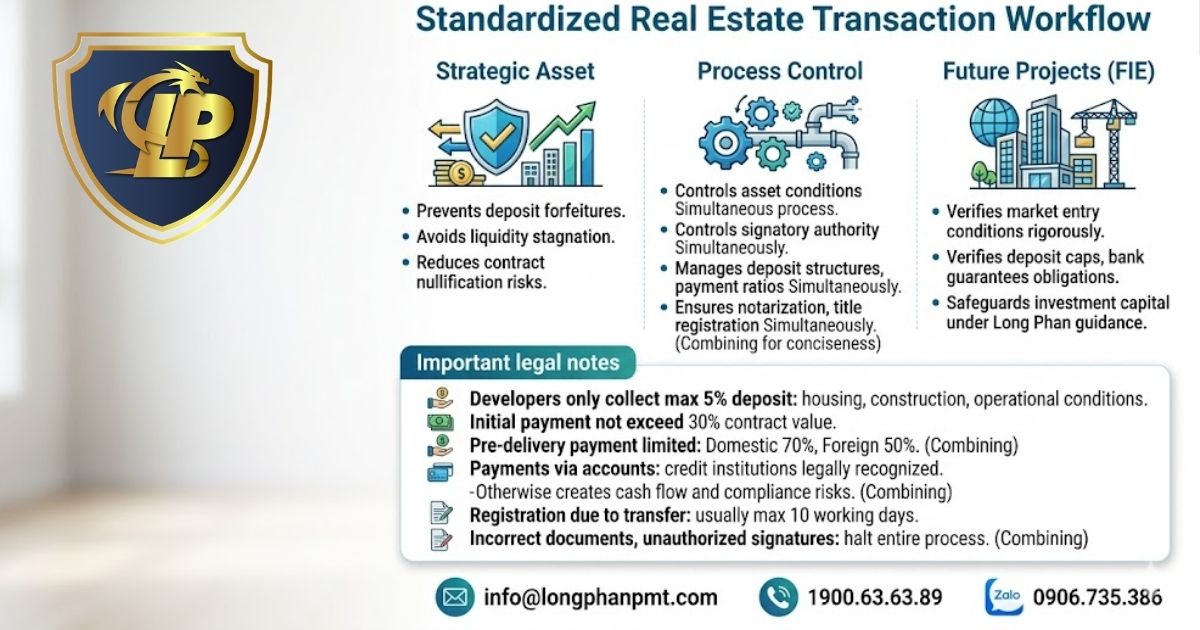
Real estate project developers are only allowed to collect a deposit of no more than 5% of the selling price or lease-purchase price of future-built housing when agreeing on a deposit as stipulated in Clause 5, Article 23 of the 2023 Law on Real Estate Business. If you are dealing with an individual (for existing housing), the deposit amount will be mutually agreed upon by the parties, but it should not exceed a safe margin to avoid the risk of capital misappropriation.
The mortgagor has the right to sell the mortgaged property if the mortgagee (bank) agrees, as stipulated in Clause 4, Article 321 of the 2015 Civil Code. Customers should request the seller to carry out the mortgage release procedure or establish a tripartite agreement (Buyer – Seller – Bank) to ensure their rights and the legal transfer of the land title.
According to Articles 235 and 236 of the 2024 Land Law, land disputes that the parties cannot resolve through self-conciliation must be submitted to the People’s Committee of the commune where the land is located for mediation. If mediation fails, for disputes with a land use certificate, the jurisdiction belongs to the People’s Court. For disputes without a land use certificate, you can choose to resolve the dispute at the competent People’s Committee or file a lawsuit in court.
Correctly executing the homebuyer needs analysis process is the core foundation for establishing a safe and effective real estate transaction. This activity not only helps you find an ideal home but ensures sustainable asset ownership under the 2023 Law on Real Estate Business.
Please contact Long Phan Consulting Company via Hotline 1900636389 for direct support from our professional expert team.