


Improper execution of the project construction acceptance procedure can disrupt project handover, delay final account settlement, and create exposure to administrative penalties for the project owner. Under the 2025 Law on Construction, acceptance of completed works or work items is valid only when construction has complied with the approved design, construction permit, applicable technical standards and regulations, and is supported by a complete quality management dossier. Sector-specific requirements, including PCCC and environmental compliance, must also be fulfilled before the project is put into operation.
Businesses should review Construction Consulting to control compliance risks from the dossier preparation stage with professional support from Long Phan Consulting.

Important legal note:
The legal conditions for accepting a completed construction work under the 2025 Construction Law require that the work must satisfy the construction design, technical regulations, applied standards, construction material management, and relevant legal provisions. This acts as a critical control point before the project owner signs off on acceptance, finalizes accounts, and puts the asset into commercial operation, pursuant to Clause 2, Article 57 of the 2025 Construction Law (effective from July 1, 2026).
Regarding the actual sequence, enterprises must clearly distinguish between acceptance levels to avoid signing at the incorrect time or overlooking documentation. The 2025 Construction Law stipulates that construction project acceptance includes acceptance during the construction process, phased acceptance when necessary, and acceptance of completed work items or entire construction projects, pursuant to Clause 1, Article 57.
The core conditions reside not only on-site but within the construction quality management records. The work must be executed fully per the design documents, complete with work and phase acceptance, passing all test results and inspections, and compliant with fire safety and environmental requirements, pursuant to Point d, Clause 1, Article 23 of Decree No. 06/2021/NĐ-CP:
Where a project is fundamentally complete per design but contains quality imperfections not affecting load-bearing capacity, lifespan, functionality, or operational safety, the project owner may consider conditional acceptance for temporary operation. This mechanism does not replace formal final acceptance and must be strictly controlled, pursuant to Clause 2, Article 23 of Decree No. 06/2021/NĐ-CP.
The construction completion process must be managed as a synchronized legal, technical, and asset-management chain. Failure to secure any link can result in delayed acceptance, deferred handovers, and obstacles in financial settlements. Enterprises should organize this process into three distinct phases, each requiring a designated focal point, evidentiary documentation, and internal audit mechanisms prior to formal submission.
This phase determines whether the project possesses a sufficient legal foundation to proceed to acceptance. Developers must simultaneously control land records, construction dossiers, and quality management records.
Failure to control this phase frequently leads to returned completion dossiers due to missing construction diaries, material acceptance records, or as-built drawings that fail to reflect site reality.
Once quality dossiers are prepared, the developer organizes the acceptance of completed works with the contractor, supervision consultant, and relevant stakeholders. This transitions the project from construction management to operational commissioning.
With valid acceptance dossiers, the enterprise proceeds to establish the asset on cadastral records. This directly impacts handover capability and the client’s ability to execute secondary transactions.
Construction quality management records serve as proof that the project meets the requirements for acceptance, handover, and final settlement. Businesses need to standardize records according to each document group to avoid a lack of technical evidence at the time of inspection.
The project completion dossier is a collection of documents related to the investment and construction process that need to be kept on file when the project is put into use.
Defining acceptance responsibilities helps businesses identify the correct party to bear the risk when a project is delayed, defects arise, or there are disputes over the quantity of work. The investor holds the highest responsibility for organizing the acceptance process, but the contractor and consultant still bear independent responsibility according to their scope of work.
| Subject | Primary responsibility | Right to refuse acceptance |
| Project investor | The responsibility for organizing the acceptance of construction works, inspecting construction methods, organizing acceptance for payment, final settlement, and archiving project completion documents rests with the investor, according to Clause 3, Article 57 and Point h, Clause 2, Article 59 of the 2025 Construction Law. | The right to refuse acceptance if the documentation, quality, or handover conditions do not meet project management requirements. |
| Construction contractor | Establishing quality management records, preparing as-built drawings, participating in acceptance testing, and being responsible for the quality of construction, including the work of subcontractors. This obligation is defined in Points d, h, and l, Clause 2, Article 61 of the 2025 Construction Law. | While not the entity approving the acceptance of its own work, it has the right to reserve its technical opinion if the acceptance results do not accurately reflect the actual site conditions. |
| Design consultation | Participate in contract acceptance and control the conformity between actual construction and approved design. The basis of responsibility lies in Point d, Clause 1, Article 62 of the 2025 Construction Law. | According to Point c, Clause 2, Article 62 of the 2025 Construction Law, contractors have the right to refuse acceptance of a construction item if they discover that the construction does not conform to the approved design. |
| Construction supervision and consulting contractor | Participating in the acceptance of completed work, phases, and projects; controlling quality, regulations, standards, and design. This responsibility is stipulated in Point a, Clause 1, Article 63 of the 2025 Construction Law. | According to Point b, Clause 2, Article 63 of the 2025 Construction Law, contractors have the right and obligation to refuse acceptance of a construction project if it does not meet quality requirements, conform to regulations, standards, or design specifications. |
| Construction specialist agency | Inspection and acceptance testing for large-scale projects with complex technical aspects and significant impacts on public safety and interests. This authority falls under Clauses 4 and 5 of Article 57 of the 2025 Construction Law. | The acceptance test results may be rejected if the project does not meet the quality management requirements or the conditions for commissioning and use. |
For projects with multiple contract packages, businesses should link acceptance responsibilities to the contract, construction log, and payment documents. Signing acceptance reports that do not reflect the actual situation can lead to compensation risks, re-inspections, or settlement disputes.
Incorrect acceptance procedures are more than mere administrative errors. For developers and contractors, these flaws trigger risks of delayed handovers, stalled financial settlements, and mandatory re-inspections. Enterprises often face risks when prioritizing handover timelines while ignoring incomplete fire safety, environmental documentation, or acceptance minutes.
Beyond monetary penalties, improper acceptance can trigger requests for counter-testing or construction audits. This generates unplanned costs, delays revenue recognition, and creates potential liabilities for designers, contractors, and supervision consultants if defects cause project losses, pursuant to the 2025 Construction Law.
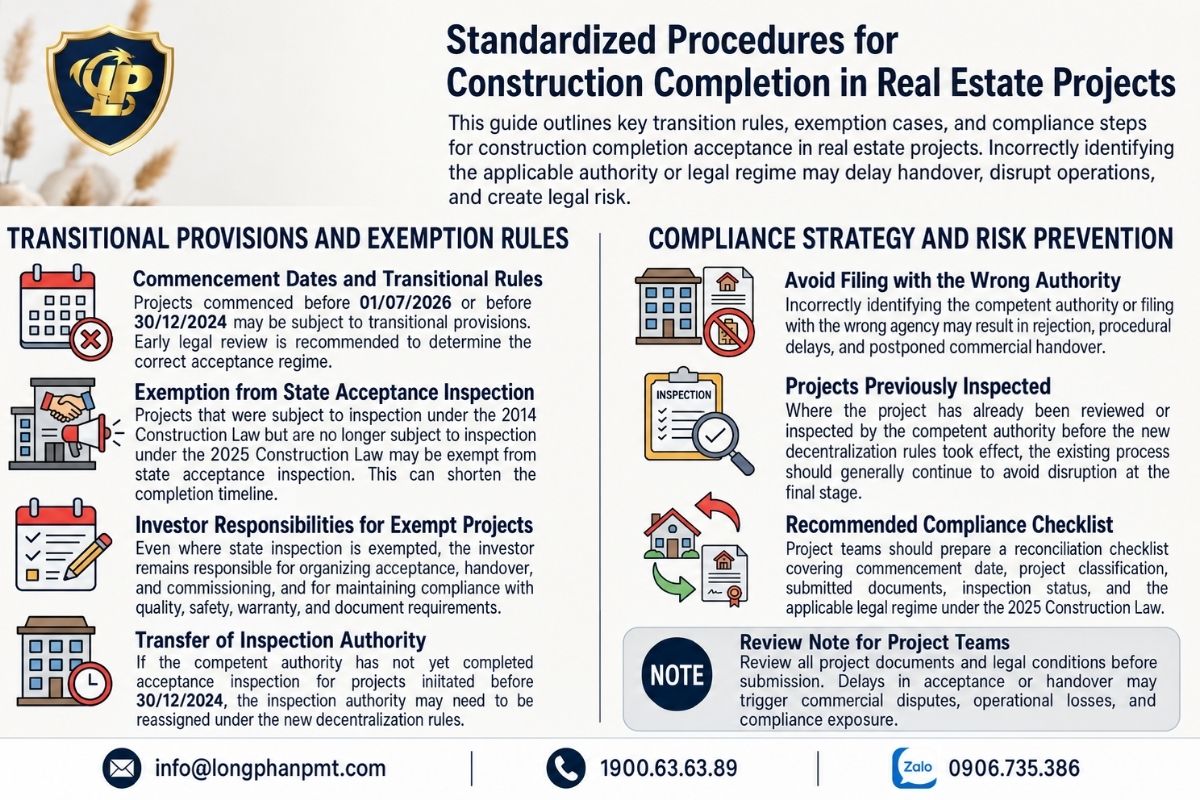
Transitional provisions are a point that needs early review for projects that commenced before that date.01/7/2026If the inspection area is incorrectly identified or the application is submitted to the wrong authority, the investor may have their application rejected, experience delays in acceptance testing, and have the commercial handover date extended.
Regarding compliance strategy, the project management team needs to create a reconciliation table including the commencement date, project classification, the agency that received the documents, the inspection status, and the scope of application according to the 2025 Construction Law. This is a step to prevent risks such as “knocking on the wrong door,” delays in operation, and disputes arising from prolonged handover schedules.
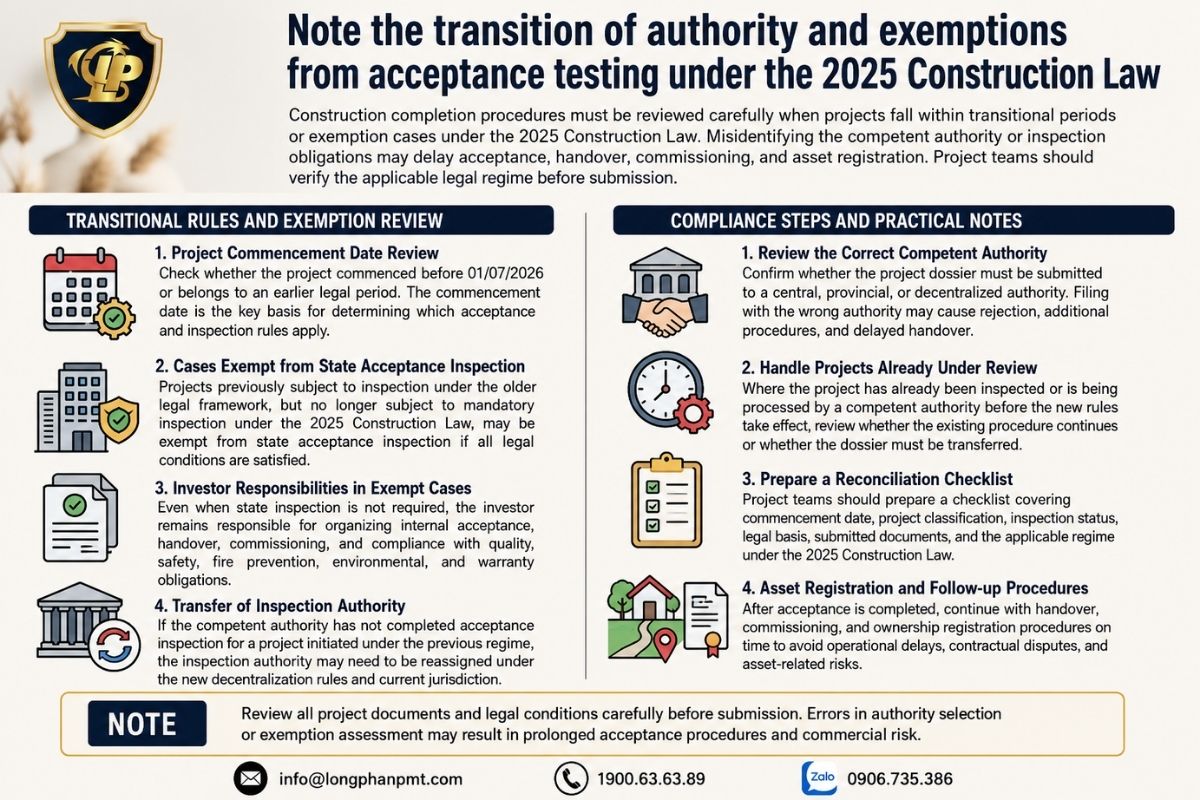
Acceptance of a project requires the synchronized management of construction dossiers, quality management records, and regulatory compliance obligations. Navigating these requirements involves rigorous risk assessment prior to submission to minimize the need for supplements, explanations, or late-stage remediation.
Our legal experts assist enterprises in resolving complex project bottlenecks through:
For a preliminary evaluation of your project dossier, please send your construction permits, as-built drawings, and acceptance minutes via Email: info@longphanpmt.com or Zalo/WhatsApp: +84 906 735 386 to Long Phan Consulting Company.
Risk management in the “project acceptance process” requires the investor and contractor to thoroughly address any issues arising from construction practice. Accurately understanding legal exceptions and penalties helps businesses prevent delays in handover or payment disputes. The following in-depth legal scenarios will clarify compliance responsibilities for the most complex issues.
Businesses are absolutely prohibited from putting a construction project into operation until the specialized acceptance testing is completed. Strict adherence to fire safety and environmental protection regulations is a mandatory condition for the state agency to approve the completion acceptance test. Businesses that violate these regulations will face delays in handover and the risk of penalties. The legal basis for this is Clause 1, Article 23 of Decree No. 06/2021/ND-CP.
Investors will face severe administrative penalties if they arbitrarily put a project into operation to expedite commercial progress. The fine for putting a project into use without prior acceptance testing ranges from VND 80,000,000 to VND 100,000,000 for organizations. Furthermore, the investor is required to conduct acceptance testing within 1 to 3 months, as stipulated in Clause 2 and Point b, Clause 4, Article 18 of Decree No. 16/2022/ND-CP.
The consulting and supervision contractor is required to respond and conduct on-site acceptance within a very short time to avoid disrupting the project progress. The construction supervisor must conduct acceptance of construction work within no more than 24 hours from the time of receiving the acceptance request from the construction contractor. This time limit is clearly stipulated in Clause 3, Article 21 of Decree No. 06/2021/ND-CP.
The investor has the full right to decide on conditional acceptance to put the project into temporary operation in order to optimize investment cash flow. However, this exception only applies when the project is basically completed according to the design and the remaining quality issues do not affect the load-bearing capacity, lifespan, functionality, and ensure safe operation. This decision is made according to the principles in Clause 2, Article 23 of Decree No. 06/2021/ND-CP.
Businesses will face maximum fines and be required to repay related financial amounts for fraudulent construction volume claims. Specifically, the act of falsely certifying the volume of work will be fined from VND 100,000,000 to VND 120,000,000 for organizations. The parties are required to re-certify the work based on the actual volume and recover the incorrectly paid amount into the investor’s account, in accordance with Clause 3, Point c and Point d of Clause 4, Article 18 of Decree No. 16/2022/ND-CP.
The construction project acceptance process is the definitive legal mechanism for securing handover schedules, validating financial settlements, and ensuring commercial operational readiness. Project owners, contractors, and supervision consultants must prioritize the standardization of quality management records and strictly adhere to the project acceptance conditions prescribed under the 2025 Construction Law. Procedural lapses during this phase not only invite significant regulatory sanctions and re-inspection costs but also jeopardize your ability to recognize revenue and settle accounts with stakeholders. To mitigate these risks and ensure your project’s full legal compliance, consult with the expert advisory team at Long Phan Consulting Company. Protect your investment by engaging our specialists today via our hotline at 1900.63.63.89.
📚This article has been professionally reviewed based on the following legal documents:


