Skip to content
  • Home Page
    • About Us
    • Career
  • Services
    • Business Registration
      • Registration of Enterprise Establishment
      • Business Registration Amendment
      • Company Liquidation
      • Corporate Restructuring
    • Sub-License Registration
      • Environment Permit
      • Food Safety Certificate
      • Liquor Business License
    • Corporate Governance Structure
    • C&B Consulting
    • Investment Consulting
      • Investment Method Consultancy
      • M&A Consultancy
      • Bidding Consultancy
      • IPO Consultancy
    • Intellectual Property Consulting
      • Brand Consultancy
      • Identifier Names Consultancy
      • Copyright Consultancy
      • Intellectual Property Dispute Resolution
    • Debt Trading Consultancy
    • Labor Consultancy
      • Work Permit
      • Labor Management
      • Labor Dispute Resolution
    • Commercial Mediation
    • Consultancy For Foreigners
      • Temporary Residence Card
      • Marriage – Divorce Procedures
      • Adoption Procedures
    • Contract Consultancy
      • Contract Templates
      • Drafting – Reviewing Contracts
      • Contract Dispute Resolution
  • Our Team
  • Resources
    • Internal Newsletter
    • Legal Updates
    • Event Commentary
    • News Article
      • Law on Enterprises and Businesses
      • Law on Investment
      • Intellectual Property
      • Debt Resolution
      • Law on Labor
      • Types of licences for foreigners
      • Dispute Resolution
      • Law on Contract
  • Contact us
  • 1900.63.63.89
  • info@longphanpmt.com
  • Tiếng Việt
  • English
Long Phan Logo
  • Home Page
    • About Us
    • Career
  • Services
    • Business Registration
      • Registration of Enterprise Establishment
      • Business Registration Amendment
      • Company Liquidation
      • Corporate Restructuring
    • Sub-License Registration
      • Environment Permit
      • Food Safety Certificate
      • Liquor Business License
    • Corporate Governance Structure
    • C&B Consulting
    • Investment Consulting
      • Investment Method Consultancy
      • M&A Consultancy
      • Bidding Consultancy
      • IPO Consultancy
    • Intellectual Property Consulting
      • Brand Consultancy
      • Identifier Names Consultancy
      • Copyright Consultancy
      • Intellectual Property Dispute Resolution
    • Debt Trading Consultancy
    • Labor Consultancy
      • Work Permit
      • Labor Management
      • Labor Dispute Resolution
    • Commercial Mediation
    • Consultancy For Foreigners
      • Temporary Residence Card
      • Marriage – Divorce Procedures
      • Adoption Procedures
    • Contract Consultancy
      • Contract Templates
      • Drafting – Reviewing Contracts
      • Contract Dispute Resolution
  • Our Team
  • Resources
    • Internal Newsletter
    • Legal Updates
    • Event Commentary
    • News Article
      • Law on Enterprises and Businesses
      • Law on Investment
      • Intellectual Property
      • Debt Resolution
      • Law on Labor
      • Types of licences for foreigners
      • Dispute Resolution
      • Law on Contract
  • Contact us
No results

CONTACT US

Sign up for consultation

Long Phan Logo

Comprehensive Guide to Applying the Project Construction Acceptance Procedure

  • Long Phan Consulting Company
  • Construction Consulting
  • Comprehensive Guide to Applying the Project Construction Acceptance Procedure
  • Luật sư Nguyễn Thu Hương Luật sư Nguyễn Thu Hương
  • July 15, 2026 10:50 am
  • No Comments
Table of Contents

Improper execution of the project construction acceptance procedure can disrupt project handover, delay final account settlement, and create exposure to administrative penalties for the project owner. Under the 2025 Law on Construction, acceptance of completed works or work items is valid only when construction has complied with the approved design, construction permit, applicable technical standards and regulations, and is supported by a complete quality management dossier. Sector-specific requirements, including PCCC and environmental compliance, must also be fulfilled before the project is put into operation.

Businesses should review Construction Consulting to control compliance risks from the dossier preparation stage with professional support from Long Phan Consulting.

Overview of the project construction acceptance procedure with conditions, deadlines, and penalties.
This featured infographic summarizes acceptance conditions, standardized inspection steps, document deadlines, and violation risks before project handover.

Important legal note:

  • Projects subject to inspection must submit documentation in advance 15 days with projects of special, level I or 10 days with the remaining structures.
  • The supervisor must inspect the construction work within a maximum of [number] days 24 hours since receiving the proposal from the construction contractor.
  • Putting a building into use before it has been inspected and approved may result in penalties 80,000,000 to 100,000,000 VND and require the organization to conduct acceptance testing in 1 to 3 months.
  • Acceptance of projects without proper quality control or acceptance of construction work may result in penalties 100,000,000 to 120,000,000 VND. This necessitates a re-inspection and recovery of the incorrect payment.

Legal Conditions and Levels of Construction Project Acceptance

The legal conditions for accepting a completed construction work under the 2025 Construction Law require that the work must satisfy the construction design, technical regulations, applied standards, construction material management, and relevant legal provisions. This acts as a critical control point before the project owner signs off on acceptance, finalizes accounts, and puts the asset into commercial operation, pursuant to Clause 2, Article 57 of the 2025 Construction Law (effective from July 1, 2026).

Regarding the actual sequence, enterprises must clearly distinguish between acceptance levels to avoid signing at the incorrect time or overlooking documentation. The 2025 Construction Law stipulates that construction project acceptance includes acceptance during the construction process, phased acceptance when necessary, and acceptance of completed work items or entire construction projects, pursuant to Clause 1, Article 57.

  • Construction task acceptance: Verifying completed portions before transitioning to the next step to control technical deviations early.
  • Construction component/phase acceptance: Applied when verifying quality at specific milestones to serve as a basis for payment or technical transition.
  • Work item acceptance: Confirming that an independent component is ready for operation, handover, or integration into the overall project.
  • Final construction project acceptance: The definitive legal step to review for handover, exploitation, usage, and contract settlement.

The core conditions reside not only on-site but within the construction quality management records. The work must be executed fully per the design documents, complete with work and phase acceptance, passing all test results and inspections, and compliant with fire safety and environmental requirements, pursuant to Point d, Clause 1, Article 23 of Decree No. 06/2021/NĐ-CP:

  • Executed per approved design and construction permits (if applicable).
  • Compliant with technical regulations, applied standards, and material management requirements.
  • Passage of all quality tests, experiments, and inspections prior to acceptance signing.
  • Completion of quality management records, as-built drawings, and relevant acceptance minutes.
  • Resolution of technical issues affecting safety, functionality, or operational capacity.
  • Fulfillment of specialized requirements (fire protection, environmental safety, operational safety).

Where a project is fundamentally complete per design but contains quality imperfections not affecting load-bearing capacity, lifespan, functionality, or operational safety, the project owner may consider conditional acceptance for temporary operation. This mechanism does not replace formal final acceptance and must be strictly controlled, pursuant to Clause 2, Article 23 of Decree No. 06/2021/NĐ-CP.

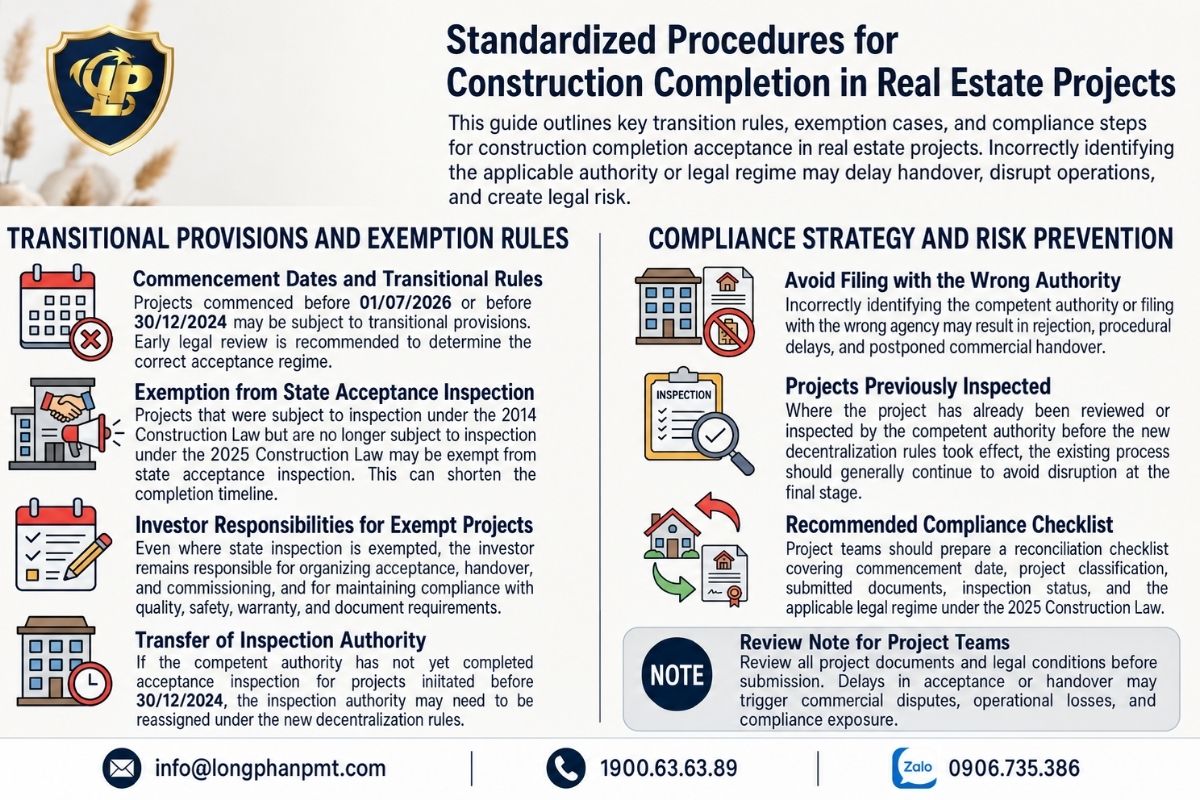
Standardized Procedures for Construction Completion in Real Estate Projects

The construction completion process must be managed as a synchronized legal, technical, and asset-management chain. Failure to secure any link can result in delayed acceptance, deferred handovers, and obstacles in financial settlements. Enterprises should organize this process into three distinct phases, each requiring a designated focal point, evidentiary documentation, and internal audit mechanisms prior to formal submission.

Legal Audit, Status Inspection, and Dossier Consolidation

This phase determines whether the project possesses a sufficient legal foundation to proceed to acceptance. Developers must simultaneously control land records, construction dossiers, and quality management records.

  • Legal and Permit Audit: Verify investment policy approval, land records, construction permits, and detailed designs to ensure execution aligns with the approved legal foundation.
  • Actual Status vs. Approved Dossier: The project management board must reconcile area, floor count, height, construction density, functionality, boundaries, and infrastructure. Discrepancies must be assessed for adjustment requirements before acceptance.
  • Quality Management Consolidation: Dossiers must reflect the full process of work-item acceptance, phase acceptance, and final completion acceptance. All construction must be executed strictly per approved designs, pursuant to Point a, Clause 1, Article 23 of Decree No. 06/2021/NĐ-CP.

Failure to control this phase frequently leads to returned completion dossiers due to missing construction diaries, material acceptance records, or as-built drawings that fail to reflect site reality.

Organized Completion Acceptance and Approval Requests

Once quality dossiers are prepared, the developer organizes the acceptance of completed works with the contractor, supervision consultant, and relevant stakeholders. This transitions the project from construction management to operational commissioning.

  • Completion Acceptance: The developer prepares completion acceptance minutes as the basis for commissioning. A written approval of acceptance results from the state authority is the mandatory basis for commissioning, pursuant to Point b, Clause 3, Article 23 of Decree No. 06/2021/NĐ-CP.
  • Compulsory Inspections: Developers must submit dossiers requesting inspection 15 days prior to the expected completion acceptance for special-grade and Grade I works, or 10 days for other works, pursuant to Point a, Clause 6, Article 24 of Decree No. 06/2021/NĐ-CP.
  • Competent Authority Timelines: Specialized agencies must issue written approval for acceptance results within 20 working days for Grade I/special-grade works and 14 working days for others, per Article 15 of Decree No. 14/2026/NĐ-CP.

Variation Registration and Asset Ownership Updates

With valid acceptance dossiers, the enterprise proceeds to establish the asset on cadastral records. This directly impacts handover capability and the client’s ability to execute secondary transactions.
  • Post-Completion Registration: Developers perform variation registration to update ownership rights for assets attached to land. The dossier must include the competent authority’s confirmation of commissioning conditions, transfer contracts, handover minutes, and the developer’s own LURC, per Clause 1, Article 41 of Decree No. 101/2024/NĐ-CP.
  • LURC Issuance for Clients: For commercial housing, developers must submit dossiers for LURC issuance to clients within 50 days from the handover date, unless clients voluntarily handle procedures, per Clause 8, Article 39 of the 2023 Housing Law.
  • Registration Timelines: Processing time for registration and LURC issuance for transferees in real estate projects shall not exceed 10 working days, per Clause 6, Article 22 of Decree No. 101/2024/NĐ-CP.
Standardized Procedures for Construction Completion in Real Estate Projects with transitional rules.
The infographic explains transitional provisions, exemption rules, authority review, and compliance steps for construction completion in real estate projects.

List of mandatory construction quality management documents

Construction quality management records serve as proof that the project meets the requirements for acceptance, handover, and final settlement. Businesses need to standardize records according to each document group to avoid a lack of technical evidence at the time of inspection.

  • Project legal documents: The project approval decision, construction permit (if required), and legal documents regarding the entity and conditions for construction implementation.
  • Design and design modification documents: Approved design drawings, design modification documents, technical specifications, and applicable standards for each item.
  • Construction log and acceptance report: Construction logbook, work acceptance report, phase acceptance report, and final item acceptance report.
  • Results of experiments, measurements, and tests: Material certificates, quality control test results, and inspection results of structural components, equipment, and parts of the construction project.
  • As-built drawings: Documents showing the actual location, dimensions, materials, and equipment used in the completed construction project, as stipulated in Clause 4, Article 2 of Decree No. 06/2021/ND-CP.
  • Professional profile: Fire safety, environmental, operational safety, and maintenance documentation if the project is subject to specialized requirements.

The project completion dossier is a collection of documents related to the investment and construction process that need to be kept on file when the project is put into use.

Defining responsibilities between the investor, contractor, and supervisory consultant

Defining acceptance responsibilities helps businesses identify the correct party to bear the risk when a project is delayed, defects arise, or there are disputes over the quantity of work. The investor holds the highest responsibility for organizing the acceptance process, but the contractor and consultant still bear independent responsibility according to their scope of work.

Subject Primary responsibility Right to refuse acceptance
Project investor The responsibility for organizing the acceptance of construction works, inspecting construction methods, organizing acceptance for payment, final settlement, and archiving project completion documents rests with the investor, according to Clause 3, Article 57 and Point h, Clause 2, Article 59 of the 2025 Construction Law. The right to refuse acceptance if the documentation, quality, or handover conditions do not meet project management requirements.
Construction contractor Establishing quality management records, preparing as-built drawings, participating in acceptance testing, and being responsible for the quality of construction, including the work of subcontractors. This obligation is defined in Points d, h, and l, Clause 2, Article 61 of the 2025 Construction Law. While not the entity approving the acceptance of its own work, it has the right to reserve its technical opinion if the acceptance results do not accurately reflect the actual site conditions.
Design consultation Participate in contract acceptance and control the conformity between actual construction and approved design. The basis of responsibility lies in Point d, Clause 1, Article 62 of the 2025 Construction Law. According to Point c, Clause 2, Article 62 of the 2025 Construction Law, contractors have the right to refuse acceptance of a construction item if they discover that the construction does not conform to the approved design.
Construction supervision and consulting contractor Participating in the acceptance of completed work, phases, and projects; controlling quality, regulations, standards, and design. This responsibility is stipulated in Point a, Clause 1, Article 63 of the 2025 Construction Law. According to Point b, Clause 2, Article 63 of the 2025 Construction Law, contractors have the right and obligation to refuse acceptance of a construction project if it does not meet quality requirements, conform to regulations, standards, or design specifications.
Construction specialist agency Inspection and acceptance testing for large-scale projects with complex technical aspects and significant impacts on public safety and interests. This authority falls under Clauses 4 and 5 of Article 57 of the 2025 Construction Law. The acceptance test results may be rejected if the project does not meet the quality management requirements or the conditions for commissioning and use.

For projects with multiple contract packages, businesses should link acceptance responsibilities to the contract, construction log, and payment documents. Signing acceptance reports that do not reflect the actual situation can lead to compensation risks, re-inspections, or settlement disputes.

Commercial Risks and Penalties for Non-Compliant Acceptance

Incorrect acceptance procedures are more than mere administrative errors. For developers and contractors, these flaws trigger risks of delayed handovers, stalled financial settlements, and mandatory re-inspections. Enterprises often face risks when prioritizing handover timelines while ignoring incomplete fire safety, environmental documentation, or acceptance minutes.

  • Operating Without Acceptance: Putting a project into use before mandatory acceptance can result in fines from 80,000,000 to 100,000,000 VND and a mandatory requirement to complete acceptance within 01 to 03 months, per Clause 2, Point b, Clause 4, Article 18 of Decree No. 16/2022/NĐ-CP.
  • Procedural Violations: Failure to follow the prescribed sequence or notify authorities regarding acceptance inspections can result in fines of 20,000,000 to 40,000,000 VND.
  • Unauthorized Handover: Handing over a project prior to formal acceptance can lead to fines of 100,000,000 to 120,000,000 VND and a mandatory order to perform full acceptance procedures.
  • Fraudulent Acceptance: Accepting non-existent volumes or poor quality can result in fines of 100,000,000 to 120,000,000 VND, requiring re-inspection, recovery of incorrect payments, and mandatory quality rectification.

Beyond monetary penalties, improper acceptance can trigger requests for counter-testing or construction audits. This generates unplanned costs, delays revenue recognition, and creates potential liabilities for designers, contractors, and supervision consultants if defects cause project losses, pursuant to the 2025 Construction Law.

Note the transition of authority and exemptions from acceptance testing under the 2025 Construction Law

Transitional provisions are a point that needs early review for projects that commenced before that date.01/7/2026If the inspection area is incorrectly identified or the application is submitted to the wrong authority, the investor may have their application rejected, experience delays in acceptance testing, and have the commercial handover date extended.

  • Exemption from state acceptance inspection: construction started before the date 01/7/2026. Construction projects that were subject to acceptance inspection under the 2014 Construction Law but not under the 2025 Construction Law are not required to undergo state acceptance inspection. This regulation applies according to Clause 8, Article 95 of the 2025 Construction Law.
  • Impact of project management: Projects exempt from inspection may shorten the waiting time for state agencies to review acceptance results. However, the investor must independently organize the acceptance, handover, and commissioning of the project, and bear full responsibility for quality, safety, warranty, and legal documentation.
  • Transfer of inspection authority: with construction started before that date30/12/2024If the specialized construction agency has not yet inspected the completion acceptance work, the authority to inspect must be redefined according to the new decentralization. This is stipulated in Point b, Clause 19, Article 122 of Decree No. 175/2024/ND-CP.
  • Cases that have been previously checked: If the specialized construction agency has already conducted inspections before the effective date of the new decentralization regulations, that agency will continue to carry out the inspections until completion. This approach helps avoid procedural disruptions for projects that have reached the final acceptance stage.

Regarding compliance strategy, the project management team needs to create a reconciliation table including the commencement date, project classification, the agency that received the documents, the inspection status, and the scope of application according to the 2025 Construction Law. This is a step to prevent risks such as “knocking on the wrong door,” delays in operation, and disputes arising from prolonged handover schedules.
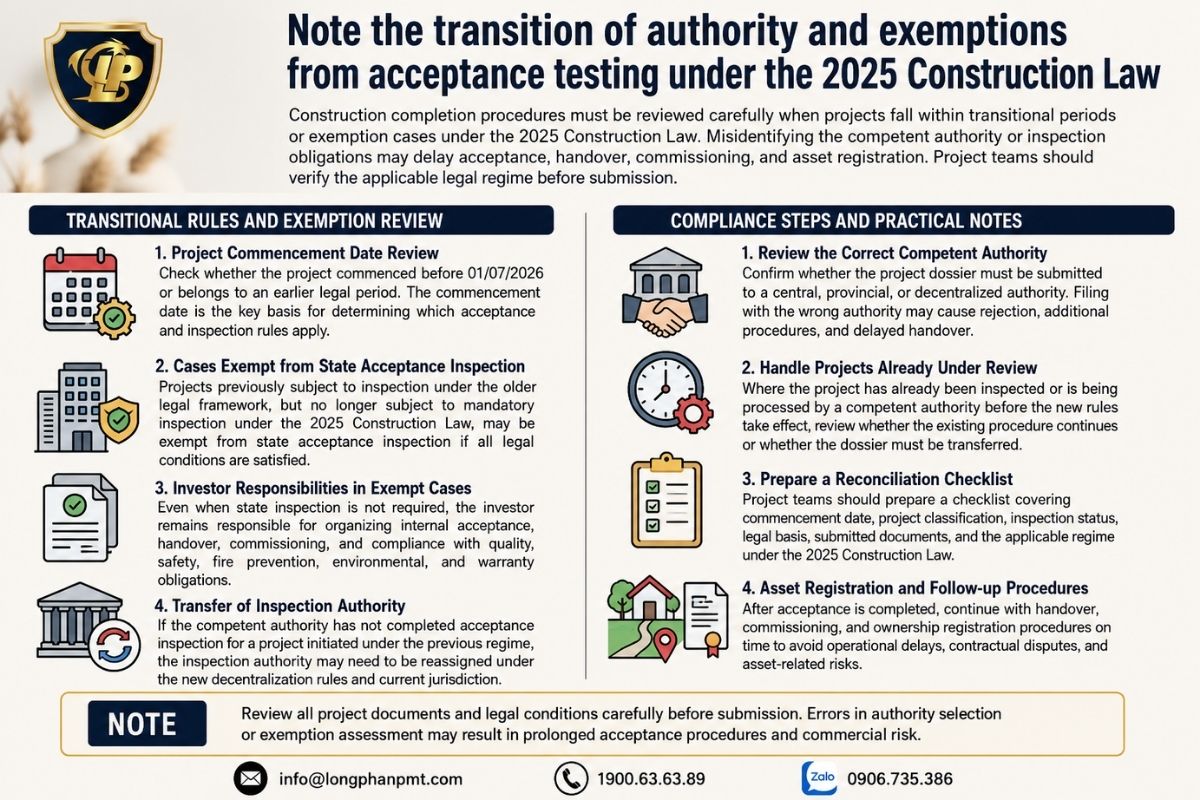
Transition of authority and exemptions from acceptance testing under the 2025 Construction Law.
The infographic outlines commencement date review, exempt inspection cases, authority transfer, reconciliation checklists, and follow-up registration procedures.

Advisory Services for Construction Acceptance and Project Compliance at Long Phan Consulting Company

Acceptance of a project requires the synchronized management of construction dossiers, quality management records, and regulatory compliance obligations. Navigating these requirements involves rigorous risk assessment prior to submission to minimize the need for supplements, explanations, or late-stage remediation.

Our legal experts assist enterprises in resolving complex project bottlenecks through:

  • Due Diligence: Auditing current construction status against permits, designs, and legal project documentation.
  • Quality Audit: Reviewing construction diaries, material certificates, and mandatory acceptance minutes for each construction phase.
  • Regulatory Remediation: Providing strategic advice on rectifying construction deviations regarding floor count, area, functionality, or safety standards.
  • Dossier Standardization: Establishing a comprehensive completion dossier checklist for regulatory inspection.
  • Competent Authority Representation: Representing enterprises before specialized construction agencies to expedite approval processes.
  • Dispute Resolution: Reworking settlement terms, quality compliance evidence, and contractual obligations with contractors.

For a preliminary evaluation of your project dossier, please send your construction permits, as-built drawings, and acceptance minutes via Email: info@longphanpmt.com or Zalo/WhatsApp: +84 906 735 386 to Long Phan Consulting Company.

Frequently Asked Questions about the project construction acceptance procedure

Risk management in the “project acceptance process” requires the investor and contractor to thoroughly address any issues arising from construction practice. Accurately understanding legal exceptions and penalties helps businesses prevent delays in handover or payment disputes. The following in-depth legal scenarios will clarify compliance responsibilities for the most complex issues.

1. Is it permissible to put a building into operation before the fire safety inspection has been completed?

Businesses are absolutely prohibited from putting a construction project into operation until the specialized acceptance testing is completed. Strict adherence to fire safety and environmental protection regulations is a mandatory condition for the state agency to approve the completion acceptance test. Businesses that violate these regulations will face delays in handover and the risk of penalties. The legal basis for this is Clause 1, Article 23 of Decree No. 06/2021/ND-CP.

2. What administrative penalties will a developer face if they put a construction project into use without conducting an acceptance test?

Investors will face severe administrative penalties if they arbitrarily put a project into operation to expedite commercial progress. The fine for putting a project into use without prior acceptance testing ranges from VND 80,000,000 to VND 100,000,000 for organizations. Furthermore, the investor is required to conduct acceptance testing within 1 to 3 months, as stipulated in Clause 2 and Point b, Clause 4, Article 18 of Decree No. 16/2022/ND-CP.

3. How long does the consulting and supervision contractor have to carry out the acceptance of construction work after receiving the request?

The consulting and supervision contractor is required to respond and conduct on-site acceptance within a very short time to avoid disrupting the project progress. The construction supervisor must conduct acceptance of construction work within no more than 24 hours from the time of receiving the acceptance request from the construction contractor. This time limit is clearly stipulated in Clause 3, Article 21 of Decree No. 06/2021/ND-CP.

4. Does the investor have the right to decide to accept and put the project into temporary operation even when it still has technical defects?

The investor has the full right to decide on conditional acceptance to put the project into temporary operation in order to optimize investment cash flow. However, this exception only applies when the project is basically completed according to the design and the remaining quality issues do not affect the load-bearing capacity, lifespan, functionality, and ensure safe operation. This decision is made according to the principles in Clause 2, Article 23 of Decree No. 06/2021/ND-CP.

5. What are the penalties for the act of falsely certifying the volume of construction work performed during the acceptance process?

Businesses will face maximum fines and be required to repay related financial amounts for fraudulent construction volume claims. Specifically, the act of falsely certifying the volume of work will be fined from VND 100,000,000 to VND 120,000,000 for organizations. The parties are required to re-certify the work based on the actual volume and recover the incorrectly paid amount into the investor’s account, in accordance with Clause 3, Point c and Point d of Clause 4, Article 18 of Decree No. 16/2022/ND-CP.

Conclusion

The construction project acceptance process is the definitive legal mechanism for securing handover schedules, validating financial settlements, and ensuring commercial operational readiness. Project owners, contractors, and supervision consultants must prioritize the standardization of quality management records and strictly adhere to the project acceptance conditions prescribed under the 2025 Construction Law. Procedural lapses during this phase not only invite significant regulatory sanctions and re-inspection costs but also jeopardize your ability to recognize revenue and settle accounts with stakeholders. To mitigate these risks and ensure your project’s full legal compliance, consult with the expert advisory team at Long Phan Consulting Company. Protect your investment by engaging our specialists today via our hotline at 1900.63.63.89.

📚This article has been professionally reviewed based on the following legal documents:

  • 2025 Law on Construction
  • Decree No. 06/2021/ND-CP detailing certain provisions on quality management, construction execution, and maintenance of construction works
  • Decree No. 16/2022/ND-CP on administrative penalties in construction
  • Decree No. 35/2023/ND-CP amending and supplementing certain articles of Decrees under the state management of the Ministry of Construction
  • Note: Laws and regulations may change over time. Please contact Long Phan Consulting directly via Hotline 1900.63.63.89 for the latest updates.
Facebook
Linkedin
Twitter
Pinterest
Luật sư Nguyễn Thu Hương
Lawyer Nguyen Thu Huong is a leading expert in the field of investment and licensing for foreigners. With extensive knowledge of investment laws and the complex regulations related to licensing procedures, she has successfully assisted numerous businesses and foreign investors in establishing their operations in Vietnam.
Read more
PrevPreviousBusiness Trademark Protection Services: Strategic Legal Advisory
NextProcedure for Preparing an Application for an On-Premises Alcohol Sales Registration Next
Table of Contents
CONTACT FORM
Call for consultation now!
1900.63.63.89
Call now

Leave a Reply

Cancel Reply

Your email address will not be published. Required fields are marked *

Related Articles

Benefits of construction consulting

Consulting Services for Foreign Construction Projects in Vietnam

Tư Vấn Long Phan 2024/03/13/
Read More »
Tư vấn giải quyết tranh chấp xây dựng

Consultancy Services For Construction Dispute Resolution

Tư Vấn Long Phan 2024/03/12/
Read More »
Consulting on construction permits

Consulting services for construction permits

Tư Vấn Long Phan 2024/03/12/
Read More »
« Page1 … Page6 Page7 Page8 »

Note: The content of the articles published on the website of Long Phan Investment Consulting Company is for reference only regarding the application of legal policies. Depending on the time, subject, and amendments, supplements, and replacements of legal policies and legal documents, the consulting content may no longer be appropriate for the situation you are facing or need legal advice on. In case you need specific and in-depth advice according to each case or incident, please contact us through the methods below. With our enthusiasm and dedication, we believe that Long Phan will be a reliable solution provider for our clients.

Long Phan Logo
Trust Entrusted – Solutions Delivered

Long Phan Investment Consulting and Legal Services Company Limited

Facebook Youtube Instagram Twitter Linkedin

Leave your email to receive the latest information from us

Contact Info
  • Email: info@longphanpmt.com
  • 1900.63.63.89
  • Commercial Lot TM7, Lavita Garden Apartment, 17 Street 3, Thu Duc Ward, Ho Chi Minh City
  • Working hours: Monday to Saturday - 8:00 to 17:30
Quick links
  • Service
  • Personnel
  • Resources
  • Contact us
  • Non - Disclosure policy
  • Payment Policy
  • Complaint Resolution Policy
  • Services Providing Process
Google Map

CONTACT: 1900.63.63.89

Copyright 2024 © Long Phan Consulting Company. All rights reserved.