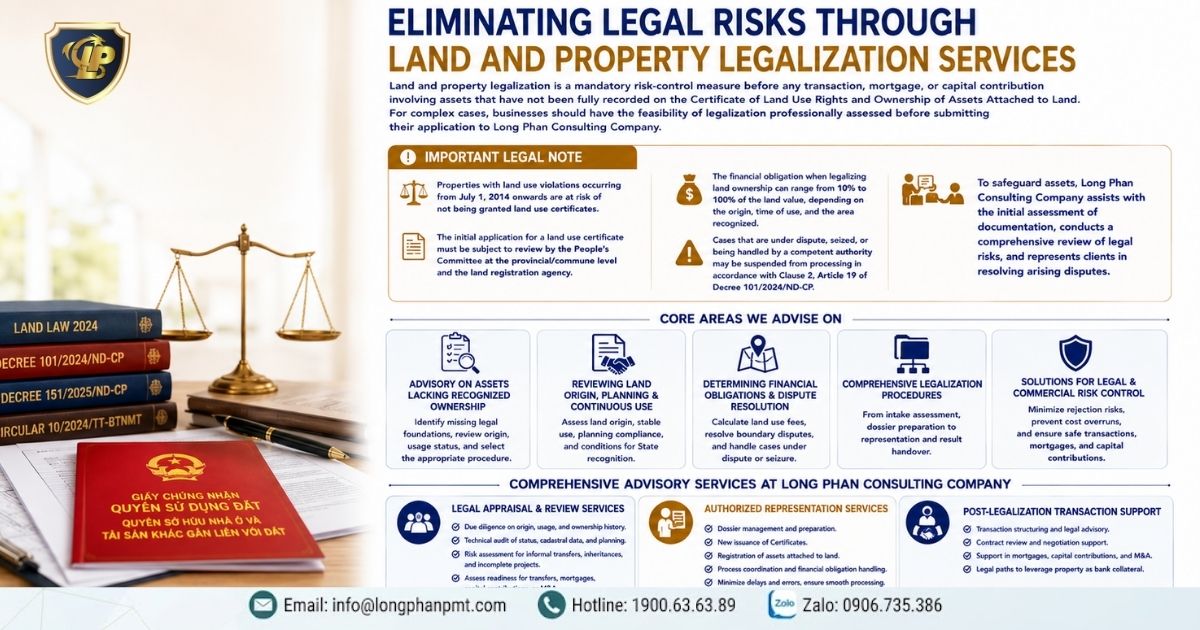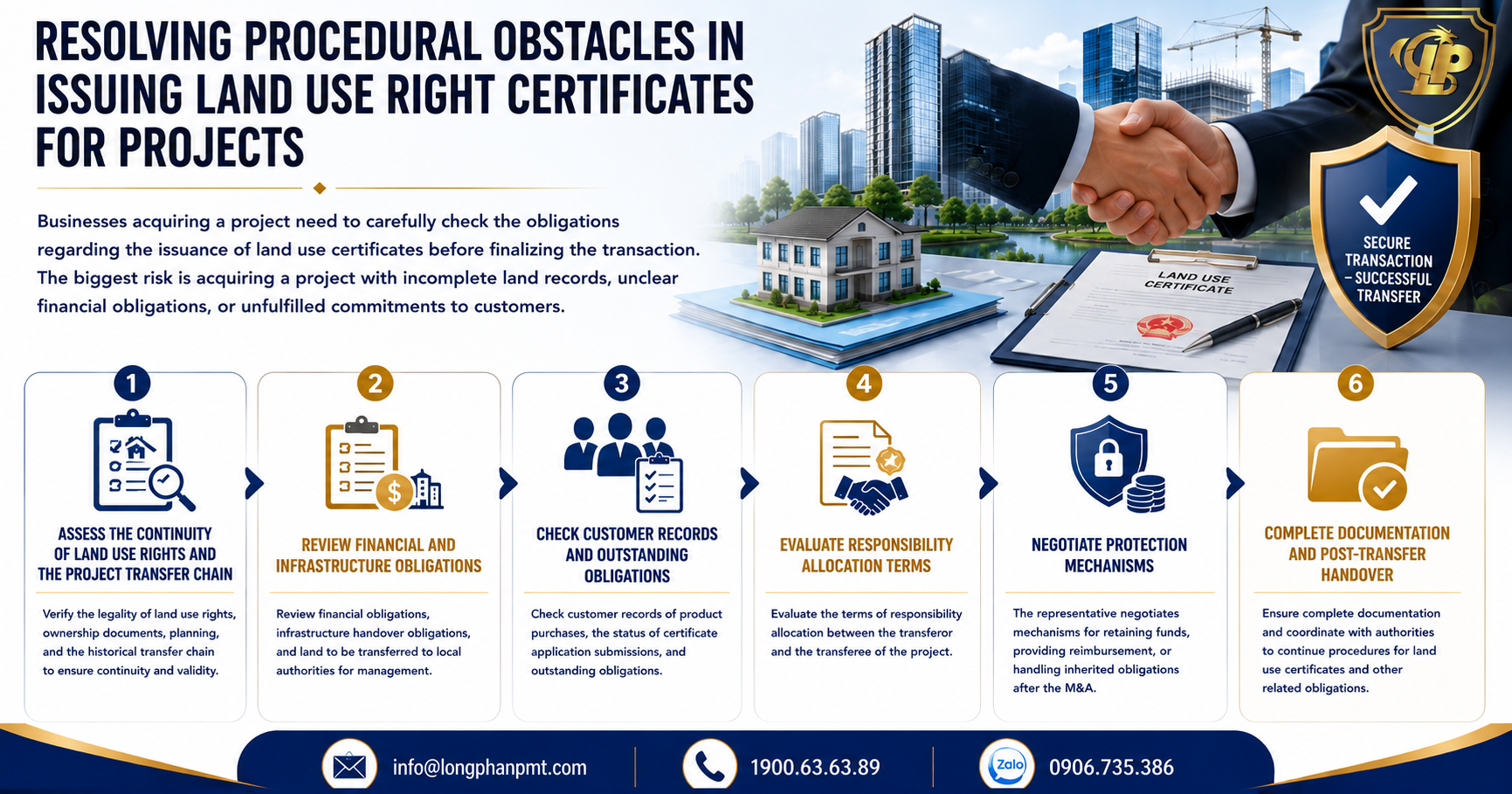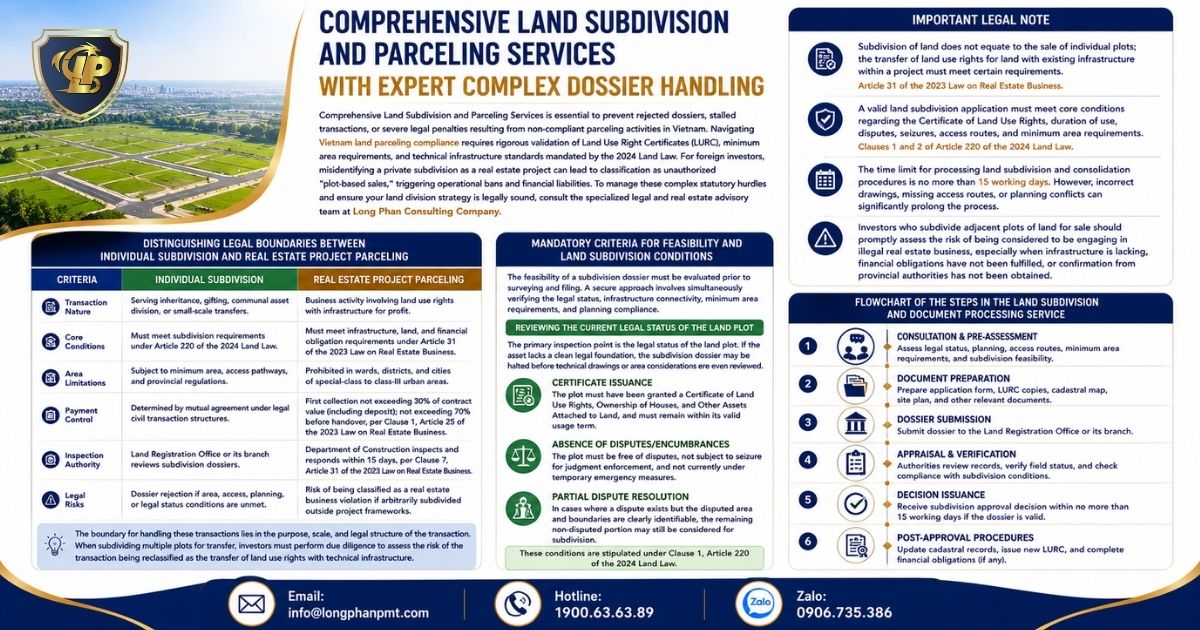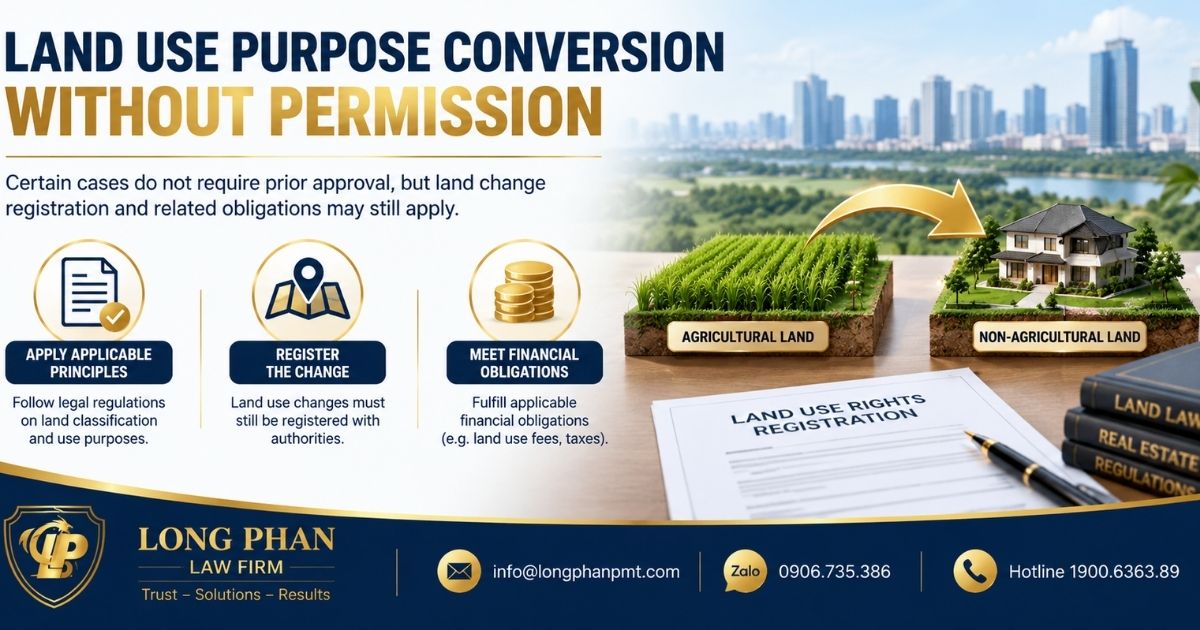

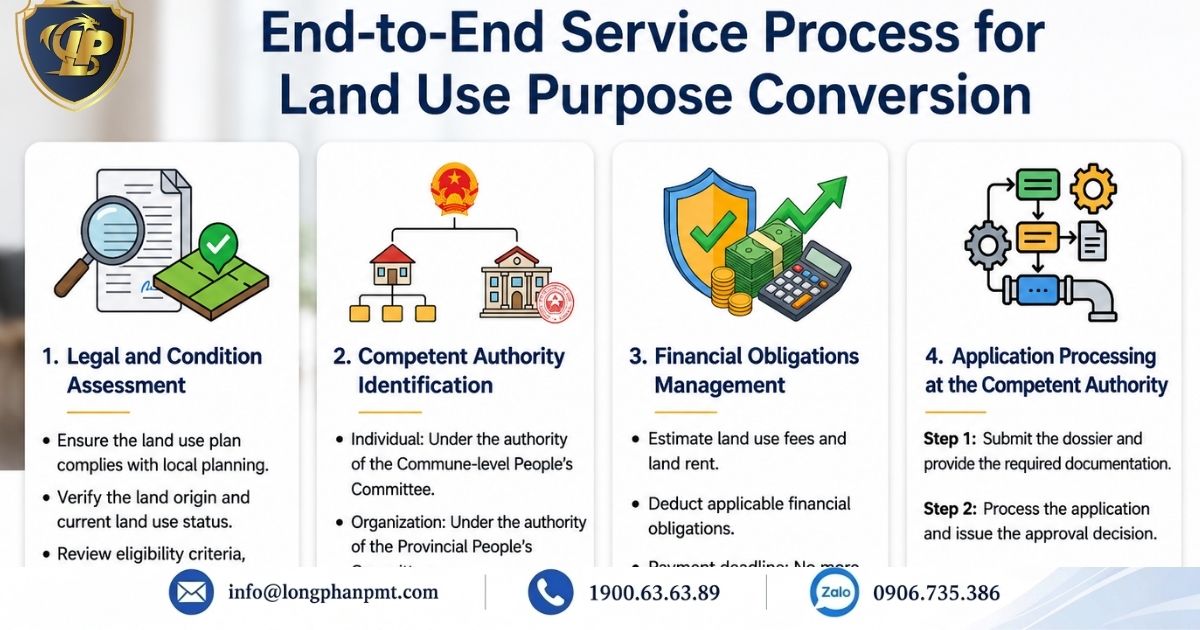
Land Use Purpose Conversion can create substantial regulatory and commercial exposure if investors fail to verify planning compatibility, approval jurisdiction, and projected financial obligations before filing. Under the Law On Land, a controlled process should start with reviewing the commune-level land use plan, determining the competent authority, completing the application dossier, and calculating expected land use fees or rental payments. Long Phan Consulting provides end-to-end support through approval, registration of changes, and final updating of the Land Use Rights Certificate.
Important legal note:
Legal appraisal is the pre-screening step that determines whether an application has a realistic chance of approval. For investors, the primary risk lies not in the submission process itself, but in purchasing or holding land parcels that do not meet the legal requirements for conversion. This assessment must be executed before signing deposit agreements, accepting transfers, or committing to business plans.
Land use purpose conversion to residential or commercial use should only proceed when the parcel complies with land use planning and lacks critical legal encumbrances. This verification process prevents applications from being returned for supplementary information, rejected, or incurring unexpected post-transaction costs.
Before submission, enterprises must audit the following criteria:
Failing to conduct this appraisal can lead investors to acquire land parcels that cannot be converted to residential status. In such cases, opportunity costs, capital costs, and project timelines are directly and negatively impacted.
Submitting to the incorrect authority leads to significant delays, particularly following recent decentralization changes in the land sector. Determining the appropriate approval entity must be conducted during the initial application design phase.
| Land User Type | Approval Authority | Legal Basis |
| Individuals | Commune-level People’s Committee Chairperson | Point m, Clause 1, Article 5, Decree No. 151/2025/NĐ-CP (corrected by Decision No. 2418/QĐ-BNNMT) |
| Economic Organizations / FIEs | Provincial-level People’s Committee Chairperson | Point d, Clause 1, Article 9, Decree No. 151/2025/NĐ-CP (corrected by Decision No. 2418/QĐ-BNNMT) |
For individuals, households, or real estate enterprises, variations in approval authority necessitate adjustments to dossier preparation and presentation strategies. Correctly identifying the approving authority accelerates processing times and minimizes the risk of adjustment requests.
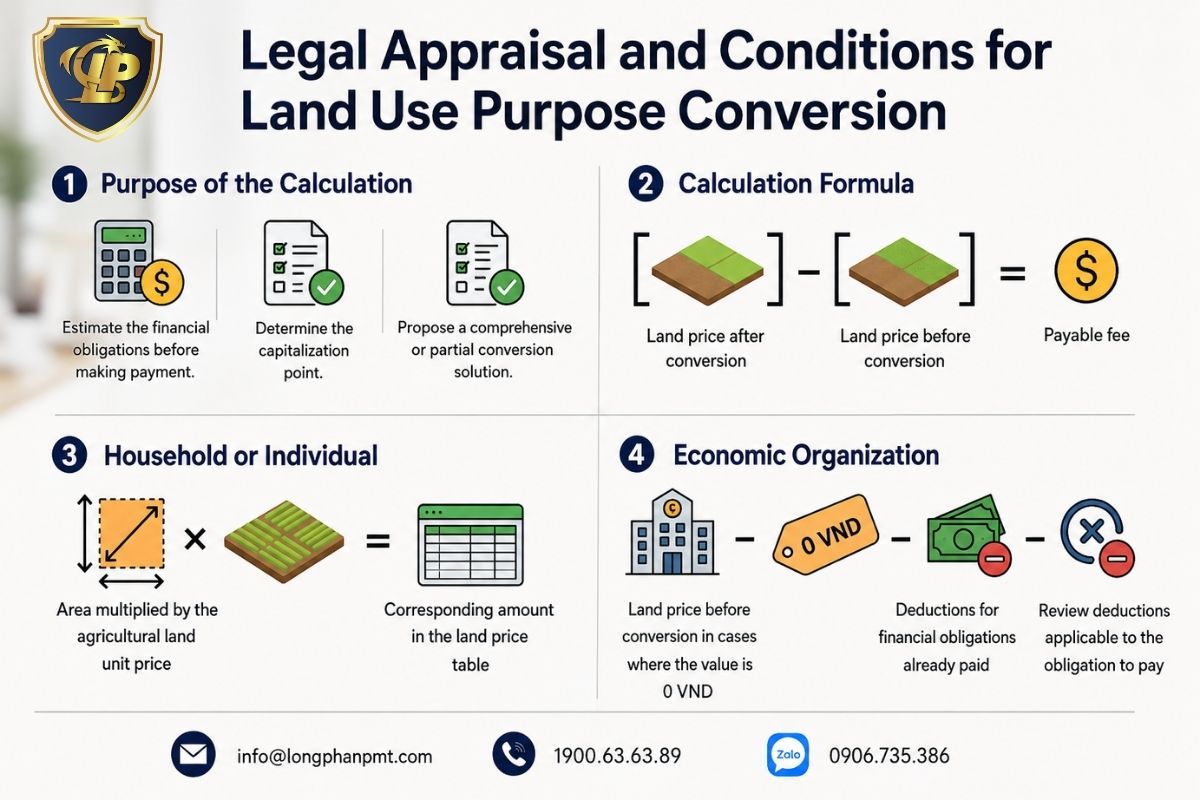
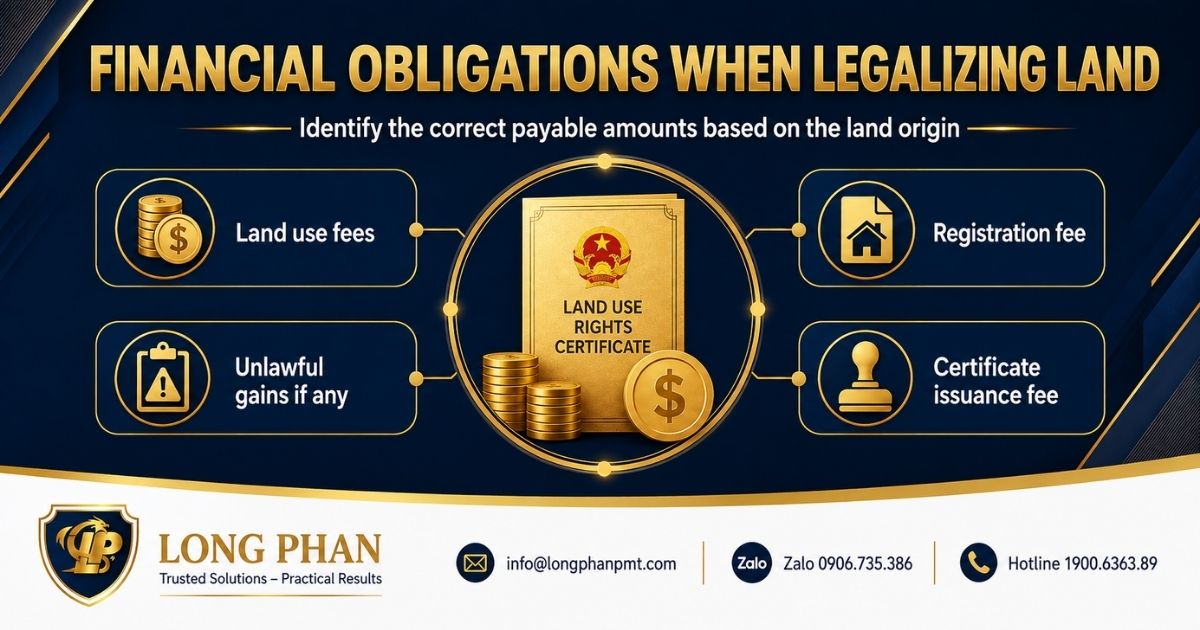
Financial obligations typically represent the most significant variable in land use purpose conversion. For investors, service fees are merely operational costs, whereas land use fees or land rents directly impact cash flow, capital costs, and overall project efficiency.
Enterprises must estimate these obligations prior to submission rather than awaiting the tax authority’s assessment. Early estimation allows for identifying break-even points, determining whether to convert the entire or partial area, and assessing the feasibility of proceeding with the transaction.
Financial principles that must be controlled include:
Guide to methods and formulas for estimating land use fees and land lease fees when changing land use purposes.
Applications submitted before the 2024 Land Law took effect require a specific review. Choosing to proceed under the previous law or requesting the application of the new law can result in significant differences in procedures, timelines, and financial obligations.
Organizations or individuals that submitted applications before August 1, 2024, but have not yet received a decision, may continue processing under the prior regulations. However, land users may request to apply the new regulations directly, pursuant to Clause 7, Article 255 of the 2024 Land Law.
For projects that received a conversion decision before August 1, 2024, but lack a land price decision, the State will calculate land use fees or one-time land rent under the new legal framework, pursuant to Clause 2, Article 50 and Clause 9, Article 51 of Decree No. 103/2024/NĐ-CP. Enterprises must re-evaluate their financial models, land origin dossiers, and existing capital investments. Delayed processing can lead to late-payment interest, prolonged LURC issuance, and increased total investment levels.
The conversion process should be designed as a strategic legal roadmap rather than a mere administrative filing. For investors, correctly formatted applications, accurate jurisdictional identification, and sufficient financial justification help mitigate the risks of supplementary requests or delayed inter-agency tax coordination.
The dossier must simultaneously prove land use rights, the necessity of conversion, and the legal status of the land use plan following the conversion. It is imperative to avoid using outdated forms if legal requirements have been updated.
The essential dossier set typically includes:
Standardizing the dossier from the outset allows for more proactive arguments. This is a practical prerequisite for shortening processing times and avoiding additional legal costs arising from returned files.
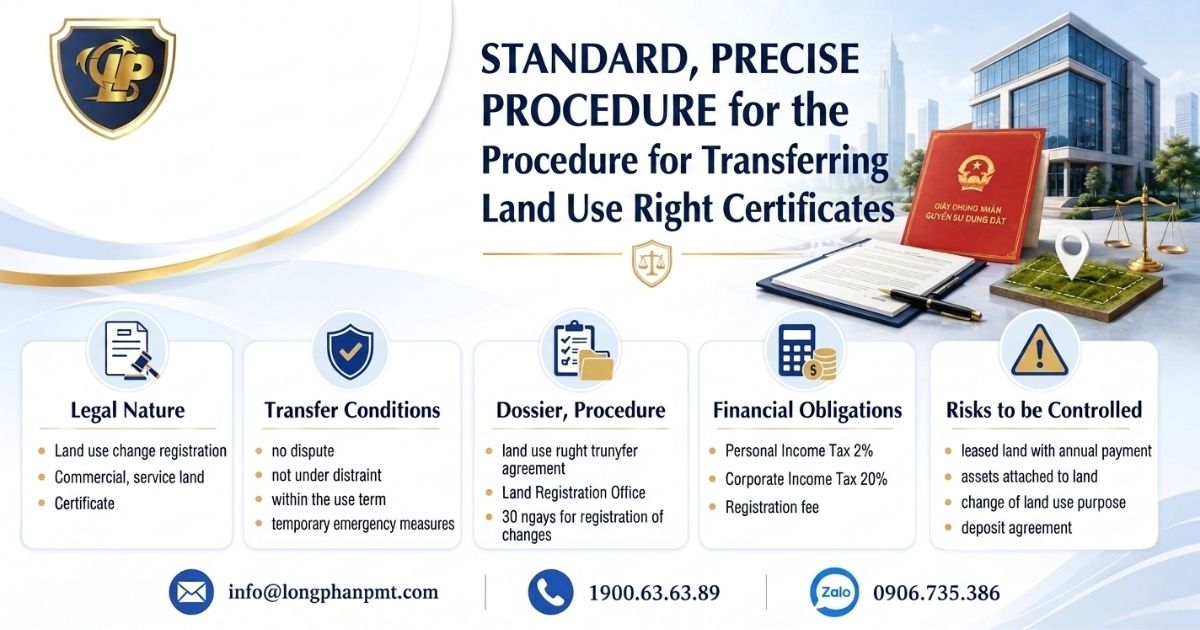
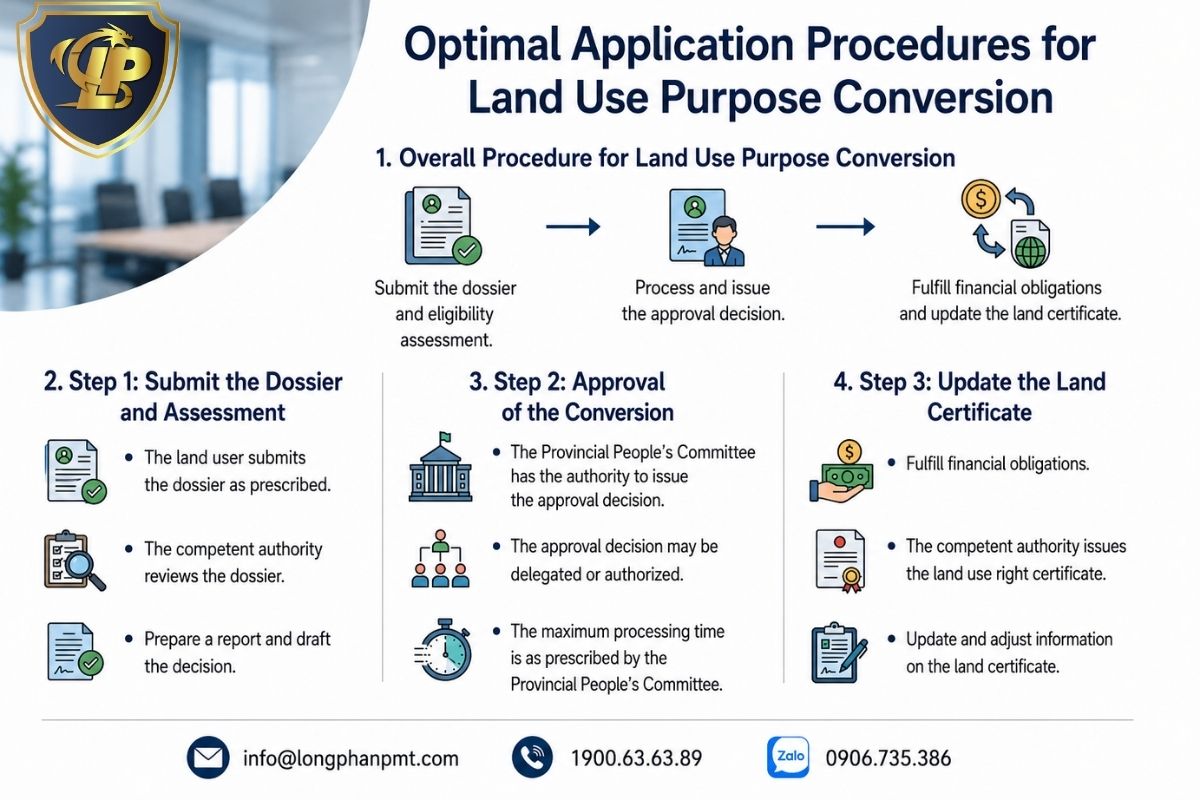
Following submission, the process extends beyond the initial receiving agency. It involves appraisal, approval submission, tax coordination, and updating cadastral records.
Flowchart of the application processing procedure at specialized agencies and the processing time for land use conversion.
>> See more: Land use conversion without investment approval
Land use purpose conversion is a complex procedure involving the intersection of land planning, administrative authority, financial obligations, and cadastral registration. Long Phan Consulting Company approaches each dossier by prioritizing risk control before initiating formal administrative procedures. This methodology enables our clients to avoid submitting incomplete applications or proceeding without a clear estimation of State financial obligations.
The appraisal phase determines the feasibility of your project before you commit to transaction or investment costs. We focus on planning compliance, current legal status, and determining the optimal conversion scope.
These results provide a definitive basis for clients to decide whether to proceed, adjust, or suspend the conversion plan before the application enters the formal administrative cycle.
Applications must utilize current forms, be signed by the correct authorized entities, and be submitted to the appropriate agencies. Errors at this stage often lead to repeated requests for supplements or stalled approval submissions.
Legal representation ensures clients maintain control over timelines and prevents the common stagnation of files resulting from inadequate legal justifications.
Financial obligations directly impact project transaction efficiency and total investment levels. Dossiers must be prepared to substantiate valid deductions before tax authorities determine the final payable amounts.
Clients may submit LURCs, land parcel information, and conversion requirements via Email: info@longphanpmt.com or Zalo: +84 906 735 386 for an initial assessment by Long Phan Consulting Company.
Proactively managing legal risks and associated costs during the “land-use conversion” process plays a crucial role in project cash flow management. Fundamental changes in approval authority, submission forms, and transitional mechanisms require operators to update their implementation strategies accordingly. The in-depth explanations below will clarify the practical aspects to ensure maximum safety for the company’s capital.
The authority to directly decide on granting permission for economic organizations to change land use purposes rests with the Chairman of the Provincial People’s Committee. Businesses and investors need to submit their applications to the correct level of management to avoid having their applications rejected due to incorrect jurisdiction. This new decentralization mechanism is detailed in Point d, Clause 1, Article 9 of Decree No. 151/2025/ND-CP, as amended by Decision No. 2418/QD-BNNMT.
Applications submitted before August 1, 2024, but not yet approved, will be processed according to the old law. However, businesses have the right to proactively request the direct application of the new legal provisions. This mechanism for reserving this proactive right is clearly stipulated in Clause 7, Article 255 of the 2024 Land Law.
Yes, economic organizations that legally acquire agricultural land will be able to deduct the amount paid from their financial obligations. In cases where the land was originally allocated by the State free of charge, the amount deducted from the original land value is automatically zero. Legitimate acquisition costs will be offset by the tax authorities according to Clauses 2 and 3 of Article 34 of Decree No. 103/2024/ND-CP.
Projects permitted to change land use purposes will have their land reclaimed by the State if it is not used continuously for 12 months or is delayed for 24 months. The investor is allowed to request an extension of up to 24 months for the land use deadline. If the land is still not used after the extension period, the State will reclaim it without compensation, in accordance with Clause 8, Article 81 of the 2024 Land Law, as guided by Decree 103/2024/ND-CP, now amended by Point h, Clause 22, Article 1 of Decree 291/2025/ND-CP, effective from November 6, 2025.
Businesses are required to conduct a preliminary environmental impact assessment and develop a reforestation plan when converting land use from 2 hectares or more. This regulation strictly applies to rice paddy land, protective forests, special-use forests, or production forests. Compliance with this area limit is a mandatory condition based on Clause 1, Article 46 of Decree No. 102/2024/ND-CP.
The land use purpose conversion process must be managed as a conditional investment decision rather than a simple administrative task. To successfully transition land to residential or commercial use, enterprises must conduct comprehensive due diligence on zoning, establish clear approval authority, standardize application dossiers, and accurately forecast financial liabilities before project deployment. Procedural errors at the initial stage frequently lead to application rejections, unexpected land use fees, or prolonged project stagnation. To effectively mitigate these risks and optimize your land conversion strategy, consult with the expert advisory team at Long Phan Consulting Company. Protect your capital investment by engaging our specialists today via our hotline at 1900636389.
📚This article has been professionally reviewed based on the following legal documents: