
Establishing Board of Directors Operating Regulations may lead to disputed resolutions, invalid transactions that exceed delegated authority, and compensation liabilities for board members. This document should clearly define the powers of the Board of Directors (BOD), General Meeting of Shareholders (GMS), Chairman of the BOD, and General Director, while also regulating conflicts of interest, related-party transactions, and disclosure obligations. Businesses should review their Charter, delegation-of-authority matrix, and Law on Enterprises and Businesses before issuing these regulations with Long Phan Consulting company.
Important legal note:
Board of Directors operational regulations function as a critical layer of internal legal control, delineating strategic management from day-to-day executive administration. In the absence of a comprehensive regulatory framework, enterprises frequently encounter jurisdiction disputes, unenforceable board resolutions, or commercial contracts subject to judicial invalidation.
In practice, Board of Directors operational regulations are not a mere bureaucratic formality to complete internal corporate files. Instead, they serve as a legally binding instrument that establishes clear operational boundaries among the Board of Directors (BOD), the General Meeting of Shareholders (GMS), the Chairman of the BOD, and the General Director / Chief Executive Officer (CEO).
Enterprises must structurally design these regulations to mitigate three core corporate governance risks:
Retaining outdated internal regulations that conflict with the Corporate Charter, the Law on Enterprises 2020, or public company governance standards poses a severe material risk. It exposes corporate resolutions to legal challenges on the grounds of ultra vires actions or defective internal approval mechanisms.
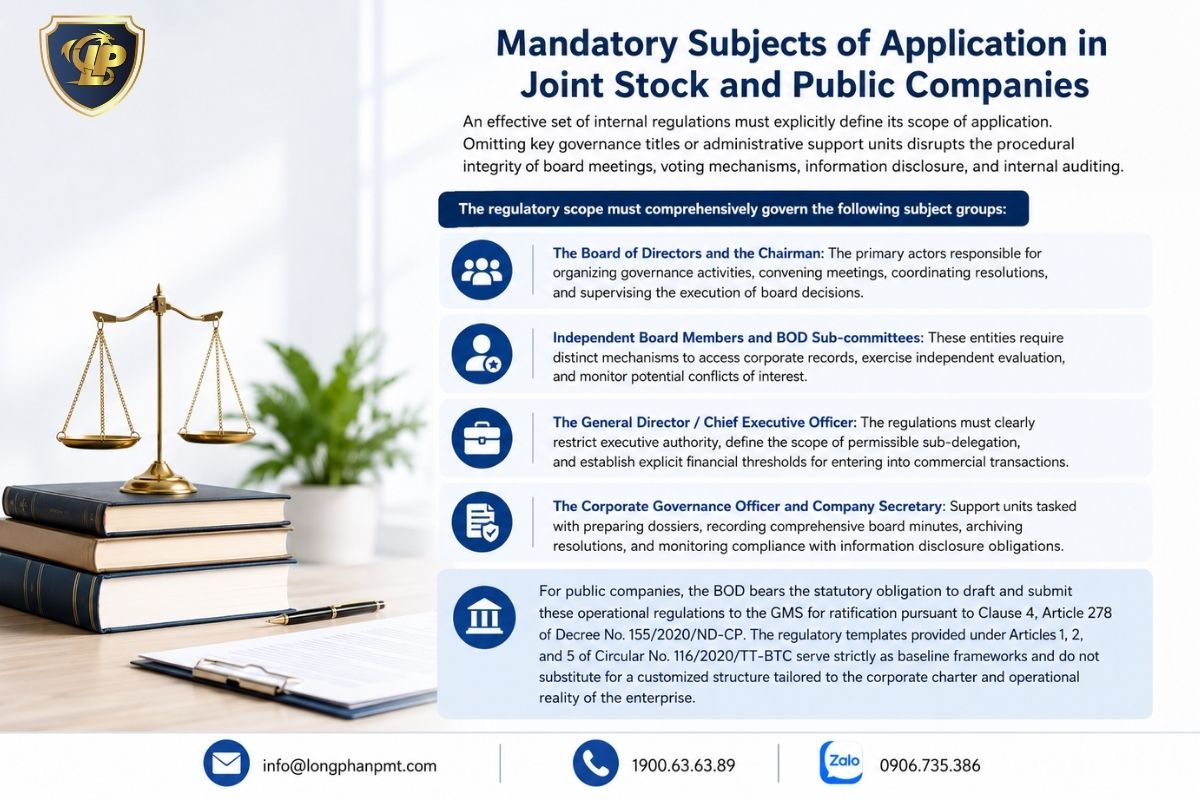
An effective set of internal regulations must explicitly define its scope of application. Omitting key governance titles or administrative support units disrupts the procedural integrity of board meetings, voting mechanisms, information disclosure, and internal auditing.
The regulatory scope must comprehensively govern the following subject groups:
For public companies, the BOD bears the statutory obligation to draft and submit these operational regulations to the GMS for ratification pursuant to Clause 4, Article 278 of Decree No. 155/2020/ND-CP. The regulatory templates provided under Articles 1, 2, and 5 of Circular No. 116/2020/TT-BTC serve strictly as baseline frameworks and do not substitute for a customized structure tailored to the corporate charter and operational reality of the enterprise.
The composition of the Board of Directors directly dictates the quality of corporate oversight, independent debate, and risk management within a Joint Stock Company. A robust set of operational regulations must transform statutory personnel requirements into practical internal mechanisms rather than treating them as mere checklists for elections.
Enterprises must explicitly stipulate the exact size, tenure, and information access rights allocated to each board member. This clear definition forms the legal bedrock for the BOD to supervise the General Director, evaluate financial exposures, and respond immediately to unauthorized actions.
The internal regulations must integrate the following core personnel matters:
For public companies, the regulations must formalize the timeline for nominee dossier submission, independent screening, and pre-meeting disclosures. Candidate information must be disclosed to shareholders at least 10 days prior to the opening date of the General Meeting of Shareholders pursuant to Clause 1, Article 274 of Decree No. 155/2020/ND-CP.
Independent board members provide an essential internal check and balance, especially in companies dominated by controlling shareholders or characterized by frequent related-party dealings. Failing to maintain the statutory ratio of independent members exposes all subsequent board resolutions to objectivity disputes and shareholder litigation.
| Public Company Governance Model | Minimum Statutory Requirement | Legal Basis | Strategic Governance Implication |
| BOD incorporating Non-Executive Members | At least 1/3 of the total board composition must be non-executive directors | Clause 2, Article 276 of Decree No. 155/2020/ND-CP | Enhances direct supervision of the executive team and restricts the concentration of operational power. |
| Model without an independent Board of Supervisors | At least 20% of the total board composition must be independent directors | Clause 4, Article 276 of Decree No. 155/2020/ND-CP | Counterbalances the lack of an external supervisory board by embedding independent control directly into the BOD. |
| BOD under 5 members in a model without a Board of Supervisors | Minimum of 1 independent board member | Clause 4, Article 276 of Decree No. 155/2020/ND-CP | Guarantees an objective check point is maintained even within a streamlined corporate structure. |
| Listed Company with Independent Board Members | Independent members must issue an annual performance evaluation report on the BOD | Clause 3, Article 277 of Decree No. 155/2020/ND-CP | Elevates corporate accountability before public shareholders and capital markets. |
The operational regulations must explicitly detail the distinct powers, obligations, and information access channels dedicated to independent directors. If an enterprise merely replicates statutory percentages in its text without designing specific rights to dissent, request records, or report to shareholders, independent oversight will exist only on paper.
The authority delegation matrix constitutes the core operational engine of the Board of Directors internal regulations. Failing to demarcate explicit financial and administrative boundaries across governance levels directly exposes an enterprise to unauthorized transactions, internal deadlock, and civil liabilities for the signing executive.
While the BOD holds the primary mandate to dictate corporate strategy, outline development paths, and approve critical management matters, it cannot usurp the statutory authority reserved exclusively for the highest corporate body, the GMS.
Enterprises must structurally design their delegation matrix based on transaction types, asset values, and explicit approval thresholds:
| Corporate Governance Event | Deciding Entity or Officer | Regulatory Control Thresholds | Legal Basis |
| Strategic direction, development plans, appointment or dismissal of the General Director/CEO | Board of Directors | Within the standard scope of corporate management | Clause 2, Article 153 of the Law on Enterprises 2020 |
| Loan agreements, lending contracts, asset disposals, and material commercial transactions | BOD (unless exclusively reserved for the GMS) | Equal to or greater than 35% of total asset value, unless a lower threshold is specified in the Corporate Charter | Clause 2, Article 153 of the Law on Enterprises 2020 |
| Internal Regulations on Corporate Governance | GMS (upon formal submission by the BOD) | Mandatory requirement for public companies | Clause 2, Article 270 of Decree No. 155/2020/ND-CP |
| Related-party transactions exceeding statutory control limits | GMS or BOD based on transaction valuation | Transactions valued at 35% or more of total assets must be tightly controlled by the competent authority | Clause 4, Article 293 of Decree No. 155/2020/ND-CP |
| Day-to-day business execution and operational management | General Director / CEO | Within assigned executive powers and strictly adhering to the delegation matrix | Clause 3, Article 162 of the Law on Enterprises 2020 |
Internal regulations must avoid broad phrases such as “the BOD decides all material matters.” Such vague language lacks practical legal enforceability. Companies must quantify administrative boundaries using asset percentages, hard currency caps, and specific transaction categories requiring mandatory board approval.
Power delegation is an operational necessity, but it must not be structured in a manner that allows the General Director/CEO to displace the oversight role of the BOD. Regulations must implement clear definitions regarding which matters can be delegated, their maximum financial values, and mandatory post-execution reporting.
Executive power controls must incorporate the following statutory layers:
If an executive executes an agreement exceeding their authorized threshold or signs a contract without following the proper internal approval sequence, the transaction may be declared null and void by a competent court. In such events, the signing executive, involved board members, or the General Director/CEO can be held personally and jointly liable for damages and forced to return all financial gains to the company pursuant to Clause 5, Article 167 of the Law on Enterprises 2020.

Procedural defects represent the single greatest threat to the validity of Board of Directors resolutions. A resolution that contains flawless business logic can still be rendered legally void if the underlying procedures for convening, voting, or minuting violate statutory requirements, creating severe litigation exposure among shareholders, directors, and executive managers.
The internal regulations must fully standardize the entire lifecycle of a board meeting, from the initial notification to the final adoption of a resolution. The core objective is to construct a clear, legally sound paper trail demonstrating that every corporate decision was validly enacted.
Enterprises should structure their board meeting framework according to the following statutory steps:
The more detailed the internal procedures are regarding meeting steps, the lower the risk that a resolution will be challenged on technical or formal grounds. This procedural precision serves as a vital shield protecting directors when executing corporate decisions.
Board meeting minutes are the central piece of legal evidence used to determine the validity of a board session. If the minutes omit mandatory details or inaccurately reflect the voting positions of individual directors, the enterprise faces substantial internal conflict and regulatory exposure.
Enterprises must enforce strict compliance regarding the creation, signing, and archiving of minutes:
For joint stock structures managing significant asset disposals or high-value foreign investments, meeting minutes are not an administrative formality. They are a binding compliance asset that safeguards corporate accountability and protects shareholder equity.
Enterprises must legally compel board members, the General Director/CEO, and senior managers to transparently disclose their interconnected interests before participating in any corporate decision. This disclosure is the prerequisite to determine voting eligibility and enforce proper recusal.
The operational regulations must codify the following critical compliance obligations:
Furthermore, public companies must absolutely block all loans, credit extensions, or financial guarantees to shareholders and their related parties, except for specific statutory carve-outs:
These exceptions must be interpreted strictly within the regulation text. Granting unauthorized loans or guarantees outside these statutory boundaries constitutes a severe breach of fiduciary duty, triggering immediate personal restitution demands.
For State-Owned Enterprises (SOEs), the regulations must integrate the latest anti-corruption asset transparency mandates. Effective July 1, 2026, senior corporate executives must file supplementary declarations detailing any asset or income fluctuations valued at 1 billion VND or more pursuant to Clause 12, Article 1 and Article 2 of the Law on Amendments to the Anti-Corruption Law (Law No. 132/2025/QH15).
The BOD does not merely rule on corporate strategy; it bears a statutory accountability mandate to the market and its shareholders. The operational regulations must transform reporting duties into structured schedules, standardized forms, and pre-disclosure verification workflows.
The transparency framework must be designed across three corporate layers:
Moreover, all inside information capable of materially impacting stock valuations or enterprise operations must be disclosed accurately, completely, and within statutory timelines pursuant to Clause 1, Article 295 of Decree No. 155/2020/ND-CP. Failure to meet these thresholds exposes the entity to severe enforcement actions, with corporate governance fine caps reaching up to 3 billion VND under Clause 4, Article 132 of the Law on Securities 2019.
Enacting internal Board of Directors regulations must never be approached as a simple template-copying exercise. To ensure operational feasibility and enforceability, an enterprise must construct its governance regulations directly from its Corporate Charter, specific corporate model, structural delegation matrix, and day-to-day transactional risk profile.
The enactment process requires a complete documentary trail spanning from the initial drafting stage through formal approval. For public corporate structures, the BOD carries the statutory mandate to spearhead the drafting process and submit the operational regulations to the GMS for final ratification pursuant to Clause 4 and Clause 6, Article 278 of Decree No. 155/2020/ND-CP.
Enterprises must structure their regulatory enactment process across the following four core phases:
Failing to maintain written consultation records or neglecting to publish the finalized regulations via approved public channels compromises the enforceability of the document, leaving subsequent board resolutions vulnerable to procedural challenges during internal corporate disputes.
A frequent corporate governance failure occurs when an enterprise adopts a visually appealing template that directly conflicts with its Corporate Charter, internal financial rules, and actual management dynamics. Such a mismatch fails to restrict executive overreach while simultaneously inflating the monitoring liabilities of individual board members.
To establish an effective internal control framework, enterprises must quantify exact financial authorization tiers across the following critical transactional groups:
BOD operational regulations only deliver genuine protective value when authority is converted into precise numbers, clear workflows, and personal accountability measures. Without this quantitative clarity, an executive can easily execute unauthorized deals while the board faces regulatory exposure for failing to maintain active supervision.
Corporate governance regulations dictate the legal validity of board resolutions, the scope of executive liability, and the structural safety of corporate transactions. Long Phan Consulting company provides comprehensive legal advisory services to design, audit, and realign corporate regulations with the underlying Corporate Charter, statutory compliance frameworks, and actual management practices.
Our core legal corporate governance capabilities include:
Corporate governance frameworks require precise customization to safeguard management operations and eliminate transaction risks under Vietnamese law. Foreign investors and enterprises are invited to submit their current Corporate Charter, active internal regulations, and corporate structures via Email (info@longphanpmt.com) or Zalo/WhatsApp (+84 906 735 386) for an initial legal evaluation.
Establishing comprehensive “Board of Directors Operating Regulations” helps businesses prevent the risk of abuse of power and tightly control conflicts of interest arising in operational practice. Understanding the limits of authority and compliance deadlines not only protects the legal safety of managers but also ensures that commercial transactions are not declared invalid. The following explanations clarify complex legal situations commonly encountered when operating this governance structure.
A Board of Directors meeting is only valid when at least three-quarters of the total number of members are present. The company may hold the meeting in person, online, or allow members to attend by proxy if approved by a majority of members. Holding the meeting below this standard quorum risks invalidating resolutions passed, as stipulated in Clause 8, Article 157 and Clause 11, Article 157 of the 2020 Enterprise Law.
This transaction requires prior approval from the General Meeting of Shareholders. Specifically, contracts valued at 35% or more of the total asset value as reported in the most recent financial statement between the company and the General Director or related parties are not within the authority of the Board of Directors. The approval procedure for transactions exceeding this threshold is strictly regulated in Point b, Clause 4, Article 293 of Decree No. 155/2020/ND-CP.
Board members are absolutely prohibited from voting on contracts or transactions that benefit themselves or related parties. These transactions must be documented in writing based on the principles of equality and voluntariness. This rule excluding voting rights, aimed at controlling conflicts of interest, is based on Clause 4, Article 291 of Decree No. 155/2020/ND-CP and Clause 1, Article 292 of Decree No. 155/2020/ND-CP.
Public companies are absolutely prohibited from providing loans or guarantees to shareholders and related parties. Such transactions are only permitted in exceptional cases, such as when the company is a credit institution or the shareholder is a subsidiary without state capital contribution prior to July 1, 2015. These exceptions for loan granting must comply with the strict conditions stipulated in Clause 2, Article 293 of Decree No. 155/2020/ND-CP and Clause 3, Article 293 of Decree No. 155/2020/ND-CP.
Board members must declare related interests within 7 working days from the date they arise. In case of any amendments or additions to the interest information, the individual must also notify the company within the same 7 working days. Compensation for personal damages will be applied if the manager violates the deadline for disclosing interests as stipulated in Clause 3, Article 164 of the 2020 Enterprise Law.
Contracts signed without proper authorization or without the proper approval of the Board of Directors will be invalidated by court decision. When a transaction is declared invalid, the General Director and relevant members of the Board of Directors shall be liable to compensate for lost benefits, return any profits earned, and jointly compensate the company for all damages in accordance with Clause 5, Article 167 of the 2020 Enterprise Law.
Board of Directors operational regulations constitute the foundational mechanism required to maintain corporate transparency, restrict executive overreach, and safeguard shareholder equity within a Joint Stock Company. Enterprises must structurally engineer these internal rules to align perfectly with their Corporate Charter, financial delegation matrices, meeting protocols, voting thresholds, related-party transaction controls, and statutory disclosure mandates. Operating under vague authority boundaries or outdated templates directly exposes corporate resolutions and high-value transactions to validity challenges and judicial nullification.
To protect your management operations and align your corporate governance framework with current statutory mandates, contact our Long Phan Consulting Company immediately via Hotline 1900636389 for elite dossier appraisal and structural execution.
📚 This article is provided with professional consultation based on the following legal framework: