
Legal advice and M&A transaction structuring for investors before valuing the target company. Whether it’s equity investment, share purchase, or asset and investment project transfer, each method leads to different legal consequences related to succession obligations, internal approval authority, and transaction completion deadlines. Follow Long Phan Consulting’s legal updates below for a better understanding.
Important legal note:
The following table outlines the legal nature and risk profiles of primary M&A structures in Vietnam:
| Transaction Structure | Legal Nature | Liability Succession Risks | Internal Approval Authority |
| Acquisition of Capital / Shares (Share Deal) | The investor becomes a member or shareholder of an existing economic organization. | Higher: The target entity retains all existing assets, contracts, debts, and operational obligations. | Requires verification of Charters, Rights of First Refusal, and internal resolutions; foreign investors must also satisfy conditions for capital contribution registration under Clause 1, Article 21 of the 2025 Law on Investment. |
| Asset Acquisition (Asset Deal) | The investor purchases specific assets, contracts, or groups of assets. | Lower: Liabilities can be isolated, but risks persist regarding title ownership, mortgages, disputes, and asset-linked licenses. | Large-scale asset transactions must be approved by internal bodies, specifically from 35% of total asset value for Joint Stock Companies (JSCs) pursuant to Point h, Clause 2, Article 153 of the 2020 Law on Enterprises. |
| Investment Project Transfer | The investor acquires an entire project or a specific portion along with the rights and obligations of the previous developer. | Significant: Risks arise if the project involves land-related encumbrances, compensation issues, financial obligations, or third-party disputes. | The project must meet transfer conditions, and the transferee succeeds all rights and obligations pursuant to Clauses 1 and 3, Article 39 of the 2023 Law on Real Estate Business. |
Selecting an inappropriate structure may force the buyer to assume unforeseen obligations or result in signatures from unauthorized parties. Consequently, an effective M&A strategy must be dictated by a comprehensive legal risk map rather than purchase price alone.
Acquiring capital contributions or purchasing shares. This structure is suitable when investors want to control the target business without transferring individual assets. It helps maintain licenses, contracts, and operational structures, but the buyer assumes the inherent risks of the entity.
Investors need to review the rights to sell, the right to buy, restrictions on transferability, and voting ratios before signing a Share Transfer Agreement or a Capital Contribution Transfer Agreement. Ignoring the articles of incorporation, the register of members, the register of shareholders, or shareholder agreements may lead to disputes over disposal rights.
For foreign investors, a share deal is not just a matter of business registration. The transaction may require registration of capital contributions, share purchases, or equity stakes before any changes to members or shareholders occur, especially when it increases the percentage of foreign ownership or involves conditional business sectors.
Buying and selling assets this is suitable when investors want to select valuable assets and limit inherited debt. However, the transaction is only safe when the asset is legally owned, not seized, not disputed, and not bound by any guarantees or obligations to third parties.
For limited liability companies, transactions involving the sale of assets amounting to 50% or more of the total asset value in the most recent financial statement must be approved by the Board of Members in accordance with Point d, Clause 2, Article 55 of the 2020 Enterprise Law. For joint-stock companies, the approval threshold is 35% of the total asset value in accordance with Point d, Clause 2, Article 138 and Point h, Clause 2, Article 153 of the 2020 Enterprise Law.
Project acquisition this creates a higher level of inheritance of obligations than a typical asset deal. The real estate project must have completed land compensation and clearance, not be subject to seizure, and not have any ongoing disputes; if a land allocation or lease decision has been made and financial obligations have been fulfilled, a Certificate of Land Use Rights is not required according to Clauses 1 and 3 of Article 40 of the 2023 Law on Real Estate Business.
For this type of transaction, the authority to approve the project transfer rests with the Prime Minister for projects whose investment policy was decided by the Prime Minister, or with the Provincial People’s Committee for projects whose investment policy was decided by the province, as stipulated in Clause 2, Article 41 of the 2023 Law on Real Estate Business. Transitional provisions should also be reviewed if the transfer application has been submitted but has not yet received a result, as the choice of continuing with the old application or resubmitting it may directly affect the transaction closing schedule.
Foreign investors must not view M&A transactions as a mere matter of signing contracts and transferring funds. The most significant risks reside in market access conditions, Foreign Ownership Limits (FOL), land use rights in sensitive areas, and the mandatory pre-transaction approval sequence.
While “Investment License” is often used colloquially, current legal dossiers must be standardized as an Investment Registration Certificate (IRC) or a written approval for the acquisition of shares or capital contributions. Foreign investors must satisfy specific conditions regarding charter capital ratios, investment forms, scope of activities, and the capacity of Vietnamese partners pursuant to Clause 3, Article 8 of the 2025 Law on Investment.
Pre-Settlement M&A Control Procedures
The regulatory control framework for foreign capital must be integrated into the transaction timeline before any payments are disbursed:
Failure to secure pre-transaction approval can result in frozen capital, delays in updating shareholder status, or the inability to complete enterprise registration changes. Consequently, foreign capital conditions must be treated as a Condition Precedent (CP) in the M&A dossier rather than a post-closing administrative formality.

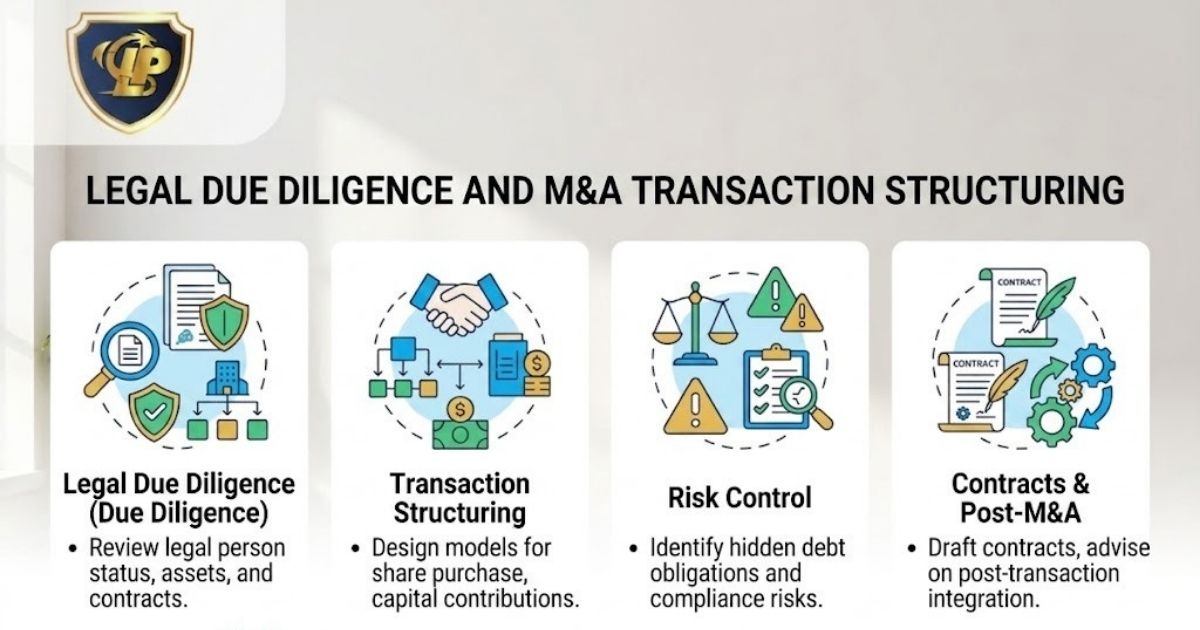
A comprehensive Legal Due Diligence (LDD) report serves as the primary risk-assessment tool before signing a Share Purchase Agreement (SPA) or Conditional Share Purchase Agreement (CSPA). For a sophisticated investor, the purchase price is only reliable when the M&A legal dossier definitively proves capital ownership, asset disposal rights, and post-transaction operational viability.
The scope of review must extend beyond the Enterprise Registration Certificate (ERC). Buyers must simultaneously verify organizational records, charter capital, shareholder history, internal resolutions, material contracts, labor relations, tax compliance, land use rights, intellectual property, sub-licenses, and pending litigation.
To ensure the transaction’s validity, the buyer must verify that the target enterprise maintains a complete archive of corporate governance documents.
Failure to secure proper internal resolutions or signing authority can lead to the nullification of transactions with related parties. In such cases, the signatory and related parties are jointly liable for damages and must return all benefits gained pursuant to Clause 5, Article 167 of the 2020 Law on Enterprises. Furthermore, for groups established before 2015, cross-ownership limits must be reviewed; while non-state-owned companies are not subject to retroactivity for investments made before July 1, 2015, they are prohibited from increasing existing cross-ownership ratios under Clause 1, Article 218 of the 2020 Law on Enterprises.
Land and real estate often underpin the valuation of an M&A deal. However, commercial value is only sustainable when the ownership of housing, construction works, and land use rights has a clear legal basis.
An M&A transaction may be contractually complete but still harbor significant regulatory risks post-closing. Investors must proactively mitigate risks associated with economic concentration (merger control), tax liabilities, and labor succession. Neglecting these obligations can distort valuation models, delay corporate integration, and trigger post-transfer indemnity claims.
In Vietnam, acquisitions or mergers constitute an “economic concentration” when the transaction grants the buyer the ability to control or dominate the target enterprise. Identifying the mandatory notification obligation is crucial to avoiding administrative sanctions after capital disbursement.
Pursuant to Clause 1, Article 13 of Decree No. 35/2020/ND-CP, investors must notify the National Competition Commission (NCC) prior to the transaction if any of the following control thresholds are met:
Transactions falling within the scope of economic concentration (under Clauses 1 and 4, Article 29 of the 2018 Law on Competition) may be prohibited if they cause significant anti-competitive effects, pursuant to Article 30 of the same Law. Failure to notify can result in a fine of up to 5% of the total revenue in the relevant market for the preceding fiscal year, according to Clause 2, Article 111 of the 2018 Law on Competition.
Tax risks in M&A often arise post-closing when tax authorities reassess transfer prices or withholding obligations. Dossiers must be prepared with the following considerations:
A complete M&A legal dossier must substantiate three critical pillars: undisputed ownership of capital or assets, valid transfer authority, and the procedural capacity to update legal status post-closing. This documentation serves as the foundation for fund disbursement and the mitigation of post-transaction liabilities.
Investors should structure their checklist according to the following layers of control:
The SPA must transform risks identified during due diligence into enforceable closing conditions and indemnity triggers. Essential clauses include:
For real estate project transfers, the contract must explicitly detail project parameters, payment schedules, and land-related procedures pursuant to Clause 3, Article 46 of the 2023 Law on Real Estate Business. Furthermore, the transfer agreement serves as the legal instrument for land use right transfers under Clause 6, Article 11 of Decree No. 96/2024/ND-CP.
M&A transactions in Vietnam demand synchronized control over legal structures, foreign capital conditions, corporate records, and merger control mandates. Long Phan Consulting Company assists investors in identifying critical bottlenecks before disbursement, effectively neutralizing dispute risks and preserving deal value. Our specialized advisory services encompass every phase of the transaction lifecycle:
For a preliminary evaluation of your transaction, please submit your target company’s profile and preliminary NDA to our experts via Email: info@longphanpmt.com or WhatsApp/Zalo: +84 906 735 386.

Acquisition transactions always carry the risk of capital flow bottlenecks and compensation disputes if participating organizations disregard specialized regulatory hurdles. Establishing a precise “M&A legal documentation” structure will help investors legitimize their right to dispose of assets and eliminate the risk of contract invalidation. Corporate managers must thoroughly understand the strictest compliance margins regarding approval authority and financial obligations before finalizing a transaction.
The law fully permits foreign investors to make payments in kind instead of cash. The general principle requires all share transfer payments to be made through a capital account; however, the state excludes exceptions for transactions involving payment in kind or other non-cash forms, based on Clause 5, Article 35 of the 2020 Enterprise Law. Investors need to carefully prepare asset valuation documents to legitimize the capital recognition.
Businesses are required to allocate a specific period of time for existing members to exercise their preemptive rights to purchase shares. The time limit for exercising this right is 30 days from the date of the offering of capital contributions, as stipulated in Point b, Clause 1, Article 52 of the 2020 Enterprise Law. If investors disregard this preemptive right, the capital transfer contract signed with a third party will directly face the risk of being declared invalid due to procedural violations.
All asset sales transactions exceeding the materiality threshold must be submitted to the general shareholders’ meeting. Specifically, for joint-stock companies, asset sales contracts must be approved by the general shareholders’ meeting if the amount sold is 35% or more of the total asset value as recorded in the most recent financial statement, based on Point d, Clause 2, Article 138 and Point h, Clause 2, Article 153 of the 2020 Enterprise Law. Those who sign without proper authority will be jointly liable for damages to the enterprise.
The state management agency can fully consider and grant a longer operating period for the target project. In transactions involving the transfer of projects where financial obligations have been fulfilled but the timeframe does not meet the business plan, the state agency will reconsider the timeframe when adjusting the investment policy based on Clause 6, Article 52 of the 2025 Investment Law. Investors should proactively submit long-term financial plans to optimize the transaction.
Businesses engaging in clandestine mergers will face severe administrative penalties from regulatory authorities. The maximum fine for businesses violating regulations on economic concentration is 5% of their total revenue in the relevant market in the preceding fiscal year, as stipulated in Clause 2, Article 111 of the 2018 Competition Law. Investors are required to provide prior notification if their total assets or revenue in Vietnam reach VND 3,000 billion or more.
Investors are required to declare changes in shareholder ownership to the state authorities within a very short time. Specifically, businesses must submit a notification of changes in foreign investor shareholders to the business registration authority within 10 days of the change, as stipulated in Clause 2, Article 31 of the 2020 Enterprise Law. This updating of documents is the final step to legalize the new ownership rights of the buyer.
Transferees are not required to divest from historical cross-ownership structures. Companies without state capital that made capital contributions before July 1, 2015, are not subject to retroactive application, but are absolutely prohibited from increasing the current cross-ownership ratio based on Clause 1, Article 218 of the 2020 Enterprise Law. Management needs to freeze the current capital ratio to prevent the risk of violating enterprise law when designing new cash flows.
A standardized M&A legal dossier is the cornerstone of risk management in corporate reorganizations and acquisitions. Whether navigating foreign ownership limits or complex land-use regulations, investors must prioritize correct transactional structuring and rigorous due diligence to prevent frozen capital or contract invalidity. To secure your investment and ensure a seamless closing, contact our hotline at 1900636389 for specialized support from Long Phan Consulting Company.
📚 This article is provided with professional consultation based on the following legal framework: