
Vietnam food product import licensing services assist businesses in completing legal procedures. This allows legal and effective food product entry into the Vietnam market. Licensing ensures compliance with food safety regulations, quarantine, and quality standards. It also minimizes legal risks, saving time and costs for businesses during customs clearance.

The licensing process for importing food products into Vietnam includes sequential and mandatory steps:
Specific steps are as follows:
Product declaration for imported food is the first and mandatory step for importing this product into Vietnam. Businesses must import product samples before official importation to register the declaration or self-declare with the competent authority.
According to Articles 5 and 7 of Decree 15/2018/ND-CP, the product declaration process is regulated as follows:
1. For product self-declaration procedure:
Required documents include:
Organizations or individuals self-declare products on mass media, their websites, or publicly display them at their headquarters. They also publish on the updated food safety data information system.
If an updated food safety data information system is unavailable, organizations or individuals submit one copy by post or directly to the competent state management agency designated by the provincial People’s Committee. This is for record-keeping and to publish the organization’s/individual’s name and self-declared products on the receiving agency’s website.
2. For product declaration registration procedure:
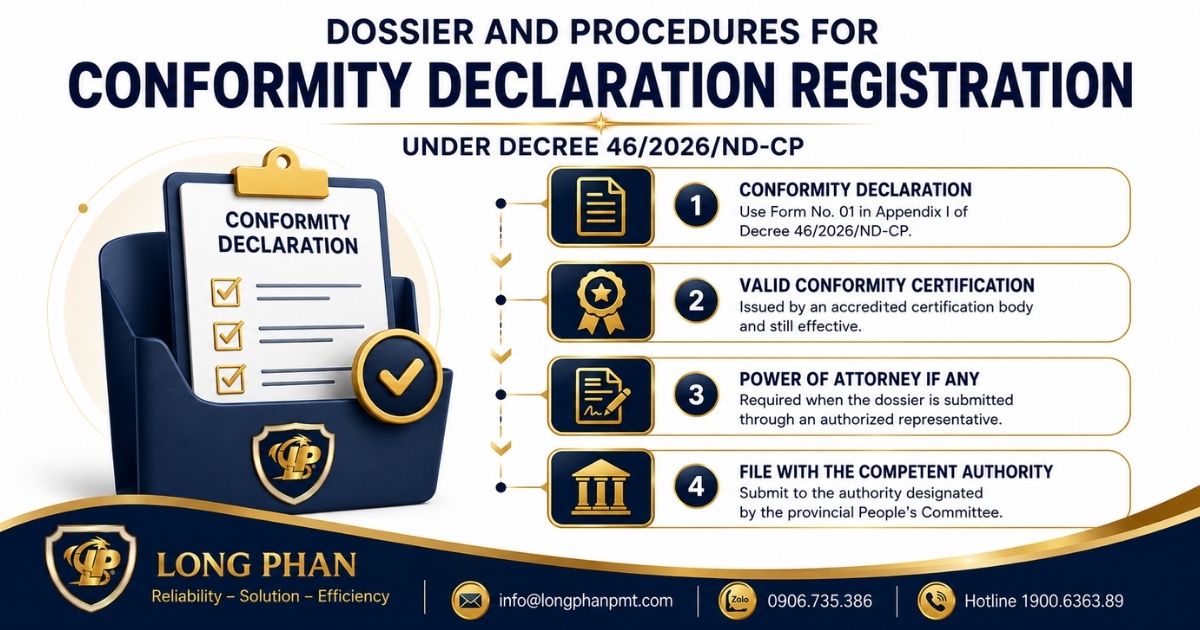
Organizations or individuals need to prepare the following documents:
Organizations or individuals submit dossiers to the competent authority corresponding to each specific case as stipulated in Clause 1, Article 8 of Decree 15/2018/ND-CP (Including: Ministry of Health; Agency designated by the provincial People’s Committee; One of the two aforementioned agencies).
Dossier processing time: 7 – 21 days, depending on the case.
Completing product declaration helps businesses take full responsibility for product quality and safety in the market. This is a key component of Vietnam food product import licensing services.

An import goods quality inspection permit is a mandatory requirement for food imported into Vietnam. Businesses need to submit inspection dossiers before or when goods arrive at the port of entry to ensure a smooth customs clearance process.
Applying for an import goods quality inspection permit is conducted according to Chapter VI of Decree 15/2018/ND-CP, with different inspection methods. State inspection agencies apply reduced inspection for high-standard goods, normal inspection for standard goods, and tightened inspection for high-risk goods.
According to Article 18 of Decree 15/2018/ND-CP, the inspection registration dossier is regulated as follows:
According to Article 19 of Decree 15/2018/ND-CP, the imported food inspection procedure is conducted within specific timeframes: 3 working days for reduced and normal inspection, 7 working days for tightened inspection. The state inspection agency is responsible for examining the dossier and issuing a notification confirming whether the food meets or fails to meet import requirements, using Model No. 05, Appendix I of Decree 15/2018/ND-CP.
Tightened inspection applies to consignments that failed previous inspections, have warnings from competent authorities, or failed to meet requirements during inspection. The consignor submits the notification confirming food meets import requirements to the customs authority to complete customs clearance.
Customs clearance is the final step in the food product import licensing process according to Vietnamese law. Businesses need to prepare a complete set of documents as per Clause 2, Article 16 of Circular 38/2015/TT-BTC, amended by Clause 5, Article 1 of Circular 39/2018/TT-BTC, including:
According to Article 19 of Decree 15/2018/ND-CP, the consignor is responsible for submitting the notification confirming food meets import requirements to the customs authority for customs clearance.
The customs system performs automatic lane assignment with three inspection levels: green lane for immediate clearance, yellow lane for document inspection, and red lane for detailed inspection of both documents and actual goods.
Businesses must fulfill import duty and value-added tax (VAT) obligations according to the declared HS code before goods are cleared. Incorrect HS code declaration can lead to administrative penalties. After completing customs clearance, businesses receive goods at the port and transport them to appropriately compliant storage facilities in preparation for market distribution. Effective management of this stage is part of comprehensive Vietnam food product import licensing services.
>>> See more: Imported foods do mot require a permit

Cases exempt from state inspection for imported food safety are specified in Article 13 of Decree 15/2018/ND-CP, including:
However, these exemptions do not apply if there is a food safety warning from competent authorities. When a food safety warning occurs, all imported food consignments must undergo tightened inspection as regulated to ensure consumer safety.
Businesses need to regularly monitor warning notices from the Ministry of Health, Ministry of Agriculture and Rural Development, and Ministry of Industry and Trade to stay updated on the exemption status of their products. Understanding exemption cases helps businesses save time and costs during legal food importation.
Vietnam food product import licensing services at Long Phan Consulting Company offer comprehensive solutions for businesses navigating these procedures. Our team of experts possesses extensive experience with Vietnamese legal regulations and administrative procedures related to food imports.
Long Phan Consulting Company’s service scope covers three main areas: specialized consultation, dossier preparation, and authorized representation for administrative procedures. We provide consultation on legal regulations, procedural guidance, and solutions for issues arising during food importation. Our dossier preparation service ensures accuracy and completeness as required by each functional agency.
Specialized consultation for Vietnam food product import licensing services includes detailed guidance on legal processes and administrative procedures. Our consultation scope includes:
Long Phan Consulting Company’s experienced consultants analyze each case to offer the most suitable advice, ensuring a smooth and efficient import process.
Preparing dossiers for Vietnam food product import licensing services demands high accuracy and strict adherence to current legal regulations. Long Phan Consulting Company drafts all necessary documents, including:
Authorized representation for administrative procedures within our Vietnam food product import licensing services helps businesses save time and personnel. Long Phan Consulting Company accepts client authorization to execute the entire process, from submitting product self-declaration dossiers to monitoring food safety inspection results. Specifically:
Our services ensure compliance with legal regulations and protect businesses’ legitimate rights. We also help save internal time and resources for clients through our specialized team and effective coordination with state agencies.
The service provision process for Vietnam food product import licensing services at Long Phan Consulting Company is designed professionally and efficiently. It includes the following steps:
Choose Long Phan Consulting Company for your Vietnam food product import licensing services. We have a team of experts experienced in administrative procedures and a deep understanding of food import/export regulations. Long Phan Consulting Company commits to providing high-quality services with a transparent process, fast processing times, and reasonable costs.
The outstanding advantages of Long Phan Consulting Company are extensive practical experience in handling complex cases and the ability to effectively resolve arising issues. We maintain good relationships with functional agencies and regularly update changes in legal regulations to ensure our services are always accurate and timely.
Our consultants are professionally trained and can support clients 24/7 when needed. Long Phan Consulting Company is committed to client information confidentiality and takes full responsibility for the quality of services provided.
Due to these factors, Long Phan Consulting Company has become a trusted partner for many businesses in the food import sector in Vietnam.
Clients can contact us through the channels below to use our Vietnam food product import licensing services:
Below are some questions that may interest you:
Businesses must have business registration with a food-related sector and a certificate of eligibility for food safety before importing. This is a mandatory condition by law.
Testing laboratories must be designated by the Ministry of Health or have ISO 17025 accreditation. Laboratories of state research institutes or universities with food specializations are often recognized.
Functional foods require additional scientific evidence proving their utility, a GMP certificate from the manufacturing facility, and product declaration registration (self-declaration is not permitted). The process is more complex and takes longer.
A Vietnamese sub-label is mandatory. It must include full information about product name, ingredients, expiry date, storage instructions, manufacturer information, and the importing unit. Labels must comply with Circular 24/2019/TT-BYT.
Importing test samples in small quantities suitable for research purposes (usually under 30kg or 100 units) is permitted. Test samples are exempt from state inspection but still require confirmation from the importing organization.
Frozen foods require a continuous cold chain, a health certificate from the exporting country, temperature checks at the port of entry, and HACCP-compliant or equivalent storage facilities.
Vietnam food product import licensing services require a profound understanding of legal regulations and practical experience in handling administrative procedures. Long Phan Consulting Company is committed to accompanying clients in successfully completing all food import procedures quickly, efficiently, and in full compliance with Vietnamese law. Contact our hotline at 1900.63.63.89 for detailed consultation and a quote for professional Vietnam food product import licensing services and other related sub-licenses.