


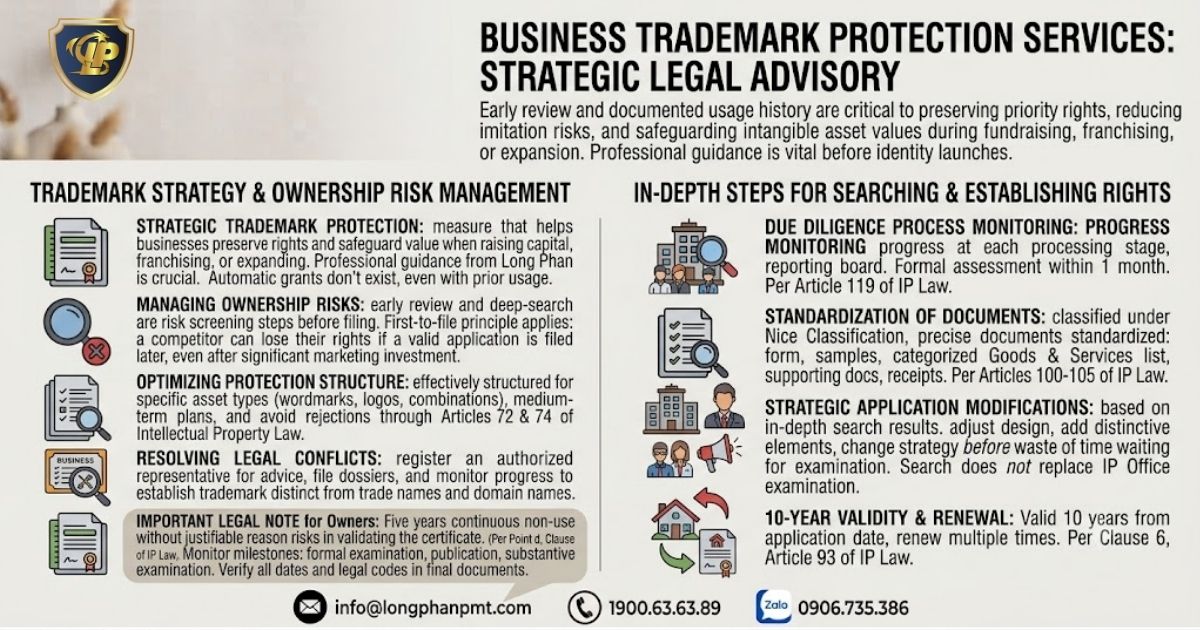
Trademark Protection Services are essential for businesses seeking to secure priority rights, prevent brand copying, and protect intangible asset value during fundraising, franchising, or market expansion. Merely using a company name, logo, or product packaging in commerce does not replace a Trademark Registration Certificate issued by the Intellectual Property Office, especially under the first-to-file rule. Before introducing a brand, businesses should conduct clearance searches, assess registrability, and structure a suitable word mark, device mark, or combined mark strategy with Intellectual Property guidance from Long Phan Consulting.
Important legal note:
Trademark protection is far more than a mere logo registration procedure. It is a strategic mechanism for establishing legal exclusivity over intangible assets before an enterprise engages in fundraising, franchising, or chain expansion. If the boundaries between trademarks, trade names, and domain names are not established early, enterprises risk losing priority rights to competitors who file ahead.
At the management level, risks often stem from three common fallacies:
These assumptions weaken your defensive posture during disputes. For startups, F&B chains, cosmetics, education, fashion, and technology sectors, delayed filing can significantly erode intellectual property valuations.
Enterprises should file for trademark protection during the initial stages of developing names, logos, and brand identity sets. Waiting for “business stability” before registering allows competitors to file for identical or confusingly similar signs. Protection is only granted to valid applications with the earliest filing or priority date in cases where multiple applications conflict. This rule is established under Clause 1, Article 90 of the 2005 Law on Intellectual Property (as amended in 2009).
Actual market usage does not automatically create legal safety for a trademark. Trademark rights are established through the issuance of a Certificate, except in cases of well-known trademarks, pursuant to Point a, Clause 3, Article 6 of the 2005 Law on Intellectual Property (as amended in 2019). Commercial risks involve the high costs of rebranding, product recalls, distribution channel disruption, and loss of investor confidence. Consequently, priority rights must be viewed as a strategic asset rather than an auxiliary administrative task.
Enterprises must distinguish between a “brand” in a business sense and the objects protected by intellectual property law. Enterprise Registration Certificates, domain names, and trademarks do not create identical scopes of protection. Differentiating between company names, trade names, and trademarks is a vital risk-control layer before launching any identity.
| Subject | Mechanism for Right Establishment | Key Scope of Protection |
| Trademark | Primarily established via the Certificate of Trademark Registration issued by the IP Office. | Protects signs used to distinguish goods or services of different entities, per Clause 16, Article 4 of the 2005 Law on Intellectual Property (amended 2009). |
| Trade Name | Established based on lawful usage; no separate registration procedure required. | Protects the name of an organization or individual in business operations, per Clause 21, Article 4 and Point b, Clause 3, Article 6 of the 2005 Law on Intellectual Property. |
| Domain Name | Does not substitute for a trademark registration certificate. | Bad-faith registration or usage of domain names identical or confusingly similar to trademarks may constitute unfair competition, per Point d, Clause 1, Article 130 of the 2005 Law on Intellectual Property (amended 2022). |
This comparison demonstrates that registering a company name does not secure trademark rights. Enterprises launching chains or executing large-scale advertising campaigns must audit trademarks, trade names, and domain names simultaneously before investing in brand identity.
An effective protection strategy must stem from the asset structure, not just a logo design. Wordmarks offer a broader margin of defense, as competitors can change the visual design while still exploiting the name or similar pronunciation.
Businesses should consider structuring their protection according to the following layers of identification:
These signs can only be protected if they are capable of distinguishing the goods and services of a business from those of other entities. The conditions regarding visible signs, sounds expressed in graphic form, and distinctiveness are stipulated in Clause 1, Article 72 of the 2005 Intellectual Property Law, as amended in 2022. Businesses should also avoid signs that are descriptive, overly simplistic, or identical or similar to already protected trademarks. The risk of rejection is controlled through Article 74 of the 2005 Intellectual Property Law, as amended in 2022.
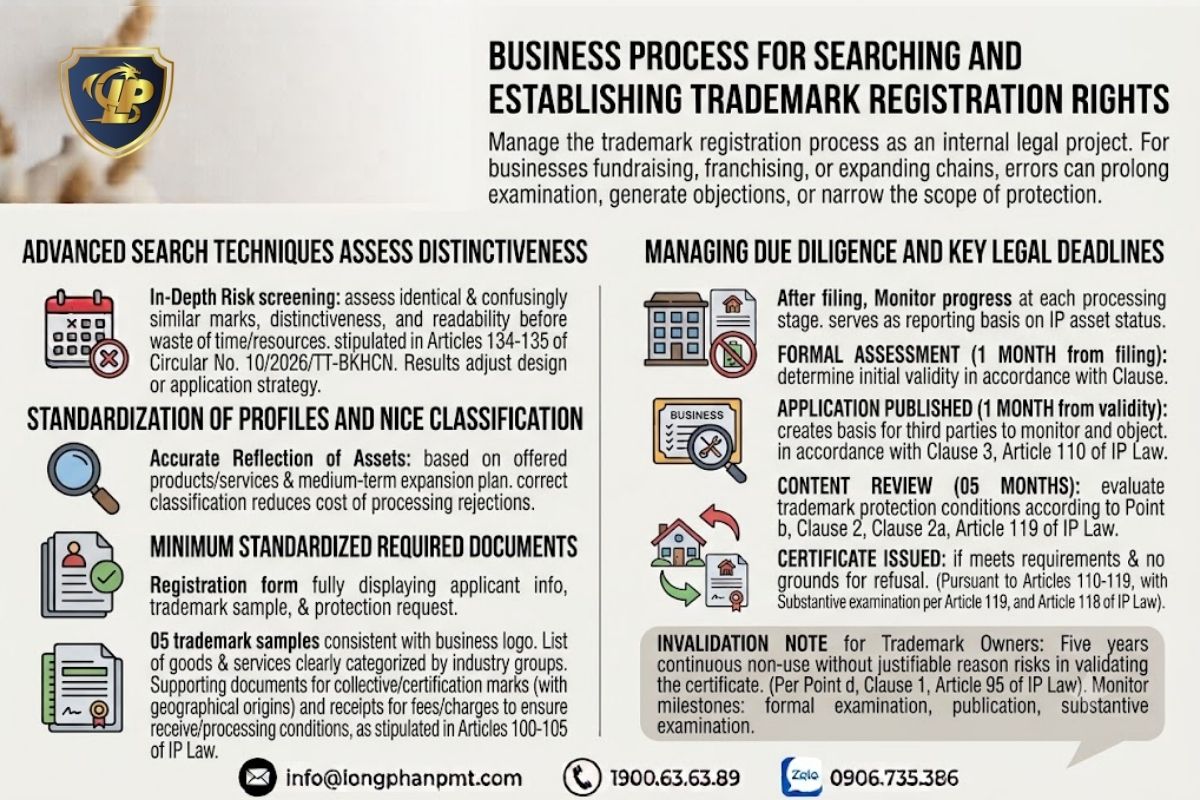
The trademark registration process should be managed as an internal legal project, not a single filing operation. For businesses preparing to raise capital, franchise, or expand their chain, errors in the search and classification stages can prolong the examination time, generate objections, or narrow the scope of protection.
A key control point is correctly identifying the trademark to be protected, the class of goods, the class of services, and the potential for conflict with previously filed applications. This approach helps businesses protect their priority rights and reduce the cost of processing rejections after filing.
In-depth research is a risk screening step before filing an application. Businesses need to assess both identical and confusingly similar trademarks, their readability, presentation, and related goods and services categories. The law allows businesses to access and conduct their own searches in public databases or use search and analysis services provided by state agencies. This mechanism is stipulated in Articles 134 and 135 of Circular No. 10/2026/TT-BKHCN.
The search results do not replace the examination decision of the Intellectual Property Office. However, they serve as a basis for adjusting the trademark design, adding distinctive elements, or changing the application strategy before wasting time waiting for examination.
The registration application must accurately reflect the assets and trademarks that the business wishes to protect. Classification according to the Nice Classification must be based on the products and services being offered and the medium-term expansion plan.
The minimum required documents should be standardized as follows:
The requirements for documents, trademark samples, lists of goods and services, and fee and charge certificates are set out in Articles 100 and 105 of the 2005 Intellectual Property Law, as amended and supplemented in 2022, and Clause 1, Article 70 of Circular No. 10/2026/TT-BKHCN.
After filing the application, businesses need to monitor the progress at each processing stage. This serves as the basis for reporting to the management board, investors, or franchise partners on the status of intellectual property assets.
The evaluation process should be managed in the following steps:
The milestones for formal examination, publication of applications, and substantive examination are established in Clause 3, Article 110 of the 2005 Intellectual Property Law, as amended and supplemented in 2022, and Article 119 of the 2005 Intellectual Property Law, as amended and supplemented in 2009.
The trademark registration certificate is valid 10 years from the date of application and can be renewed multiple times, according to Clause 6, Article 93 of the 2005 Intellectual Property Law. This applies if the trademark is not used continuously for 5 years. Without justifiable reason, the certificate risks being invalidated according to Point d, Clause 1, Article 95 of the 2005 Intellectual Property Law, as amended and supplemented in 2022.
>> See more: Extending the validity of Trademark Registration Certificate
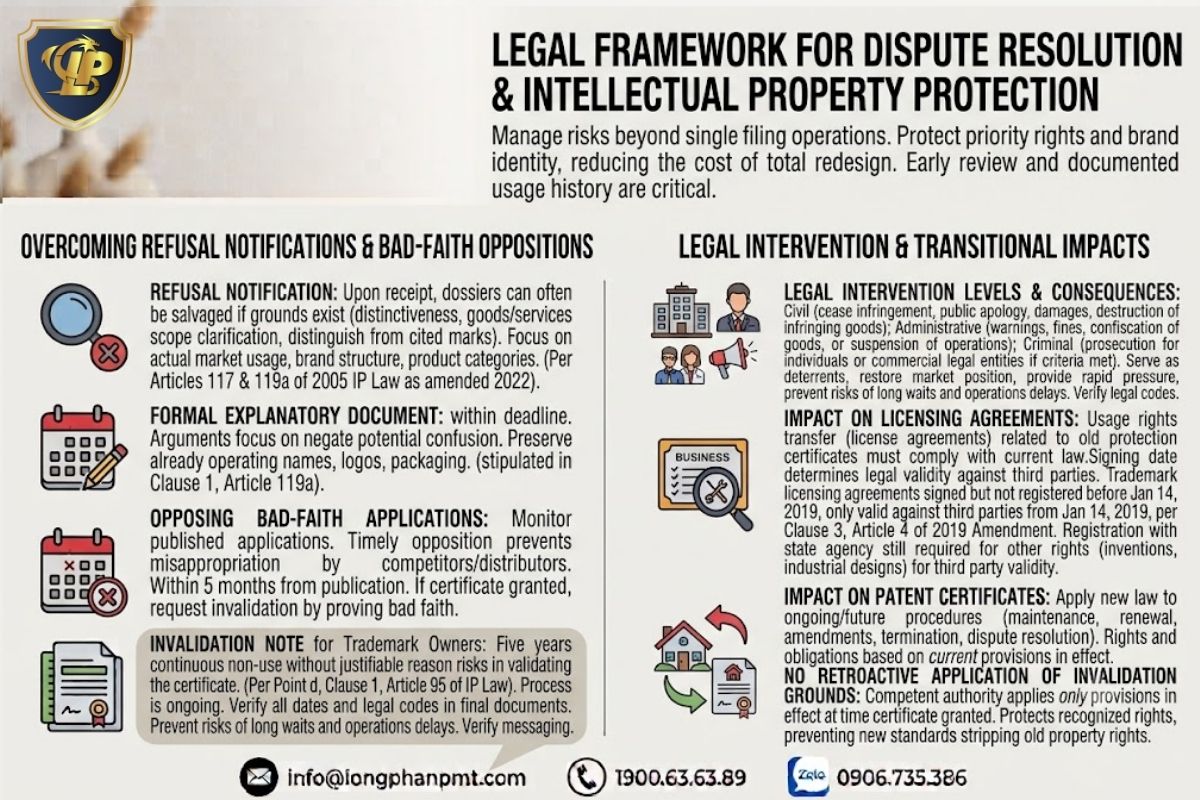
Trademark protection risks often extend beyond mere application rejections. Enterprises frequently face opposition proceedings, bad-faith filings, or disputes arising from licensing contracts. An effective strategy must be built upon a robust evidentiary foundation, a documented history of brand usage, and a clear understanding of the legal status of each application. Failure to respond promptly can result in the loss of priority rights or necessitate expensive litigation after significant market investment.
Upon receiving a notification of intended refusal, enterprises should not perceive this as a final judgment. Dossiers can often be salvaged if there are viable grounds to argue for distinctiveness, clarify the scope of goods and services, or distinguish the application from cited marks.
Enterprises must prepare a formal explanatory document within the deadline set by the IP Office. Arguments should focus on actual market usage, brand identity structure, product categories, and factors that negate potential confusion. This process is governed by Article 117 and Clause 1, Article 119a of the 2005 Law on Intellectual Property (as amended in 2022). The commercial value of this step lies in preserving the names, logos, and packaging already in operation, thereby minimizing the costs of total brand redesign across the enterprise.
Enterprises must monitor published applications to identify competitors, distributors, or third parties attempting to misappropriate their brands. Timely opposition can prevent bad-faith applicants from being granted protection.
Third parties have the right to oppose the granting of protection within five months from the date the trademark application is published in the Industrial Property Gazette, per Point a, Clause 1, Article 112a of the 2005 Law on Intellectual Property (as amended in 2022). If a certificate has already been issued, enterprises may request the invalidation of the entire validity period by proving the applicant’s bad faith, per Point a, Clause 1, Article 96 of the 2005 Law on Intellectual Property (as amended in 2022).
| Intervention Level | Key Legal Consequences | Commercial Impact |
| Civil | Cease infringement, public apology, damages, destruction of infringing goods. | Restores market position and mitigates losses from counterfeit goods. |
| Administrative | Warnings, fines, confiscation of goods, or suspension of business operations. | Provides rapid pressure to halt violations. |
| Criminal | Prosecution for individuals or commercial legal entities if criteria for criminal liability are met. | Serves as a significant deterrent against severe infringement. |
Businesses that own patents or participate in industrial property rights transfer transactions (licensing agreements) through various amendments to the Intellectual Property Law need to pay particular attention to reviewing their legal status based on transitional provisions. These changes in legislation create distinct impacts as follows:
Impact on Patent Certificates for protection certificates granted under previous legal regulations, the transitional mechanism applies the principle of separation between “current rights and obligations” and “grounds for past certificate granting”:
Impact on Licensing Agreements(Transfer of usage rights) The procedure for transferring the usage rights of industrial property objects (license agreements) related to old protection certificates must comply with current legal regulations. However, businesses need to carefully review the signing date to determine the legal validity against third parties, especially trademark usage agreements.
Trademark protection requires the integration of asset strategy, legal documentation, and dispute resolution expertise. Long Phan Consulting Company approaches these challenges by prioritizing risk prevention before enterprises commit to identity launches, capital raises, franchising, or market expansion. The law permits enterprises to legally authorize an industrial property representative organization to provide advice, file dossiers, and protect their interests during the rights establishment process.
The initial stage identifies which assets require protection versus those serving purely commercial purposes. Misstructured portfolios may result in wasted registration costs without providing a defense against copying. We assist enterprises in the following critical tasks:
These results empower management to determine which assets to file immediately, which to adjust, and which to maintain as contingency trademarks.
Once the protection structure is determined, the filing stage requires strict control over trademark samples, service categories, and fee documentation. Errors here may prolong examination timelines or trigger revision notices. Long Phan Consulting Company represents enterprises in:
Authorized representation minimizes the risk of missing notifications, critical deadlines, or strategic adjustment opportunities.
Trademark disputes often emerge after significant market investment. Legal responses must be swift, evidence-based, and aligned with specific business goals. We support clients in:
For a preliminary evaluation of your project dossier, please send your construction permits, as-built drawings, and acceptance minutes via Email: info@longphanpmt.com or Zalo/WhatsApp: +84 906 735 386 to Long Phan Consulting Company.
“Understanding the legal risks and procedures for protecting intellectual property is a prerequisite for all businesses in today’s competitive environment. Issues related to establishing rights, resolving disputes, and managing the validity of protection certificates directly affect the security of trademarks and the commercial value of businesses. Below are key points to help businesses proactively protect their industrial property rights.”
Businesses need to register their trademarks because the Business Registration Certificate does not replace trademark ownership rights. Trademark rights are only established through a decision to grant protection by a state agency based on the first-to-file principle, not automatically acquired through actual use. Failure to register a trademark carries the risk of third parties misappropriating ownership rights, even if the business has been using the trade name previously. This is based on Point a, Clause 3, Article 6 of the 2005 Intellectual Property Law (amended and supplemented in 2019).
Businesses must immediately review their application and submit written explanations and rebuttals to the Intellectual Property Office regarding the reasons for refusal within the timeframe set by the agency. If the application is not corrected or the explanation is unsatisfactory, leading to a formal refusal decision, the business has the right to appeal or file a lawsuit against that decision in a competent court to protect its rights. This is based on Article 117 and Clause 1 of Article 119a of the 2005 Intellectual Property Law (amended and supplemented in 2022).
The law applies the first-to-file principle, so protection certificates are only granted to the valid application with the earliest filing date. When multiple parties file applications for identical or confusingly similar trademarks, the later-filed application will be rejected, even if the business has been operating stably beforehand. Businesses that file late face the risk of having to change their brand identity, destroy their products, or buy back the right to use the trademark from a competitor who has already registered it. This is based on Clause 3, Article 6 of the 2005 Intellectual Property Law.
Businesses are required to use their trademarks continuously to maintain the validity of their protection certificates. If a trademark is not used by the owner or licensee for five consecutive years without a valid reason, the certificate risks being terminated by another party. Use through a licensing agreement with a third party is also recognized as trademark use. This is based on Point d, Clause 1, Article 95 of the 2005 Intellectual Property Law (amended and supplemented in 2022).
Third parties have the right to file objections to the granting of a trademark registration certificate within 5 months from the date the application is published in the Industrial Property Gazette. The management agency will consider the arguments and evidence from the objector before deciding whether to grant or refuse the registration certificate to the competitor. Furthermore, if it can be proven that the competitor registered with malicious intent, the aggrieved party has the right to request the cancellation of the certificate after it has been granted. This is based on Clause 1, Article 112a and Point a, Clause 1, Article 96 of the 2005 Intellectual Property Law (amended and supplemented in 2022).
Securing trademark protection in Vietnam is a critical strategic imperative for safeguarding your intangible assets and ensuring the long-term commercial viability of your brand. Relying on an official Certificate of Trademark Registration is the only reliable way to preemptively defend your market position against bad-faith filings and identity misappropriation. By effectively auditing your trademark structure and aligning it with your growth objectives, you secure the legal foundation necessary for safe fundraising, franchising, and expansion. Do not leave your brand vulnerable to competitors due to administrative delays or incomplete IP strategies. For professional counsel and to ensure your trademark portfolio is fully protected, contact Long Phan Consulting Company today via our hotline at 1900636389.
📚 This article has been professionally reviewed based on the following legal documents:


