


From July 1, 2026, the suspension of construction contract performance is governed by the 2025 Law on Construction and Decree No. 210/2026/ND-CP, replacing Decree No. 37/2015/ND-CP, which is no longer effective. Long Phan Consulting notes an important new point: the parties now have an additional ground for suspension where the counterparty fails to perform its contract security obligations, while the requirements for written notice and a maximum notice period of 28 days remain mandatory to avoid being deemed in breach. This article on construction consulting explains the cases in which suspension of construction contract performance is permitted, the legally compliant procedure, and the legal consequences of suspending performance without proper grounds.

Important Notes:
Suspension of construction contract performance is where a party stops performing part or all of its work under the contract when a statutory ground arises, without terminating the contract’s validity. It is a lawful self-protection measure available to the aggrieved party, applied alongside the right to claim damages or to terminate the contract if the breach is not remedied.
Construction Law 2025 and Decree No. 210/2026/ND-CP set out three groups of grounds for suspension: breach by the contractor, breach by the employer, and objective events beyond the parties’ control. Each group has its own conditions and timeframes, so businesses need to identify the correct ground before issuing a suspension notice.
The employer may suspend the contract where the contractor seriously breaches quality, labor safety, or construction progress requirements, or fails to perform its committed contract performance guarantee obligation. The applicable grounds are Clause 1, Article 85 of Construction Law 2025, covering breaches of quality, progress, and safety. A further ground is Article 83 of Construction Law 2025 combined with Article 13 of Decree No. 210/2026/ND-CP, covering breach of the contract performance guarantee obligation. In practice, this typically covers a contractor that fails to renew its performance guarantee after the original guarantee has expired. It also covers a contractor that builds contrary to the approved design without remedying the breach after a written reminder.
The contractor may suspend the contract where the employer fails to pay the agreed value of a payment milestone for more than 28 days from the payment due date. This ground is set out at Point a, Clause 2, Article 26 and Point 1, Clause 4, Article 28 of Decree No. 210/2026/ND-CP, unless otherwise agreed in the contract. The contractor may also suspend where the employer fails to perform its contract performance guarantee obligation under Article 83 of Construction Law 2025 and Article 13 of Decree No. 210/2026/ND-CP. Examples include the employer failing to hand over sufficient construction site area, or failing to pay a committed advance-payment guarantee.
Beyond contractual breaches, either party may suspend the contract where a force majeure event directly affects performance of the work. Suspension is also available where a competent state authority requests it for reasons of construction safety, national defense, security, or the public interest. The applicable grounds are Clauses 3 and 4, Article 85 of Construction Law 2025. For this group, the maximum 28-day notice period does not apply mandatorily, since force majeure events are typically unforeseeable at the time performance ends.
>>>See more: Process for Claiming Damages Due to Breach of Construction Contracts

A party seeking suspension of construction contract performance must follow the correct notice procedure under Article 26 of Decree No. 210/2026/ND-CP to avoid being treated as unilaterally breaching the contract. The four steps below apply generally to every ground for suspension, unless the contract sets out a more detailed procedure.
The suspending party must send a written notice to the other party, specifying the legal grounds and the actual facts giving rise to the suspension. The notice is important evidence in the event of a later dispute, so it should accurately reference the relevant contract clauses and the applicable legal provisions.
The notice period is as agreed by the parties in the contract but must not exceed 28 days, except in cases of force majeure. Where the contract does not specify a period, the parties should apply the 28-day cap as the limit to avoid the risk of the notice being treated as invalid.
During the suspension, the suspending party remains responsible for cooperating in protecting the works, materials, and equipment already brought to the construction site, under Article 85 of Construction Law 2025. This helps avoid additional damage that would increase liability later.
After giving notice of suspension, the parties are responsible for actively negotiating to remedy the cause and resume performing the contract as agreed, under Article 26 of Decree No. 210/2026/ND-CP. This step helps limit the need to move to contract termination, which carries greater legal consequences and cost for both parties.
| Party Entitled to Suspend | Applicable Ground | Legal Basis |
| Employer | Contractor breaches quality, labor safety, or progress requirements | Clause 1, Article 85, Construction Law 2025 |
| Employer or Contractor | The other party fails to perform its contract performance guarantee obligation | Article 83, Construction Law 2025; Article 13, Decree No. 210/2026/ND-CP |
| Contractor | Employer delays payment by more than 28 days from the due date | Point a, Clause 2, Article 26; Point 1, Clause 4, Article 28, Decree No. 210/2026/ND-CP |
| Both Parties | Force majeure event or request from a competent state authority | Clauses 3 and 4, Article 85, Construction Law 2025 |
Decree No. 210/2026/ND-CP significantly expands the scope of grounds for suspension of construction contract performance compared to the former Decree No. 37/2015/ND-CP. It also links the right to suspend more closely to the contract performance guarantee regime, a point the previous regulations did not clearly address.
A party’s failure to submit, renew, or maintain the validity of its contract performance guarantee is now an independent ground for the other party to suspend the contract. This follows Article 83 of Construction Law 2025 and Article 13 of Decree No. 210/2026/ND-CP. There is no need to wait for a breach of quality or progress to arise. This is a new ground that the now-expired Decree No. 37/2015/ND-CP did not separately regulate.
From the effective date of Decree No. 210/2026/ND-CP, Decree No. 37/2015/ND-CP on construction contracts, Decree No. 50/2021/ND-CP amending Decree No. 37/2015/ND-CP, and Article 9 of Decree No. 35/2023/ND-CP all simultaneously ceased to be effective. Businesses should review the suspension clauses in their standard contract templates to update them in line with the new legal grounds, and avoid referencing expired instruments in newly signed contracts.
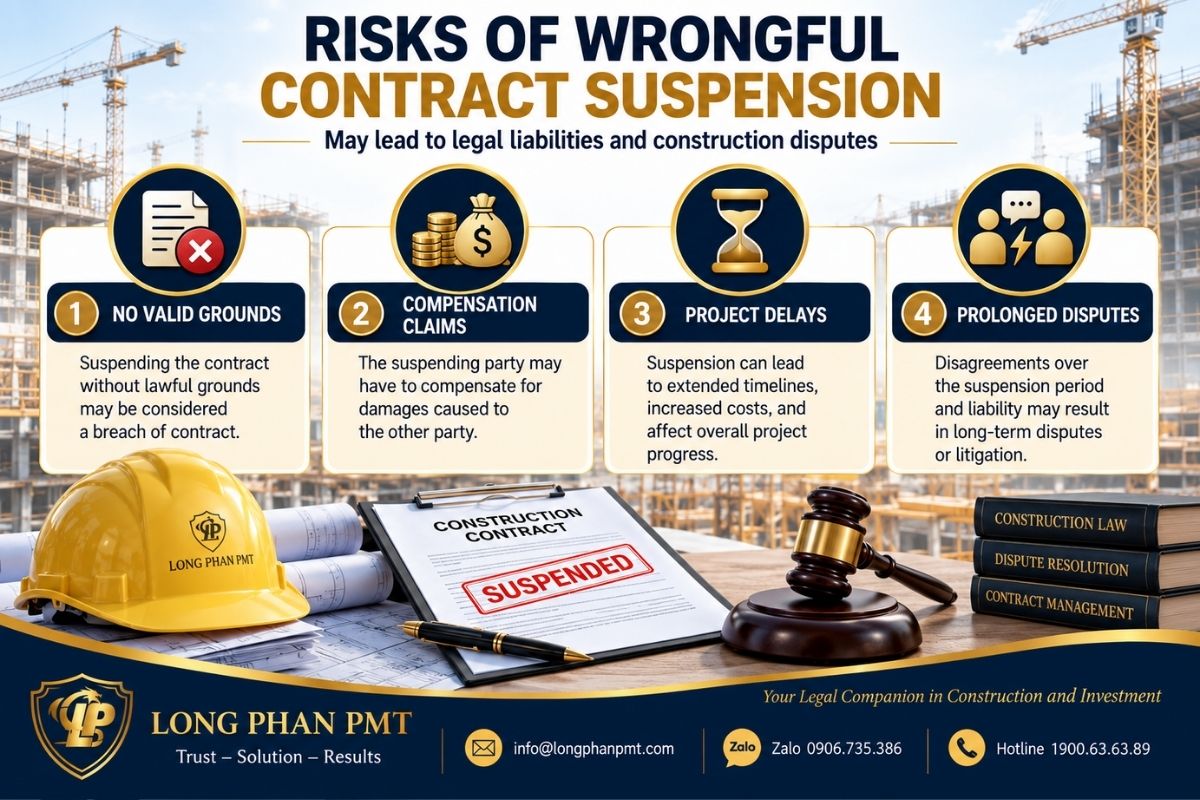
Improper suspension of construction contract performance on an incorrect ground or through an incorrect procedure does not release the suspending party from its contractual liability. It instead gives rise to an additional obligation to pay damages and a risk of prolonged disputes.
Under Clause 2, Article 86 of Construction Law 2025, the suspending party must pay damages for the actual loss suffered by the other party. This applies where it fails to give notice, or where the reason for suspension is inconsistent with the contract. Losses may include idle machinery and labor costs, costs arising from delayed progress, or reputational damage affecting related contracts.
The choice of method for resolving a construction contract dispute under Clause 5, Article 86 of Construction Law 2025 is as agreed by the parties. The parties may apply a dispute adjudication board model consistent with international practice. During dispute resolution, the parties must continue performing the obligations relating to the unaffected part of the work. Exceptions apply for force majeure, a request from a competent authority, or a valid ground for suspension under Points a and b, Clause 2, Article 26 of Decree No. 210/2026/ND-CP.
Long Phan Consulting provides comprehensive support to enterprises in handling suspension of construction contract performance matters under the new regulations:
Clients may send their case documents via email at [info@longphanpmt.com](mailto:info@longphanpmt.com) or via Zalo at 0906.735.386 for a preliminary assessment.
Below are common practical situations enterprises encounter when applying the new regulations on suspension of construction contract performance.
Yes, if the delay constitutes a serious breach under Clause 1, Article 85 of the 2025 Law on Construction and the contract links the progress obligation to the payment obligation. The employer must still provide written notice stating the reason before suspending payment to avoid being considered in breach itself.
No. The notice period is agreed by the parties in the contract but may not exceed 28 days, except in cases of force majeure under Article 26 of Decree No. 210/2026/ND-CP. The parties may agree on a shorter period but may not extend it beyond this limit.
No. Suspension is only a temporary measure relating to the business suspension procedure or the performance of work. The contract remains in effect, and the parties are responsible for negotiating the resumption of performance under Article 26 of Decree No. 210/2026/ND-CP. Only if the breach is not remedied after the suspension period may the parties consider terminating the contract under Article 27 of Decree No. 210/2026/ND-CP.
Failure to provide notice, or suspending for reasons inconsistent with the contract, does not in itself result in an administrative penalty, but it may give rise to an obligation to compensate the other party for damages under Clause 2, Article 86 of the 2025 Law on Construction. The amount of compensation is determined based on the actual damages arising from the improper suspension.
Decree No. 210/2026/ND-CP contains transitional provisions in Article 33 for construction contracts signed before the Decree took effect. Enterprises should compare the specific transitional provisions with the date on which the suspension event arose and the contents of the executed contract. Where the applicable legal instrument remains unclear, Long Phan Consulting can review the matter on a case-by-case basis.
From July 1, 2026, the suspension of construction contract performance is governed by the 2025 Law on Construction and Decree No. 210/2026/ND-CP, with a notable new ground for suspension relating to contract performance security obligations. To properly exercise the right of suspension and avoid compensation risks, enterprises should carefully review the applicable legal grounds before issuing a notice. Long Phan Consulting provides consulting and support for construction contract suspension matters via Hotline 1900636389.
📚 This article has been professionally reviewed based on the following legal documents:


