


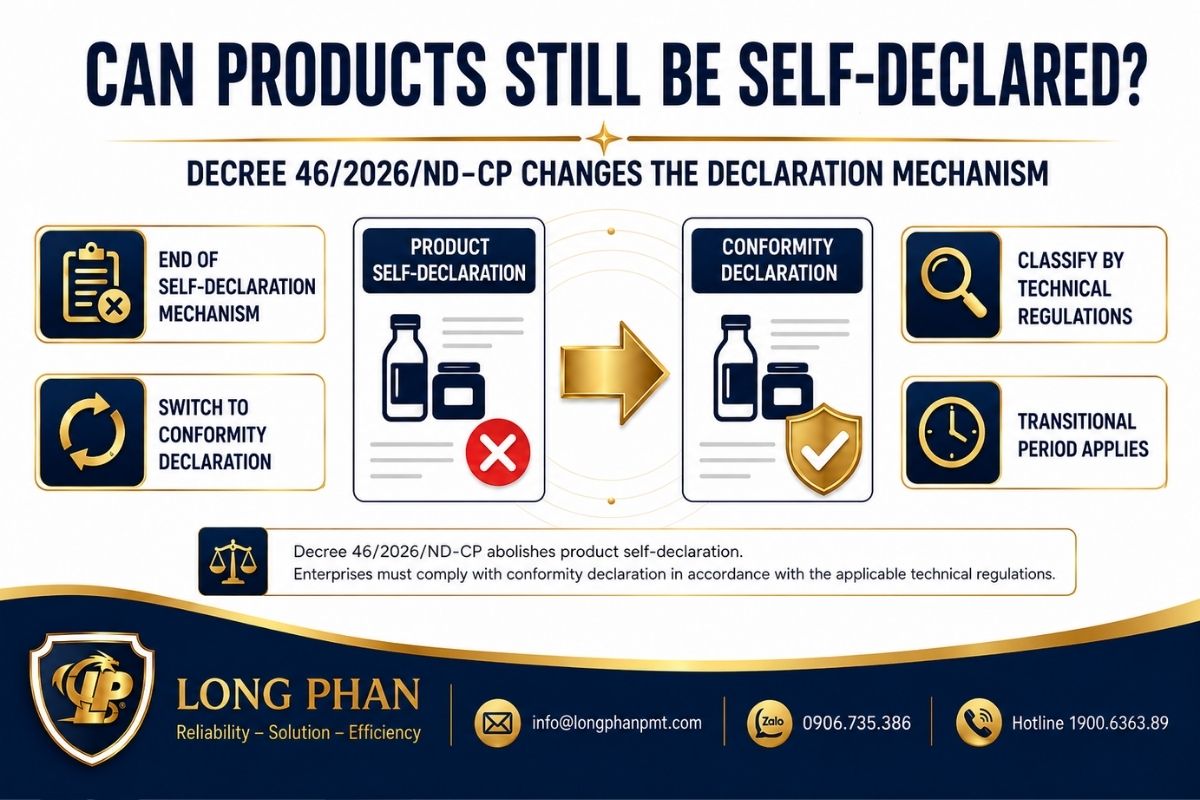
Long Phan Consulting updates clients on self-declaration of food products, one of the most significant shifts in Vietnam’s food safety framework in years. From 26 January 2026, Decree 46/2026/ND-CP fully replaced Decree 15/2018/ND-CP, ending the self-declaration mechanism long relied on by tens of thousands of food businesses. The question raised most often today is whether self-declaration of food products remains available, and if not, which conversion procedure applies. Enterprises that also need support with their Business Registration filings during this transition may find it useful to review the analysis below. It is prepared by Long Phan Consulting on the new mechanism, required dossiers, transition deadlines, and legal risks under Decree 46/2026/ND-CP and Resolution 66.13/2026/NQ-CP.
Important legal notice:
Decree 46/2026/ND-CP shifts the regulatory philosophy from post-market inspection to pre-market inspection for food groups with applicable technical regulations. Businesses no longer self-certify and sell immediately after filing, as under the previous mechanism. Instead, the competent authority must receive and publicly disclose the dossier before the product may be sold. Before reviewing the specific dossier requirements, businesses must first determine which category their product falls into.
Under Article 4 of Decree 46/2026/ND-CP, organizations and individuals must register a conformity declaration for food products subject to a national technical regulation on quality or safety criteria. This covers pre-packaged processed food, food additives, food processing aids, and food-contact packaging and utensils.
This requirement applies only where the product already has a corresponding national technical regulation and an accredited certification body capable of issuing conformity certification. If no technical regulation or no suitable certification body exists yet, the product is not subject to conformity declaration registration under Decree 46/2026/ND-CP. Instead, it follows the applicable standard declaration procedure or product declaration registration procedure under Resolution 66.13/2026/NQ-CP, discussed in the transition section below.
Previously, under Clause 1, Article 4 of Decree 15/2018/ND-CP, tools, materials, and packaging in direct contact with food were treated as a self-declared product group, without a separate management mechanism from other food categories.
Decree 46/2026/ND-CP fundamentally changes this approach. Food-contact packaging and utensils must now register a conformity declaration (Article 4), fall under state inspection for food safety (Article 20), and are managed by provincial People’s Committees regarding food safety conditions (Article 51). There is no longer a separate self-declaration mechanism for food-contact packaging and utensils, a change that packaging manufacturers should note early.
Comparison: Self-Declaration Under Decree 15/2018 vs. Conformity Declaration Registration Under Decree 46/2026
| Criteria | Decree 15/2018/ND-CP (self-declaration) | Decree 46/2026/ND-CP (conformity declaration registration) |
| Mechanism | Business self-declares and self-certifies responsibility | Registration; authority receives and publicly discloses the dossier |
| When trading is allowed | Immediately after self-declaration | After the dossier is disclosed by the receiving authority |
| Main dossier components | Self-declaration form, test result certificate | Conformity declaration (Form No. 01, Appendix I), conformity certification result, power of attorney (if any) |
| Receiving authority | State authority under decentralized jurisdiction | Authority designated by the provincial People’s Committee where headquartered |
| Dossier validity | Nearly indefinite, until changed | Maximum 3 years (Article 6), updated when the technical regulation changes |
The conformity declaration registration procedure has two main components: preparing the dossier according to the prescribed form, and filing it with the correct receiving authority based on the business’s registered location.
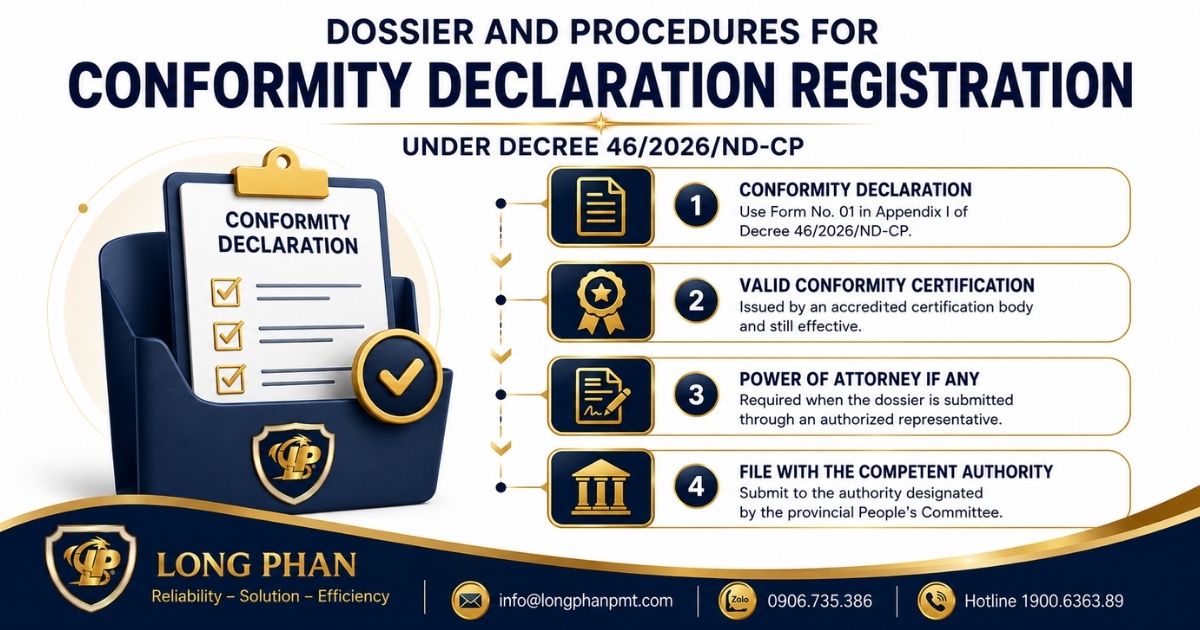
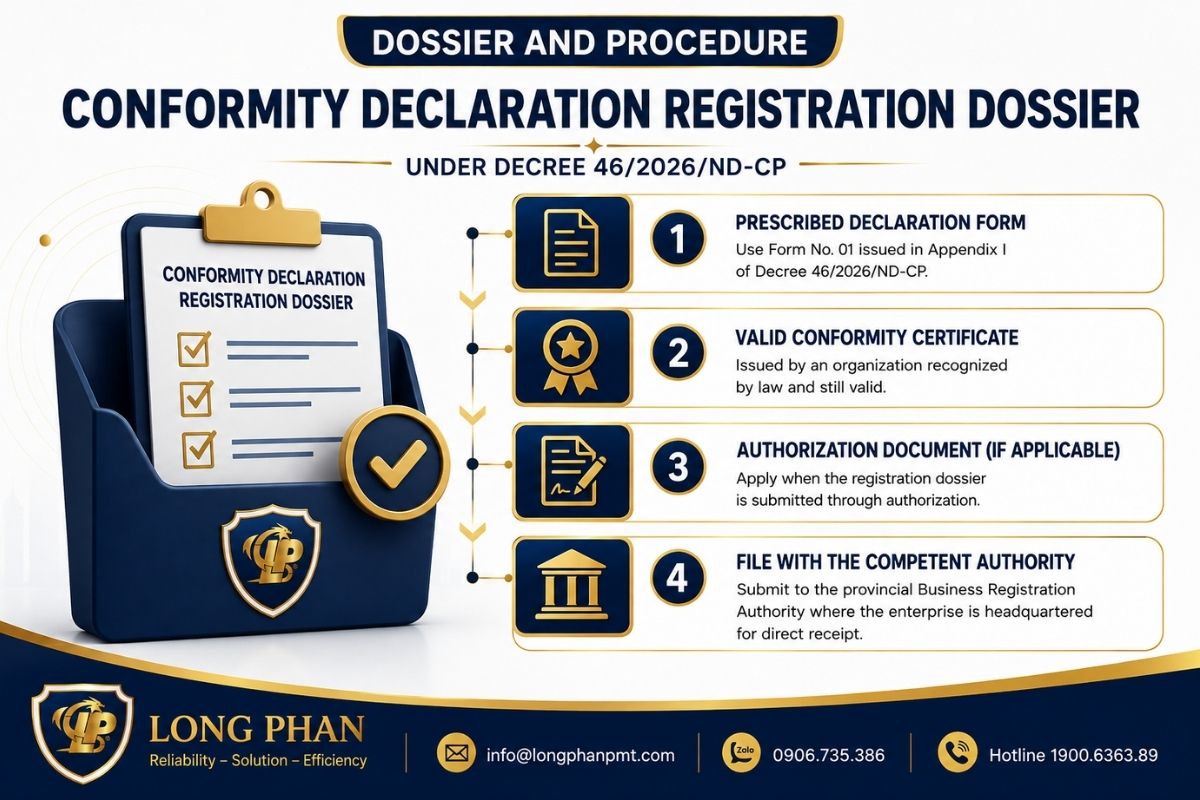
Under Clause 1, Article 5 of Decree 46/2026/ND-CP, the conformity declaration registration dossier includes:
Under Point a, Clause 2, Article 5 of Decree 46/2026/ND-CP, businesses submit one dossier set through one of three channels: online, postal service, or direct submission to the competent authority. The online channel covers the National Public Service Portal, the National Single Window Portal, and ministerial or provincial administrative procedure information systems. The competent authority is designated by the provincial People’s Committee where the business is headquartered. Businesses with multiple business locations may choose to file at one of their registered locations.
Within 10 days of receiving the dossier, the receiving authority must publicly disclose the name of the organization or individual and the accepted product on its own portal and on the provincial People’s Committee’s portal. Businesses selling on e-commerce platforms are also responsible for disclosing their valid conformity declaration registration dossier for the product.
The conformity declaration is valid for a maximum of 3 years under Article 6 of Decree 46/2026/ND-CP. When the applicable technical regulation for the product changes, businesses must re-certify conformity under the new regulation and redo the conformity declaration registration procedure.
This is the biggest concern for businesses still holding self-declaration dossiers under Decree 15/2018/ND-CP: whether existing products must be re-filed immediately, and how long the conversion period lasts. The specific deadline depends on whether the product falls under the conformity declaration registration track or the applicable standard declaration and product declaration registration track.
Products self-declared before 26 January 2026 that fall under a technical regulation follow the conformity declaration registration track of Decree 46/2026/ND-CP. Under Clause 1, Article 54, businesses may continue manufacturing, trading, and importing the product until registration is completed. They must complete this registration within 12 months from the effective date of Decree 46/2026/ND-CP. Because Decree 46/2026/ND-CP officially took effect again from 16 April 2026 after its suspension period, the 12-month period is counted from that date, meaning the deadline falls before 16 April 2027.
This also covers product declaration registration dossiers filed before 27 January 2026, products already issued a Certificate of Receipt of Product Declaration Registration, and supplementary foods transitioning from self-declaration to product declaration registration. Under Clause 1, Article 15 of Resolution 66.13/2026/NQ-CP, businesses must complete the product declaration registration dossier within 24 months from 27 January 2026. After this transition period expires, the old self-declaration dossier or Certificate of Receipt is no longer valid for manufacturing or importing.
Not every food product follows the conformity declaration registration track under Decree 46/2026/ND-CP. Resolution 66.13/2026/NQ-CP separately governs pre-packaged processed food, food additives, processing aids, and food-contact packaging and utensils that do not yet have a corresponding national technical regulation or a suitable certification body. It also covers specific groups: micronutrients, health protection food, medical nutrition food, food for special dietary uses, supplementary food, and nutritional products for children.
For these groups, the applicable procedure is applicable standard declaration or product declaration registration under Resolution 66.13/2026/NQ-CP, not conformity declaration registration under Decree 46/2026/ND-CP. Businesses must confirm which track their product falls under before preparing the dossier, since filing under the wrong track is a common reason dossiers are returned or processing is delayed.
Late conversion is not limited to the risk of administrative penalties. It also directly affects a business’s right to continue manufacturing and selling its products on the market.
The transition period is 12 months for the conformity declaration registration group under Clause 1, Article 54 of Decree 46/2026/ND-CP, or 24 months for the group under Clause 1, Article 15 of Resolution 66.13/2026/NQ-CP. After it expires, the old self-declaration dossier or Certificate of Receipt is no longer valid for manufacturing, trading, or importing. Products sold after this point without a valid conformity declaration or product declaration are considered a violation of food product declaration regulations.
Penalties currently apply under Decree 115/2018/ND-CP, as amended and supplemented by Decree 124/2021/ND-CP, on administrative violations in food safety. Fine levels depend on the specific violation, with remedial measures such as mandatory change of use, reprocessing, or destruction of the product. The Ministry of Health is currently drafting a replacement decree with higher maximum penalties, but since it has not yet been issued, Decree 115/2018/ND-CP, as amended, remains the applicable basis for penalties.
In practice, dossiers are commonly returned or delayed for three reasons. First, the conformity certification result comes from a certification body that is not accredited. Second, the business files under the conformity declaration registration track when the product actually falls under the applicable standard declaration track under Resolution 66.13/2026/NQ-CP. Third, the power of attorney is missing mandatory content required under Article 7 of Decree 46/2026/ND-CP. Each rejection means the business must refile from the beginning. This extends the time to market and directly affects delivery schedules under contracts already signed with distribution partners.
Long Phan Consulting supports food businesses in converting within the applicable deadline under Decree 46/2026/ND-CP and Resolution 66.13/2026/NQ-CP. Its services include: Reviewing the list of self-declared products and classifying them by whether a technical regulation already applies, to determine the correct procedural track. Determining the specific transition deadline, 12 months or 24 months, for each product group and preparing a prioritized conversion plan. Preparing and reviewing conformity declaration registration dossiers or applicable standard declaration dossiers according to the prescribed forms. Assisting with contacting accredited conformity certification bodies and working directly with the local receiving authority. Monitoring appraisal progress and handling supplementary dossier requests from the receiving authority.
Enterprises, clients, or investors seeking a preliminary assessment may send their documents via email at info@longphanpmt.com or Zalo/WhatsApp at +84 906 735 386.
When does Decree 46/2026/ND-CP take effect? Decree 46/2026/ND-CP was issued and took effect on 26 January 2026. However, its application was later suspended under subsequent Government resolutions. Currently, under Resolution 15/2026/NQ-CP, Decree 46/2026/ND-CP remains suspended until the amended Law on Food Safety and its implementing decree take effect. During this period, Decree 15/2018/ND-CP and its related guiding documents continue to apply.
No. The transitional mechanism under Decree 46/2026/ND-CP should not yet be applied to require businesses to redo their dossiers, because this decree is currently suspended. During the suspension period, businesses continue to follow Decree 15/2018/ND-CP and should monitor new legal documents to determine when and how to convert their dossiers once the new mechanism officially takes effect.
Processing of an already-filed dossier must be based on the regulation in force at the time the competent authority resolves it. Because Resolution 66.13/2026/NQ-CP is also currently suspended under Resolution 15/2026/NQ-CP, businesses should not automatically apply the 24-month transition period without first checking the regulation in force at the time the procedure is carried out.
While Decree 46/2026/ND-CP remains suspended, the applicable procedure for food-contact packaging and utensils continues to be determined under Decree 15/2018/ND-CP and related specialized regulations. Businesses should avoid applying the conformity declaration registration mechanism under Decree 46/2026/ND-CP in advance of its official return to effect.
The validity period of a conformity declaration must be determined under the law actually in force at the time the procedure is carried out. The 3-year maximum period under Decree 46/2026/ND-CP should not yet be applied while this decree remains suspended.
The competent authority and filing method must be determined under the legal mechanism currently in force. Since Decree 46/2026/ND-CP remains suspended, businesses should not rely solely on Article 5 of this decree to determine where to file, and should instead check Decree 15/2018/ND-CP and the regulations of the competent specialized authority.
Penalties can only be determined once a business has an obligation to carry out the procedure under a regulation currently in force but fails to do so, or does so incorrectly. Because Decree 46/2026/ND-CP is currently suspended, the exact obligation for each product type must first be confirmed under Decree 15/2018/ND-CP and the applicable food safety penalty regulations before concluding that a violation applies.
Decree 46/2026/ND-CP ended the self-declaration mechanism relied on for nearly 8 years. It is replaced by conformity declaration registration for food groups with applicable technical regulations, and by applicable standard declaration or product declaration registration under Resolution 66.13/2026/NQ-CP for groups without one. Businesses should review their self-declared product portfolio now and confirm the applicable transition deadline, 12 months or 24 months, to avoid disruption once it expires. Clients seeking specific advice on self-declaration of food products are welcome to contact Long Phan Consulting via hotline 1900636389 for prompt support.
📚 This article has been professionally reviewed based on the following legal documents:


