


Initiating retail operations without a Retail Distribution License for FDI in Vietnam exposes foreign investors to severe compliance risks, including operational suspension and wasted commercial lease expenditures. A Foreign-Invested Enterprise cannot legally sell goods based solely on its Investment and Enterprise Registration Certificates. Corporate executives must clearly secure a Business License for distribution rights and a distinct Retail Outlet Setup License for physical storefronts, in accordance with the Law on Commerce 2005, Law on Investment 2025,…. Proving market access, financial capacity, and strict tax compliance is mandatory before you [apply for a Retail Distribution License in Vietnam]. To help multinational clients navigate this dual-licensing framework, mitigate Economic Needs Test hurdles, and ensure seamless market entry, Long Phan Consulting Company outlines the precise legal conditions and approval procedures below.
Important legal notice:
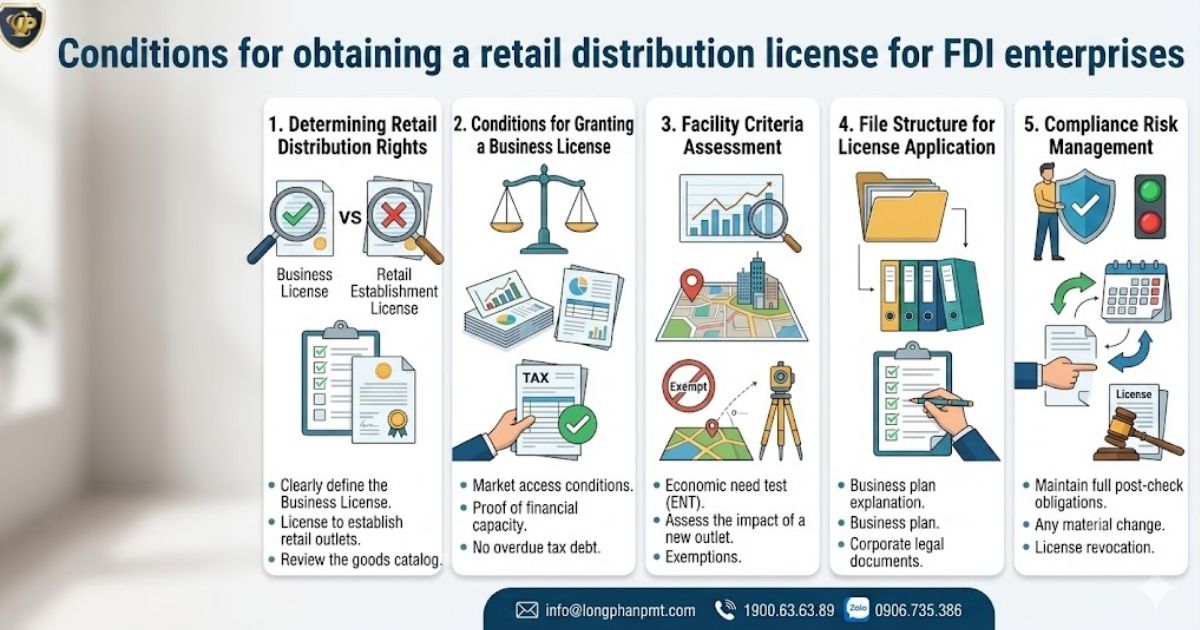
Foreign Direct Investment (FDI) Enterprises must identify the correct licensing tier before importing goods, executing commercial leases, or announcing store openings. Conflating distribution rights with the right to establish a physical retail outlet causes launch delays, sunk lease costs, and severe cash flow disruptions.
Holding an Investment Registration Certificate (IRC) and Enterprise Registration Certificate (ERC) does not automatically authorize a Foreign-Invested Enterprise to execute full retail operations. Corporate clients must strictly separate general distribution rights from the legal right to operate specific physical retail locations.
| Criteria | Business License | Retail Outlet Setup License |
| Legal Nature | Authorizes a Foreign-Invested Enterprise to exercise retail distribution rights in Vietnam. | Authorizes the establishment and operation of a specific location. “A retail outlet is a location for conducting retail activities” pursuant to Clause 8, Article 3 of Decree No. 09/2018/ND-CP. |
| Applicability | Retail Distribution License for FDI Enterprise exercising retail distribution rights, pursuant to Clause 1, Article 5 of Decree No. 09/2018/ND-CP. | Required when opening a store, showroom, minimart, supermarket, Commercial Center, or direct sales point, pursuant to Clause 3, Article 5 of Decree No. 09/2018/ND-CP. |
| Application Timing | Must be secured before the enterprise engages in any retail distribution activity. | Typically executed after securing a Business License and holding valid commercial lease documents. |
Enterprises cannot freely open supermarkets relying solely on an IRC and ERC. Each physical retail outlet requires an independent assessment regarding its specific license, location, zoning compliance, and operational model. For the First Retail Outlet located in the same province or municipality as the corporate head office, enterprises may submit applications for both licenses simultaneously. This mechanism is codified in Clause 4, Article 5 of Decree No. 09/2018/ND-CP.
Filing concurrently accelerates administrative timelines but does not dilute strict statutory appraisal conditions. Foreign Investors must completely finalize their financial plan, location dossier, and registered goods list before committing to binding lease expenditures.
The registered goods list dictates the licensing scope, the requisite explanatory depth, and additional specialized sub-licenses. Misclassifying HS codes or proposing restricted products can trigger the licensing authority to demand a complete revision of your corporate business plan.
Enterprises must strictly classify and evaluate the following product categories:
Securing a Business License does not replace specialized sub-licenses for strictly regulated goods. Enterprises must simultaneously satisfy dual compliance layers: the foreign investor’s distribution rights and product-specific commercial trading conditions. Foreign Investors must finalize this goods list review before executing imports, signing distribution contracts, or designing store layouts.
FDI Enterprises should only execute import plans or launch sales channels after fully evaluating licensing conditions. The licensing authority simultaneously evaluates the investor’s nationality, the registered goods list, the financial plan, and tax compliance history.
Licensing conditions vary across foreign investors. The appraisal depth depends strictly on Vietnam’s market opening commitments and the nature of the proposed goods.
| Investor Group | Core Conditions | Risks to Control |
| Investors from countries or territories with market access commitments | Must satisfy Market Access Conditions, possess a solid financial plan, and hold no Overdue Tax Debts if operating for 01 year or more. Pursuant to Point c, Clause 1, Article 9 of Decree No. 09/2018/ND-CP. | Applications may face delays if the goods scope misaligns with commitments or the financial plan lacks feasibility. |
| Investors from countries without commitments or distributing uncommitted goods | In addition to financial and tax requirements, the enterprise must explain compliance with specialized laws, job creation potential, budget contributions, and competitive impacts. Pursuant to Clauses 2 and 3, Article 9 of Decree No. 09/2018/ND-CP. | Licensing authorities exercise a broader appraisal scope, particularly concerning local economic benefits and impacts on domestic enterprises. |
Hailing from a member state with WTO, CPTPP, and EVFTA Commitments does not guarantee unrestricted retail rights for all products. Enterprises must simultaneously cross-reference investor nationality, commitment scopes, and management policies for each product group. The explanatory dossier must clearly demonstrate investment scale, supply chain mechanics, labor demand, and state budget contributions.
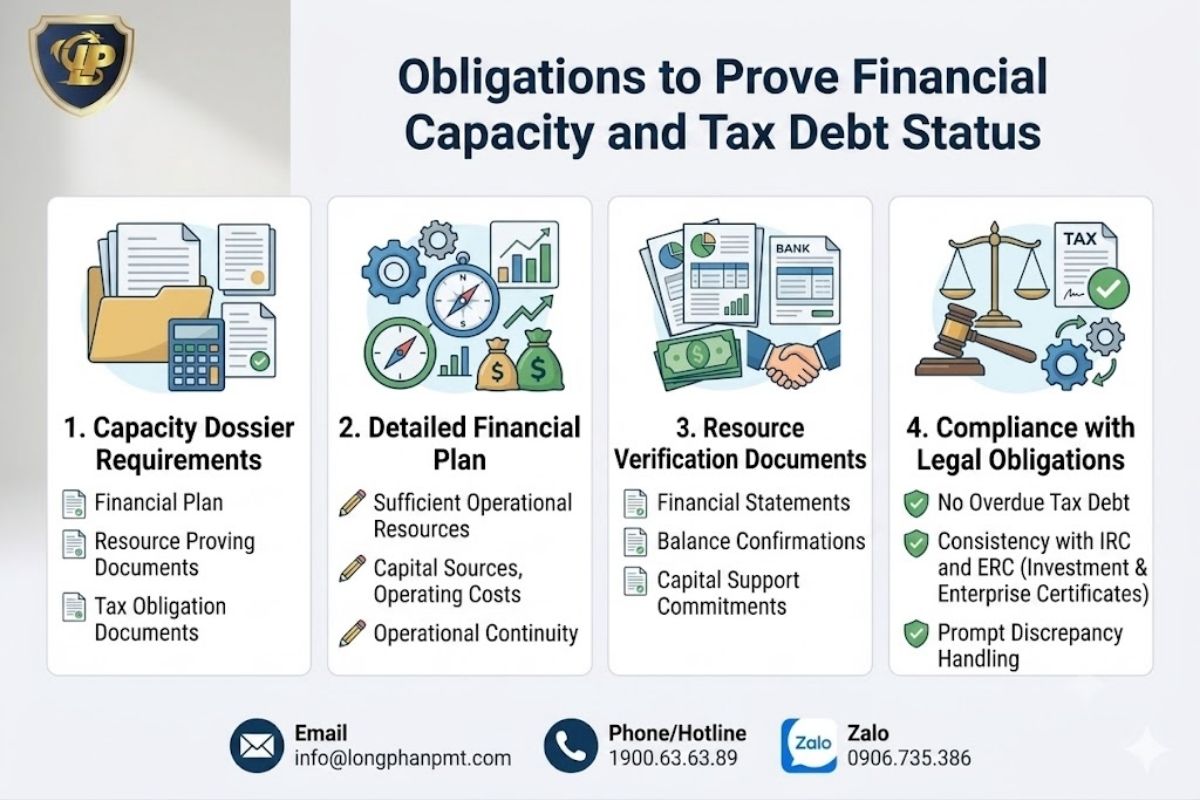
The financial plan must demonstrate the enterprise holds sufficient resources to sustain retail operations throughout the initial phase. The licensing authority typically assesses the consistency between investment capital, import costs, commercial leases, personnel, and projected revenue.
Enterprises must standardize the following document groups:
The 01-year threshold is calculated based on the enterprise’s establishment and operational status in Vietnam, irrespective of the intended store opening date. Unresolved tax dossiers can stall the entire licensing progress. Before submission, enterprises must reconcile tax liabilities, financial statements, and contributed capital. Resolving discrepancies early mitigates the risk of multiple explanatory rounds and protects launch timelines.
Opening physical retail points carries high risk. Enterprises frequently must commit to lease deposits and renovation costs before receiving licenses. Foreign Investors must meticulously appraise locations, store structures, and the potential application of an Economic Needs Test (ENT) before executing long-term commercial leases.
The First Retail Outlet is exempt from an Economic Needs Test (ENT). However, it remains subject to strict appraisals regarding corporate finance, tax compliance, and location suitability. A Business License does not automatically validate the legal right to operate a specific store. Enterprises must satisfy the following core conditions:
These standards are established under Clause 1, Article 22 of Decree No. 09/2018/ND-CP. Failing a single condition can delay licensing despite substantial site investments. Foreign Investors should insert license-contingency clauses into commercial lease agreements. This mechanism mitigates financial losses if locations fail zoning checks or applications are rejected.
Establishing Subsequent Retail Outlets typically requires passing an Economic Needs Test (ENT). This constitutes a stringent assessment of the new sales point’s impact on local markets and developmental conditions. The ENT Council evaluates the following critical criteria:
These criteria are mandated under Clause 2, Article 23 of Decree No. 09/2018/ND-CP. ENT dossiers lacking robust market data or thorough impact assessments frequently trigger multiple explanatory rounds.
Enterprises obtain ENT exemptions if the premises span less than 500 square meters, locate within a Commercial Center, and do not operate as a Convenience Store or Minimart. All three conditions must be satisfied concurrently under Clause 1, Article 23 of Decree No. 09/2018/ND-CP. Foreign Investors must finalize location strategies prior to lease negotiations. Altering physical dimensions or business models post-signing drastically increases costs and shatters chain expansion plans.
The licensing application must demonstrate absolute consistency across registered business lines, investment objectives, goods, financial resources, and the retail location. A minor discrepancy between the Investment Registration Certificate (IRC), Enterprise Registration Certificate (ERC), and the explanatory statement can delay launch timelines and trigger multiple supplementary rounds.
Foreign Investors must separate the Business License application from the Retail Outlet Setup License dossier. Each set serves a distinct appraisal scope and must accurately reflect the practical operational model.
The core dossier checklist includes:
Business License dossiers are regulated under Article 12 of Decree No. 09/2018/ND-CP. Retail Outlet Setup License dossiers follow Article 27 of Decree No. 09/2018/ND-CP.
Enterprises must identify the precise submission authority for each license type. Filing at the incorrect jurisdiction disrupts store opening schedules and extends non-revenue generating commercial lease periods.
Corporate clients should control the execution process through these steps:
The Department of Industry and Trade (DOIT) holds authority to issue, amend, and revoke Business Licenses pursuant to Clause 1, Article 8 of Decree No. 09/2018/ND-CP. Authority regarding Retail Outlet Setup Licenses is defined in Clause 2, Article 8 of this Decree. Enterprises must allocate contingency time for explanations and physical appraisals. Launch plans should only be finalized after explicitly confirming the licensed scope.
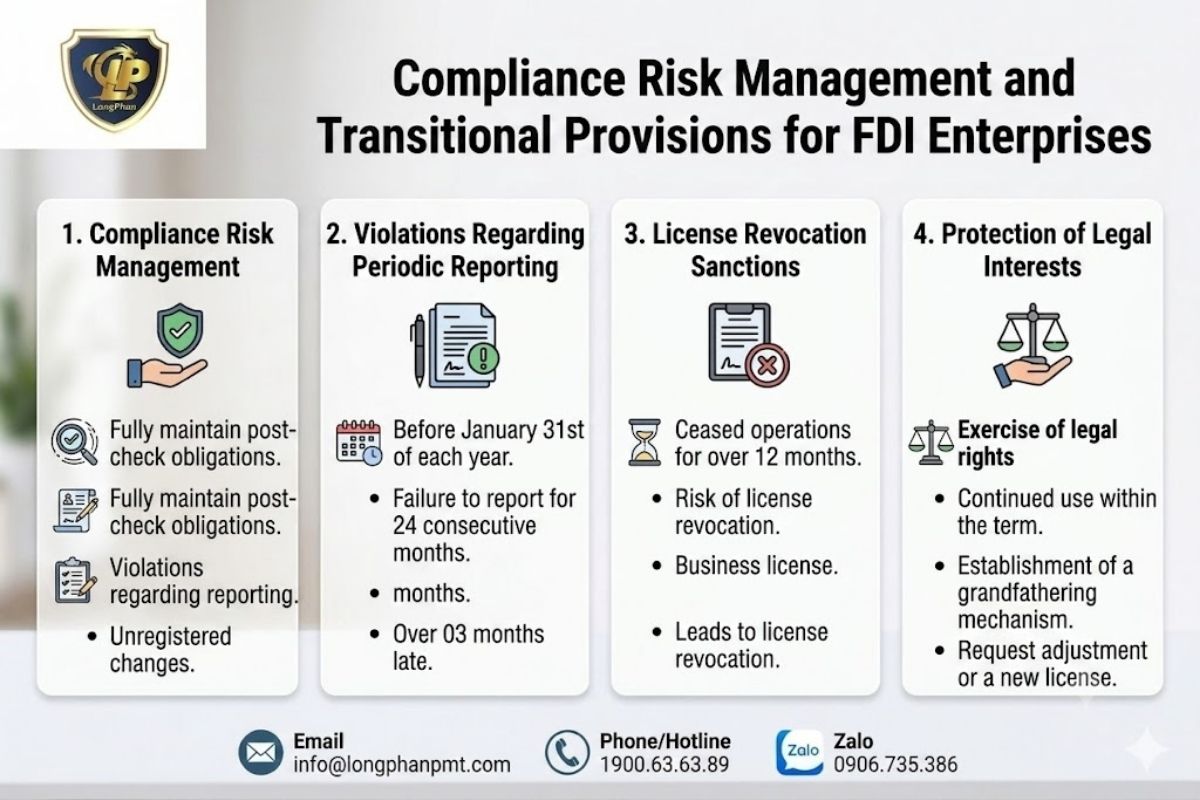
Licenses only guarantee commercial rights when enterprises fully maintain post-licensing compliance. Reporting violations, operating outside the permitted scope, or implementing unregistered corporate changes can trigger immediate license revocation.
Enterprises must establish a centralized compliance schedule for each retail outlet. Corporate executives must assign the following strict deadlines to their legal, accounting, and operations departments:
Enterprises must operate strictly within the approved location, registered goods list, and retail model. Any material corporate changes require formal license amendments prior to physical deployment.
Valid licenses issued before the new legal framework took effect remain valid for their recorded durations. This reservation mechanism is established under Clause 1, Article 50 of Decree No. 09/2018/ND-CP. Foreign-Invested Enterprises utilizing legacy licenses must apply for formal amendments or distinct new licenses when altering their goods, locations, or retail scales. This strict obligation is regulated under Clauses 2 and 3, Article 50 of Decree No. 09/2018/ND-CP.
Securing a retail license for an FDI Enterprise requires seamless alignment between investment structures, goods lists, financial plans, and commercial locations. Long Phan Consulting Company provides comprehensive legal oversight throughout the licensing lifecycle, preventing prolonged application delays, unusable commercial leases, and retail operational disruptions.
Our B2B corporate legal services are tailored to specific project requirements:
Foreign Investors may transmit their IRC, ERC, goods list, and lease documents via Email at info@longphanpmt.com or Zalo/WhatsApp at +84 906 735 386 for an immediate preliminary evaluation by Long Phan Consulting Company.
Managing compliance risks during the application for a “Retail Distribution License for FDI” and the operation of a retail chain requires investors to thoroughly understand stringent legal exceptions. Practical difficulties regarding economic needs testing or the risk of license revocation can seriously damage the market expansion strategy of foreign-invested economic organizations. In-depth analysis of typical legal scenarios will help management optimize investment plans for safety.
An FDI enterprise established in Vietnam for one year or more must provide documentation confirming that it has no outstanding tax debts. This requirement is prescribed in Point c, Clause 1, Article 9 of Decree No. 09/2018/ND-CP. If the enterprise has not fully settled its tax obligations, the licensing application may be rejected by the competent authority.
A retail outlet may be exempt from the economic needs test if it simultaneously satisfies three conditions: the retail area is less than 500 square meters, the outlet is located in a shopping mall, and it does not operate as a convenience store or mini-supermarket. These conditions are provided in Clause 1, Article 23 of Decree No. 09/2018/ND-CP.
No. Foreign-invested economic organizations may only be considered for retail distribution rights for sensitive goods such as rice, sugar, books, and newspapers when they have established retail outlets operating as supermarkets, mini-supermarkets, or convenience stores. The retail sale of these goods must be conducted directly at those establishments under Point c, Clause 4, Article 9 of Decree No. 09/2018/ND-CP.
A foreign-invested economic organization may have its business license revoked if it fails to submit periodic reports for 24 consecutive months, pursuant to Point d, Clause 1, Article 43 of Decree No. 09/2018/ND-CP. License revocation risks may also arise where the investor fails to submit the required explanatory documents within the prescribed period after being requested by the licensing authority.
The provincial People’s Committee currently holds the authority to review and approve applications relating to the establishment of retail outlets by foreign-invested enterprises. Under Decree No. 146/2025/ND-CP, authority over the issuance and adjustment of business licenses and retail establishment licenses has been decentralized to the provincial level. Enterprises continue to submit their application dossiers through the local Department of Industry and Trade for processing.
Securing a Retail Distribution License for FDI in Vietnam is a pivotal prerequisite for foreign investors expanding into the local retail market. Corporate executives must strictly separate Business Licenses from Retail Outlet Setup Licenses while proactively managing Economic Needs Test (ENT) hurdles, specialized goods lists, financial capacity, and periodic reporting obligations. Committing to lease agreements or importing goods prior to licensing approval risks store opening delays, sunk capital, and license revocation. Contact Hotline 1900636389 to engage Long Phan Consulting Company for structural legal audits and streamlined compliance execution
📚 This article has been professionally reviewed based on the following legal documents:


