Regulations food additive labeling must be controlled carefully in Vietnam because labeling errors may trigger customs delays, compulsory recalls, and administrative fines of up to VND 200,000,000. Foreign enterprises must ensure product labels match statutory requirements, including the “Food Additive” designation, complete ingredient information, and expiry dates, while remaining consistent with declared product dossiers. Any mismatch between technical documents and actual packaging can disrupt import, distribution, or repackaging plans.
Businesses should review Legal Updates and work with Long Phan Consulting to manage food additive compliance risks before market entry.

Important legal note:
Food additive packaging functions as a critical compliance document rather than a mere commercial identifier. Every data point on the label must enable regulatory authorities, distribution partners, and end-users to accurately trace the product. Consequently, enterprises must exercise strict control over labeling from the initial design and printing file stages.
The QA/QC and Legal departments should consider label checklists as a prerequisite before mass printing. Missing any required information can result in product rejection, corrective action required, or penalties for labeling violations.
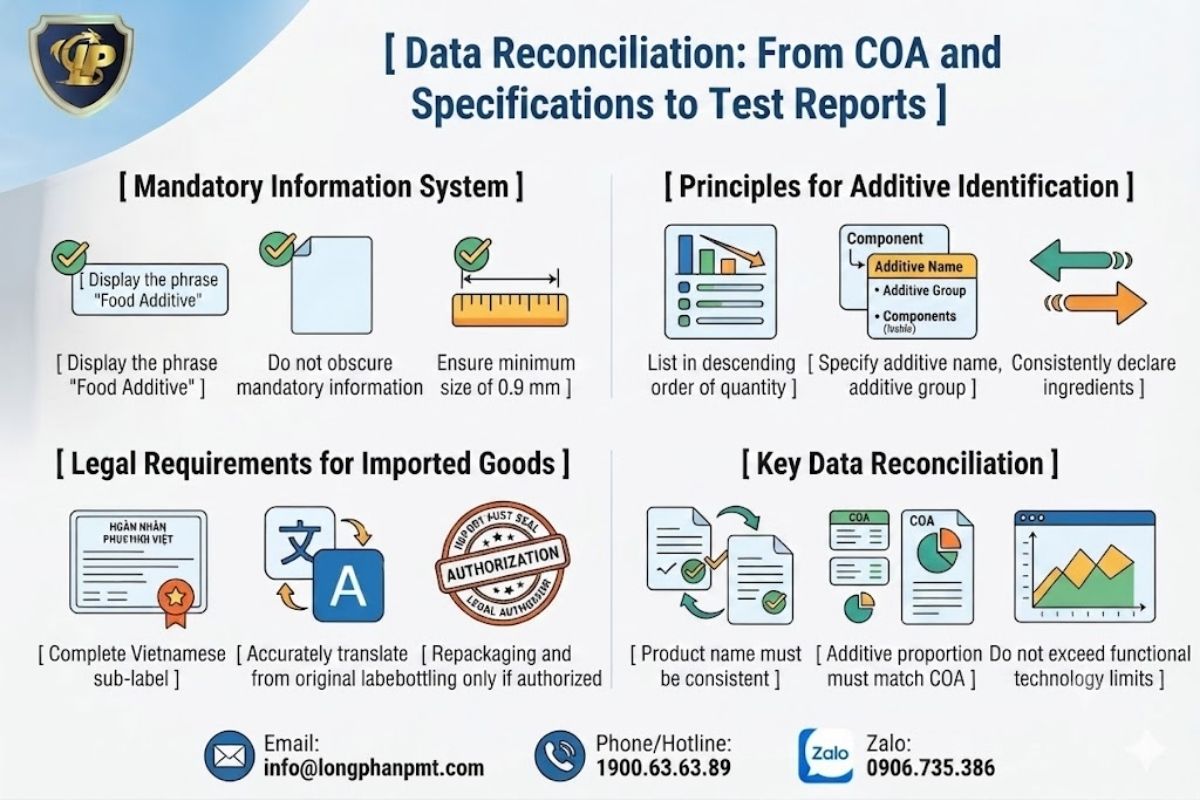
For small-sized packaging, the letters and numbers on food additive labels must meet minimum size requirements.0,9 mm. According to Clause 4, Article 37 of Decree No. 37/2026/ND-CP, in the case of additives sold loose or simply packaged, businesses must still publicly display the product name, expiration date, warnings, and information of the responsible unit at the point of sale, as stipulated in Article 51 of Decree No. 37/2026/ND-CP.
Product names must not convey misleading impressions regarding the additive’s function or inherent nature. When determining nomenclature, International Numbering System (INS) codes, and technological functions, enterprises must verify their data directly against the “List of food additives permitted for use in food” as stipulated in Article 5 of Consolidated Document 09/VBHN-BYT (2024).
Consistency across labels, product declaration dossiers, and technical documentation is mandatory. Discrepancies regarding substance names, concentrations, or technological functions may result in the product being deemed non-compliant with its declared standards.
Imported and repackaged food additives are high-risk categories concerning origin accuracy, original label integrity, and quality liability. Minor translation errors or a lack of proper authorization can lead to customs clearance delays, distribution failures, or mandatory product recalls. Enterprises must implement a dual-layer control system. Imported goods must satisfy Vietnamese secondary label requirements before circulation, while repackaged items must provide evidence of authorization for repackaging and guarantee the retention of the original product quality, pursuant to Articles 40, 42, 44, and 46 of Decree 37/2026/NĐ-CP, and Article 10 of Consolidated Document 09/VBHN-BYT (2024).
Upon customs clearance, the original foreign-language label must at least contain the product name, origin, and manufacturer information. This serves as the foundational data for customs authorities, importers, and legal departments to verify against import dossiers. Before circulation in Vietnam, enterprises must finalize the Vietnamese secondary label. This label must be affixed directly to the packaging, provide an accurate translation of the original label, include missing legal information, and not obscure mandatory content on the original label, in accordance with Clauses 1 and 3, Article 40 of Decree 37/2026/NĐ-CP.
The primary risk remains discrepancies between original labels, secondary labels, and customs declarations. Enterprises should pre-verify product names, origins, and manufacturer data to prevent cargo from being trapped at warehouses, ports, or within distribution systems.
Repackaging food additives is not merely a logistical task. It triggers specific liabilities concerning quality, labeling, and traceability for each product batch.
For F&B raw material importers, the critical control point is maintaining the link between the new label and the original technical dossier. Each batch division must include a batch record, defined storage conditions, and clear documentation justifying the expiration date.
Consistency between labeling and product declaration dossiers is the definitive requirement for the legal circulation of food additives. Minor discrepancies regarding product names, concentrations, or origins can trigger recalls, administrative fines, or supply chain disruptions.
Most standard food additives utilize the Product Self-Declaration mechanism. However, blended additives with new functions or those absent from the approved list require the registration of a Product Declaration dossier with the Vietnam Food Administration (VFA), pursuant to Clause 2, Article 11, Consolidated Document 09/VBHN-BYT (2024).
The QA/QC department must treat the label as the nexus connecting legal, technical, and import documentation. Circulating goods must conform to the applicable declared standards and labeling regulations.
Enterprises must perform a 100% reconciliation of critical data fields across the product label, Self-Declaration dossier, Product Declaration, COA, Specification, Test Report, and import documentation:
Note: The COA is the Certificate of Analysis issued by the manufacturer; the Test Report is the result sheet from a testing laboratory; and the Specification is the technical standard used to control parameters before product declaration and label printing.
Enterprises should implement a standard operating procedure (SOP) to audit internal processes before releasing goods into distribution. This facilitates the early detection of discrepancies between physical labels and declaration dossiers.
Effective QA/QC is only achieved when conducted prior to mass printing. Once products enter circulation, any deviation manifests as costly recall expenses, formal explanation requests, and legal liability.
Labeling non-compliance for food additives is not merely a packaging error. It represents a substantial commercial risk that can result in customs detention, distributor rejection, and the obligation to issue formal explanations to regulatory authorities.
The maximum administrative fine in the food safety sector is 100,000,000 VND for individuals and 200,000,000 VND for organizations, pursuant to Clause 1, Article 3 of Decree 115/2018/NĐ-CP (amended by Decree 124/2021/NĐ-CP). Enterprises must systematically review label discrepancies based on operational risk groups.
| Violation Behavior | Legal Risk / Remedial Measures | Expected Penalty Framework |
| Incorrect naming or misleading descriptions | Deemed as non-compliant labeling; requires sale suspension and immediate rectification | May trigger a mandatory public notification and suspension of sales |
| Claiming functions exceeding the declared dossier | Risks being categorized as non-compliant with standards; potential for mandatory product recall | Fine of 01 to 02 times the total value of consumed violating products |
| Unauthorized modification of ingredients | Severe violation affecting product integrity; triggers recall and loss of partner trust | Fine of 02 to 03 times the total value of consumed violating products |
| Omission or misrepresentation of origin | Cargo detention at ports or bonded warehouses due to documentation conflict | Mandatory label rectification and suspension of circulation |
| Missing Vietnamese secondary label | Renders goods ineligible for circulation; critical for B2B industrial raw materials | Penalties for non-compliant goods under Decree 37/2026/NĐ-CP |
| Altering/tampering with declaration dossiers | Compromises legal validity; requires resubmission and formal verification | Fine of 40,000,000 VND to 60,000,000 VND |
Enterprises should prioritize the control of three data pillars: product names, ingredient compositions, and origins. These specific fields are the most frequent causes of punitive sanctions, product recalls, and commercial disputes with distribution partners.
>>> See more: Proof of Vietnamese Origin for Property Purchase
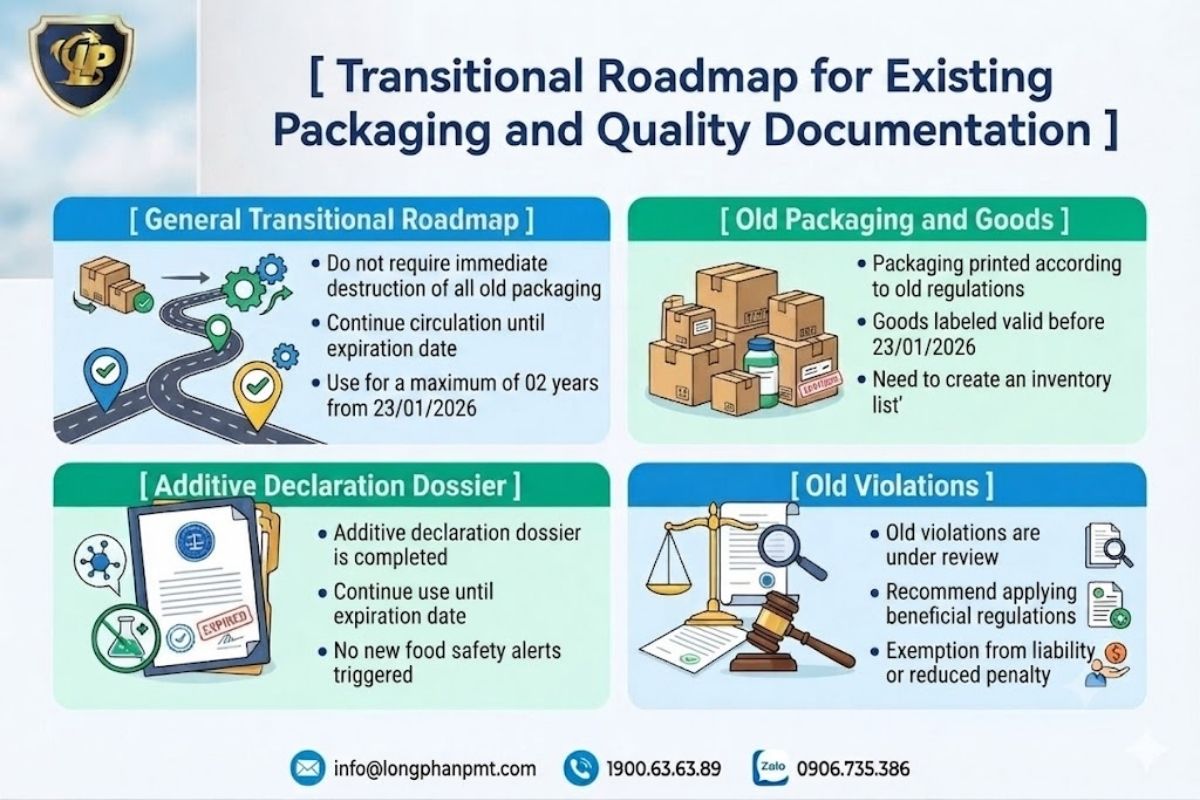
Businesses are not required to immediately discard all existing packaging if the labels were printed or the products were manufactured, imported, or circulated before the transitional deadline. These transitional provisions help optimize inventory costs but do not exempt businesses from complying with the new labeling requirements for subsequent production and imported batches.
Products bearing labels that complied with the previous regulations and were manufactured, imported, or circulated before January 23, 2026, may continue to be marketed until the expiration date stated on the label. Commercial labels and packaging printed before this date may continue to be used for up to two years from January 23, 2026, in accordance with Clauses 3 and 4, Article 98 of Decree No. 37/2026/ND-CP.
Ensuring regulatory compliance for food additives requires seamless coordination between legal, QA/QC, R&D, import, and packaging design departments. Long Phan Consulting supports enterprises in mitigating risks arising from product declaration dossiers, original labeling, Vietnamese secondary labels, and batch traceability. Our service methodology emphasizes practical document audits, gap identification, and the proposal of operational-ready remediation strategies to minimize the risks of cargo detention, product recalls, and administrative sanctions.
For a preliminary evaluation of your labels, product declarations, COAs, Specifications, or import documents, please forward them to our team via Email: info@longphanpmt.com or Zalo/WhatsApp: +84 906 735 386.
Synchronizing information between self-declared records and actual product labels is a mandatory requirement for businesses to avoid serious legal risks. Any discrepancies in ingredients, quantities, or origin on the packaging can lead to administrative penalties or forced product destruction by authorities. Businesses need to thoroughly understand the current “Regulations on Food Additive Labeling” to ensure transparency, safety, and protect their brand reputation in the eyes of consumers.
Imported food additives are required to have a Vietnamese supplementary label affixed before being circulated in the Vietnamese market. The supplementary label must be directly attached to the packaging, accurately translated from the original label, and must not obscure the mandatory content of the original label. This regulation aims to ensure complete legal information for consumers in accordance with Clauses 1 and 3 of Article 40 of Decree No. 37/2026/ND-CP.
Businesses that repackage products must clearly state the original production date, the repackaging date, the manufacturer’s expiration date, and the new expiration date if the repackaging changes the shelf life. This shelf life must be calculated from the production date shown on the original label before repackaging, in accordance with Point c, Clause 1, Article 10 of Consolidated Document No. 09/VBHN-BYT of 2024 and Article 46 of Decree No. 37/2026/NĐ-CP.
Businesses will be fined from 2 to 3 times the total value of the infringing products sold if they arbitrarily change the ingredients or additives compared to the declared information. This is a serious violation of product integrity according to Point b, Clause 1, Article 22 of Decree No. 115/2018/ND-CP (amended and supplemented by Decree No. 124/2021/ND-CP).
Food additive labels must clearly state the product name, quantity, production date, expiration date, ingredients, instructions for use and storage, warning information, and the name and address of the responsible organization. In particular, the label must display the phrase “Food additive” or “Food processing aid” for accurate classification according to Section 9, Appendix I of Decree No. 37/2026/ND-CP.
Businesses that alter or falsify the content of their self-declared product information will be fined between VND 40,000,000 and VND 60,000,000. In addition, authorities will require the return of the altered documents in accordance with Point a, Clause 2 and Point e, Clause 6 of Article 19 of Decree No. 115/2018/ND-CP (amended and supplemented by Decree No. 124/2021/ND-CP).
Food additive labeling compliance is a critical legal control point that precedes the import, repackaging, distribution, or utilization of ingredients within the F&B supply chain. Enterprises must ensure absolute consistency across original labels, Vietnamese secondary labels, COAs, Specifications, Test Reports, and Product Declaration dossiers. Discrepancies regarding additive names, INS codes, composition, functionality, origin, or expiry dates can lead to customs detention, product recalls, administrative fines, and the loss of distribution rights. For expert review of your documentation and labeling before market circulation, contact the hotline at 1900636389 or reach out to Long Phan Consulting for professional support.
📚 This article has been professionally reviewed based on the following legal documents: