


Registration for Pawnshop Services based solely on an Enterprise Registration Certificate may expose the operator to administrative sanctions, business suspension, and significant financial losses. After completing Business Registration, the enterprise must obtain a Certificate of Satisfaction of Security and Order Conditions before receiving pledged property. The application should also include documents on the operating premises, fire prevention and firefighting compliance, and the personal records of the individual responsible for security and order.
Long Phan Consulting supports businesses in reviewing licensing requirements, controlling interest-rate exposure, and reducing risks from accepting assets with unclear ownership or origin.
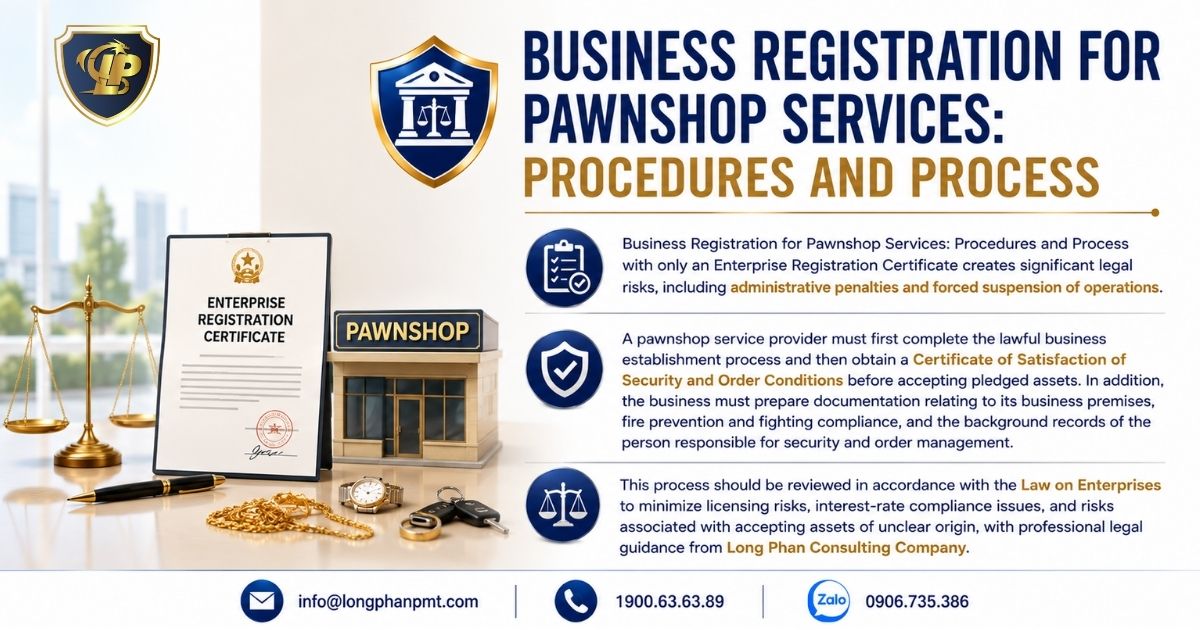
Key legal notes:
A pawn shop facility may only operate legally if it satisfies simultaneous requirements regarding legal personality, location, fire prevention and fighting (PCCC) standards, and personnel responsible for security. The most significant risk for investors is investing substantial capital and securing premises only to have their application rejected due to an inadequate legal foundation from the outset.
Investors must review the following mandatory requirements before submission:
Consequently, site acquisition, corporate documentation, and personnel appointments should not be treated as isolated tasks. Investors must synchronize these steps to avoid the sunk costs of leasing premises that lack the capacity for licensed operation.
Investors may choose to operate as a household business, private enterprise, Limited Liability Company (LLC), or Joint Stock Company depending on capital scale and management requirements. However, regardless of the chosen structure, it must be legally registered before you apply for the Certificate of Eligibility for Security and Order.
Pawn services involve lending money against valid assets pledged by the borrower. This definition confirms that pawn brokering is not merely a civil financial activity; it is intrinsically linked to the obligation of controlling the origin of assets, pursuant to Clause 4, Article 3 of Decree 96/2016/NĐ-CP.
When establishing your facility, investors must prepare the following elements:
For existing businesses, simply adding the pawn service line does not grant immediate operational rights. You must still complete the application for the Certificate of Eligibility for Security and Order before accepting any collateralized assets.
The person responsible for security and order is the most sensitive control point in your pawn business dossier. Enterprises should screen these individuals before submission, as any discrepancy in their background may derail your entire opening schedule.
For Vietnamese citizens, the person responsible must not currently be under criminal investigation, possess a criminal record for national security offenses, or have been convicted of an intentional crime with a sentence of over three years that has not been expunged. These conditions are established under Clause 2, Article 7 of Decree 96/2016/NĐ-CP.
The pawn industry imposes even stricter requirements regarding administrative violations. Pursuant to Article 9 of Decree 96/2016/NĐ-CP (amended by Decree 56/2023/NĐ-CP), within five consecutive years prior to the registration date, the person responsible must not have been sanctioned for core prohibited behaviors, including usury, gambling, theft, or fraud.
| Personnel Check | Risk to Pawn Business Dossier | Legal Basis |
| Currently under criminal investigation | Disqualified from serving as security manager | Clause 2, Art. 7, Decree 96 |
| Criminal record for national security crimes | Permanently ineligible for key personnel roles | Clause 2, Art. 7, Decree 96 |
| Unexpunged intentional crime (>3 years) | High risk of application rejection | Clause 2, Art. 7, Decree 96 |
| Sanctioned for usury, gambling, or fraud within 5 years | Fails industry-specific compliance requirements | Art. 9, Decree 96 (amended by Decree 56) |
| Sanctioned for obstructing officials or public disorder | Increased risk of security certificate denial | Art. 9, Decree 96 (amended by Decree 56) |
In practice, investors should not focus solely on the legal representative. The person directly responsible for security and order must also undergo a thorough review of their Judicial Record Card, history of administrative sanctions, and actual operational involvement in the facility.
Pawn business registration must be understood as a two-tiered process. The first tier establishes the legal business entity, while the second tier secures the Certificate of Eligibility for Security and Order before any collateralized assets can be accepted.
A common error is viewing the Enterprise Registration Certificate (ERC) as an operational license. This misunderstanding leads to significant risks, including administrative fines, operational suspension, and the loss of pre-launch investment costs.
The implementation process should follow these four steps:
If dossier data is integrated and shared across the electronic administrative environment, enterprises may be exempt from submitting corresponding hard copies, as permitted under Clause 6, Article 23 of Decree 96/2016/NĐ-CP (amended by Decree 56/2023/NĐ-CP).
The initial phase aims to establish the legal personality of the pawn service facility. Investors must select a model that aligns with their capital scale, the number of transaction points, and their risk management requirements.
For corporate entities, the application typically includes the following essential documents:
These documentation groups are governed by Clauses 1, 2, 3, and 4, Article 24 of Decree 168/2025/NĐ-CP. Once a valid application is submitted, the review period for issuing the Enterprise Registration Certificate is 03 working days, pursuant to Clause 5, Article 26 of Decree 168/2025/NĐ-CP.
Provincial or district-level Business Registration Offices overseeing the headquarters location have the jurisdiction to receive these applications, pursuant to Articles 21 and 22 of Decree 168/2025/NĐ-CP. However, please note that this is merely the “legal birth” of your entity and does not grant the right to operate pawn services.
The Certificate of Eligibility for Security and Order serves as the most critical legal barrier prior to your opening date. Enterprises must prepare accurate documentation to prevent application rejections or unnecessary delays in operational commencement.
| Component / Criterion | Execution Requirement | Legal Basis |
| Application Request | Prepare the formal request for the Certificate | Clause 1, Art. 19, Decree 96/2016/NĐ-CP |
| Business Registration | Submit a valid copy proving legal establishment | Point a, Clause 2, Art. 19, Decree 96/2016/NĐ-CP |
| Fire Safety Dossier | Submit valid proof of PCCC compliance | Clause 3, Art. 19, Decree 96/2016/NĐ-CP |
| Security Personnel Records | Prepare background check and Criminal Record Certificate | Point a, Clause 4, Art. 19, Decree 96/2016/NĐ-CP |
Key Administrative Parameters:
For renewal or re-issuance, the processing time is 04 working days, pursuant to Point b, Clause 3, Article 23 of Decree 96/2016/NĐ-CP. Monitoring these timelines allows businesses to forecast their launch schedule, adding business lines, or expanding to new service locations
Following licensing, the risk profile of a pawn service facility shifts from administrative documentation to daily transaction oversight. A single transaction lacking ownership documentation, a formal contract, or exceeding interest rate caps can transform short-term profit into significant financial penalties, civil disputes, or criminal liability.
Enterprises must standardize their internal operational processes to include:
The core of your management strategy is not a one-time dossier submission, but the continuous maintenance of compliance evidence throughout your operation. This serves as a vital defense layer during sudden inspections or asset-related disputes.
Enterprises should establish a step-by-step asset intake procedure. This protocol ensures staff do not inadvertently accept unauthorized assets, items lacking required documentation, or goods originating from illicit activities.
Note that photocopied vehicle registrations, digital images of documents, or verbal assurances are insufficient substitutes for proof of lawful ownership. For assets owned jointly by spouses or third parties, the lack of formal authorization can lead to complex disputes over asset restitution.

Operational errors in the pawn industry rarely occur in isolation. A transaction lacking a formal contract can simultaneously trigger failures to store documentation, unauthorized asset intake, and an inability to prove the lawful origin of pledged goods.
| Common Violations | Penalties or Sanctions | Legal Basis |
| Failure to retain copies of pledgor ID | 3,000,000 – 5,000,000 VND | Point h, Clause 2, Art. 15, Decree 282/2025/NĐ-CP |
| Accepting pledges without contracts, original ownership titles, or third-party authorization | 5,000,000 – 10,000,000 VND | Points i, k, l, Clause 3, Art. 15, Decree 282/2025/NĐ-CP |
| Operating without or with a revoked Certificate of Eligibility for Security and Order | 10,000,000 – 20,000,000 VND | Point a, Clause 4, Art. 15, Decree 282/2025/NĐ-CP |
| Exceeding interest rate limits | 10,000,000 – 20,000,000 VND | Point d, Clause 4, Art. 15, Decree 282/2025/NĐ-CP |
| Lacking or utilizing non-registered asset storage | 10,000,000 – 20,000,000 VND | Points đ, l, Clause 4, Art. 15, Decree 282/2025/NĐ-CP |
| Accepting assets acquired through theft, fraud, or other crimes | 20,000,000 – 40,000,000 VND | Point b, Clause 5, Art. 15, Decree 282/2025/NĐ-CP |
| Serious or repeated violations | Suspension of Certificate for 03 to 09 months and asset confiscation | Clause 7, Art. 15, Decree 282/2025/NĐ-CP |
The most significant risk involves accepting illicitly acquired assets. Beyond administrative fines, the facility may be held jointly liable during police investigations if you cannot demonstrate strict adherence to asset-origin verification protocols.
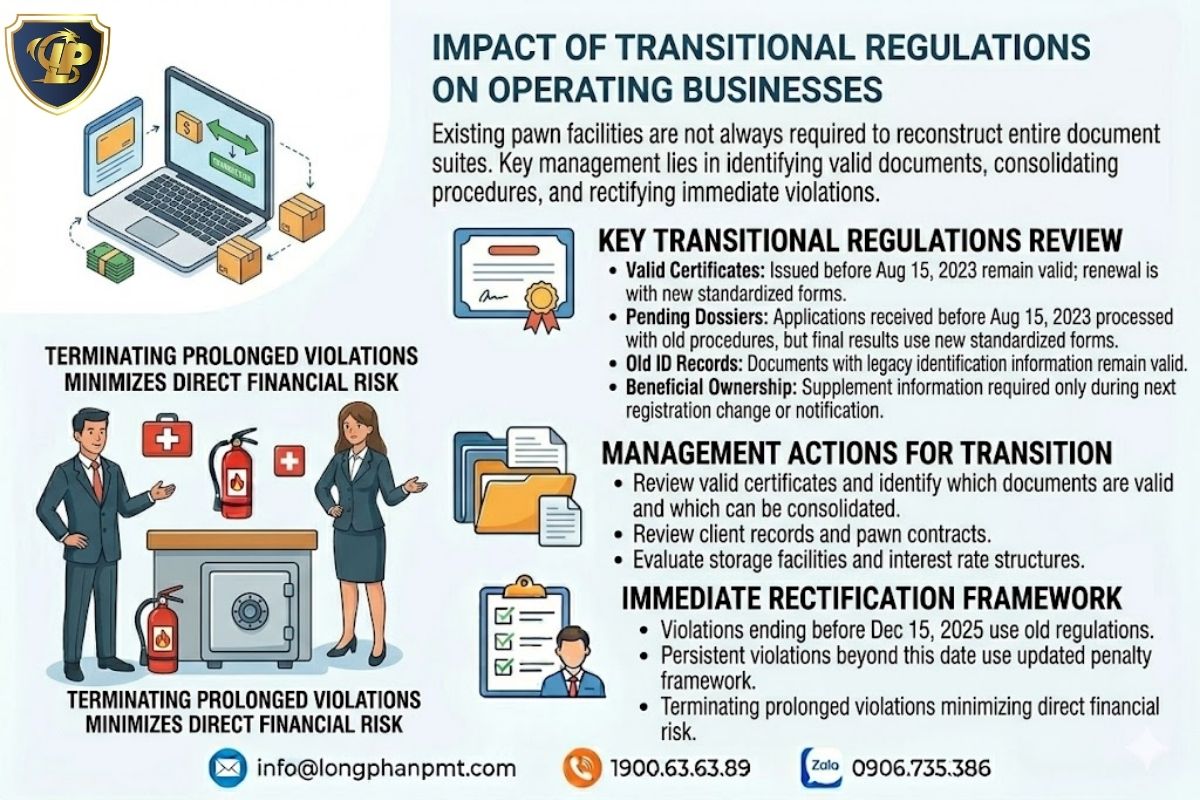
Existing pawn service facilities are not always required to reconstruct their entire documentation suite when new regulations take effect. The management challenge lies in identifying which documents remain valid, which procedures can be consolidated, and which violations must be rectified immediately.
Key transition milestones should be reviewed across the following dossier groups:
Currently operating enterprises should immediately review the status of their certificates, client records, pawn contracts, storage facilities, and interest rate structures. If prolonged violations are detected, terminating and rectifying them prior to the application of new penalties is a vital step to minimize direct financial risk.
The pawn business requires enterprises to simultaneously manage entity formation, security and order conditions, facility location, fire safety standards, and asset intake protocols. Long Phan Consulting Company assists investors in auditing their business models before deployment to mitigate the risk of application rejection or post-licensing non-compliance.
Our consulting tasks are implemented with an execution-focused approach, closely adhering to licensing requirements and actual operational needs:
Enterprises are invited to send existing documentation via Email: info@longphanpmt.com or Zalo/WhatsApp: +84 906 735 386 for a preliminary evaluation and strategic roadmap by Long Phan Consulting Company.
The process of registering a pawnshop business requires strict compliance to ensure the legal safety of the organization. Thorough review of personnel standards, record-keeping rules, and potential blind spots helps investors establish a sustainable operating mechanism. Further in-depth explanations will directly address the most stringent compliance challenges from state management agencies.
Businesses are absolutely prohibited from accepting collateral if customers only provide photocopies of ownership documents. Business owners are required to verify and retain the original ownership certificates for assets requiring registration. The obligation to retain the original property documents is mandated in Clause 3, Article 29 of Decree No. 96/2016/ND-CP.
Businesses must require customers bringing assets for collateral to provide a valid power of attorney from the asset owner. Accepting assets that are not legally owned poses a significant risk of civil disputes for businesses. The mandatory requirement for a legally valid power of attorney for assets belonging to a third party is clearly stated in Clause 4, Article 29 of Decree No. 96/2016/ND-CP. Failure to provide a power of attorney will result in a fine of VND 5,000,000 to VND 10,000,000 according to Point l, Clause 3, Article 15 of Decree No. 282/2025/ND-CP.
No, individuals who have been previously penalized for administrative violations related to gambling are not permitted to be named as security personnel for a pawnshop. The law completely prohibits this group of personnel from participating in the operation if the violation occurred within the five consecutive years prior to registration. The five-year legal barrier for gambling and usurious lending offenses is stipulated in Article 9 of Decree No. 96/2016/ND-CP, amended and supplemented by Decree No. 56/2023/ND-CP.
The state management agency will complete the issuance of the new Certificate within a maximum of 5 working days. The district-level police have the authority to review and issue the license immediately upon receiving a complete and valid application from the enterprise. The regulation regarding the 5-day review period is clearly stipulated in Point a, Clause 3, Article 23 of Decree No. 96/2016/ND-CP.
Businesses will be fined by state authorities for administrative violations ranging from VND 10,000,000 to VND 20,000,000. Opening to customers before completing the security permit is a serious violation of mandatory operating conditions. The fine range of VND 10,000,000 to VND 20,000,000 for operating without a permit is applied according to Point a, Clause 4, Article 15 of Decree No. 282/2025/ND-CP.
Businesses will be fined between VND 20,000,000 and VND 40,000,000 and may have their licenses revoked. The maximum fine for consuming stolen property is between VND 20,000,000 and VND 40,000,000 as stipulated in Point b, Clause 5, Article 15 of Decree No. 282/2025/ND-CP. In addition, businesses may also face the supplementary penalty of having their Certificate of Eligibility for Security and Order revoked for a period of 3 to 9 months, as stipulated in Clause 7, Article 15 of Decree No. 282/2025/ND-CP.
Successfully registering a pawn shop business license in Vietnam requires rigorous management of your corporate entity, security certifications, facility safety standards, and transactional protocols. Investors must avoid the critical trap of launching operations based solely on general business registration; failing to secure the mandatory Certificate of Eligibility for Security and Order will trigger severe administrative sanctions, operational suspension, and potential criminal liability regarding asset origin. To build a resilient and fully compliant pawn brokerage, you must standardize every aspect of your asset intake, interest rate structure, and record-keeping procedures. For expert guidance in navigating these complex regulatory hurdles and securing your facility’s operational foundation, contact the senior legal team at Long Phan Consulting Company via our direct hotline at 1900636389.
📚 This article is provided with professional consultation based on the following legal framework:


