


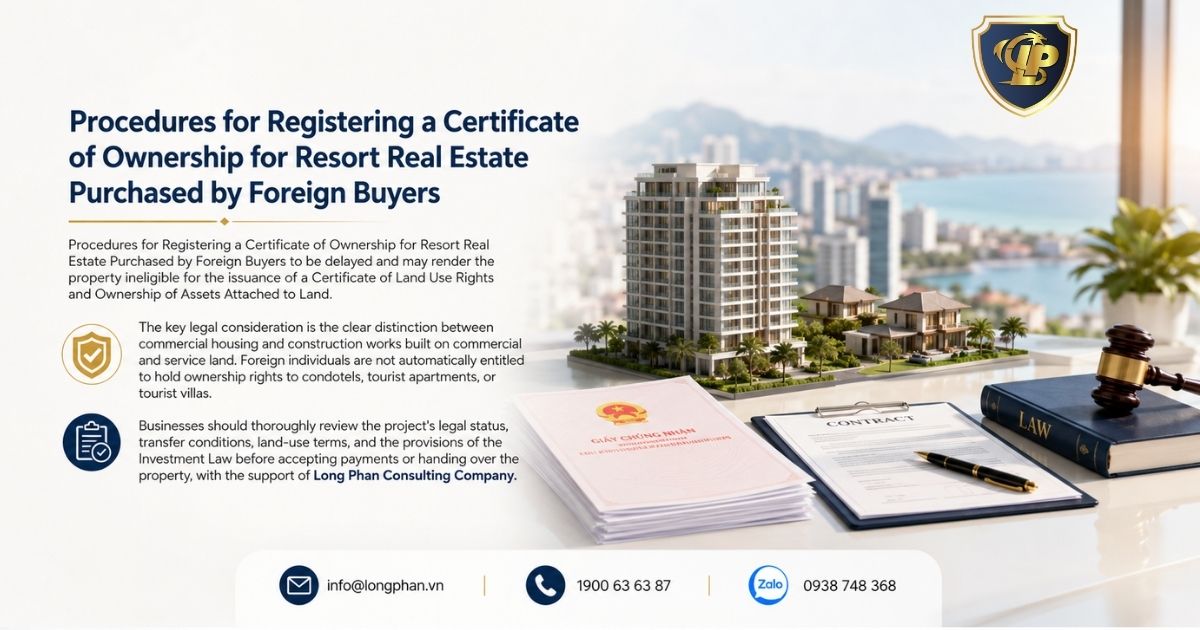
Registering a Certificate of Ownership for Resort Real Estate acquired by foreign buyers may face delays or rejection if the asset fails to qualify for certification of land use rights and ownership of attached assets. The key compliance issue is separating commercial housing from construction works developed on commercial and service land under the Law On Land. Foreign individuals do not automatically obtain ownership rights over condotels, tourist apartments, or resort villas. Enterprises should examine project legality, transfer eligibility, land-use duration, and investment conditions before receiving payments or delivering property, with guidance from Long Phan Consulting.
Important legal note:
Processing the Certificate of Land Use Rights and Ownership of Land-Attached Assets for foreign-invested resort properties differs fundamentally from standard residential transactions. The primary risk involves asset misclassification. This error renders contracts unenforceable and blocks ownership registration. Enterprises must determine outright whether the asset is commercial housing or a construction work on commercial and service land. This classification dictates eligible ownership subjects, operational lifespans, and the legal capacity to hold the title deed.
Accurate asset classification serves as the mandatory initial legal control prior to accepting deposits, executing contracts, or handing over properties. Treating condotels, tourist apartments, or tourist villas identically to commercial housing generates false ownership expectations for foreign investors.
| Asset Classification | Governing Legal Framework | Foreign Ownership Eligibility |
| Commercial housing within projects permitted for foreign sale | Housing Law 2023 | Foreign individuals and organizations may own these properties subject to valid entry status, statutory quota limits, and location outside national defense and security zones. |
| Non-residential resort constructions (tourist apartments, villas, mixed-use) | Real Estate Business Law 2023 & Land Law 2024 | The legal framework does not grant foreign individuals the direct right to purchase or own non-residential construction works. |
| Construction works on commercial and service land | Real Estate Business Law 2023 | Non-citizen overseas Vietnamese and legally operating foreign-invested economic organizations (FIEOs) in Vietnam may purchase, lease, or lease-purchase these assets according to their designated functions. |
The critical distinction applies to non-residential construction works. Pursuant to Clauses 2 and 3, Article 15 of the Real Estate Business Law 2023, only non-citizen overseas Vietnamese and legally operating foreign-invested economic organizations may purchase these structures. Developers must explicitly declare the asset type across all sales materials, contracts, and project legal dossiers. The term “condotel pink book” holds mere marketing value and cannot substitute the statutory property certificate.
For commercial housing, the foreign buyer’s personal legal status acts as a mandatory control point. Developers must verify passports alongside entry conditions and the permitted project scope. Enterprises must strictly review the following conditions before contract execution:
These criteria apply strictly to commercial housing and must not be mechanically applied to non-residential resort constructions. Selling the wrong asset class to foreign individuals guarantees dossier rejection during the subject eligibility inspection phase. Legal departments managing high-value transactions must construct dedicated verification matrices cross-referencing nationality, entry status, and asset type. This strategy prevents refund liabilities, deposit penalties, and title registration disputes.
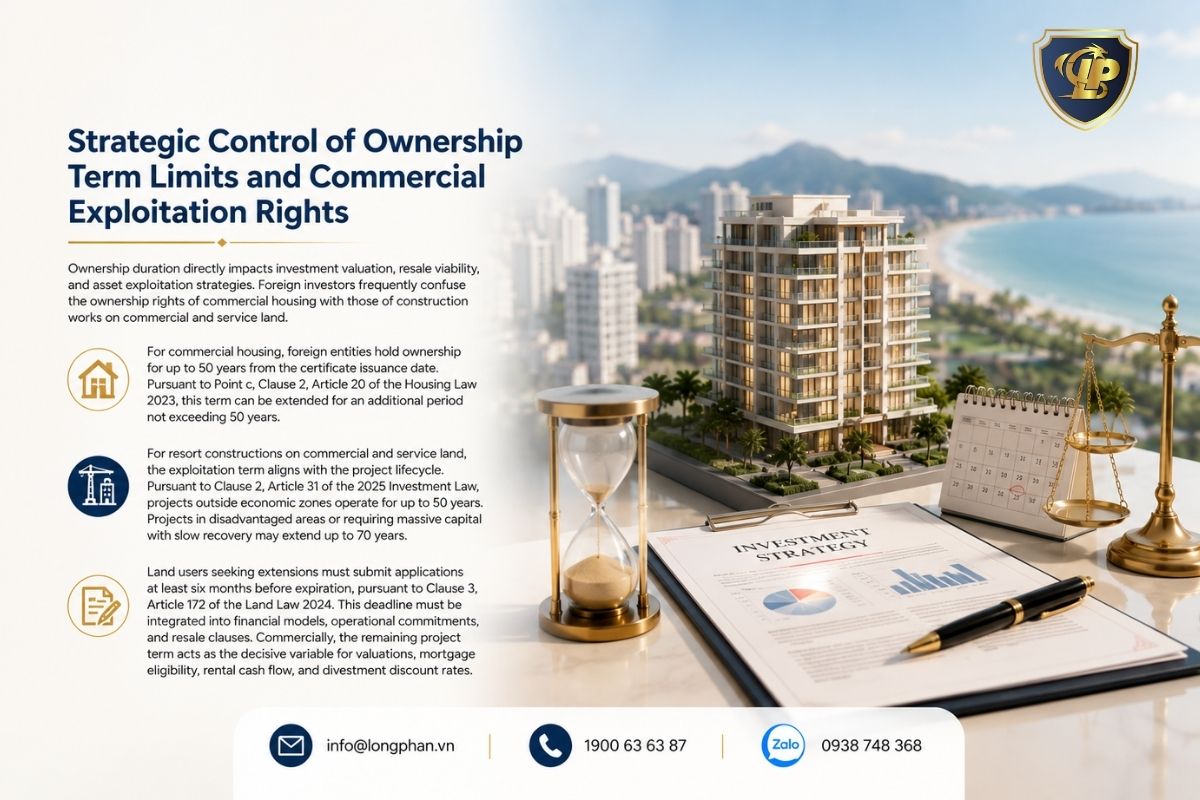
Ownership duration directly impacts investment valuation, resale viability, and asset exploitation strategies. Foreign investors frequently confuse the ownership rights of commercial housing with those of construction works on commercial and service land.
For commercial housing, foreign entities hold ownership for up to 50 years from the certificate issuance date. Pursuant to Point c, Clause 2, Article 20 of the Housing Law 2023, this term can be extended for an additional period not exceeding 50 years.
For resort constructions on commercial and service land, the exploitation term aligns with the project lifecycle. Pursuant to Clause 2, Article 31 of the 2025 Investment Law, projects outside economic zones operate for up to 50 years. Projects in disadvantaged areas or requiring massive capital with slow recovery may extend up to 70 years.
Land users seeking extensions must submit applications at least six months before expiration, pursuant to Clause 3, Article 172 of the Land Law 2024. This deadline must be integrated into financial models, operational commitments, and resale clauses. Commercially, the remaining project term acts as the decisive variable for valuations, mortgage eligibility, rental cash flow, and divestment discount rates.
The dossier for resort real estate certificate registration does not initiate with the buyer. The critical factor lies in the developer’s foundational legal dossier, encompassing land use rights, real estate trading eligibility, and construction acceptance status. For foreign-element transactions, a single missing foundational document can delay the entire title transfer and ownership registration process. Legal departments must conduct due diligence on the project before authorizing deposits, executing contracts, or accepting milestone payments.
For completed resort constructions, legal due diligence must focus on the asset’s trading eligibility and the buyer’s ownership registration conditions. Developers must substantiate that the construction work qualifies for commercial exploitation, relying on statutory approvals rather than mere sales materials or commercial commitments.
The priority checklist for foundational dossiers includes:
Mandatory prerequisites for existing construction works stipulate they must be accepted for operation, free from disputes or distraint, and the developer must have fulfilled all land-related financial obligations. This aligns with Points a, b, and c, Clause 1, and Point a, Clause 2, Article 14 of the Real Estate Business Law 2023.
When trading a specific construction floor area, that footprint must possess a designated use purpose and independent spatial design for separate management. This constitutes a vital condition for condotels, resort shophouses, or commercial zones within mixed-use complexes.
For future-formed real estate (off-plan properties), the primary risk arises when investors disburse funds before the asset achieves trading eligibility. Developers must provide legal dossiers proving construction progress and sales eligibility, rather than relying solely on handover commitments.
Off-plan properties require a construction permit or commencement notice, design dossiers, and technical infrastructure acceptance documents matching the project schedule. Developers must simultaneously fulfill land-related financial obligations and publicly disclose property information prior to commercialization, pursuant to Clauses 1, 3, 6, and 7, Article 24 of the Real Estate Business Law 2023.
Payment caps act as critical cash flow protections for investors. The initial payment must not exceed 30% of the contract value, including deposits. Total payments before handover cannot exceed 70%. If the seller is a Foreign-Invested Economic Organization (FIEO), pre-handover payments are strictly capped at 50% of the contract value, pursuant to Clause 1, Article 25 of the Real Estate Business Law 2023.
Consequently, sale or lease-purchase contracts must tie payment milestones to acceptance documents, the Notification of Eligibility for Real Estate Trading, and actual handover dates. Should the contract deviate from statutory templates or exceed collection quotas, investors possess valid grounds to demand adjustments, suspend payments, or renegotiate protective clauses.
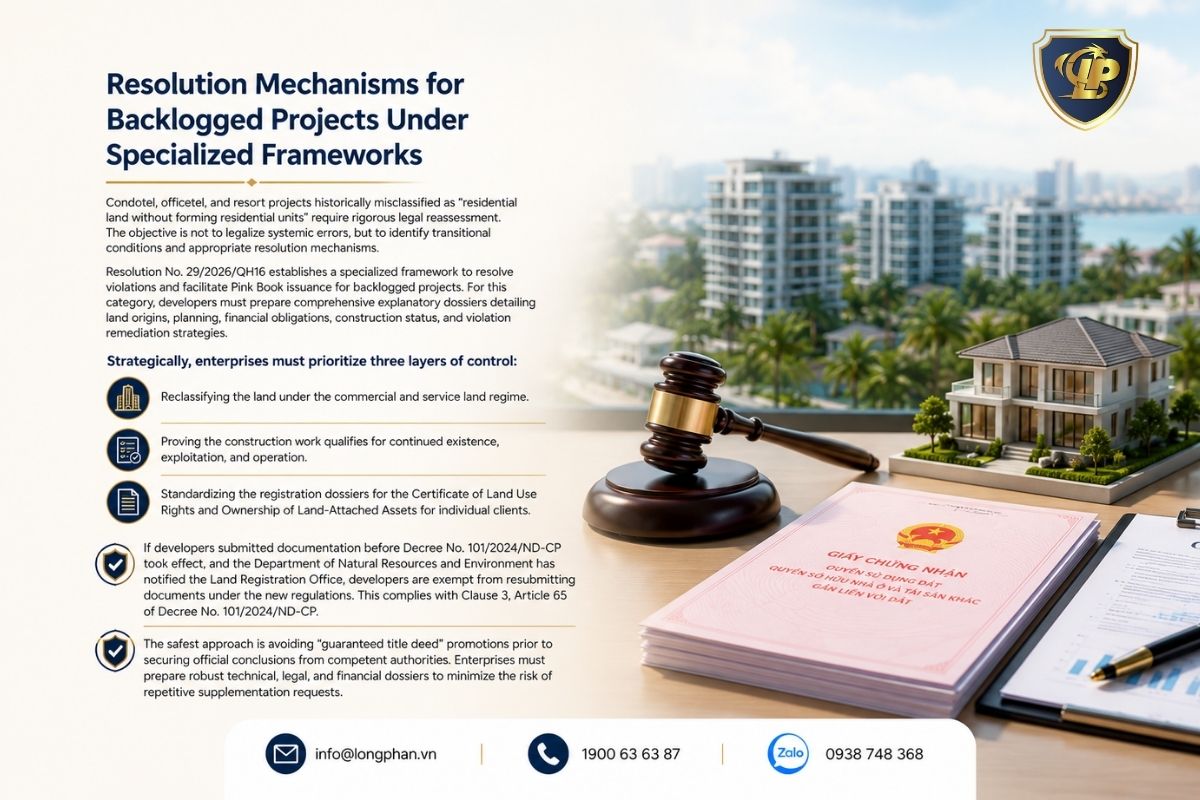
Condotel, officetel, and resort projects historically misclassified as “residential land without forming residential units” require rigorous legal reassessment. The objective is not to legalize systemic errors, but to identify transitional conditions and appropriate resolution mechanisms.
Resolution No. 29/2026/QH16 establishes a specialized framework to resolve violations and facilitate Pink Book issuance for backlogged projects. For this category, developers must prepare comprehensive explanatory dossiers detailing land origins, planning, financial obligations, construction status, and violation remediation strategies.
Strategically, enterprises must prioritize three layers of control:
If developers submitted documentation before Decree No. 101/2024/ND-CP took effect, and the Department of Natural Resources and Environment has notified the Land Registration Office, developers are exempt from resubmitting documents under the new regulations. This complies with Clause 3, Article 65 of Decree No. 101/2024/ND-CP.
The safest approach is avoiding “guaranteed title deed” promotions prior to securing official conclusions from competent authorities. Enterprises must prepare robust technical, legal, and financial dossiers to minimize the risk of repetitive supplementation requests.
Title registration for foreign buyers transcends standard administrative filing. It constitutes a rigorous inspection of subject eligibility, project compliance, financial obligations, and transactional validity. For resort real estate, the Land Registration Office scrutinizes the exact asset class being certified. Any legal mischaracterization within the dossier will delay or outright reject the issuance of the Certificate of Land Use Rights and Ownership of Land-Attached Assets.
Dossiers for the registration of land changes must demonstrate absolute consistency across developer information, buyer credentials, contracts, and the transacted asset. For foreign clients, discrepancies in passports, entry status, or transfer eligibility trigger mandatory supplementation requests under Decree No. 151/2025/ND-CP, as amended by Decree No. 49/2026/ND-CP.
The mandatory document checklist includes:
Decree No. 101/2024/ND-CP governs registration procedures, while Circular No. 10/2024/TT-BTNMT regulates cadastral dossiers and certificate templates. Enterprises must audit dossiers by subject group prior to submission to prevent rejections caused by missing translations, lack of consular legalization, or mismatched personal data.
The registration process operates efficiently only when financial obligations are processed punctually. A legally complete dossier will stall if the buyer or developer fails to settle tax and fee liabilities.
The procedural sequence must be controlled through the following milestones:
The statutory processing time for issuing the certificate is a maximum of 05 working days, pursuant to Point p, Clause 2, Article 22 of Decree No. 101/2024/ND-CP. This timeline strictly applies only to fully compliant dossiers with cleared financial obligations. Missing acceptance documents, trading eligibility notifications, or flawed buyer credentials will severely extend actual processing times.
Land dossier submission authorities are shifting under new decentralization mechanisms. Enterprises must accurately identify the processing hub to prevent misdirected filings, especially for multi-zone resort projects.
Applicants registering land and land-attached assets may select any authorized submission point at the provincial level. This bypasses the commune-level authority where the land is located, pursuant to Clause 1, Article 18 of Decree No. 151/2025/ND-CP. This provision offers a practical advantage for developers and foreign clients, allowing dossier consolidation at convenient provincial receiving points.
For pending dossiers submitted prior to this decentralization, the newly authorized body must inherit all records and completed results. They are prohibited from demanding resubmissions or repeating finalized procedures, pursuant to Point b, Clause 1, Article 23 of Decree No. 151/2025/ND-CP. For risk management, enterprises should implement specialized tracking matrices for client dossiers, recording submission locations, the new processing authority, financial obligations, return dates, and pending documents.
Securing property certificates for foreign buyers requires simultaneous management of project parameters, subject eligibility, cash flows, and provincial land administrative bodies. Long Phan Consulting Company delivers strategic legal structures to safeguard international capital prior to contract execution, asset handover, or formal dossier submission. Our core value centers on precise asset classification, preventing non-compliant transactions, and protecting post-certification exploitation rights.
Rigorous due diligence allows developers and international investors to identify registration bottlenecks early, mitigating refund or penalty risks. Long Phan Consulting Company executes critical legal operations including:
When a transaction satisfies all statutory prerequisites, standardizing documentation is vital to prevent administrative delays. Long Phan Consulting Company provides comprehensive administrative representation:
Legal compliance risks persist beyond title deed issuance, affecting operations, refinancing, and divestment. Long Phan Consulting Company provides post-transaction support:
Clients may forward project legal dossiers, commercial contracts, and transactional materials via Email: info@longphanpmt.com or Zalo: 0906.735.386 for a preliminary legal evaluation by our Senior Partners.
Resolving legal obstacles related to business conditions is crucial for protecting investment capital. From the initial application for approval of the industrial park investment plan to its operation, investors must strictly adhere to sales regulations. The following in-depth explanations will help investors and businesses minimize legal risks.
No. Foreign individuals are not permitted to purchase and own non-residential construction works such as resort real estate in their personal capacity. Only legally established foreign-invested economic organizations are entitled to acquire such properties. In addition, overseas Vietnamese who retain Vietnamese nationality may also have ownership rights in accordance with applicable regulations. These conditions are prescribed under Clauses 2 and 3, Article 15 of the 2023 Law on Real Estate Business.
Foreign individuals and organizations may own commercial housing in Vietnam for a period of up to 50 years from the date the ownership certificate is issued. Upon expiry, the ownership term may be extended in accordance with legal requirements, but the extension period must not exceed an additional 50 years. This is stipulated in Point c, Clause 2, Article 20 of the 2023 Housing Law.
No. Before selling completed construction works, the developer must fully satisfy its financial obligations to the State regarding land. In addition, the construction works must have been duly accepted upon completion and must not be subject to land-related disputes. These requirements are set out in Points a, b, and c, Clause 1, and Point a, Clause 2, Article 14 of the 2023 Law on Real Estate Business.
The developer may collect no more than 30% of the contract value as the initial payment, including any deposit amount. The total payments received before handover must not exceed 70% of the contract value. Where the seller is a foreign-invested economic organization, the maximum amount collected before handover is limited to 50% of the contract value. These payment limits are prescribed in Clause 1, Article 25 of the 2023 Law on Real Estate Business.
No. Applicants registering land or assets attached to land are not required to submit their dossiers at the commune where the property is located. They may choose any authorized application-receiving authority within the same province or centrally governed city. This decentralized filing mechanism is provided under Clause 1, Article 18 of Decree No. 151/2025/ND-CP.
The Decision on Approval of Investment Policies and foundational project legal records serve as the starting point for controlling resort real estate certificate registration for foreigners in Vietnam. Enterprises must differentiate commercial housing from commercial and service land, verifying buyer eligibility, construction acceptance, financial settlements, and updated provincial submission rules before initiating transactions. Any procedural error can halt registration, trigger refund liabilities, or spark complex corporate disputes. For targeted risk audits and dossier structuring, contact the senior corporate attorneys at Long Phan Consulting Company immediately via Hotline 1900636389.
📚 This article is provided with professional consultation based on the following legal framework:


