


Long Phan Consulting has received many inquiries from businesses regarding the re-declaration of beneficial owners after Decree No. 296/2026/ND-CP and Circular No. 121/2026/TT-BTC successively came into effect in 2026. Many business owners are concerned that they must immediately review and resubmit their documents, even though the company’s ownership information has not actually changed. This article provides an accurate analysis of when the re-declaration of beneficial owners is mandatory, when it is not required, and the proper procedure for implementation using the latest prescribed forms.

Important Notes:
The exclusion of state capital representatives from the concept of beneficial owner is not an isolated administrative exception. It is built consistently across three layers of legal instruments: the Law on Enterprises, the decree guiding business registration, and the legal nature of the representation relationship itself. The four grounds below show that this exclusion applies consistently at every stage of determining beneficial ownership, not only at the first step.
Clause 35, Article 4 of the Law on Enterprises 2020 was supplemented by Point d, Clause 1, Article 1 of Law 2025, effective from 1 July 2025. This provision defines a beneficial owner as an individual who actually owns the charter capital or has the right to control the enterprise. The definition itself excludes two groups: direct owner representatives at enterprises wholly owned by the State, and state capital representatives at joint-stock companies or two-member-or-more limited liability companies.
The key point is that this exclusion is not set out in a separate provision. It sits directly within the clause defining beneficial owner itself. Legislatively, this means a state capital representative has never fallen within the scope of beneficial owner from the outset, rather than being excluded only after first being identified as a beneficial owner under the general criteria.
Article 17 of Decree 168/2025/ND-CP, as amended by Article 3 of Decree 296/2026/ND-CP (effective from 23 July 2026), provides that the beneficial owner of an enterprise with legal entity status is one or more individuals who directly or indirectly own or ultimately control the enterprise in practice, excluding individuals representing state capital in the enterprise.
This wording is broader than the wording under the Law on Enterprises. The Law only names two specific cases: representatives at wholly state-owned enterprises, and state capital representatives at joint-stock companies or two-member-or-more limited liability companies. Decree 168/2025/ND-CP, as amended, uses the broader phrase “individuals representing state capital in the enterprise” directly within the opening definition clause, applying it to the entire Article 17 rather than to a single clause.
Clause 3, Article 17 (as amended by Decree 296/2026/ND-CP) provides that where no individual meets the 25% ownership criterion under Clause 1 or the actual control criterion under Clause 2, the enterprise must identify the managing individual with the highest authority to act on the enterprise’s behalf, except for individuals representing state capital in the enterprise.
This has significant practical implications. Even where a state capital representative holds the highest managerial position, such as Chairman of the Board of Directors, Chairman of the Members’ Council, or General Director, the enterprise still cannot declare this person as a beneficial owner under the final fallback method. The enterprise must continue searching for another qualifying individual, or conclude that no beneficial owner exists outside the state capital if no other suitable individual can be found.
In substance, a state capital representative does not hold capital or control the enterprise for their own economic benefit. This individual exercises the rights and obligations of the state capital owner under an authorization mechanism from the state capital ownership representative agency, subject to direction, supervision, and reporting obligations under the law on state capital management and investment in enterprises. All economic benefits arising from that capital belong to the State, not to the individual representative.
This is precisely why the concept of beneficial owner, designed to trace the individual who genuinely benefits economically from and controls an enterprise for the purpose of ownership transparency and anti-money laundering under the FATF approach, does not apply to an administrative representation relationship that does not give rise to independent decision-making power for personal benefit.
>>>See more: Professional Vietnam M&A Advisory for Foreign Investors

The exclusion only applies within the scope set out by law. The two points below help enterprises and related individuals determine the precise boundary of application, and avoid extending the exclusion to cases not permitted by law.
The exclusion under Clause 35, Article 4 of the Law on Enterprises and Article 17 of Decree 168/2025/ND-CP attaches only to the capacity of state capital representative, not to the individual in every capacity they hold. In other words, the law excludes the act of exercising shareholder or member rights in the capacity of a person appointed to represent state capital, rather than exempting that individual from the beneficial ownership declaration obligation in every other capacity they may hold.
Enterprises apply this scope to two groups: the Legal Representative Position at enterprises wholly owned by the State, and state capital representatives at joint-stock companies or two-member-or-more limited liability companies under the law on state capital management and investment in enterprises. Outside these two groups, every other individual remains subject to the general beneficial ownership criteria.
This is a situation enterprises often overlook. An individual appointed as a state capital representative at a joint-stock company may, at the same time, personally hold a separate shareholding in the same company, either directly or through their spouse or child, outside the state capital.
In this situation, the capital representing the State is excluded as normal, but the individually held shares must still be assessed independently under the 25% ownership criterion in Clause 1, Article 17, or under the family relationship group in Clause 22, Article 4 of the Law on Enterprises if combined holdings with relatives reach the threshold. Enterprises cannot invoke the state capital representative capacity to also exclude this separate personal shareholding.
Having state capital does not mean an enterprise is fully exempt from the beneficial ownership declaration obligation. The following three groups of individuals must still be identified and declared under the normal rules, alongside the state capital portion that has already been excluded.
Under Clause 1, Article 17 of Decree 168/2025/ND-CP (as amended by Decree 296/2026/ND-CP), an individual who directly, indirectly, or both directly and indirectly owns 25% or more of the charter capital or 25% or more of the total voting shares of the enterprise is a beneficial owner. This threshold applies to capital outside state ownership. Where a private shareholder in an enterprise with state capital reaches the 25% threshold calculated on the total charter capital, that shareholder must be declared as a beneficial owner even though the enterprise is controlled by state capital.
For indirect ownership through an intermediary organization, the enterprise must review every level of the ownership structure under Clause 1, Article 18 of Decree 168/2025/ND-CP until the individual with ultimate ownership or actual control is identified, rather than stopping at the direct corporate shareholder.
Clause 1, Article 17 of Decree 168/2025/ND-CP further provides that where a group of individuals with family relationships under Clause 22, Article 4 of the Law on Enterprises, or individuals bound by a contract to jointly own capital, together directly or indirectly own 25% or more of the charter capital or total voting shares, the enterprise must identify the individuals within that group as beneficial owners. Family relationships under Clause 22, Article 4 include spouses, biological parents, adoptive parents, parents-in-law, biological children, adopted children, sons-in-law, daughters-in-law, siblings, and certain other close relatives specifically listed in the law.
This rule prevents ownership from being split among multiple family members to avoid the individual 25% threshold, while the family as a whole retains significant control over the enterprise.
Two situations lead to this step. Either no individual reaches the 25% ownership threshold, or there are grounds indicating that the individual who reaches that threshold is only a nominee holder. In either case, the enterprise must identify the individual with actual control under Clause 2, Article 17.
This control may take several forms, including the right to appoint or remove the majority or all members of the Board of Directors, Members’ Council, Director, or General Director. It may also include the right to amend the charter, change the organizational structure, or decide financial, investment, and operational policy.
A typical example is a private strategic investor who holds less than 25% of the capital but, under an investment agreement, holds veto rights over the budget, business plan, or appointment of the General Director. A low capital ratio does not remove the declaration obligation. That investor may still be a beneficial owner under the actual control criterion, entirely independent of the state capital portion.
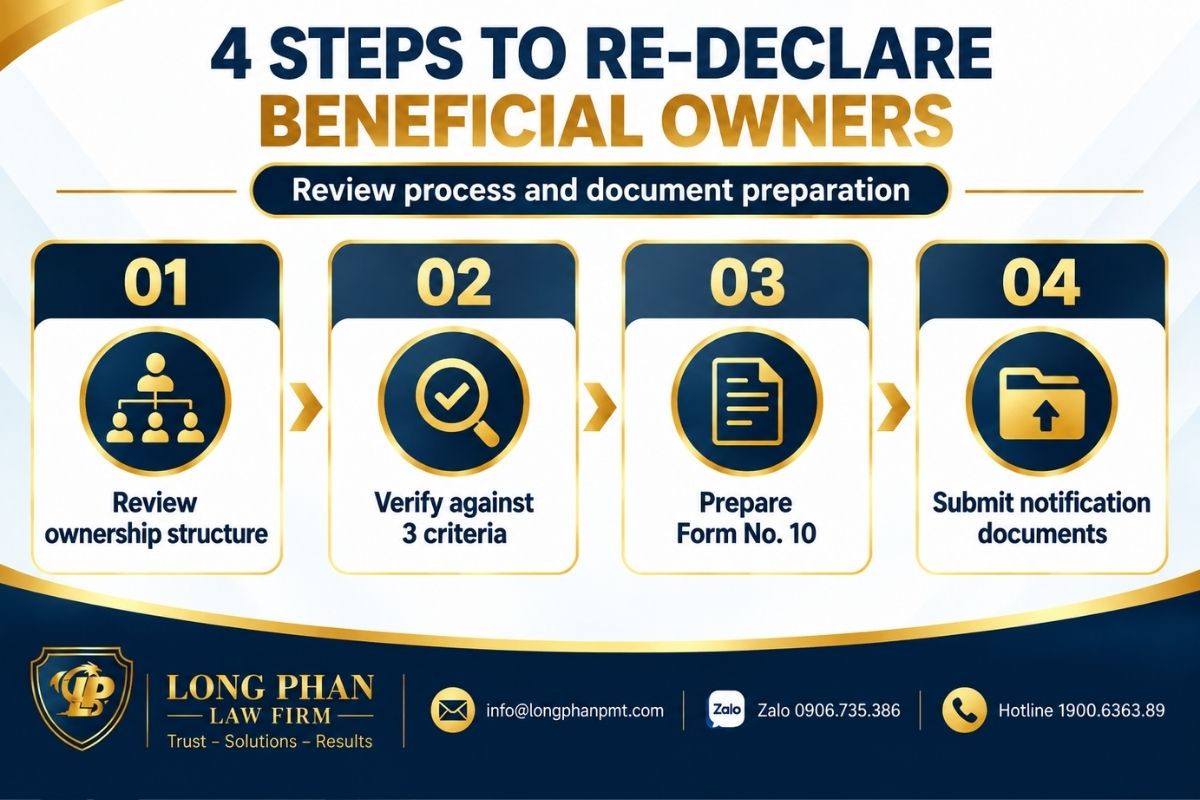
Article 18 of Decree 168/2025/ND-CP, as amended by Article 4 of Decree 296/2026/ND-CP, establishes a declaration sequence of three steps corresponding to the three clauses of Article 17. Enterprises with state capital must complete all three steps in order, while correctly applying the exclusion at each step to avoid incorrectly declaring a state capital representative.
The enterprise first declares and notifies the Business Registration Authority of the individual meeting the 25% ownership criterion under Clause 1, Article 17, based on Point a, Clause 2, Article 18. This step applies only to capital outside state ownership. The state capital portion, and the individual representing it, has already been excluded from the beneficial owner definition from the outset of Article 17.
The enterprise must consider all four types of ownership: direct ownership, indirect ownership through an intermediary organization, family relationship groups, and groups jointly owning capital under contract.
Where no individual meets the ownership criterion at Step 1, or where there are grounds indicating that the individual reaching the ownership threshold is not the true beneficiary, the enterprise proceeds to declare one or more individuals meeting the actual control criterion under Clause 2, Article 17. Control arising from the state capital representative capacity, such as voting rights exercised under authorization from the ownership representative agency, is not counted at this step, because the representative already falls outside the beneficial owner concept from the outset.
Where no individual meets the criteria at either Step 1 or Step 2, Point c, Clause 2, Article 18 requires the enterprise to declare the individual described in Clause 3, Article 17, namely the managing individual with the highest authority to act on the enterprise’s behalf. This is the final fallback method, intended to prevent an enterprise from declaring that no beneficial owner exists at all. However, Clause 3, Article 17 expressly excludes individuals representing state capital in the enterprise. Even where a state capital representative holds the position of Chairman of the Board of Directors or General Director, the enterprise cannot declare this person under Step 3.
Errors in beneficial ownership declarations at enterprises with state capital are not merely administrative mistakes. The three risk groups below arise directly from the presence of state capital within the ownership structure and require more careful review than for purely private enterprises.
This is a common error where an enterprise mechanically applies Step 3 (identifying the senior managing official) without reviewing the exclusion under Clause 3, Article 17. Inaccurate declaration of beneficial ownership information in the business registration dossier may be subject to a fine of VND 30,000,000 to VND 70,000,000 for organizations, under Article 43 of Decree 122/2021/ND-CP as amended and supplemented by Decree 288/2026/ND-CP, effective from 21 July 2026. The fine for individuals is one-half of the fine applicable to organizations.
Enterprises with state capital sometimes assume that state-controlled capital removes the need to declare beneficial ownership at all, resulting in a complete omission of the declaration obligation for private shareholders reaching the 25% threshold. Under Point c, Clause 4, Article 46 of Decree 122/2021/ND-CP (supplemented by Decree 288/2026/ND-CP), failing to declare beneficial ownership information at the time of enterprise establishment registration is subject to a fine of VND 50,000,000 to VND 100,000,000 for organizations, together with a remedial measure requiring the enterprise to supplement the information as required.
The obligation to determine beneficial ownership does not arise only once at the time of establishment registration. Under Clause 1, Article 18 of Decree 168/2025/ND-CP (as amended by Decree 296/2026/ND-CP), the enterprise has a continuing responsibility to review every level of the ownership structure whenever changes occur, such as a transfer of privately held shares, a capital increase or decrease, or a change in a shareholder agreement affecting control. An enterprise established before 1 July 2025 that fails to supplement beneficial ownership information when carrying out its most recent business registration change procedure may be fined VND 70,000,000 to VND 100,000,000 under Clause 6, Article 44 of Decree 122/2021/ND-CP (as amended by Decree 288/2026/ND-CP). Failing to honestly report beneficial ownership information when requested by a competent authority is also separately penalized under Article 48 of this Decree.
Facing the risk of a fine of up to VND 100 million and the possibility of document rejection due to using incorrect forms, many businesses choose to authorize lawyers to handle the entire process of re-declaring beneficial owners. Long Phan Consulting supports businesses with:
Clients may send their case documents via email info@longphanpmt.com or Zalo 0906.735.386 for a preliminary assessment.
Below are some common issues businesses encounter when carrying out the re-declaration of beneficial owners.
Yes. For a single-member limited liability company, the individual who owns the company is always identified as the beneficial owner, regardless of the specific ownership ratio. The business must still declare this information using Form No. 10 under Circular No. 121/2026/TT-BTC when registering establishment or changes to business registration contents, pursuant to Point c Clause 1 Article 18 of Decree No. 168/2025/ND-CP.
The business must continue reviewing the control rights criteria under Point b Clause 1 Article 17 of Decree No. 168/2025/ND-CP. These criteria include the right to appoint or dismiss key personnel, amend the company charter, decide on organizational restructuring, or dissolve the enterprise, rather than relying solely on ownership percentage.
Incorrect or late declaration is generally subject to administrative penalties and mandatory supplementation under Decree No. 122/2021/ND-CP, as amended by Decree No. 288/2026/ND-CP. The Enterprise Registration Certificate may only be revoked if the declared information is determined to be fraudulent under Article 212 of the Law on Enterprises 2020.
Yes. Article 17 of Decree No. 168/2025/ND-CP does not exclude individuals based on nationality. A foreign individual shareholder who meets the ownership threshold of 25% of charter capital, voting shares, or has controlling rights over the enterprise must also be declared as a beneficial owner, similar to a domestic shareholder.
Enterprises established from August 21, 2026 must declare beneficial owner information at the time of establishment registration using Form No. 10 issued together with Circular No. 121/2026/TT-BTC. Form No. 11 under Circular No. 68/2025/TT-BTC is no longer applicable because it has been abolished.
No. Beneficial owner information is not automatically disclosed in the same manner as founding shareholder information. Decree No. 168/2025/ND-CP requires the business registration authority to retain beneficial owner information for state management purposes. The provision of such information to third parties must comply with current regulations on access to enterprise registration data.
The core principle when handling beneficial owner declaration is that businesses only need to re-declare beneficial owners when actual ownership information changes or when carrying out procedures for changing business registration contents from August 21, 2026 onward. The adjustment of identification criteria under Decree No. 296/2026/ND-CP does not automatically require businesses to review all previous records. However, businesses should proactively update information using the correct Form No. 10 to avoid fines of up to VND 100 million or document rejection. If you have concerns regarding the re-declaration of beneficial owners for your specific business case, Long Phan Consulting is available to provide support via hotline 1900636389.
📚 This article is professionally consulted based on the following legal documents:


