
Projects Requiring an Environmental Impact Assessment (EIA) must be identified early when they fall under Group I or Group II and involve environmentally sensitive factors. Failure to complete the EIA process may delay investment policy approval, construction licensing, trial operation, and the issuance of an environmental permit. Investors should assess project type, scale, capacity, location, and reporting obligations during the preparation phase to prevent costly redesigns, administrative sanctions, or project suspension.
These Legal Updates should be reviewed before capital allocation, EPC contract signing, or construction commencement with Long Phan Consulting.
Important legal note:
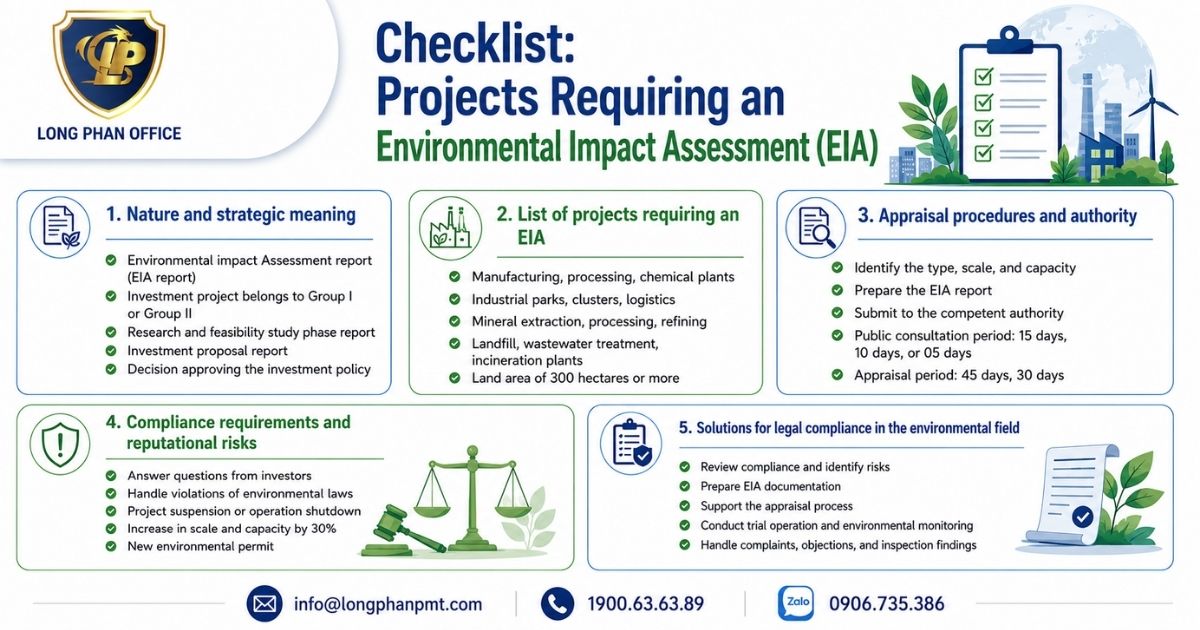
Investors must initiate the obligation to prepare an Environmental Impact Assessment report at the inception of project development. This is not merely a technical environmental document but a critical risk control condition prior to navigating the project’s sequence of investment approvals, feasibility appraisals, construction permitting, and commercial operation.
An EIA report empowers enterprises to identify, forecast, and design measures to mitigate negative environmental impacts. Pursuant to Clause 7, Article 3 of the 2020 Law on Environmental Protection, this is the process of analyzing, assessing, identifying, and forecasting the environmental impacts of an investment project to propose measures that minimize adverse effects.
Key milestones that must be managed include:
Failure to identify or delaying this EIA obligation may result in skewed capital disbursement schedules, necessitating extensive amendments to investment dossiers and the loss of commercial leverage when negotiating with contractors, banks, or M&A partners.
The obligation to prepare an Environmental Impact Assessment (EIA) report is not determined by the commercial name of the project, but by its scale, capacity, type, and implementation location. Enterprises must accurately classify their projects during the pre-feasibility stage to avoid inadequate dossiers, submission to the wrong authorities, or design adjustments after capital has been allocated.
Pursuant to Points a and b, Clause 1, Article 30 of the 2020 Law on Environmental Protection, the groups required to conduct an EIA include Group I investment projects and Group II investment projects with environmentally sensitive factors.
| Project Group | Risk Identification Criteria | Compliance Consequence |
| Group I Investment Projects | High risk of negative environmental impact, typically associated with industry, scale, capacity, or sensitive locations. | Must verify EIA obligations from the project preparation stage. |
| Group II Investment Projects with Sensitive Factors | Environmental risk is lower than Group I but involves sensitive factors regarding location, resources, or affected areas. | Must prepare an EIA if falling under statutory conditions. |
| Projects not in the above groups | Does not meet mandatory criteria for EIA based on risk classification. | Must review other environmental obligations, such as Environmental Licenses or Environmental Registration. |
Project classification is based directly on scale, capacity, and environmental sensitivity factors at the project site, pursuant to Clause 1, Article 28 of the 2020 Law on Environmental Protection. This serves as the foundational step for determining the entire subsequent licensing roadmap.
>>> See more: Investment projects according to environmental criteria
Industrial projects with large discharge flows, complex technologies, or high risks of pollution must be reviewed for EIA requirements at an early stage. If evaluated solely based on registered business lines, enterprises may overlook risks stemming from capacity, input materials, and waste treatment technologies.
Groups requiring careful inspection typically include:
These groups must be cross-referenced with the lists in Appendix III and Appendix IV of Decree No. 08/2022/NĐ-CP (as amended and supplemented by Decree No. 48/2026/NĐ-CP). When food processing or textile dyeing factories increase their scale, the risk of having to re-prepare an EIA must be managed before signing machinery contracts.
Infrastructure and real estate projects are often erroneously assumed to only require land, planning, and construction checks. In reality, EIA obligations can become a bottleneck if the project generates significant wastewater flow, population density, traffic infrastructure, or major community impacts.
Project groups requiring review include:
For new urban area projects, the answer does not lie in the name “urban area,” but in the specific environmental risk classification. Investors must cross-reference scale, capacity, and sensitive factors before submitting investment dossiers or construction permits.
Projects involving mineral extraction, construction material production, or the use of sensitive land funds carry higher legal risks than standard projects. Factors such as forest land, rice cultivation land, water surfaces, coastal areas, or conservation zones can alter the project group and EIA obligations.
Regarding the criteria for land or water surface use scale, the law classifies project levels based on specific area:
These thresholds are stipulated in Point b, Clause 1, Article 25 of Decree No. 08/2022/NĐ-CP (as amended and supplemented by Decree No. 48/2026/NĐ-CP). For mineral extraction projects or projects involving the conversion of forest land or rice cultivation land, enterprises should review the EIA in parallel with land dossiers, planning, and specialized permits.
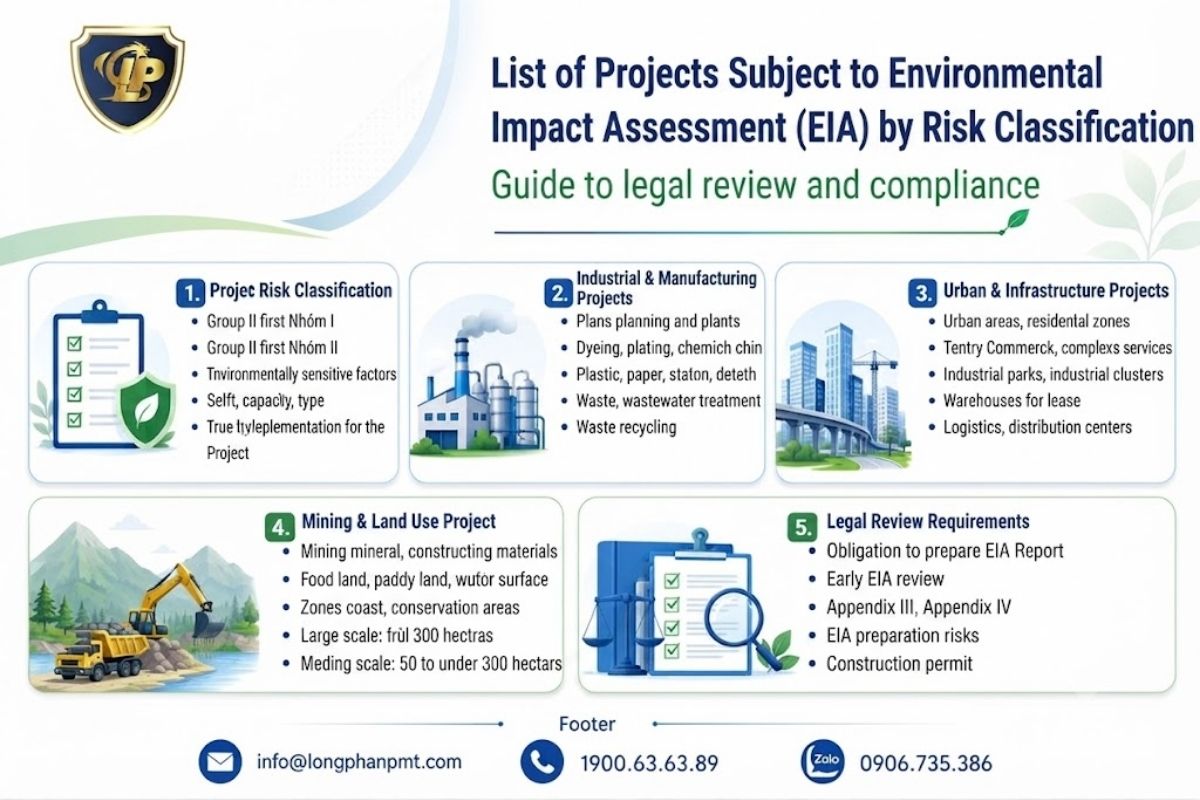
Investors must treat the appraisal of an Environmental Impact Assessment (EIA) report as an independent milestone within the project’s legal timeline. Submitting dossiers late or to the incorrect authority can cause procedural flows for investment, construction, and environmental licensing to extend beyond the planned capital expenditure schedule.
The EIA dossier must be prepared based on authentic data regarding project type, capacity, technology, location, and discharge sources. The dossier for appraisal includes the application form, the Environmental Impact Assessment report, and the Feasibility Study Report or equivalent documentation, pursuant to Clause 1, Article 34 of the 2020 Law on Environmental Protection.
Implementation procedures should be controlled via the following steps:
Public consultation is more than a procedural step. It serves as a control point for community complaints, environmental disputes, and the risk of being required to adjust waste treatment plans.
Enterprises must correctly identify the appraisal agency before submission. Decentralizing authority to local levels streamlines processing but increases the requirements for on-site inspection of location, land area, and project characteristics.
The Chairperson of the Provincial People’s Committee is delegated the authority to appraise Environmental Impact Assessment reports for various project groups, including Group II projects, public investment projects not under Central authority, and specific unique projects. This is established under Clause 1, Article 26a of Decree No. 08/2022/NĐ-CP (as amended and supplemented by Decree No. 48/2026/NĐ-CP).
Appraisal timelines must be integrated into the project’s legal schedule from the outset:
These timelines are stipulated in Points a and b, Clause 6, Article 34 of the 2020 Law on Environmental Protection. For multi-provincial projects, enterprises must identify the locality with the largest land use area to avoid administrative filing errors.
Violating Environmental Impact Assessment (EIA) obligations creates risks far beyond environmental administrative penalties. For investment projects, this non-compliance can fracture the licensing chain, delay capital disbursement, increase contractor costs, and degrade the legal value of project assets.
The decision approving the results of the EIA appraisal serves as a vital legal foundation for a project to proceed to dependent procedures. Absent this approval, dossiers for feasibility study appraisals, construction permits, or environmental licenses may be blocked during condition-checking phases.
Pursuant to Clause 1, Article 36 of the 2020 Law on Environmental Protection, the EIA appraisal approval serves as the basis for competent authorities to perform related procedures, including feasibility study appraisal and the issuance of mineral exploitation licenses.
Greater risks emerge when projects modify their scale after environmental dossiers have been established. If a project increases its scale or capacity by 30% or more, resulting in increased negative environmental impacts, the investor may be compelled to re-prepare the EIA, pursuant to Point a, Clause 2, Article 27 of Decree No. 08/2022/NĐ-CP (as amended and supplemented by Decree No. 05/2025/NĐ-CP).
Projects that have commenced construction without an approved EIA appraisal result may be treated as a material compliance violation. Consequences extend beyond monetary fines, directly affecting the conditions for continued construction, trial operation, and obtaining an environmental license.
Investment projects already implemented or facilities in operation without an approved EIA appraisal decision shall be subject to administrative penalties in the field of environmental protection, pursuant to Clause 14, Article 168 of Decree No. 08/2022/NĐ-CP (as amended and supplemented by Decree No. 48/2026/NĐ-CP).
Following the handling of violations, investors may only prepare dossiers for an environmental license if the project remains consistent with planning and environmental zoning, pursuant to Clause 14, Article 168 of Decree No. 08/2022/NĐ-CP (as amended and supplemented by Decree No. 48/2026/NĐ-CP). Investors must also fully implement the requirements set forth in the EIA approval decision throughout the implementation process. Failure to comply may lead to the suspension of construction or operation, pursuant to Clause 2, Article 37 of the 2020 Law on Environmental Protection.
For businesses undergoing M&A of factories, industrial parks, or unfinished projects, the old EIA report needs to be assessed as a legal asset. If the old decision is still valid and carry-over, the buyer can save considerable time and costs in re-preparing the report.
Decisions approving environmental impact assessment reports or equivalent documents issued before the new law came into effect are still recognized as equivalent to decisions approving the results of the environmental impact assessment report review, according to Clause 2, Article 171 of the 2020 Law on Environmental Protection.
Group I investment projects have undergone environmental impact assessment (EIA) review and approval without requiring revisions, or have been approved within the specified timeframe 24 months prior to the effective date of Decree No. 08/2022/ND-CP, preliminary environmental impact assessments were not required, according to Clause 9, Article 168 of Decree No. 08/2022/ND-CP, as amended and supplemented by Decree No. 05/2025/ND-CP.
In project transfer transactions, businesses need to verify the compatibility between the old Environmental Impact Assessment (EIA), the current operational status, and the environmental permit. Discrepancies between the documentation and reality can reduce the value of the transaction or create remediation obligations after the transfer.
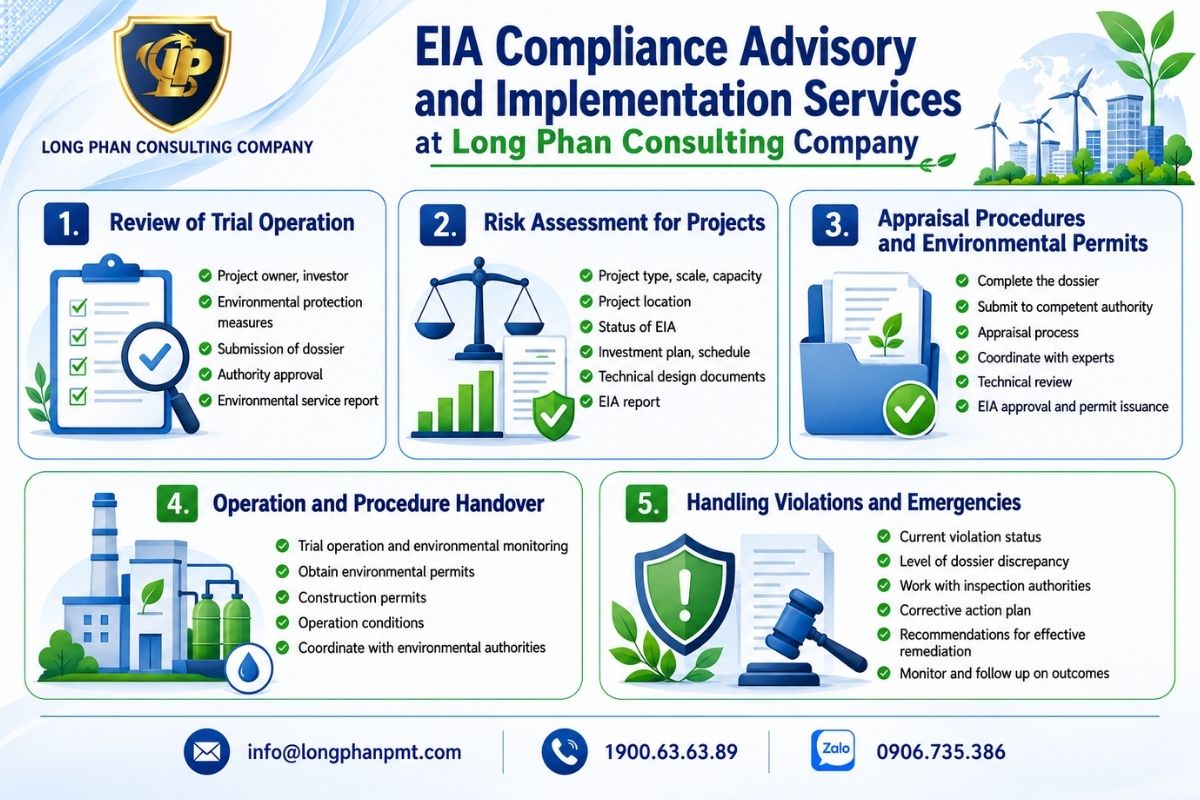
The Environmental Impact Assessment (EIA) obligation requires coordination between legal, environmental engineering, investment, construction, and project operation departments. Long Phan Consulting Company assists enterprises in managing risks from the document preparation stage until the project satisfies conditions for commercial operation.
This review service is designed for investors, M&A partners, and legal departments needing to swiftly determine if a project is subject to EIA requirements. We focus on mitigating risks related to improper dossier submission, incorrect jurisdictional filing, or overlooked environmental obligations:
The appraisal phase requires consistent documentation, robust technical data, and a clear explanatory strategy. Discrepancies between reports, design, and physical status can prolong processing times:
For projects that have commenced construction or operation without completing the EIA, our objective extends beyond resolving the violation. We provide a legal roadmap for remediation to avoid prolonged suspension:
Enterprises may submit project dossiers via Email: info@longphanpmt.com or Zalo: +84 906 735 386 for a preliminary evaluation by Long Phan Consulting Company.
Many projects requiring environmental impact assessments (EIAs) are delayed not due to a lack of funding, but because of incorrect project classification or submission of documents at the wrong time. The questions below focus on common business scenarios encountered when applying for investment approvals, construction permits, environmental permits, or legal due diligence for M&A.
Yes, new urban area projects must prepare an Environmental Impact Assessment Report if they fall under Group I or Group II investment projects with environmentally sensitive elements. Businesses should not assess based on the project name, but rather review the scale, capacity, and sensitive elements at the implementation site. The EIA obligation applies according to Points a and b, Clause 1, Article 30 of the 2020 Environmental Protection Law and the classification criteria according to Clause 1, Article 28 of the 2020 Environmental Protection Law.
Food processing or textile dyeing factories must conduct an Environmental Impact Assessment (EIA) when the project falls under Group I or Group II, which involves environmentally sensitive elements. Businesses need to verify the type of production, capacity, technology, wastewater, emissions, and waste generated before approving the investment plan. Industries with a risk of pollution are reviewed according to Appendix III and Appendix IV of Decree No. 08/2022/ND-CP, as amended and supplemented by Decree No. 48/2026/ND-CP.
Businesses must check their environmental impact assessment (EIA) obligations from the project preparation stage, not waiting until construction begins. Preliminary environmental impact assessments must be conducted during the pre-feasibility study or investment project proposal phase, according to Clause 2, Article 29 of the 2020 Environmental Protection Law. The official environmental impact assessment report must be prepared concurrently with the feasibility study report or equivalent document, according to Clause 1, Article 31 of the 2020 Environmental Protection Law.
The maximum time limit for environmental impact assessment (EIA) review is 45 days for Group I projects and 30 days for Group II projects with environmentally sensitive elements. Businesses need to include these milestones in their legal progress, capital progress, and construction plan. The review period is stipulated in Points a and b, Clause 6, Article 34 of the 2020 Law on Environmental Protection. The review council must have at least 7 members as stipulated in Point a, Clause 3, Article 34 of the 2020 Law on Environmental Protection.
Community consultation is mandatory if the project directly impacts the local community, relevant agencies, or organizations. Project owners must conduct consultations in accordance with Clause 1, Article 33 of the 2020 Environmental Protection Law. The electronic consultation posting period is 15 days for Group I projects, 10 days for Group II projects, and 5 days for projects in concentrated production, business, and service zones or industrial clusters, as stipulated in Point a, Clause 3, Article 26 of Decree No. 08/2022/ND-CP, amended and supplemented by Decree No. 05/2025/ND-CP.
Projects under construction or operating facilities that have not yet received approval for the Environmental Impact Assessment (EIA) will be subject to administrative penalties for environmental violations. After the violation is processed, the enterprise may only submit an application for a permit if the project remains in accordance with the planning. The handling mechanism is stipulated in Clause 14, Article 168 of Decree No. 08/2022/ND-CP, amended and supplemented by Decree No. 48/2026/ND-CP. Violations may also lead to suspension of implementation or operation according to Clause 2, Article 37 of the 2020 Law on Environmental Protection.
Investors need to check the previous Environmental Impact Assessment (EIA) approval decision, project scope, actual capacity, and the usability of the old documents to apply for an environmental permit. Environmental impact assessment report approval decisions or equivalent documents issued before the new law are still recognized as equivalent documents, according to Clause 2, Article 171 of the 2020 Law on Environmental Protection. Group I projects approved within 24 months before the effective date of Decree No. 08/2022/ND-CP may be exempt from preliminary assessment, according to Clause 9, Article 168 of Decree No. 08/2022/ND-CP, as amended and supplemented by Decree No. 05/2025/ND-CP.
Projects subject to an Environmental Impact Assessment (EIA) require review from the investment preparation stage to accurately identify reporting obligations, appraisal jurisdiction, and implementation timelines. For investors, errors in project classification, public consultation, or post-approval compliance can delay construction permits, trial operations, and environmental licenses. Enterprises should perform an internal dossier audit before signing construction contracts, accepting project transfers, or expanding capacity. Please contact our Hotline at 1900636389 for compliance roadmap assistance from Long Phan Consulting Company.
📚 This article has been professionally reviewed based on the following legal documents: