
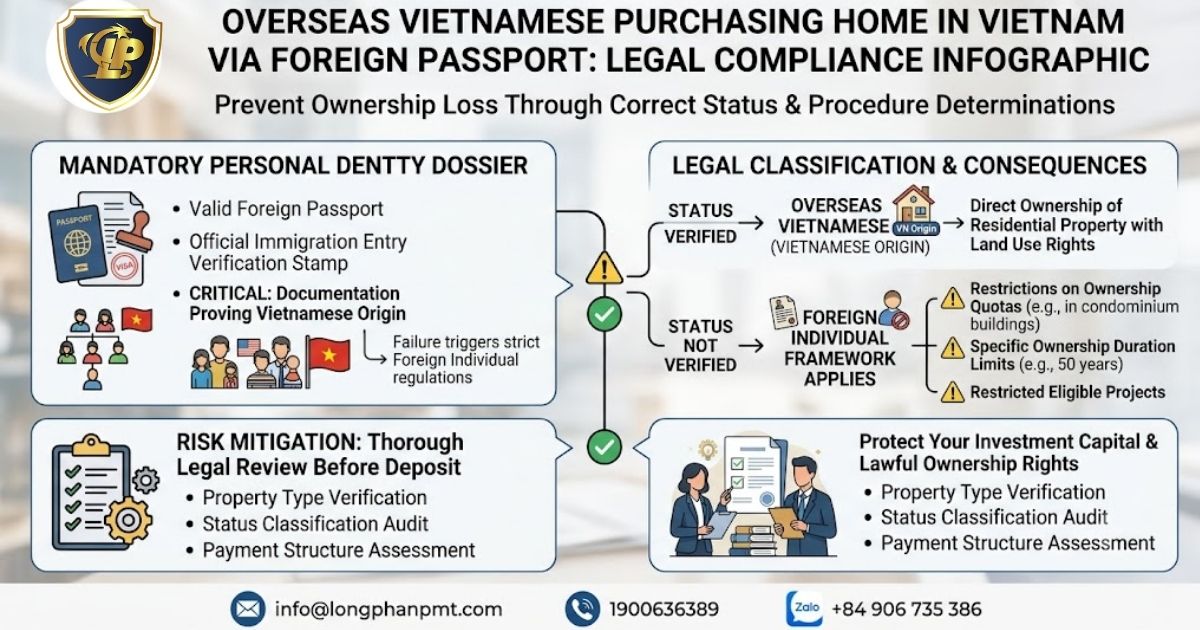
Overseas Vietnamese purchasing home with a foreign passport may face ownership registration risks if legal status, property eligibility, or payment arrangements are not properly verified. Under the Law on Houses, Vietnamese citizens residing abroad should hold a valid passport, entry confirmation, and documents proving Vietnamese origin. Without sufficient proof, the transaction may be treated under rules for foreign individuals, including limits on ownership ratios, ownership term, and eligible projects. Long Phan Consulting advises buyers to conduct a legal review before making deposits to protect investment capital and lawful ownership rights.
Key legal notes:
Overseas Vietnamese utilizing foreign passports do not automatically lose their rights to acquire real estate in Vietnam. Material legal and financial risks typically materialize when a transaction is misclassified between an “Overseas Vietnamese residing abroad” and a “Foreign individual.”
This baseline statutory classification directly dictates the permitted scope of real estate assets available for acquisition, the permissible duration of ownership, statutory volume caps, and final eligibility for a land use rights certificate. Property developers, brokerages, and notary practice organizations must strictly verify the buyer’s precise statutory status prior to accepting any commercial deposits.
Purchasers presenting foreign passports must be accurately categorized at the earliest stage of the transaction. This classification serves as the foundational legal prerequisite for establishing real estate ownership rights, executing lawful transfers, and processing title registration.
| Subject Classification | Mandatory Personal Documentation | Core Legal Implications |
| Overseas Vietnamese Residing Abroad (of Vietnamese Origin) | Valid foreign passport, an official entry verification stamp, and a certified document verifying Vietnamese origin. | Granted broader structural rights, including the direct acquisition of residential properties linked to residential land use rights. |
| Foreign Individuals (Unable to Prove Vietnamese Origin) | Valid foreign passport, an official entry verification stamp, and a written commitment confirming non-entitlement to diplomatic immunities. | Strictly restricted by property types, total volume limits, specific ownership durations, and authorized geographic zones. |
Pursuant to Point b, Clause 2, Article 3 of Decree No. 95/2024/ND-CP, the identity dossier for an Overseas Vietnamese residing abroad must contain an official document confirming their Vietnamese origin. Furthermore, the foreign passport must be valid and bear a clear entry verification stamp executed by immigration authorities at the time of entering into the transaction, as mandated by Point c, Clause 3, Article 3 of Decree No. 95/2024/ND-CP.
In instances where a purchaser cannot legally prove their Vietnamese origin, the transaction is strictly governed by the regulatory framework applicable to foreign individuals. The structural prerequisites for such transactions include a valid passport with an official entry stamp and a formal written commitment confirming that the buyer does not enjoy diplomatic privileges or immunities, pursuant to Point c, Clause 2 and Point d, Clause 3, Article 3 of Decree No. 95/2024/ND-CP.
The specific category of real estate selected for acquisition represents the most frequent point of confusion in overseas transactions. Presenting a foreign passport does not grant an open-ended right to acquire all forms of real estate, particularly raw un-demarcated land plots situated outside structured development projects.
| Subject Classification | Accessible Asset Categories | Material Regulatory Constraints |
| Overseas Vietnamese Residing Abroad | Residential housing attached to land use rights; residential land use rights within structured housing development projects. | Legal rights do not extend to the purchase of raw land plots or subdivided plots outside formal developer projects. |
| Foreign Individuals | Commercial apartments or detached houses situated strictly within approved commercial housing development projects. | Acquisitions must be located outside geographical areas designated for national defense and security. |
Pursuant to Point h, Clause 1, Article 28 of the Law on Land 2024, Overseas Vietnamese residing abroad are legally entitled to acquire residential land use rights within structured housing development projects. However, this statutory mechanism must not be misinterpreted as an authorization to receive transfers of standard land use rights under subdivided plots or land lots located outside formal real estate projects.
Concurrently, foreign individuals are strictly restricted to purchasing or lease-purchasing commercial housing units within approved housing development projects. The underlying real estate project must be explicitly certified as lying outside national defense and security assurance areas, pursuant to Clause 1, Article 16 and Point b, Clause 2, Article 17 of the Law on Housing 2023.
The statutory volume caps governing foreign individuals remain highly restrictive. The maximum allowable threshold is capped at 30% of the total apartments in a single condominium building, or a maximum of 250 detached residential houses within a geographic boundary equivalent to a ward-level administrative unit, as set forth in Clause 1, Article 19 of the 2023 Law on Housing.
Furthermore, the statutory ownership duration for foreign individuals is capped at a maximum of 50 years from the date of issuance of the land use rights certificate. A single extension may be granted for a period not exceeding an additional 50 years, provided all statutory criteria are met, pursuant to Point c, Clause 2, Article 20 of the 2023 Law on Housing.
Planning modifications concerning national defense and security zones can completely eliminate a developer’s capacity to sell real estate portfolios to foreign buyers. Project developers must rigorously monitor their asset allocations before, during, and after commercial launch phases.
When an active project is formally reclassified as falling within a national defense and security assurance area, the transaction must be processed according to the following mandatory principles:
These provisions impose a strict fiduciary obligation on project developers and real estate trading floors to manage client allocations. Executing sales to an ineligible client pool invalidates the transaction and subjects the developer to direct liabilities for damages.
Home purchases by Vietnamese expatriates are not solely dependent on price agreements and deposits. Personal documents, immigration status, and payment cash flow determine the likelihood of notarization, transfer of ownership, and protection of property rights.
Before signing the contract, the developer, broker, and notary public must simultaneously verify the buyer’s qualifications and the property’s condition. Any deficiencies may result in the application being rejected during the registration phase.
Personal identification documents are the first line of control in transactions involving foreign nationals. For Vietnamese citizens residing abroad, the documents must prove legal entry status and provide proof of Vietnamese origin.
The order in which to prepare the application documents should be reviewed according to the following document groups:
If the buyer cannot prove their Vietnamese origin, the application will be transferred to the foreign individual category. In that case, the buyer must also provide a written commitment stating that they are not entitled to diplomatic privileges or immunities, as stipulated in Point d, Clause 3, Article 3 of Decree No. 95/2024/ND-CP.
The cash flow for purchasing a home is crucial evidence for protecting property rights. Incorrect payment methods can make it difficult to prove the source of funds, resolve disputes, and handle the transaction when reselling the property.
For foreign individuals purchasing or leasing housing in Vietnam, payments must be made through a credit institution or a branch of a foreign bank operating in Vietnam, as stipulated in Point c, Clause 2, Article 21 of the 2023 Housing Law.
The principles for controlling cash flow should be established right from the deposit agreement:
Payment control serves not only the purpose of fulfilling payment obligations. It also acts as a layer of evidence to protect investors in case of disputes arising from transactions involving nominees, disputes over jointly owned property, or claims for refunds due to ineligible transactions.
The process of transferring ownership to Vietnamese citizens residing abroad needs to be scrutinized before signing the deposit agreement. If the project, contract, or personal documents do not meet the requirements, the transaction may be stalled at the notarization or registration stage.
For developers and real estate agencies, this is a process for managing the legal risks of the product. For investors, it serves as a basis for protecting cash flow and ownership rights after payment is completed.
Before making a transaction, investors need to determine whether the property is eligible for sale. Signing a deposit agreement when the project is not yet eligible for sale can lead to disputes over refunds and compensation.
The legal review process for a project should follow these steps:
Project appraisal is not just about checking paperwork. It’s a step to eliminate the risk of buying the wrong product, buying into a project that doesn’t meet the requirements, or a project that isn’t permitted to be sold to foreign individuals.
Once the project meets the transaction requirements, the sales contract must be properly formatted and suitable for the transfer of ownership registration procedure. Missing required documents will delay the issuance of the Certificate of Ownership.
The vehicle ownership transfer registration process should be carried out in the following order:
Certificates issued in accordance with regulations before the new Land Law came into effect remain legally valid. Investors are not required to switch to the new form, Clause 3, Article 256 of the 2024 Land Law.

The most substantial exposures in cross-border property acquisitions do not occur during the initial contract signing phase. Instead, structural risks routinely emerge from attempts to bypass statutory ownership criteria, utilizing non-compliant payment channels, or entering into informal nominee arrangements with local relatives.
These real estate disputes are exceptionally difficult to resolve because the initial transaction records almost always lack verified documentary evidence. International investors must embed rigorous legal defense mechanisms directly into their preliminary deposit agreements rather than waiting until a land registration agency rejects a title transfer application.
Appointing parents, siblings, or local associates to hold property titles on one’s behalf represents an extraordinarily high-risk asset exposure. When ownership disputes inevitably materialize, the investor who financed the acquisition bears the heavy burden of proving the exact source of funds, the existence of an internal ownership agreement, and the underlying protective intent of the nominee structure.
In the absence of an explicit, legally binding power of attorney, comprehensive bank transfer statements, and notarized asset acknowledgments, reclaiming the land use rights is immensely difficult. Within Vietnamese judicial practice, a land use rights certificate constitutes primary, formidable evidence establishing the absolute ownership rights of the registered title holder.
Investors must mitigate these asset exposures by implementing the following protective measures:
The most secure strategy remains holding the property deed directly in your own name if you fulfill the statutory requirements. Utilizing a nominee title holder must be treated strictly as a last resort and must be insulated by an airtight, legally enforceable evidentiary trail.
Real estate assets situated in Vietnam frequently become highly contested targets when a marriage involves foreign elements. Regulatory exposure escalates dramatically if the source of investment capital, the exact date of acquisition, and the governing spousal property regime are not legally formalized prior to closing.
A marriage and family relationship is statutorily classified as involving a foreign element when at least one contracting party is a foreign national or an Overseas Vietnamese residing abroad, pursuant to Clause 25, Article 3 of the Law on Marriage and Family.
Corporate asset managers and individual buyers must audit the following pillars prior to purchase:
In the event of a divorce between a Vietnamese citizen and a foreign national, or between two foreign nationals permanently residing within the territory of Vietnam, competent local courts retain exclusive jurisdiction to resolve disputes concerning real estate assets located in Vietnam, under Clause 1, Article 127 of the Law on Marriage and Family.
Executing a transaction on an unauthorized real estate format will completely block a title transfer, even if the purchaser has settled all financial obligations in full. This structural failure occurs frequently when buyers acquire raw land plots, properties situated outside structured commercial projects, or developments that have not secured market-entry clearances.
Pursuant to Clause 3, Article 7 of Decree No. 95/2024/ND-CP, where a transaction exceeds statutory volume caps or involves a development restricted from foreign ownership, the underlying contract is deemed legally void, and no land use rights certificate will be issued. Under these circumstances, the selling or lease-purchasing entity is legally required to provide full compensation for all verified losses suffered by the buyer.
Furthermore, if a foreign individual’s statutory 50-year ownership duration expires and they fail to execute a valid sale or donation transaction, the housing asset automatically reverts to public ownership. This serves as an immediate statutory sanction for failing to liquidate or transfer the asset within the prescribed timelines, under Point d, Clause 2, Article 20 of the 2023 Law on Housing.
In scenarios where a foreign owner faces an official deportation or expulsion order from competent state bodies, their real estate assets within Vietnam will be forcibly processed and liquidated in strict compliance with formal administrative enforcement decrees, pursuant to Point d, Clause 2, Article 21 of the 2023 Law on Housing.
Investors must perform an exhaustive evaluation of the property classification, the remaining foreign ownership quotas, and the project’s regulatory approvals before placing a deposit. Conducting an audit after funds are transferred severely diminishes an investor’s leverage and significantly reduces the probability of capital recovery.
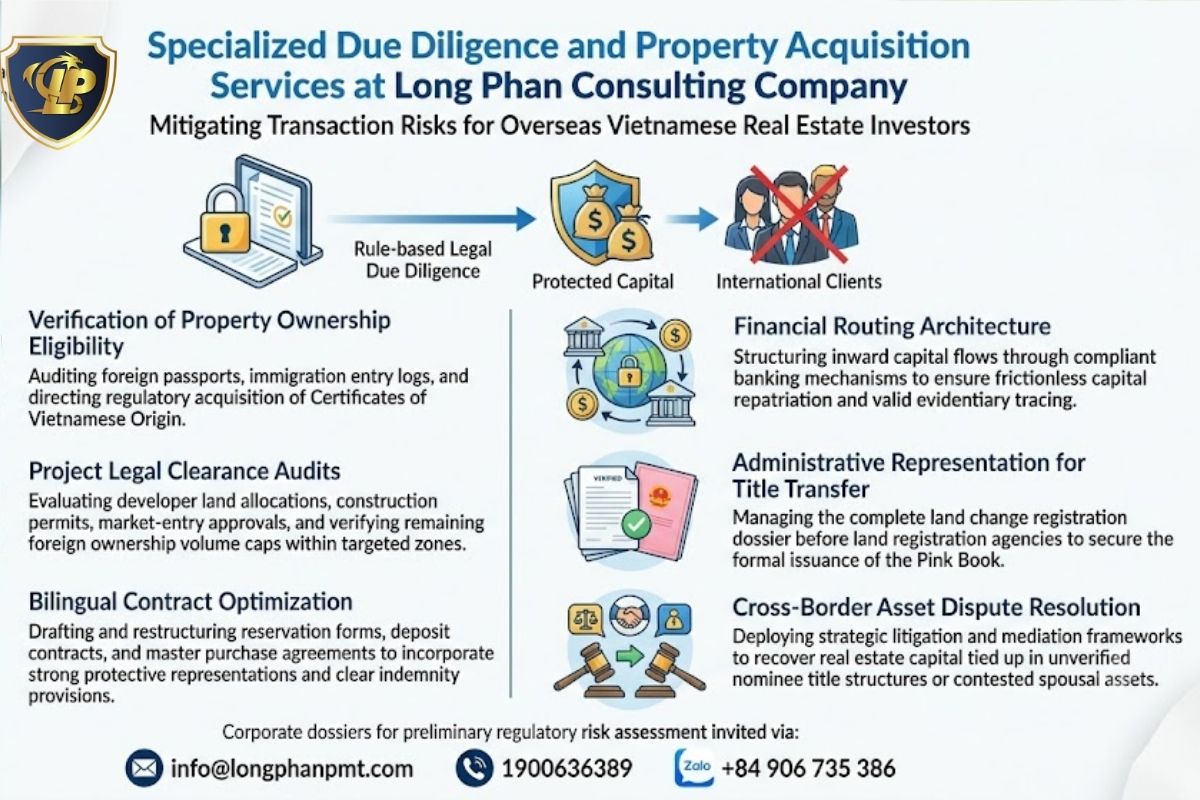
Cross-border real estate acquisitions by Overseas Vietnamese require concurrent verification of immigration status, certified ancestry documentation, property compliance, and strict adherence to banking regulations. Long Phan Consulting Company mitigates these multi-layered transaction risks through rigorous legal due diligence, protecting your capital before you execute binding deposit commitments or enter non-compliant nominee arrangements.
Our senior real estate attorneys guide international corporate clients and high-net-worth investors through the following specialized workstreams:
Foreign investors, C-suite executives, and multinational enterprises requiring a preliminary regulatory risk assessment of their local licensing frameworks are invited to submit their corporate dossiers via Email at info@longphanpmt.com or through Zalo and WhatsApp at +84 906 735 386 for immediate evaluation.
Overseas Vietnamese purchasing home using foreign passports often face risks in borderline situations, such as lacking proof of Vietnamese origin, purchasing the wrong type of property, or incorrect payment flow. The following questions focus on bottlenecks that can prevent the transaction from being transferred, prevent the issuance of a Certificate of Ownership, or result in liability for compensation.
Yes, buyers who cannot prove their Vietnamese origin will be subject to the regulations for foreign individuals in housing transactions. Vietnamese nationals residing abroad must possess a valid foreign passport, an entry stamp, and documents confirming their Vietnamese origin, as stipulated in Points b and c, Clause 2, Clause 3, Article 3 of Decree No. 95/2024/ND-CP. The lack of these documents restricts ownership rights and the types of properties that can be purchased.
Yes, a valid entry stamp is a mandatory personal requirement when buyers use foreign passports to establish housing transactions in Vietnam. For Vietnamese citizens residing abroad, the passport or international travel document must be valid and bear an entry stamp at the time of signing the transaction, as stipulated in Points b and c, Clause 2, Clause 3, Article 3 of Decree No. 95/2024/ND-CP.
No, Vietnamese people residing abroad should not understand the right to buy a house as the right to acquire all types of land. Vietnamese people are only entitled to land use rights in housing development projects, according to Point h, Clause 1, Article 28 of the 2024 Land Law. Foreign individuals are only allowed to purchase commercial housing in projects not located in areas requiring national defense and security protection, according to Clause 1, Article 16 and Point b, Clause 2, Article 17 of the 2023 Housing Law.
Developers must control the foreign ownership limit before signing contracts for the purchase or lease of commercial housing. Foreign individuals are not allowed to own more than 30% of the apartments in a condominium building, Clause 1, Article 19 of the 2023 Housing Law. For individual houses, the limit is no more than 250 units in an area with a population size equivalent to a ward, Clause 1, Article 19 of the 2023 Housing Law.
Foreign individuals are allowed to own housing for a maximum of 50 years from the date of issuance of the Certificate of Ownership and can renew it once for no more than 50 years, Point c, Clause 2, Article 20 of the Housing Law 2023. Applications for renewal must be submitted at least 3 months before the expiration date, Point a, Clause 2, Article 6 of Decree No. 95/2024/ND-CP. Failure to process the renewal within the deadline may result in the loss of the right to dispose of the property.
No, for foreign individuals purchasing or lease-purchasing housing in Vietnam, payments must go through a valid banking channel. Transactions must be made through a credit institution or a branch of a foreign bank operating in Vietnam, as stipulated in Point c, Clause 2, Article 21 of the 2023 Housing Law. Incorrect cash flow weakens evidence of source of funds and increases the risk of disputes when refunding or transferring ownership.
The investor must immediately stop selling or leasing housing to foreign organizations or individuals when the project is reclassified as an area requiring national defense and security protection, Point a, Clause 1, Article 95 of Decree No. 95/2024/ND-CP. Foreign individuals who have been granted a Certificate of Ownership may only sell or gift that housing to domestic organizations or individuals or Vietnamese people residing abroad, Point b, Clause 1, Article 95 of Decree No. 95/2024/ND-CP.
Executing a successful property acquisition in Vietnam requires a precise statutory determination of your legal status prior to committing deposit capital, notarizing sales contracts, or executing title transfers. The structural variations governing certified Vietnamese origin, immigration entry stamps, permissible property configurations, and formal banking channels completely dictate the legal validity of your transaction. Venturing into unauthorized land formats, non-compliant funding mechanisms, or unverified title nominee structures leaves international buyers highly vulnerable to total asset loss, capital lockups, and protracted judicial contentions. To implement a secure investment structure and guarantee your [real estate ownership laws in Vietnam], please contact the specialized legal specialists at Long Phan Consulting Company via our centralized Hotline at 1900636389.
📚 This article is provided with professional consultation based on the following legal framework: