

Operating without required licenses in conditional business sectors can expose enterprises to fines, profit recovery, contract disputes, and transaction invalidation. Before issuing invoices, signing key agreements, joining tenders, raising capital, or entering M&A deals, directors should review licensing obligations and distinguish Business Registration from sector-specific approvals, including business licenses, eligibility certificates, practice certificates, and official permits. Long Phan Consulting supports companies in identifying required licenses and controlling compliance risks before commercial operations.
Key legal notes:
Enterprises frequently encounter severe compliance risks by failing to distinguish between the basic right to establish a corporate entity and the specific right to operate in conditional business sectors. Within these regulated frameworks, an Enterprise Registration Certificate serves merely as an initial corporate birth certificate; it does not substitute for specialized operational sub-licenses, Certificates of Satisfaction of Business Conditions, practicing certificates, or sector-specific administrative authorizations.
Corporate management must not treat the inclusion of a business business line code on an ERC as sufficient legal authorization to execute commercial contracts, render services, or issue statutory value-added tax (VAT) invoices for conditional operations. Pursuant to Clause 1, Article 5 of the 2025 Law on Investment and Clause 1, Article 8 of the Law on Enterprises 2020, business entities are strictly permitted to conduct conditional business investments only when they satisfy all legal criteria and maintain those conditions continuously throughout their operational lifecycle.
| Statutory Criteria | Enterprise Registration Certificate (ERC) | Specialized Sub-License / Operational Permit |
| Primary Function | Establishes and recognizes the legal personality of the corporate entity. | Confirms fulfillment of statutory conditions for a specific operational sector. |
| Corporate Value | Serves as the official “birth certificate” of the enterprise. | Grants authorization to initiate and execute conditional commercial activities. |
| Regulatory Scope | Verifies corporate name, headquarters address, charter capital, legal representatives, and registered business lines. | Verifies statutory capital, professional personnel, practicing certificates, physical infrastructure, fire safety, environmental standards, and localized site conditions. |
| Non-Compliance Risk | Results in invalid or inaccurate corporate registration data. | Deems activities as unlicensed business operations or non-compliant market participation. |
A business activity is statutory defined as the continuous execution of stages from investment, production, through to the marketing of products or rendering of services for profit-making purposes under Clause 21, Article 4 of the 2020 Law on Enterprises. Consequently, if an enterprise renders conditional services, collects payments, or recognizes corporate revenue before obtaining full administrative authorizations, the legal exposure extends far beyond a simple licensing defect. It creates immediate vulnerabilities regarding contract enforceability, tax invoice legitimacy, and statutory reporting obligations to competent authorities.
Licensing omissions rarely manifest at the immediate date of corporate incorporation. Substantial regulatory risks typically arise when an enterprise scales its business model, changes its operational location, rotates key professional personnel, or prematurely executes commercial agreements before completing mandatory regulatory onboarding.
Corporate management must actively audit their operations for the following red flags:
Pursuant to Clause 3, Article 6 of Decree No. 98/2020/ND-CP, actions such as operating without a license, utilizing expired permits, failing to maintain statutory conditions, or exploiting the licensing credentials of another trader constitute explicit administrative violations. These specific operational defects carry a high probability of detection during routine sector-specific inspections, tax invoice audits, competitive public bidding evaluations, or comprehensive Legal Due Diligence (LDD) processes in M&A transactions.
Enterprises must not evaluate their licensing risks based solely on the generic titles of their registered business lines. The only secure approach is to cross-reference actual day-to-day operations against the official statutory schedule of conditional business investment sectors and their corresponding ministerial regulations.
The most common high-risk industry groups include:
Pursuant to Clause 1, Article 7 of the 2025 Law on Investment, conditional business investment sectors comprise industries where operations must satisfy specific prerequisites to safeguard national defense, public security, social order, social morality, or community health. Therefore, the requirement to secure a sub-license is dictated strictly by the actual substance of the business operations, not merely by the formal industry codes inscribed within the corporate registry file.
The regulatory exposure of operating without a specialized license extends far beyond basic statutory fines. For corporate entities managing active revenue streams, multi-year commercial agreements, formal tax accounts, public procurement bids, or active capital-raising cycles, a licensing defect can immediately paralyze operations and severely erode the commercial value of an entire corporate transaction.
Corporate management must treat licensing sanctions as a critical cash-flow risk rather than a minor administrative expense. Statutory fines levied against organizational entities are double the amount imposed on individuals, while the mandatory disgorgement of illegal profits can directly wipe out recognized corporate revenues.
| Violating Conduct | Primary Administrative Fine | Statutory Legal Basis |
| Operating in a conditional business investment sector without a license, under an expired permit, without meeting conditions, or utilizing a third-party license. | Individuals: VND 10,000,000 to VND 15,000,000.
Organizations: Applied at twice (2x) the individual rate. |
Clause 3, Article 6 and Clause 4, Article 4 of Decree No. 98/2020/ND-CP. |
| Conducting business investments within sectors that are strictly prohibited by law. | Organizations: VND 200,000,000 to VND 300,000,000. | Clause 3, Article 16 of Decree No. 122/2021/ND-CP. |
| Carrying out business operations under a corporate structure without an ERC, or continuing operations after the ERC has been officially revoked. | Organizations: VND 50,000,000 to VND 100,000,000. | Clause 4, Article 46 of Decree No. 122/2021/ND-CP. |
The most severe financial exposure stems from the mandatory remedial measure forcing the enterprise to remit all illegal profits derived from the commission of the administrative violation. This enforcement measure is strictly applied pursuant to Clause 7, Article 6 of Decree No. 98/2020/ND-CP and Clause 4, Article 16 of Decree No. 122/2021/ND-CP, resulting in the complete confiscation of gross revenues generated during the non-compliant period.
When competent state authorities apply operational suspensions or revoke existing sub-licenses, the resulting operational disruptions cause far greater economic damage than the base financial penalties. Enterprises can instantly lose their legal capacity to fulfill active contracts, ship goods, clear finalizations, issue VAT invoices, or honor investor guarantees.
The regulatory enforcement process typically unfolds across the following progressive stages:
If a regulatory inspection reveals that an enterprise is operating outside its authorized scope, the management team must immediately cease the non-compliant activities, isolate all affected commercial agreements, and compile a formal explanatory dossier. Continuing operations during an active investigation exacerbates the legal violation and limits any available administrative remedies.
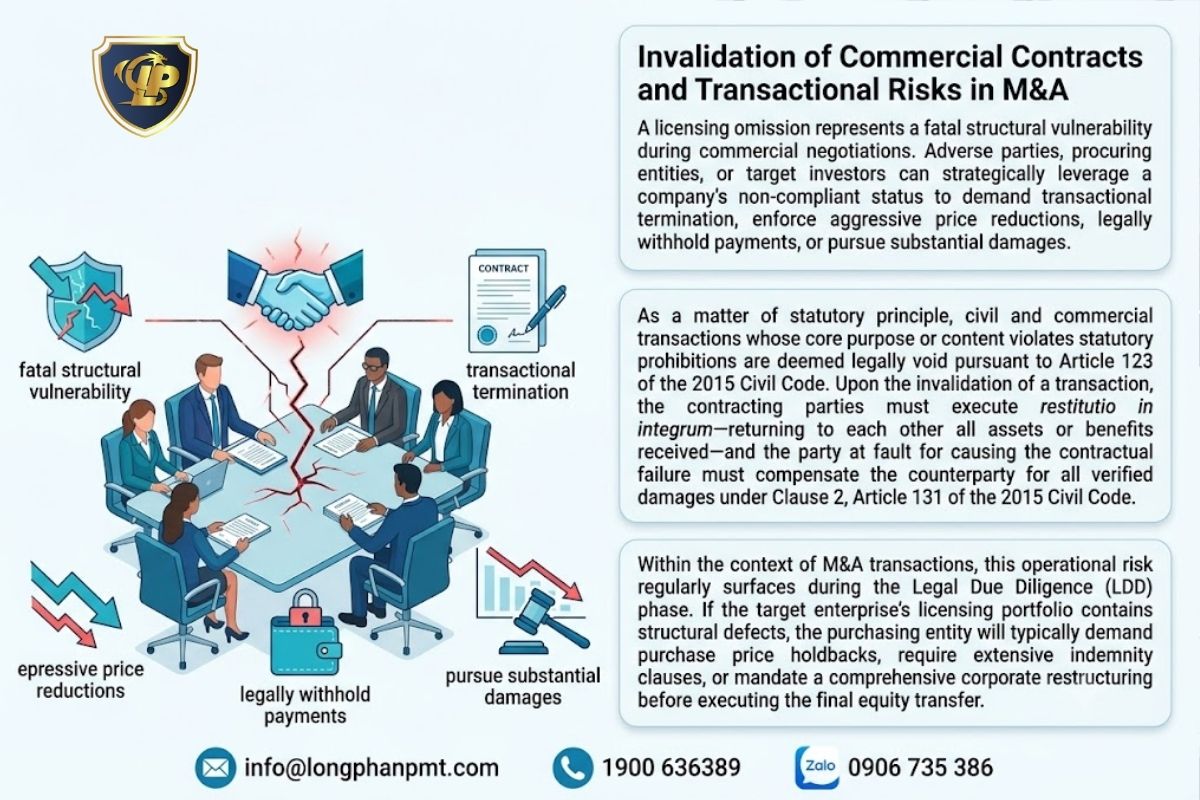
A licensing omission represents a fatal structural vulnerability during commercial negotiations. Adverse parties, procuring entities, or target investors can strategically leverage a company’s non-compliant status to demand transactional termination, enforce aggressive price reductions, legally withhold payments, or pursue substantial damages.
As a matter of statutory principle, civil and commercial transactions whose core purpose or content violates statutory prohibitions are deemed legally void pursuant to Article 123 of the 2015 Civil Code. Upon the invalidation of a transaction, the contracting parties must execute restitutio in integrum—returning to each other all assets or benefits received and the party at fault for causing the contractual failure must compensate the counterparty for all verified damages under Clause 2, Article 131 of the 2015 Civil Code.
Within the context of M&A transactions, this operational risk regularly surfaces during the Legal Due Diligence (LDD) phase. If the target enterprise’s licensing portfolio contains structural defects, the purchasing entity will typically demand purchase price holdbacks, require extensive indemnity clauses, or mandate a comprehensive corporate restructuring before executing the final equity transfer.
Preventing the regulatory risks associated with unlicensed operations must occur well before executing commercial contracts, issuing tax invoices, or deploying services. Within conditional business investment sectors, the executive board must treat licensing compliance as a core component of the company’s internal control system, rather than a disconnected administrative task.
Enterprises must establish a specialized Legal Checklist tailored to their actual operational activities, rather than relying solely on the generic business line codes printed on the ERC. This checklist enables management to clarify which regulatory requirements must be fully satisfied prior to launch, and which operational standards must be maintained continuously throughout the business lifecycle.
The primary pillars of this compliance due diligence framework include:
For example, pursuant to Clause 9, Article 25 of Decree No. 96/2016/ND-CP, conditional business establishments operating under public order and security regulations are strictly restricted to employing individuals who are 18 years of age or older. This provision demonstrates that every conditional industry possesses highly localized, granular rules, meaning corporate management cannot rely on a generic compliance checklist across diverse business units.
Securing an initial operational sub-license is merely the first step; corporate entities must actively manage the ongoing legal lifecycle of every permit. Regulatory non-compliance frequently triggers when a specialized license expires, or when an enterprise modifies its headquarters, updates its legal representative, or alters its production scale without updating its administrative permits.
Internal compliance systems should be structured around the following systematic procedures:
Enterprises are statutorily required to register modifications to their Enterprise Registration Certificate within 10 days from the date of the operational change pursuant to Clause 2, Article 30 of the 2020 Law on Enterprises. Furthermore, if a corporate entity completely ceases its business operations for 1 consecutive year without providing formal notification to the Corporate Registration Office and the tax authority, its ERC faces mandatory revocation under Point c, Clause 1, Article 212 of the 2020 Law on Enterprises.
When corporate management discovers that the enterprise is operating without a required specialized sub-license, the immediate objective is to stop further legal exposure. The executive board must execute a controlled crisis containment plan, consolidate missing regulatory files, and prepare a formal compliance defense to present to state inspectors.
An enterprise must not continue running any operational segment that lacks full regulatory authorization. Prolonging non-compliant activities exacerbates the administrative violation, expands the financial basis for the disgorgement of illegal profits, and provides adverse parties with clear legal grounds to dispute active contracts.
The internal risk isolation protocol must be deployed immediately:
If the core purpose or content of a commercial contract violates a statutory prohibition, the transaction faces a high risk of being declared legally void under Article 123 of the 2015 Civil Code. Upon judicial invalidation, contracting parties must return all received assets to one another to restore the original status, and the party at fault for causing the contractual failure must compensate for all verified losses pursuant to Clause 2, Article 131 of the 2015 Civil Code.
Once the immediate legal risks are contained, the enterprise must transition to a structured remediation roadmap. The core focus shifts to satisfying outstanding specialized criteria, submitting new or amended licensing applications, and preparing an explanatory compliance defense that demonstrates good-faith cooperation to state bodies.
Corporate management should execute remediation steps in the following sequence:
Regarding enforcement jurisdiction, the Inspectorate of the Department of Planning and Investment holds the authority to sanction administrative violations within the scope of corporate registrations and business investments pursuant to Article 73 of Decree No. 122/2021/ND-CP. Concurrently, the Market Surveillance Agency possesses the statutory authority to penalize licensing and operational violations within commercial activities under Clause 3 and Clause 4, Article 82 of Decree No. 98/2020/ND-CP.
For past operational non-compliance, corporate executives should not passively accept the standard statutory penalty frameworks cited by a regulatory inspection team. General Counsel must audit the exact date the conduct occurred, the date it was officially discovered, and the effective life cycle of the governing decrees to determine if more favorable regulations apply.
The following legal defense strategies should be prioritized:
Within commercial and trading activities, the principle of retroactive application of favorable regulations is formally recognized under Article 90 of Decree No. 98/2020/ND-CP. Similarly, within the planning and investment sector, the statutory basis for applying more favorable administrative rules is anchored in Clause 1, Article 81 of Decree No. 122/2021/ND-CP.
In the public order and security sector, enterprises currently operating under older eligibility certificates are granted a maximum transitional window of 18 months to conform to updated standards and exchange their documentation for a new Certificate of Satisfaction of Conditions for Security and Order pursuant to Clause 1, Article 52 of Decree No. 96/2016/ND-CP. Corporate management must actively leverage these statutory transitional phases to standardize their licensing portfolios before technical compliance defects escalate into continuous, high-fines violations.
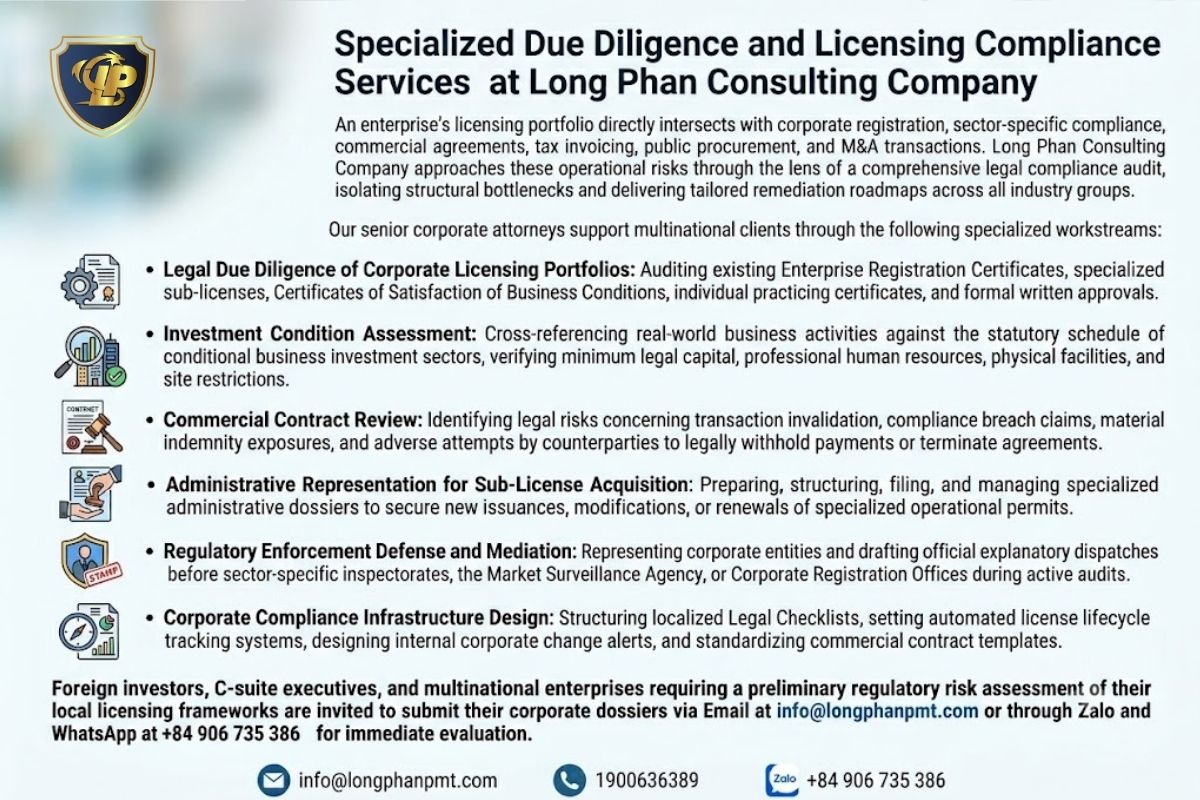
An enterprise’s licensing portfolio directly intersects with corporate registration, sector-specific compliance, commercial agreements, tax invoicing, public procurement, and M&A transactions. Long Phan Consulting Company approaches these operational risks through the lens of a comprehensive legal compliance audit, isolating structural bottlenecks and delivering tailored remediation roadmaps across all industry groups.
Our senior corporate attorneys support multinational clients through the following specialized workstreams:
Foreign investors, C-suite executives, and multinational enterprises requiring a preliminary regulatory risk assessment of their local licensing frameworks are invited to submit their corporate dossiers via Email at info@longphanpmt.com or through Zalo and WhatsApp at +84 906 735 386 for immediate evaluation.
The following questions focus on the practical bottlenecks businesses encounter when identifying risks of operating without a license in operations, contracts, inspections, and M&A transactions. The focus is on correctly identifying licensing obligations, limiting penalties, and handling situations that could disrupt cash flow.
No, businesses should not operate in conditional investment and business sectors if they have not yet met the required specialized conditions. The business registration certificate only acknowledges legal status and does not replace licenses, certificates of eligibility, professional certificates, or approval documents. Investors must meet and maintain the conditions throughout their operation in accordance with Clause 1, Article 5 of the 2025 Investment Law and Clause 1, Article 8 of the 2020 Enterprise Law.
There is a risk of a contract being invalidated if the provision of services without sufficient licenses constitutes a violation of legal prohibitions or content. When a transaction is invalidated, the business may have to return what it has received and compensate for damages if there is fault. Civil transactions violating prohibitions are invalid under Article 123 of the 2015 Civil Code, and the consequences of return and compensation are governed by Clause 2, Article 131 of the 2015 Civil Code.
Businesses can be fined up to VND 30,000,000 if they operate in conditional investment and business sectors without a license or use a license improperly. The base fine for individuals is VND 10,000,000 to VND 15,000,000, while organizations are subject to double that amount. The basis for the penalty is Clause 3, Article 6 of Decree No. 98/2020/ND-CP and Clause 4, Article 4 of Decree No. 98/2020/ND-CP.
Businesses should not continue operating during periods of suspension, revocation, or cancellation of licenses, as continued activity increases the risk of penalties. The penalty for individuals ranges from VND 15,000,000 to VND 20,000,000, while organizations may face double that amount if the violation falls under the corresponding category. Continuing business operations while suspended, revoked, or having a license cancelled is punishable under Clause 4, Article 6 of Decree No. 98/2020/ND-CP.
Yes, businesses may be required to return any illegal profits obtained from operating without a license or violating business conditions. This is a serious financial risk because it directly impacts profits generated during the period of violation, not just administrative fines. This remedial measure is applied according to Clause 7, Article 6 of Decree No. 98/2020/ND-CP and Clause 4, Article 16 of Decree No. 122/2021/ND-CP.
Businesses must closely monitor notification deadlines to avoid errors in documentation and the risk of having their Business Registration Certificate revoked. Changes to the content of the Business Registration Certificate must be registered within 10 days from the date of the change, as stipulated in Clause 2, Article 30 of the 2020 Enterprise Law. Temporary suspension of business operations must be notified at least 3 working days before the suspension date, as stipulated in Clause 1, Article 206 of the 2020 Enterprise Law.
Businesses need to identify the correct sanctioning authority based on the specific violation to prepare appropriate explanatory documents. The Inspectorate of Planning and Investment has the authority to impose administrative penalties for violations in the field of business registration and investment according to Article 73 of Decree No. 122/2021/ND-CP. Market Management forces have the authority to penalize violations related to licenses in commercial activities according to Clauses 3 and 4 of Article 82 of Decree No. 98/2020/ND-CP.
Engaging in unlicensed business operations in Vietnam within regulated industries exposes corporate entities to severe administrative sanctions, the total disgorgement of illegal profits, operational suspensions, and fatal contract invalidation risks during public bidding, capital-raising, or M&A transactions. Executive management must clearly distinguish between a basic Enterprise Registration Certificate and specialized operational permits, Certificates of Satisfaction of Business Conditions, individual practicing certificates, or sector-specific administrative authorizations while maintaining a localized Legal Checklist to verify expiration timelines and compliance scopes. To audit your corporate licensing systems, resolve regulatory enforcement disputes, and secure your long-term [licensing compliance in Vietnam], please contact the specialized corporate attorneys at Long Phan Consulting Company via our central Hotline at 1900636389.
📚 This article is provided with professional consultation based on the following legal framework: