


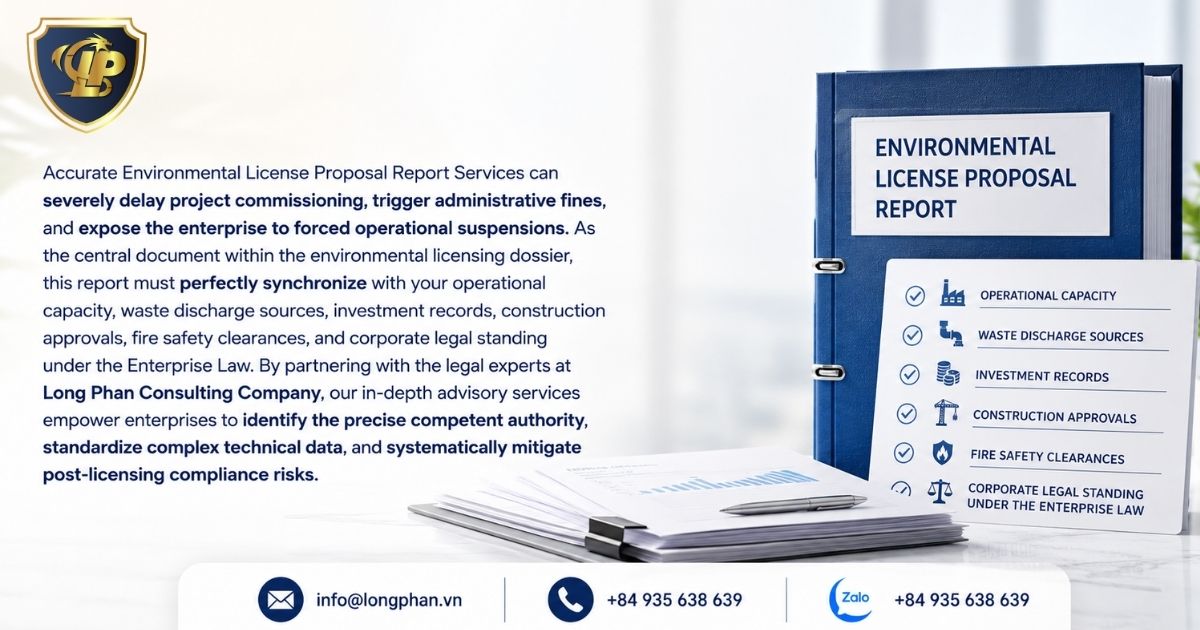
An Environmental License Proposal Report must be prepared with precision to avoid project approval delays, administrative penalties, and suspension risks. As a core component of the licensing dossier, it should align with operating capacity, waste sources, investment documents, construction permits, fire safety approvals, and corporate status under the Law on Enterprises and Businesses. Long Phan Consulting provides comprehensive advisory support to determine the competent authority, standardize technical data, and reduce post-licensing compliance exposure.
Important legal note:
The environmental license proposal report transcends basic administrative paperwork. It serves as the definitive compliance document controlling operational conditions, waste discharge sources, and environmental liabilities prior to lawful commercial launch. For foreign investors, misidentifying the regulated entity or missing the submission deadline triggers commissioning delays, prolonged production schedules, and severe administrative sanctions. Consequently, executing a strict regulatory audit during the pre-operational phase constitutes a mandatory risk management protocol.
Enterprises must accurately determine whether their facility falls within the mandatory environmental licensing scope before finalizing operational budgets and timelines. Early verification eliminates two critical compliance risks: executing redundant administrative filings or inadvertently bypassing statutory licensing obligations.
The core classifications subject to verification include:
Corporate classification must never rely solely on registered business lines. A Project Owner must cross-reference operational capacity, technological frameworks, waste streams, and hazardous waste volumes to determine precise licensing obligations.
An Environmental Impact Assessment (EIA) Report, an Environmental License, and an Environmental Registration serve entirely distinct legal functions. Conflating these three administrative procedures guarantees structural flaws in legal planning, budgetary misallocations, and severe operational launch delays.
| Compliance Mechanism | Statutory Nature | Core Filing Timeline | Dossier Focus |
| Environmental Impact Assessment (EIA) | Evaluates impacts prior to project deployment. | Executed during the project preparation and formal approval phase. | Projected environmental impacts and required mitigation measures. |
| Environmental License | Authorizes physical waste discharge and operational launch. | Secured prior to trial operations or actual waste discharge. | Operational capacity, waste streams, treatment facilities, and incident response. |
| Environmental Registration | Records basic environmental obligations for low-risk entities. | Executed based on specific timelines for non-licensed groups. | Baseline environmental data and facility operational metrics. |
From a corporate governance perspective, the EIA acts as the baseline input data. The environmental license proposal report must aggressively translate that theoretical data into concrete, enforceable operational conditions subject to strict ex-post environmental inspections at the physical site.
The dossier submission timeline directly dictates the commercial operational schedule. Enterprises must avoid delaying report preparation until the immediate eve of trial operations or site commissioning. The statutory processing window often excludes the time required for mandatory dossier amendments.
Compliance officers must rigidly enforce the following regulatory milestones:
In practice, these 30-day or 45-day thresholds remain secure only when the dossier is structurally complete and technically uniform. Submitting flawed capacity metrics or incorrect waste source data will trigger application rejections, pushing back the commercial operational timeline substantially.
An environmental license proposal report only holds regulatory value when its legal and technical data are perfectly synchronized. The core objective is not merely completing administrative forms, but decisively proving that the project operates strictly within its authorized capacity, accurately identifies waste discharge sources, and utilizes compliant environmental protection works.
Enterprises must systematically compile baseline compliance documentation before drafting the report. Submitting deficient or contradictory technical data empowers competent state authorities to mandate extensive amendments, severely delaying the commercial operational timeline.
Internal legal and HSE teams must compile dossiers by cross-referencing corporate legal standing, physical site blueprints, applied technologies, and waste treatment systems. An official application dossier comprises the request letter, the proposal report, and all relevant legal and technical documents, pursuant to Clause 1, Article 43 of the 2020 Environmental Protection Law.
The mandatory documentation audit must include:
Specifically for projects exempt from an EIA, the Project Owner must attach a certified copy of the feasibility study report or equivalent investment and construction documentation, pursuant to Clause 1, Article 29 of Decree No. 08/2022/ND-CP.
The report must explicitly detail the exact waste streams generated, the designated treatment facilities, and the post-licensing environmental monitoring protocols. This content must strictly adhere to Form No. 43a, pursuant to Clause 4, Article 46 of the 2020 Environmental Protection Law.
Pursuant to Article 9 of Circular No. 09/2026/TT-BNNMT, the core technical contents of the environmental license proposal report must include:
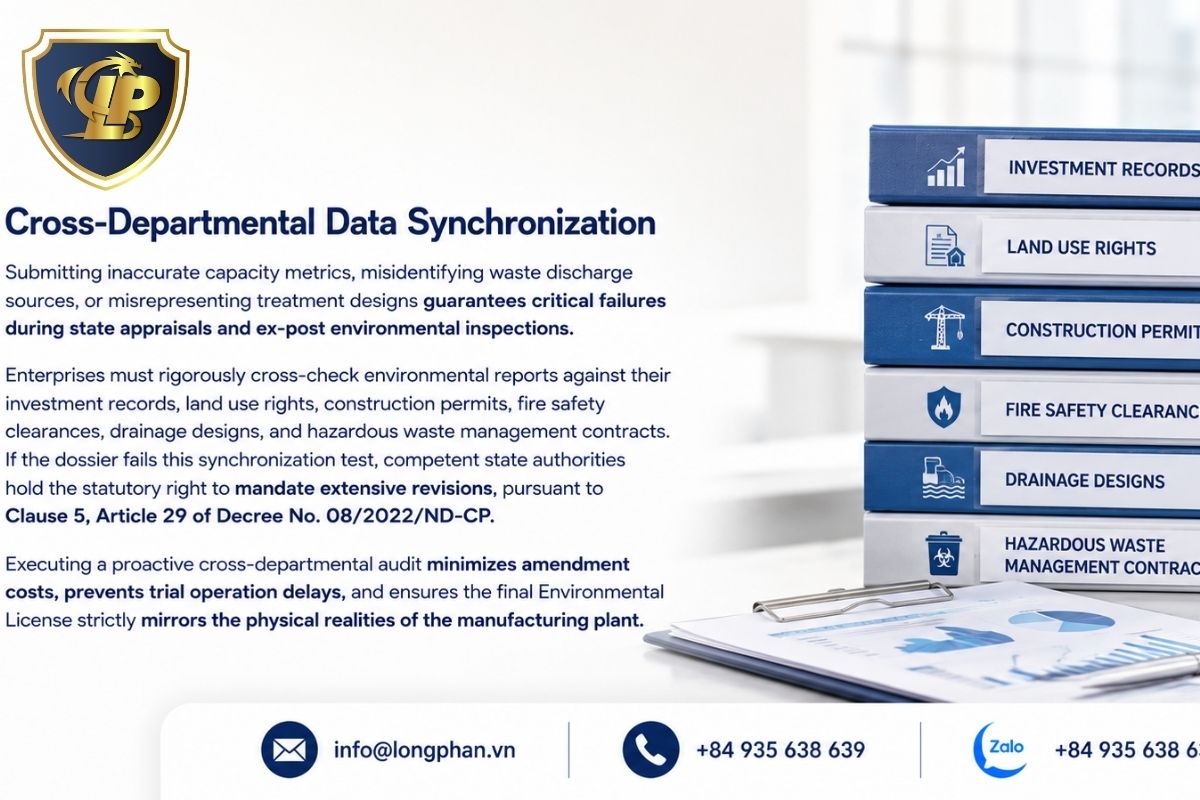
The most severe regulatory risk occurs when a formatted report presents flawless paperwork that blatantly contradicts physical operations. Submitting inaccurate capacity metrics, misidentifying waste discharge sources, or misrepresenting treatment designs guarantees critical failures during state appraisals and ex-post environmental inspections.
Enterprises must rigorously cross-check environmental reports against their investment records, land use rights, construction permits, fire safety clearances, drainage designs, and hazardous waste management contracts. If the dossier fails this synchronization test, competent state authorities hold the statutory right to mandate extensive revisions, pursuant to Clause 5, Article 29 of Decree No. 08/2022/ND-CP.
Executing a proactive cross-departmental audit empowers the Board of Directors to neutralize compliance vulnerabilities before formal submission. This strategic approach minimizes amendment costs, prevents trial operation delays, and ensures the final Environmental License strictly mirrors the physical realities of the manufacturing plant.
The preparation of an environmental license proposal report must be managed as a comprehensive legal, technical, and operational project. Each step directly dictates the probability of dossier acceptance, successful site appraisals, and on-time licensing. Enterprises must not solely focus on the final paperwork. True compliance value lies in conducting accurate physical site audits, strictly identifying the correct competent state authority, and executing precise technical defenses against state appraisal mandates.
A professional workflow empowers enterprises to control timelines from initial audits to final license issuance. Competent state authorities strictly audit the completeness and validity of the dossier prior to content appraisal. They retain the statutory right to mandate amendments if the legal basis is insufficient. Pursuant to Clause 3, Article 34 of the 2025 National Assembly Law No. 146/2025/QH15, the Minister of Agriculture and Environment details the dossier requirements, timelines, contents, and appraisal organization for environmental reports.
A compliant corporate workflow must proceed through the following sequence:
This disciplined workflow prevents enterprises from submitting dossiers purely for trial and error. Repeated amendments severely prolong commissioning schedules, inflate trial operation costs, and disrupt overarching commercial timelines.
Identifying the correct licensing jurisdiction cannot rely on generic assumptions like filing at the provincial Department. Enterprises must pinpoint the exact competent state authority based on the project scale, classification group, geography, waste types, and environmental sensitivities. In 2025, the Ministry of Natural Resources and Environment (MONRE) merged into the new Ministry of Agriculture and Environment, effective March 1, 2025. Furthermore, new decentralization decrees take effect on July 1, 2025. Consequently, enterprises must rigorously verify current jurisdiction on the National Public Service Portal prior to dossier submission.
| Competent State Authority | Target Project Classifications | Statutory Legal Basis |
| Ministry-level (Ministry of Agriculture and Environment) | Projects holding Ministry-approved EIA reports, projects spanning two or more provinces, scrap import facilities, and hazardous waste treatment facilities. | Clause 1, Article 41 of the 2020 Environmental Protection Law |
| Ministry of National Defense, Ministry of Public Security | Investment projects involving classified state secrets regarding national defense and security. | Clause 2, Article 41 of the 2020 Environmental Protection Law |
| Provincial People’s Committee | Group II and Group III projects spanning two or more communes, or projects officially decentralized to the provincial level. | Clause 3, Article 41 of the 2020 Environmental Protection Law |
| Communal People’s Committee | Remaining projects falling outside the jurisdiction of Ministries or Provincial Committees. | Clause 4, Article 41 of the 2020 Environmental Protection Law |
In practice, Ministry-level filings are currently processed through the One-Stop Office of the Ministry of Agriculture and Environment, postal services, or the National Public Service Portal. Therefore, jurisdictional audits must be finalized before executing dossiers and remitting statutory appraisal fees.
Statutory licensing timelines only commence when the competent state authority formally receives a complete, legally valid dossier. If an enterprise must independently amend its application, that downtime is strictly excluded from the state’s administrative processing window.
Pursuant to Clause 4, Article 43 of the 2020 Environmental Protection Law, the statutory time limit for issuing an Environmental License is strictly capped. The maximum duration is 45 days for Ministry-level authorities and 30 days for Provincial or Communal People’s Committees. However, Ministry-level procedures logged on the National Public Service Portal currently enforce a strict 20-day maximum for projects not requiring trial operations of waste treatment facilities, while maintaining the 45-day limit for all other cases.
The appraising authority may establish an appraisal council or deploy a physical site inspection delegation prior to issuing the license. An appraisal council requires a minimum of 07 members at the central level, 05 members at the provincial level, and 03 members for communal appraisal teams, pursuant to Clause 4, Article 29 of Decree No. 08/2022/ND-CP.
To aggressively control the commercial timeline, enterprises must prepare robust technical defenses addressing operational capacity, waste streams, treatment efficiency, and monitoring plans in advance. Presenting highly synchronized technical data decisively mitigates the risk of prolonged administrative disputes.
An environmental license proposal report only holds regulatory value when its legal and technical data are perfectly synchronized. The core objective is not merely completing administrative forms, but decisively proving that the project operates strictly within its authorized capacity, accurately identifies waste discharge sources, and utilizes compliant environmental protection works.
Enterprises must systematically compile baseline compliance documentation before drafting the report. Submitting deficient or contradictory technical data empowers competent state authorities to mandate extensive amendments, severely delaying the commercial operational timeline.
Internal legal and HSE teams must compile dossiers by cross-referencing corporate legal standing, physical site blueprints, applied technologies, and waste treatment systems. An official application dossier comprises the request letter, the proposal report, and all relevant legal and technical documents, pursuant to Clause 1, Article 43 of the 2020 Environmental Protection Law.
The mandatory documentation audit must include:
For projects exempt from an EIA, the Project Owner must attach a certified copy of the feasibility study report or equivalent investment and construction documentation, pursuant to Clause 1, Article 29 of Decree No. 08/2022/ND-CP.
The report must explicitly detail the exact waste streams generated, the designated treatment facilities, and the post-licensing environmental monitoring protocols. This content must strictly adhere to Form No. 43a, pursuant to Clause 4, Article 46 of the 2020 Environmental Protection Law.
Pursuant to Article 9 of Circular No. 09/2026/TT-BNNMT, the core technical contents include:
Submitting inaccurate capacity metrics, misidentifying waste discharge sources, or misrepresenting treatment designs guarantees critical failures during state appraisals and ex-post environmental inspections.
Enterprises must rigorously cross-check environmental reports against their investment records, land use rights, construction permits, fire safety clearances, drainage designs, and hazardous waste management contracts. If the dossier fails this synchronization test, competent state authorities hold the statutory right to mandate extensive revisions, pursuant to Clause 5, Article 29 of Decree No. 08/2022/ND-CP.
Executing a proactive cross-departmental audit minimizes amendment costs, prevents trial operation delays, and ensures the final Environmental License strictly mirrors the physical realities of the manufacturing plant.
The environmental permit application process requires coordination between corporate legal, environmental engineering, and actual operational data. Long Phan Consulting Company, Approach the case file with a risk assessment approach before preparing the report, instead of simply creating a form based on fragmented information.
The goal is to help businesses reduce the risk of repeated requests for additional capacity, minimize capacity discrepancies, and ensure that the issued license can be safely used during the operational, inspection, and auditing phases.
Before preparing the report, the background documents need to be reviewed to identify discrepancies between the legal paperwork and the actual state of the plant. This step helps management identify potential risks that could affect the licensing process.
Long Phan Consulting Company assists businesses in implementing:
The review results help businesses know whether their application can be submitted immediately or needs further adjustments. This reduces the risk of applications being rejected or unexpected requests for technical explanations.
Environmental permit application reports must accurately reflect the current legal, technical, and waste treatment capacity. Therefore, report preparation must include surveys, data verification, and standardized forms for each type of project.
The scope of support includes:
This implementation method helps businesses avoid having to handle complex technical requirements themselves. The process is controlled from data input to the post-submission explanation stage.
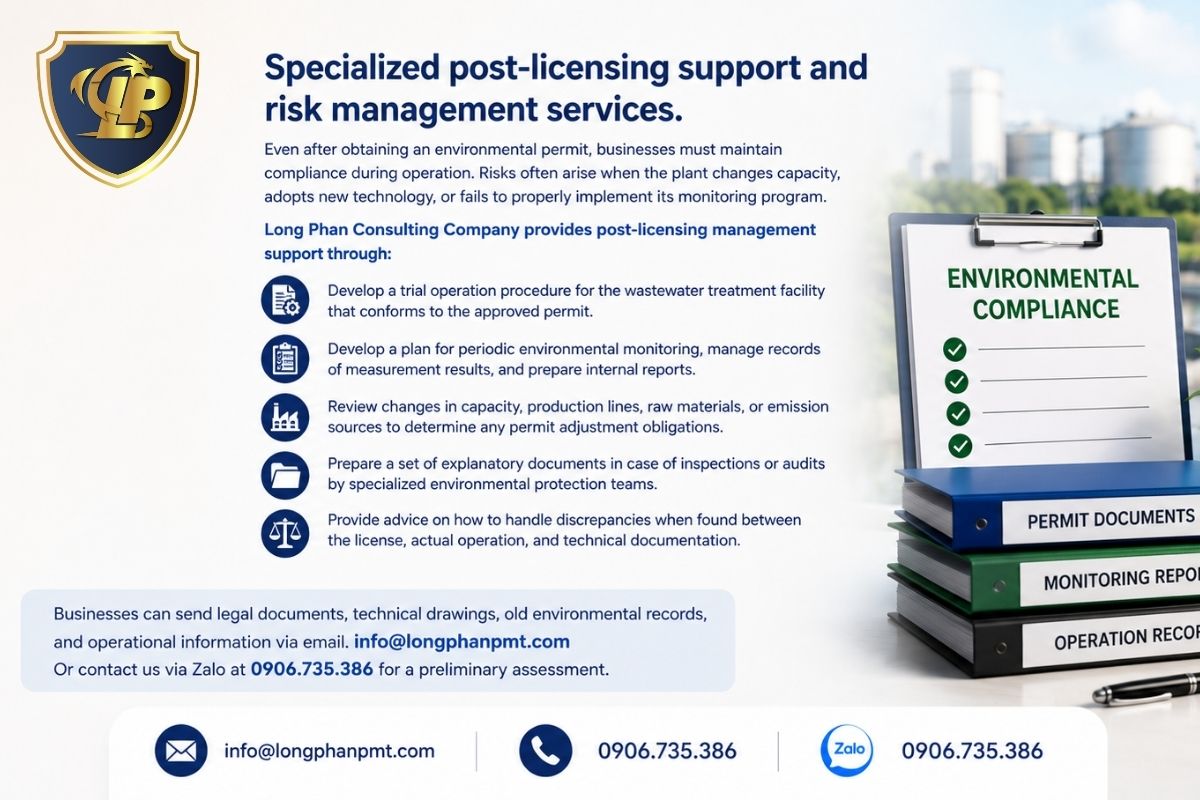
Even after obtaining an environmental permit, businesses must maintain compliance during operation. Risks often arise when the plant changes capacity, adopts new technology, or fails to properly implement its monitoring program.
Long Phan Consulting Company provides post-licensing management support through:
Businesses can send legal documents, technical drawings, old environmental records, and operational information via email. info@longphanpmt.com or contact us via Zalo at 0906.735.386 for a preliminary assessment.
Post-licensing risks often arise from inconsistent capacity data, emission sources, and baseline records. With an Environmental Permit Proposal Report, businesses need to monitor the submission timing, authority, previous permits, and potential penalties to avoid operational disruptions.
Yes. Factories classified as Group I, Group II, or Group III projects that generate wastewater, dust, exhaust gases requiring treatment, or hazardous waste requiring management must obtain an environmental permit before commencing operation. The Environmental Permit Proposal Report is a mandatory and central document in the environmental permit application dossier, pursuant to Clause 1, Article 39 of the 2020 Law on Environmental Protection.
Operating facilities must submit their environmental permit applications before the statutory deadline. Establishments under ministerial authority must submit applications at least 45 days before the deadline, while those under provincial or commune authority must submit them at least 30 days in advance. This requirement is prescribed in Point d, Clause 2, Article 29 of Decree No. 08/2022/ND-CP.
The processing period is calculated from the date the competent authority receives a complete and valid application dossier. The issuance period must not exceed 45 days for ministerial-level authorities and 30 days for provincial or district-level People’s Committees, according to Clause 4, Article 43 of the 2020 Law on Environmental Protection.
Yes. Environmental permits and component environmental licenses issued before the effective date of the 2020 Law on Environmental Protection remain valid until their expiration date. Where a component environmental permit does not specify an expiration date, it may continue to be used for five years from January 1, 2022. This is provided under Clause 4 and Clause 5, Article 171, together with Point d, Clause 2, Article 42 of the 2020 Law on Environmental Protection.
When a component environmental permit expires, the business must apply for a new environmental permit covering the entire facility rather than renewing each individual component permit. This unified permitting approach is required under Clause 12, Article 168 of Decree No. 08/2022/ND-CP.
Businesses that provide inaccurate or untruthful information regarding the completion of environmental protection works may face administrative penalties depending on the licensing authority. Fines range from VND 25,000,000 to VND 30,000,000 for commune-level authorities, VND 100,000,000 to VND 150,000,000 for provincial-level authorities, and VND 150,000,000 to VND 200,000,000 for ministerial-level authorities, pursuant to Point d, Clause 1, Article 11; Point d, Clause 2, Article 11; and Point d, Clause 3, Article 11 of Decree No. 45/2022/ND-CP.
Yes, but only after the project owner has been sanctioned for the violation. Following compliance with the applicable penalties, the project may be considered for legalization if its location conforms to planning requirements and environmental carrying capacity. The enterprise must then prepare a complete environmental permit application and undertake any necessary review, renovation, or upgrading of environmental protection facilities, as provided in Clause 14, Article 168 of Decree No. 08/2022/ND-CP.
A meticulously synchronized environmental license proposal report in Vietnam serves as the definitive legal foundation for proving operational compliance, controlling waste discharges, and eliminating the catastrophic risks of administrative fines or forced facility shutdowns. Foreign investors must construct this critical document upon absolute data uniformity across operational capacity, waste treatment infrastructure, and baseline investment, construction, and fire safety records. Executing early jurisdictional audits and technical data synchronization decisively minimizes commercial commissioning delays and expensive post-licensing remediation costs. To aggressively safeguard your market entry timeline and secure flawless regulatory compliance, contact the hotline at 1900636389 for specialized corporate legal support from Long Phan Consulting Company.
📚 This article is provided with professional consultation based on the following legal framework:


