Enterprise Management Prohibitions define the group of subjects restricted by law from business freedom. This regulation ensures state management order and investment environment transparency. The 2020 Enterprise Law and its guiding documents identified these groups; however, from 01/07/2025, the 2025 Enterprise Law amendment brings significant adjustments. The following article analyzes the new regulations in detail.
The right to establish and manage enterprises is a fundamental right of citizens, recognized by the Constitution and law. This right permits organizations and individuals to conduct investment and business activities.
Under Clause 1, Article 17, 2020 Enterprise Law, all organizations and individuals have the right to establish and manage enterprises in Vietnam. This right is exercised freely, except in cases limited by law. This limitation only applies to specific subjects related to Enterprise Management Prohibitions. The current prohibitions (before 01/07/2025) aim to ensure public order, prevent conflicts of interest, and combat corruption.
Regulations on Enterprise Management Prohibitions from 1/7/2025
Under Clause 2, Article 17, 2020 Enterprise Law, amended by Clause 6, Article 1, 2025 Enterprise Law, there have been adjustments for two groups:
Cadres, civil servants, and public employees under the Law on Cadres and Civil Servants and the Law on Public Employees, except when permitted under laws on science, technology, innovation, and national digital transformation.
Persons being prosecuted for criminal liability, held in temporary detention, serving a prison sentence, serving an administrative handling measure at a compulsory detoxification or education establishment, or being banned by a court from holding certain positions, practicing certain professions, or doing certain jobs; other cases under the Law on Bankruptcy and the Anti-Corruption Law.
Thus, as of 01/07/2025, the Enterprise Management Prohibitions include the following subjects:
State agencies and units of the people’s armed forces using state assets to establish a business for their own profit.
Cadres, civil servants, and public employees, except when acting under laws on science, technology, innovation, and national digital transformation.
Officers, non-commissioned officers, professional military personnel, workers, and public employees in agencies and units of the People’s Army of Vietnam; officers, professional non-commissioned officers, and public security workers in agencies and units of the People’s Public Security of Vietnam, except those appointed as authorized representatives to manage state capital contributions or manage state-owned enterprises.
Leaders and managers in state-owned enterprises under Point a, Clause 1, Article 88 of the 2020 Enterprise Law, except those appointed as authorized representatives to manage state capital contributions in other enterprises.
Minors; persons with limited or lost civil act capacity; persons with cognitive difficulties and difficulty in controlling their behavior; organizations without legal person status.
Persons being prosecuted for criminal liability, held in temporary detention, serving a prison sentence, serving an administrative handling measure at a compulsory detoxification or education establishment, or being banned by a court from holding certain positions, practicing certain professions, or doing certain jobs; other cases under the Law on Bankruptcy and the Anti-Corruption Law.
If requested by the Business Registration Office, the enterprise founder must submit a judicial record to the Business Registration Office.
Commercial legal entities banned from business or specific activities under the 2015 Penal Code.
Expert Notes on Enterprise Establishment and Management
The process of establishing an enterprise and operating its management demands strict legal compliance. Thorough preparation of foundational elements helps businesses minimize legal risks. Long Phan Consulting Company advises clients on three core aspects.
On Choosing the Enterprise Type
Choosing an enterprise type is a strategic decision that directly impacts operational structure, tax obligations, and legal liability. Long Phan Consulting Company assists clients in analyzing specific needs for an optimal choice:
Based on Asset Liability: If the priority is protecting personal assets and clearly separating company assets (limited liability), the LLC or JSC model is suitable. Conversely, a Private Enterprise (unlimited liability) should only be considered if the owner accepts comprehensive risk in exchange for simplified management.
Based on Capital Raising Needs: For large-scale, flexible capital raising, especially from the public or venture capital funds, the JSC is mandatory due to its ability to issue diverse shares. If the capital scale is closed (mainly from members or loans) and requires strict control over the ownership structure, the LLC (single-member or multi-member) simplifies governance.
Based on Governance Structure: The LLC structure (Members’ Council) is suitable for family businesses or groups of trusted partners, where capital transfer is tightly controlled. The JSC structure (General Meeting of Shareholders, Board of Directors) is more complex but ensures high transparency, suitable when many investors are not directly involved in management.
On the Beneficial Owner and Legal Representative
Current law places high demands on transparency in corporate governance. Long Phan Consulting Company highlights two important subjects:
Legal Representative: An enterprise may have one or more representatives. However, legal risks often arise when the company Charter does not clearly define the rights and obligations of each representative.
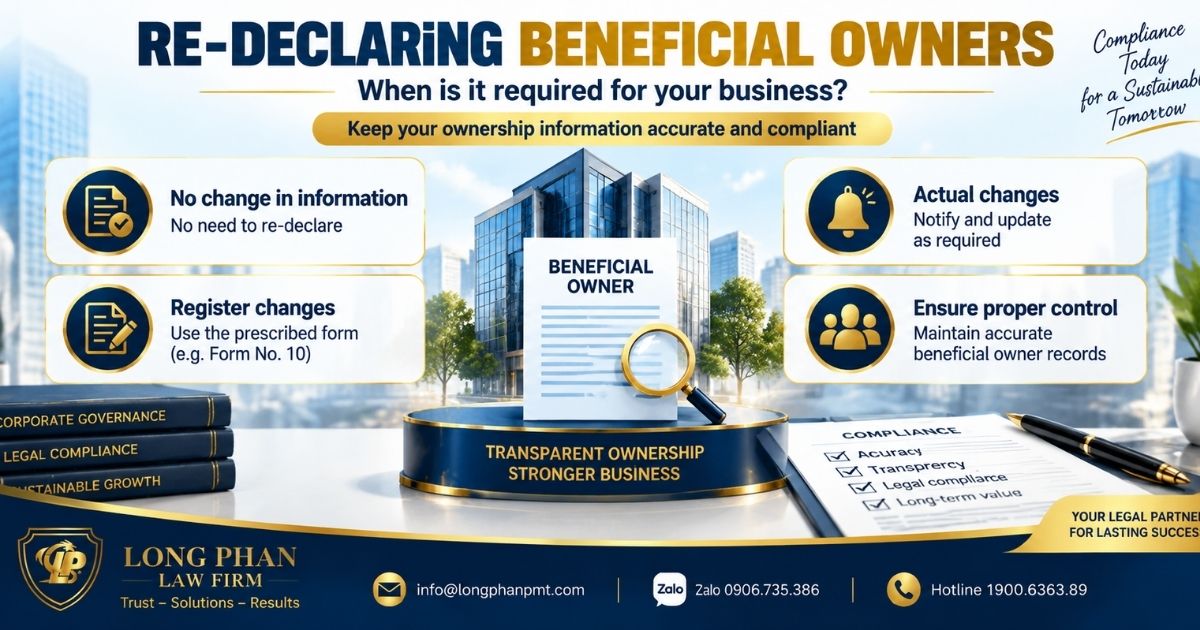
Beneficial Owner: This is a new requirement to comply with anti-money laundering (AML) regulations. Under Article 17, Decree 168/2025/ND-CP, the beneficial owner is defined as the individual(s) who actually control, directly or indirectly, the enterprise, not necessarily based on nominal capital ownership. Article 18, Decree 168/2025/ND-CP requires enterprises to take measures to identify, collect, store, and update beneficial owner information (including nationality, address, method of control).
On Registration Procedures
Clients must choose the optimal registration method based on the enterprise’s actual situation. Under Clause 1, Article 26, 2020 Enterprise Law (amended 2025), all three methods (direct, postal, electronic) have legal validity.
If the enterprise has a public digital signature and prioritizes speed, the electronic method via the National Portal optimizes time. Conversely, if the dossier is complex or the founder is unfamiliar with technology, clients can choose direct filing at the Business Registration Office.
During operation, if there are any changes to registration content (e.g., address, representative, charter capital), clients must complete the procedure to notify the provincial Business Registration Office. Maintaining the currency of the legal file is a mandatory compliance requirement.
Key issues enterprises should pay attention to
Enterprise Establishment Services at Long Phan Consulting Company
In the context of frequently amended enterprise laws, grasping accurate legal regulations is a key factor for lawful and effective operation. Long Phan Consulting Company provides comprehensive services such as reviewing founder conditions, advising on business type and governance structure selection, and executing full-service enterprise registration procedures, supporting clients in building a solid legal foundation from the very first step.
Long Phan Consulting Company provides the following advisory and support services:
Initial Legal Review and Structuring:
Reviewing the founder’s legal status against the new Enterprise Management Prohibitions.
Analyzing the business model to advise on the optimal enterprise type (LLC, JSC, etc.).
Advising on internal governance structure, representative’s rights/obligations, and beneficial owner declaration.
Dossier Preparation and Charter Drafting:
Drafting a standardized, detailed company Charter appropriate for the chosen governance model.
Preparing all required forms, member/shareholder lists, and the Application for Enterprise Registration.
Guiding the preparation of personal legal documents (ID card/Passport) and documents related to the head office.
Registration and Post-Establishment:
Acting on the client’s behalf to submit the dossier and perform enterprise registration (online or direct).
Monitoring the application processing, proactively providing explanations, and adjusting the dossier as required.
Representing the client to receive the Certificate of Enterprise Registration and performing the enterprise information disclosure procedure.
Frequently Asked Questions
Below are common questions about subjects who do not have the right to establish and manage enterprises.
From 01/07/2025, are civil servants permitted to establish enterprises?
Under the new regulations, cadres, civil servants, and public employees are still subjects of Enterprise Management Prohibitions, EXCEPT when it is carried out under the provisions of law on science, technology, innovation, and national digital transformation. Legal basis: Clause 2, Article 17, 2020 Enterprise Law (amended by Clause 6, Article 1, 2025 Enterprise Law).
Is a person being prosecuted for criminal liability banned from establishing an enterprise?
Yes. Persons being prosecuted for criminal liability, held in temporary detention, serving a prison sentence, or being banned by a court from holding certain positions or practicing certain professions are subjects of Enterprise Management Prohibitions. Legal basis: Clause 2, Article 17, 2020 Enterprise Law (amended by Clause 6, Article 1, 2025 Enterprise Law).
What methods can be used to register an enterprise?
According to regulations, an enterprise founder can register via three methods: (1) Direct registration at the Business Registration Office; (2) Registration via postal services; (3) Registration via the electronic information network (online). Legal basis: Clause 1, Article 26, 2020 Enterprise Law (amended 2025).
Who is a “Beneficial Owner” under the new regulations?
The Beneficial Owner is the individual (or individuals) who actually controls, directly or indirectly, the enterprise. This identification is not necessarily based on the individual’s nominal capital ownership percentage. Legal basis: Article 17, Decree 168/2025/ND-CP.
What obligations does an enterprise have regarding beneficial owner information?
The enterprise must take measures to identify, collect, store, and update the beneficial owner’s information (including information such as nationality, address, method of control). Legal basis: Article 18, Decree 168/2025/ND-CP.
Conclusion
Compliance with enterprise law, especially regulations concerning Enterprise Management Prohibitions, is crucial for ensuring lawful and sustainable operations. Long Phan Consulting Company provides professional services in reviewing conditions, advising on type selection and governance structure, and executing full-service enterprise registration procedures. Contact Hotline 1900636389 for detailed support.
Facebook
Linkedin
Twitter
Pinterest
Luật sư Nguyễn Thu Hương
Lawyer Nguyen Thu Huong is a leading expert in the field of investment and licensing for foreigners. With extensive knowledge of investment laws and the complex regulations related to licensing procedures, she has successfully assisted numerous businesses and foreign investors in establishing their operations in Vietnam.