


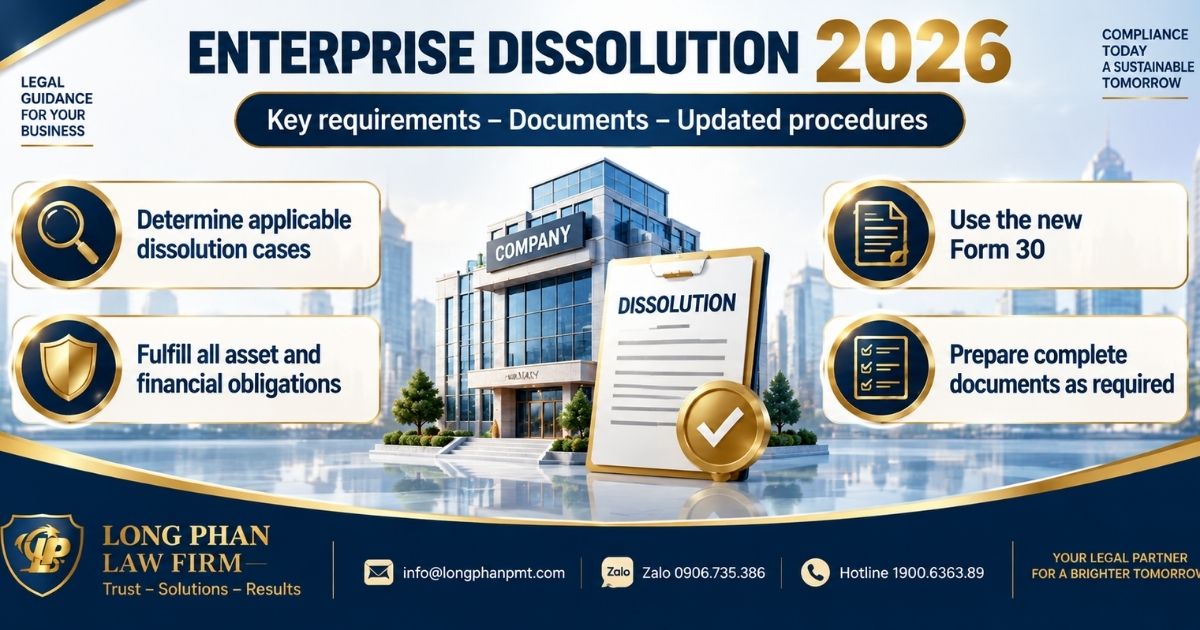
Long Phan Consulting notes that many businesses are facing difficulties when carrying out enterprise dissolution 2026 because the application forms have recently changed. From August 21, 2026, Circular No. 121/2026/TT-BTC introduced Form No. 30 – Notice of Enterprise Dissolution, replacing the corresponding form under Circular No. 68/2025/TT-BTC. The conditions, procedures, and order of debt payment upon dissolution remain governed by the Law on Enterprises 2020 (amended and supplemented in 2025) and Decree No. 168/2025/ND-CP. This article consolidates the current legal framework to help businesses identify the applicable cases, prepare the correct forms, and avoid rejection during submission.
Important Notes:
Legal basis: Article 207, Law on Enterprises and Businesses 2020 (Point c, Clause 1, as amended by Law No. 76/2025/QH15).
Before preparing a dossier, an enterprise must confirm which of the four dissolution cases applies and whether it meets the statutory conditions. These two factors determine the entire course of action.
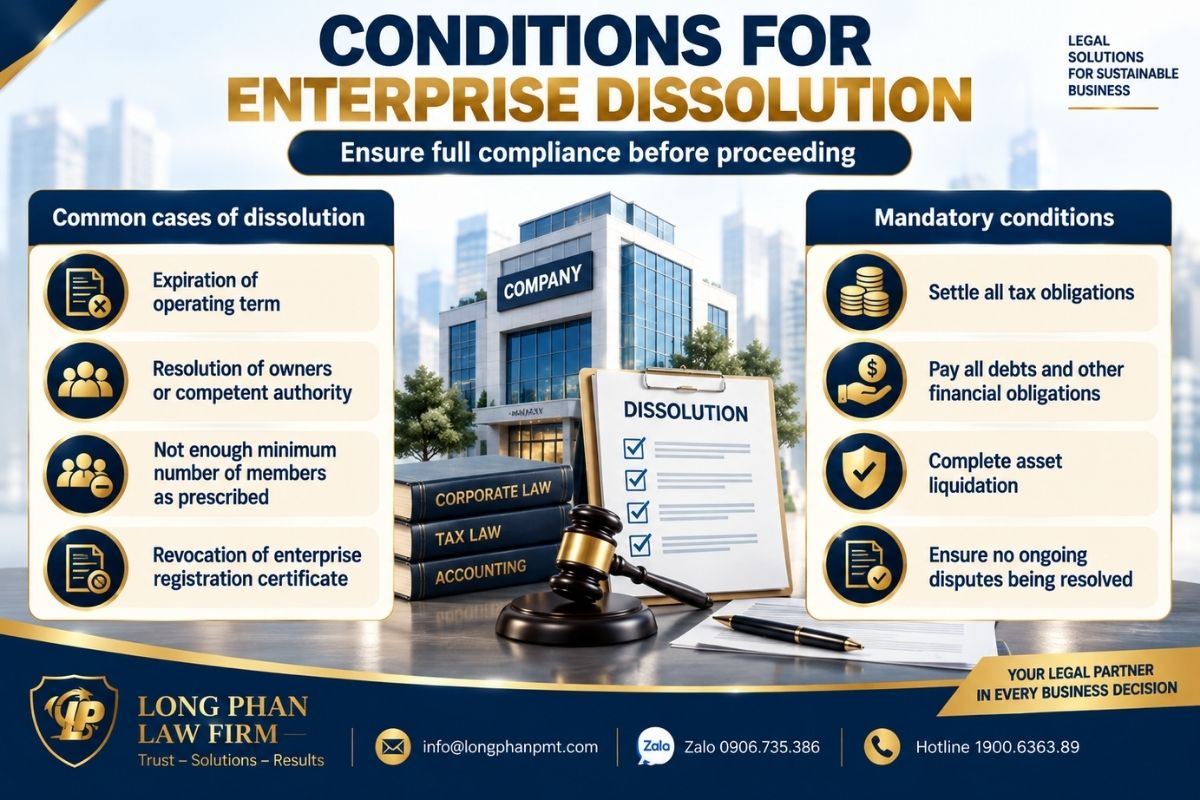
Under Clause 1, Article 207, Law on Enterprises and Businesses 2020, an enterprise is dissolved in one of the following four cases:
The first three cases are voluntary dissolution, carried out at the enterprise’s own initiative under Article 208, Law on Enterprises and Businesses 2020. The fourth case follows a separate procedure under Article 209, discussed later in this article.
Under Clause 2, Article 207, Law on Enterprises and Businesses 2020, an enterprise may only dissolve if it simultaneously satisfies two conditions:
If these two conditions are not both met, the enterprise cannot file a dissolution dossier, even if it already falls within one of the four cases above.
For voluntary dissolution under Points a, b, and c, Clause 1, Article 207, the enterprise must complete the following four steps in sequence. Skipping a step or performing them out of order is a common cause of rejected dossiers or delayed processing.
| Order | Debt given priority payment |
| 1 | Unpaid wages, severance allowance, social insurance, health insurance, unemployment insurance, and other employee entitlements under collective bargaining agreements or labor contracts |
| 2 | Tax debts |
| 3 | Other debts |
After the dissolution costs and the debts above are paid in full, the remaining assets are distributed to the sole proprietorship owner, members, shareholders, or company owner in proportion to their contributed capital or shares (Clause 6, Article 208, Law on Enterprises and Businesses 2020).
Need a review of a specific dossier at this stage? Clients may send the enterprise name, business type, debt status, and desired completion timeframe for Long Phan Consulting to review before filing.
>>>See more: Popular business valuation methods and applications
Legal basis: Article 210, Law on Enterprises and Businesses 2020; Article 64, Decree 168/2025/ND-CP; Circular 121/2026/TT-BTC.
From August 21, 2026, the required dossier components remain unchanged from Article 210, Law on Enterprises and Businesses 2020, but the dissolution notice form has been replaced. Enterprises should review both points below before filing.
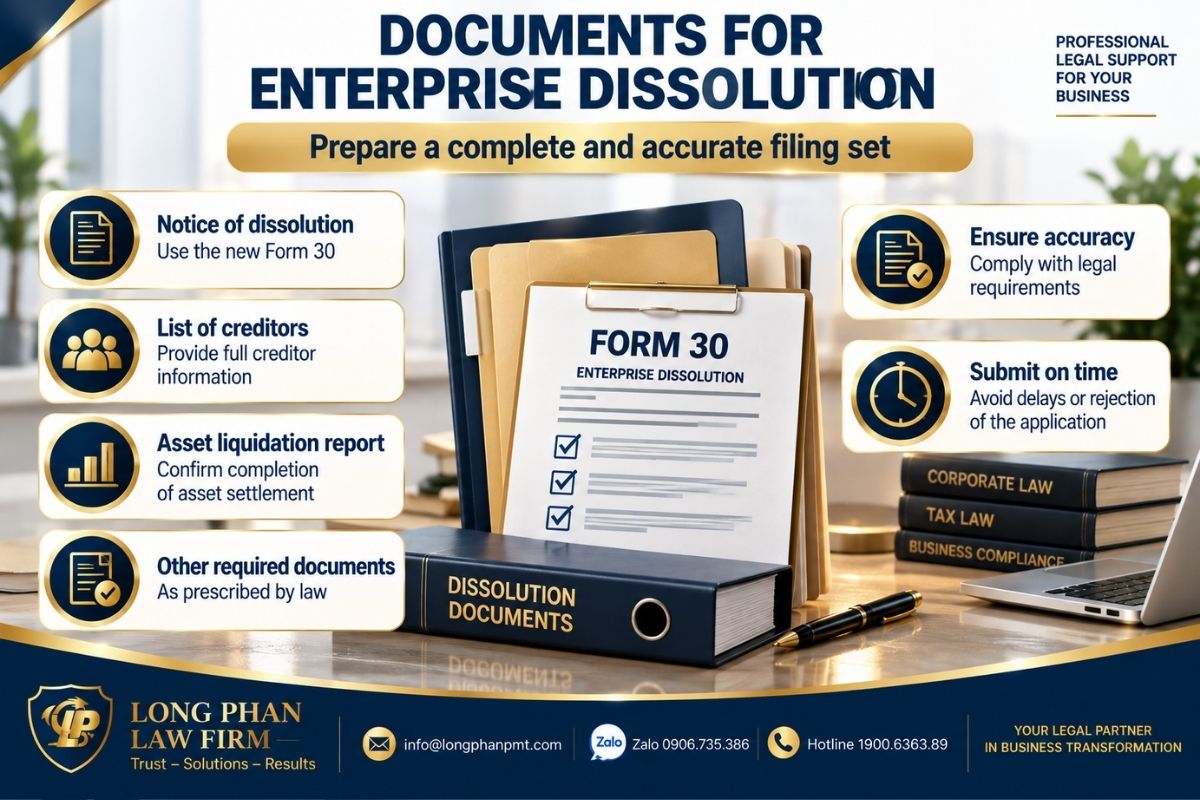
Under Article 210, Law on Enterprises and Businesses 2020 and Article 64, Decree 168/2025/ND-CP, an enterprise dissolution 2026 dossier includes:
Form No. 30 in the Appendix to Circular 121/2026/TT-BTC replaces the corresponding form under Circular 68/2025/TT-BTC, while keeping the same mandatory content: the enterprise name, enterprise code, and head office address; the reason for dissolution; confirmation of completed tax and social insurance obligations; and a commitment that all debts have been paid. Enterprises should download the official form from the National Business Registration Portal rather than reuse an old saved copy, to avoid citing the wrong document number.
Decree 168/2025/ND-CP prioritizes filing through the National Business Registration Portal using a digital signature, which carries the same legal value as a paper dossier. Enterprises may also file directly or by postal service to the Business Registration Division under the Department of Finance where their head office is located.
Legal basis: Article 209, Law on Enterprises and Businesses 2020.
Unlike the three voluntary dissolution cases, dissolution due to revocation of the Enterprise Registration Certificate (Point d, Clause 1, Article 207) is initiated by the business registration authority. The enterprise has an obligation to cooperate rather than decide the timing itself.
The business registration authority must announce the enterprise’s dissolution status on the National Business Registration Portal at the same time as issuing the revocation decision, or immediately upon receiving an effective court dissolution decision (Article 209, Law on Enterprises and Businesses 2020). The enterprise must convene a meeting to decide on dissolution within the statutory period; if it fails to do so, the business registration authority and relevant departments coordinate to carry out the asset liquidation.
The relevant managers and the enterprise jointly bear responsibility for the enterprise’s debts where the Enterprise Registration Certificate is revoked (Clause 3, Article 207, Law on Enterprises and Businesses 2020). The enterprise must still complete debt payment in the priority order under Clause 5, Article 208 before the authority updates the status to “dissolved.”
Legal basis: Articles 210 and 211, Law on Enterprises and Businesses 2020; Circular 121/2026/TT-BTC.
Most rejected enterprise dissolution 2026 dossiers fall into four error groups below. Recognizing them early helps enterprises avoid refiling.
From August 21, 2026, a dissolution notice using the form under Circular 68/2025/TT-BTC will not be accepted by the Business Registration Division. Enterprises must use the correct Form No. 30 under Circular 121/2026/TT-BTC before filing.
This is a mandatory condition under Clause 2, Article 207, Law on Enterprises and Businesses 2020. A dossier lacking evidence of paid tax or social insurance debts, or lacking tax finalization confirmation from the tax authority, will be rejected or delayed.
Where a dissolution dossier is inaccurate or falsified, the persons listed in Clause 2, Article 210, Law on Enterprises and Businesses 2020 — members of the Board of Directors, Members’ Council, company owner, sole proprietorship owner, Director or General Director, general partners, and legal representative — must jointly pay unresolved employee entitlements, unpaid taxes, and other unpaid debts, and bear personal liability for 5 years from the date the dossier is filed.
Under Clause 1, Article 211, Law on Enterprises and Businesses 2020, once a dissolution decision is issued, the enterprise and its managers are prohibited from: concealing or dissipating assets; waiving or reducing debt claims; converting unsecured debts into debts secured by company assets; entering new contracts, except those needed to carry out the dissolution; pledging, mortgaging, donating, or leasing assets; terminating effective contracts; and raising capital in any form. Violations may result in administrative penalties or criminal liability depending on severity, plus compensation for any resulting damage.
Legal basis: Article 214, Law on Enterprises and Businesses 2020; Bankruptcy Law 2014.
Many enterprises confuse these two procedures. Article 214, Law on Enterprises and Businesses 2020 refers bankruptcy matters to the Bankruptcy Law.
| Criteria | Enterprise Dissolution | Enterprise Bankruptcy |
| Legal basis | Articles 207–214, Law on Enterprises and Businesses 2020 | Bankruptcy Law 2014 |
| Cause | Expired operating term, voluntary termination, insufficient minimum members, or revoked Enterprise Registration Certificate | Insolvency in paying due debts |
| Handling authority | Business registration authority | Competent People’s Court |
| Prerequisite condition | All debts and property obligations already paid | Not necessarily fully paid; assets distributed by the Court’s priority order |
| Manager liability | May be barred from holding management positions in certain cases under the Bankruptcy Law if the case converts from dissolution to bankruptcy | May be restricted from managing enterprises under a Court decision |
Where an enterprise discovers during dissolution that it cannot pay all its debts, it must switch to the bankruptcy procedure instead of continuing dissolution.
Long Phan Consulting provides legal consulting and support for businesses during dissolution, restructuring, termination of operations, and settlement of related legal obligations, including:
Customers can send case documents via email info@longphanpmt.com or Zalo 0906.735.386 for an initial assessment.
Enterprise dissolution requires a business to complete various obligations before its legal existence can be terminated, including paying outstanding debts, fulfilling tax obligations, and preparing the required documents under current regulations. Changes to forms and procedural requirements may directly affect the dissolution process. The following frequently asked questions help businesses better understand the applicable conditions, timelines, and legal issues when carrying out dissolution procedures.
No. Circular No. 121/2026/TT-BTC took effect on August 21, 2026 and does not apply retroactively. A dossier validly received by the business registration authority before this date will continue to be processed using the previous form. Businesses only need to use the new Form No. 30 for dissolution dossiers submitted from August 21, 2026 onward.
The processing period depends on the liquidation of assets, settlement of debts, and completion of the company’s tax obligations. After receiving a valid dossier, the business registration authority updates the company’s legal status within 5 working days or after 180 days from receipt of the dissolution resolution if no objection is raised, pursuant to Clause 8, Article 208 of the Law on Enterprises 2020.
No. Under Clause 2, Article 207 of the Law on Enterprises 2020, a business may only be dissolved after fully paying all debts and other property obligations, including tax debts. The business must complete tax finalization and fulfill its tax obligations before submitting the dissolution dossier.
No. Clause 2, Article 207 of the Law on Enterprises 2020 provides that a business may not be dissolved while a dispute is being resolved by a Court or commercial arbitration. The business must wait until the dispute has been resolved by an effective judgment or decision before proceeding with dissolution.
Under Clause 2, Article 210 of the Law on Enterprises 2020, members of the Board of Directors, members of the Members’ Council, company owners, Directors or General Directors, and legal representatives may be jointly liable for employee benefits, unpaid taxes, and outstanding debts, and may bear personal legal liability for 5 years from the date of submission of the dissolution dossier.
Voluntary dissolution under Points a, b, and c, Clause 1, Article 207 of the Law on Enterprises 2020 is initiated by the business and carried out under Article 208. Dissolution resulting from revocation of the Enterprise Registration Certificate or a Court decision under Point d, Clause 1, Article 207 is carried out under Article 209, with a separate procedure and supervision by the business registration authority.
Under Article 64 of Decree No. 168/2025/ND-CP, the dissolution dossier may be submitted to the Business Registration Office under the Department of Finance where the enterprise’s head office is located, or online through the National Business Registration Portal using a legally valid digital signature equivalent to a paper dossier.
Enterprise dissolution in 2026 continues to be governed primarily by Articles 207–214 of the Law on Enterprises 2020 and Decree No. 168/2025/ND-CP. However, the key change concerns the application form: from August 21, 2026, businesses must use Form No. 30 under Circular No. 121/2026/TT-BTC instead of the previous form. Businesses should correctly identify the applicable dissolution case, fully settle obligations according to the statutory priority order, and prepare the dossier using the latest form to avoid rejection or delays. Long Phan Consulting is ready to review the dossier and provide comprehensive support throughout the enterprise dissolution procedure. For specific advice, please contact 1900636389.
📚 This article is professionally reviewed based on the following legal documents:


