



Distinguishing between brands and logos is important to help businesses understand how to protect and develop their brands. A brand is any sign used to distinguish the goods or services of one business from those of other businesses and may include words, images, colors, sounds, or a combination of these. A logo is a special form of a brand, usually a visual symbol that represents the brand, making it easy to recognize and remember.

Brands and logos have many similarities with each other, specifically:
Although they are the same objects of industrial property protection, brands and logos are not the same thing but will have some differences as follows:
| Comparison criteria | Brand | Logo |
| Concept | According to Clause 16, Article 4 of the Law on Intellectual Property 2005, amended and supplemented in 2022, a brand is a sign used to distinguish goods and services of different organizations and individuals. | A logo is a brand symbol, a graphic design, symbol, or symbol for a specific brand or brand. It is a visual design product and is composed of images or text, sometimes including both text and images. |
| Characteristic | ● Brands must be visible signs, clearly distinguishable, easy to recognize, and easy to remember for consumers; ● The brand must not infringe the rights of another registered or widely used trademark, cause confusion as to the origin of goods or services, or take advantage of the reputation of that trademark; ● Distinguishing trademarks takes place between branded products of different enterprises, or within the same enterprise. |
● A logo is designed with one or more images, colors or words put together to create a shape that makes customers remember the day they visited the business that owns the logo; ● Logos help customers identify this brand from other brands, so it must be unique; ● The logo must be easily applied on many different platforms and sizes, from product packaging, signs, websites to advertising publications, without losing aesthetics or ease of recognition;
|
| Function | A sign that helps customers easily distinguish goods and services from businesses. | ● Icons represent brands and trademarks;
● Each logo will contain its own meaning and implications, replacing the verbal expression coming from the business. |
| Scope of protection | The scope of protection of a trademark must meet the protection requirements in Article 72, Article 73 and Article 74 of the Law on Intellectual Property 2005 (amended and supplemented in 2022), specifically:
● A visible sign: includes letters, words, drawings, images, three-dimensional images, or a combination of these elements, and can be expressed in color or sound in graphic form. ● Distinctive: A trademark must be able to clearly distinguish the owner’s goods and services from those of other entities. ● Not included in the following cases that are not protected: signs that are identical or similar to the national flag, state symbols, names of famous people, signs describing goods, or are identical to registered or widely used trademarks of others. |
Because a logo is a symbol of a brand, currently, the current Law on Intellectual Property does not have separate protection regulations for logos. So for a logo to be protected, it must meet the conditions according to regulations on trademark protection. |
| For example | Brands of OMO, Samsung, Unilever, Comfort, … | Microsoft’s logo is four small squares with four colors (red, yellow, green and blue) combined into a large square. |

Registering brands and logos brings many important benefits to businesses and organizations, including:
In short, registering logos and trademarks is an important way to protect property rights, build a strong brand and prevent legal risks that may occur during the business process.

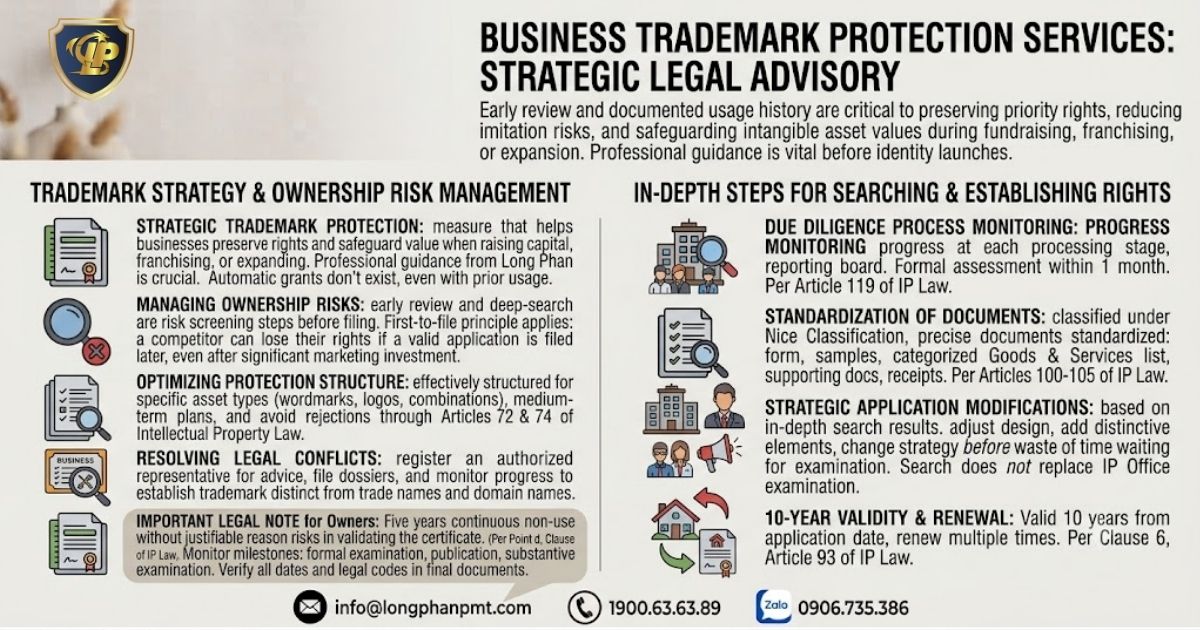
Registering brands and logos is an important procedure in the current era of international trade and international exchange development. At Long Phan, we provide comprehensive consulting and support services in carrying out logo and trademark registration procedures.
Below are the services we provide:
>>> Reference:
With a team of experienced experts and deep understanding of intellectual property law, Long Phan’s consulting services will help you save time and effort in registering and protecting your logo and trademark. Contact us today via the hotline 0906735386 for free consultation and start protecting your brand!


