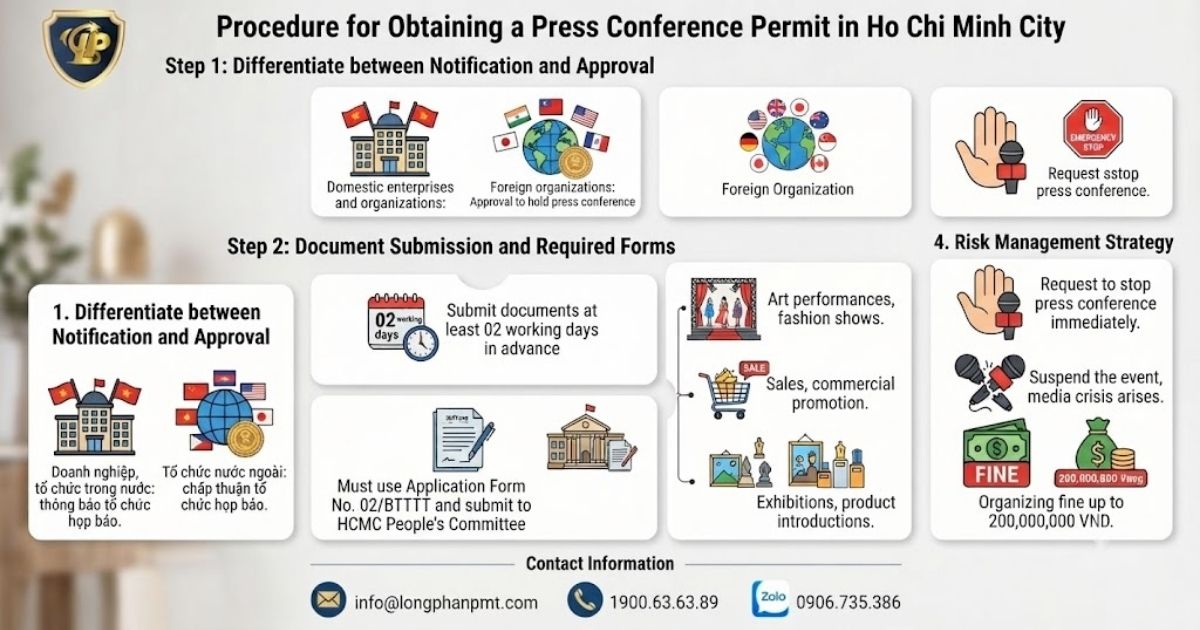
Preparing a Chemical Incident Prevention Plan is critical for manufacturers in Vietnam to prevent licensing delays, penalties, and business interruptions. Facilities storing hazardous chemicals above regulated thresholds must secure state approval before commercial operation. Legal Updates require technical data to align with the Environmental License, fire prevention approvals, and enterprise registration records. Early compliance review helps reduce repeated dossier rejections and shorten approval timelines. Long Phan Consulting supports enterprises with chemical compliance audits, dossier structuring, and strategic licensing advisory services.
Important legal note:
Enterprises must not initiate compliance dossiers by merely filling out administrative templates. The absolute priority is accurately determining the hazardous chemical storage thresholds. Misclassifying the required dossier as a “Plan” rather than a “Measure” triggers jurisdictional filing errors, severely delaying the factory commissioning timeline.
Facilities processing paints, solvents, electroplating, industrial gases, pharmaceuticals, fertilizers, wastewater, or electronics inherently carry high risks. However, the statutory obligation to establish a Chemical Incident Prevention and Response Plan does not arise solely from the business sector. It depends strictly on the regulated list of hazardous chemicals and the maximum storage volume at any single given time.
“Hazardous chemicals” are defined as substances causing harm to humans, property, or the environment, possessing at least one dangerous characteristic under specialized classification principles. Grasping this definition empowers enterprises to accurately identify chemicals requiring risk management, pursuant to Clause 4, Article 2 of the 2025 Chemical Law.
| Classification Criteria | Chemical Incident Prevention and Response Plan | Chemical Incident Prevention and Response Measure |
| Statutory Application Base | Stores regulated chemicals exceeding statutory volume thresholds. | Stores hazardous chemicals but falls outside the formal Plan threshold. |
| Executing Subject | Project Investor or Facility Operator. | Project Investor or Facility Operator. |
| Legal Mechanism | Must be submitted to competent state authorities for formal approval. | Internally established and officially promulgated by the facility. |
| Misclassification Risk | Dossier rejections, delayed factory commissioning, and administrative sanctions. | Deemed as lacking risk control during ex-post compliance inspections. |
Enterprises storing regulated chemicals exceeding statutory thresholds must establish a Plan for formal state approval, pursuant to Points a and b, Clause 1, Article 37 of the 2025 Chemical Law. If the facility falls below the threshold or outside the regulated list, it must still formally promulgate a Chemical Incident Prevention and Response Measure, pursuant to Clause 1, Article 38 of the 2025 Chemical Law.
Transitional regulations serve as critical schedule control points for factories under construction, FDI projects, or facilities preparing for operations. Legacy dossiers existing before the new law takes effect do not automatically lose validity. However, projects failing to finalize these compliance obligations will be legally blocked during the commercial exploitation phase.
Foreign investors must verify the following transitional rules:
For the Project Investor, the primary risk is not merely possessing a dossier, but ensuring the document strictly reflects the correct classification, precise storage thresholds, and lawful timing. This rigorous compliance audit must be executed long before finalizing any commercial operations schedule.
A Chemical Incident Prevention and Response Plan must never be constructed as an isolated set of administrative templates. For manufacturing plants processing hazardous chemicals, the dossier must rigorously reflect the actual applied technology, physical storage configurations, impact zones, and the genuine on-site emergency response capacity.
The provided legal framework does not explicitly mandate a rigid, itemized table of contents for the Plan. Consequently, enterprises must structure the dossier following a strict risk management logic to decisively prove their incident risks, response scenarios, and localized control capacity.
Enterprises must systematically compile the following technical components:
This structural approach empowers the appraising authority to visualize the direct link between theoretical chemical risks and actual physical response capabilities. The more the dossier aligns with the physical reality, the lower the risk of facing extensive technical defense demands.
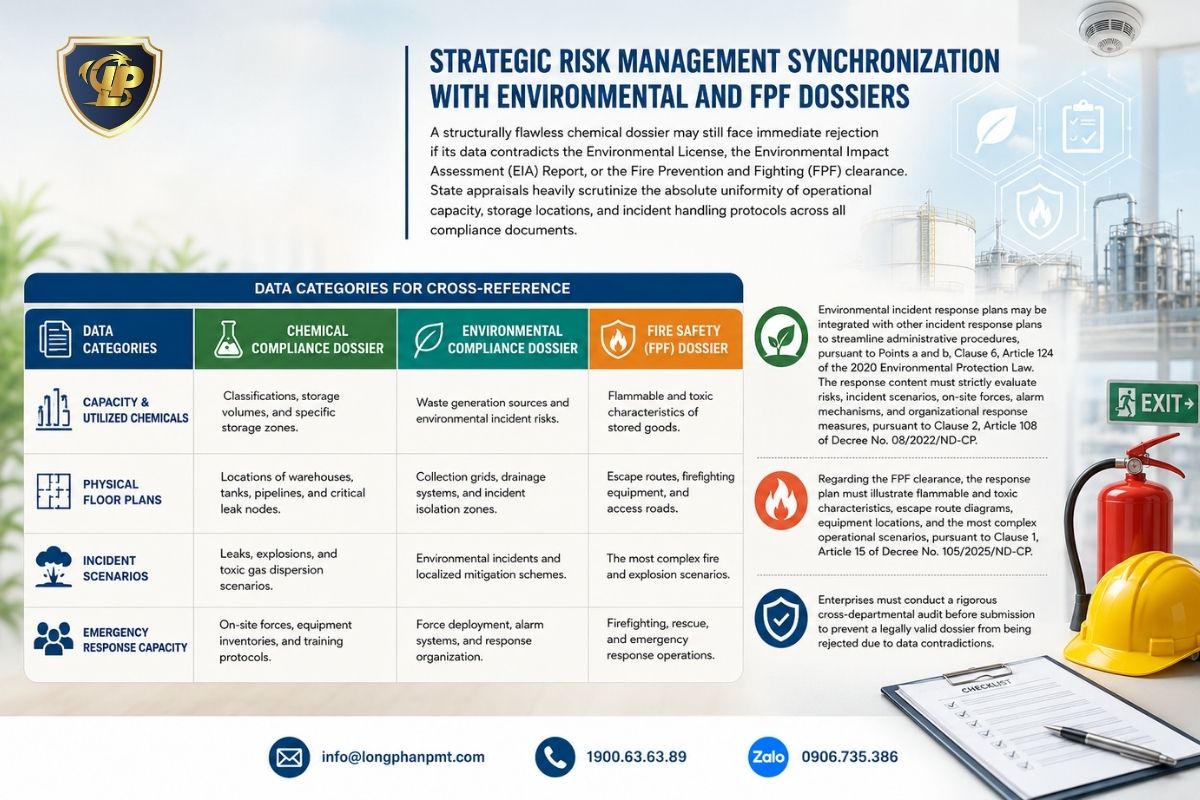
A structurally flawless chemical dossier may still face immediate rejection if its data contradicts the Environmental License, the Environmental Impact Assessment (EIA) Report, or the Fire Prevention and Fighting (FPF) clearance. State appraisals heavily scrutinize the absolute uniformity of operational capacity, storage locations, and incident handling protocols across all compliance documents.
| Data Categories for Cross-Reference | Chemical Compliance Dossier | Environmental Compliance Dossier | Fire Safety (FPF) Dossier |
| Capacity & Utilized Chemicals | Classifications, storage volumes, and specific storage zones. | Waste generation sources and environmental incident risks. | Flammable and toxic characteristics of stored goods. |
| Physical Floor Plans | Locations of warehouses, tanks, pipelines, and critical leak nodes. | Collection grids, drainage systems, and incident isolation zones. | Escape routes, firefighting equipment, and access roads. |
| Incident Scenarios | Leaks, explosions, and toxic gas dispersion scenarios. | Environmental incidents and localized mitigation schemes. | The most complex fire and explosion scenarios. |
| Emergency Response Capacity | On-site forces, equipment inventories, and training protocols. | Force deployment, alarm systems, and response organization. | Firefighting, rescue, and emergency response operations. |
Environmental incident response plans may be integrated with other incident response plans to streamline administrative procedures, pursuant to Points a and b, Clause 6, Article 124 of the 2020 Environmental Protection Law. The response content must strictly evaluate risks, incident scenarios, on-site forces, alarm mechanisms, and organizational response measures, pursuant to Clause 2, Article 108 of Decree No. 08/2022/ND-CP.
Regarding the FPF clearance, the response plan must illustrate flammable and toxic characteristics, escape route diagrams, equipment locations, and the most complex operational scenarios, pursuant to Clause 1, Article 15 of Decree No. 105/2025/ND-CP. Enterprises must conduct a rigorous cross-departmental audit before submission to prevent a legally valid dossier from being rejected due to data contradictions.
A rejected dossier does not merely delay administrative procedures. For a manufacturing plant preparing to launch, prolonged state appraisals directly disrupt commissioning schedules, supply chain deliveries, capital disbursement, and the overall commercialization timeline of the investment project.
Appraising authorities do not evaluate the chemical dossier in a vacuum. The submitted data is rigorously cross-referenced against the physical reality of the factory, environmental compliance dossiers, FPF clearances, licensed storage capacities, and tangible on-site emergency response capabilities.
The most frequent technical vulnerabilities leading to dossier rejection include:
These critical errors compel specialized agencies to demand extensive explanations, mandatory amendments, or a complete redrafting of the risk assessment. Enterprises must execute a rigorous cross-departmental audit prior to submission, rather than passively awaiting official state requests for dossier supplementation.
Legal risks don’t stop at the lengthy application review process. If a facility commences operations without fulfilling its obligations regarding the Chemical Incident Prevention and Response Plan, the business may face penalties, suspension, and legal prosecution if consequences occur.
| Legal conduct or consequences | Sanctions, risk levels | Legal basis |
| Submit the Chemical Incident Prevention and Response Measures in the Industrial Sector and the Decision to Issue the Measures more than 10 working days after the date of the Decision to Issue the Measures to the Department of Industry and Trade of the province or city where the chemical activity project is being built for monitoring and management; | A fine of 2,000,000 to 3,000,000 VND will be imposed. | Point a, Clause 14, Article 1 of Decree 17/2022/ND-CP |
| The document lacks only the mandatory content of the Chemical Incident Prevention and Response Measures; | A fine of 3,000,000 to 4,000,000 VND will be imposed. | Point b, Clause 14, Article 1 of Decree 17/2022/ND-CP |
| Failure to send the Chemical Incident Prevention and Response Measures in the Industrial Sector and the Decision promulgating the Measures to the Department of Industry and Trade of the province or city where the chemical activity project is being built for monitoring and management; | A fine of 4,000,000 to 5,000,000 VND will be imposed. | Point c, Clause 14, Article 1 of Decree 17/2022/ND-CP |
| Failure to retain the Chemical Incident Prevention and Response Measures issued at the chemical facility as a basis for organizations and individuals to carry out safety control work at the facility and to present them to competent authorities upon request; | A fine of 5,000,000 to 10,000,000 VND will be imposed. | Point d, Clause 14, Article 1 of Decree 17/2022/ND-CP |
| Although measures for preventing and responding to chemical incidents were developed, no decision was made to issue the measures, and the project was still put into operation. | A fine of between 10,000,000 VND and 12,000,000 VND will be imposed. | Point d, Clause 14, Article 1 of Decree 17/2022/ND-CP |
| No additions or modifications to the Chemical Incident Prevention and Response Measures shall be made in the event of changes in the investment and operation process related to the contents set out in the Measures; | A fine of between 12,000,000 VND and 15,000,000 VND will be imposed. | Point e, Clause 14, Article 1 of Decree 17/2022/ND-CP |
| The project was put into operation without establishing measures to prevent and respond to chemical incidents. | A fine of between 15,000,000 VND and 20,000,000 VND will be imposed. | Point g, Clause 14, Article 1 of Decree 17/2022/ND-CP |
For plant management, the critical risk area is the responsibility of the Legal Representative and the Chemical Safety Officer. When records do not accurately reflect the situation, it is difficult for the business to prove that it had established appropriate preventative measures before the incident occurred.
Optimizing the approval timeline does not equate to bypassing procedures by omitting technical data. For a Chemical Incident Prevention and Response Plan, the correct strategy centers on eliminating repetitive administrative amendment rounds. This is achieved by ensuring absolute data uniformity, submitting the dossier to the precise competent authority, and preparing robust technical defenses in advance.
Enterprises must pinpoint the exact appraisal jurisdiction before drafting compliance dossiers. This is particularly critical for FDI projects, major chemical warehouses, or multi-line manufacturing plants. Pursuant to Articles 37 and 42 of the 2025 Chemical Law, formal approval authority is strictly delegated to competent state management agencies, specifically including the Ministry of Industry and Trade (MOIT) and Provincial People’s Committees.
To secure on-time approvals, enterprises must execute the following actions:
Since the provided legal framework does not mandate a specific maximum timeframe for this administrative approval, enterprises must treat the reduction of mandated amendment rounds as the true metric for optimization, rather than relying solely on nominal administrative deadlines.
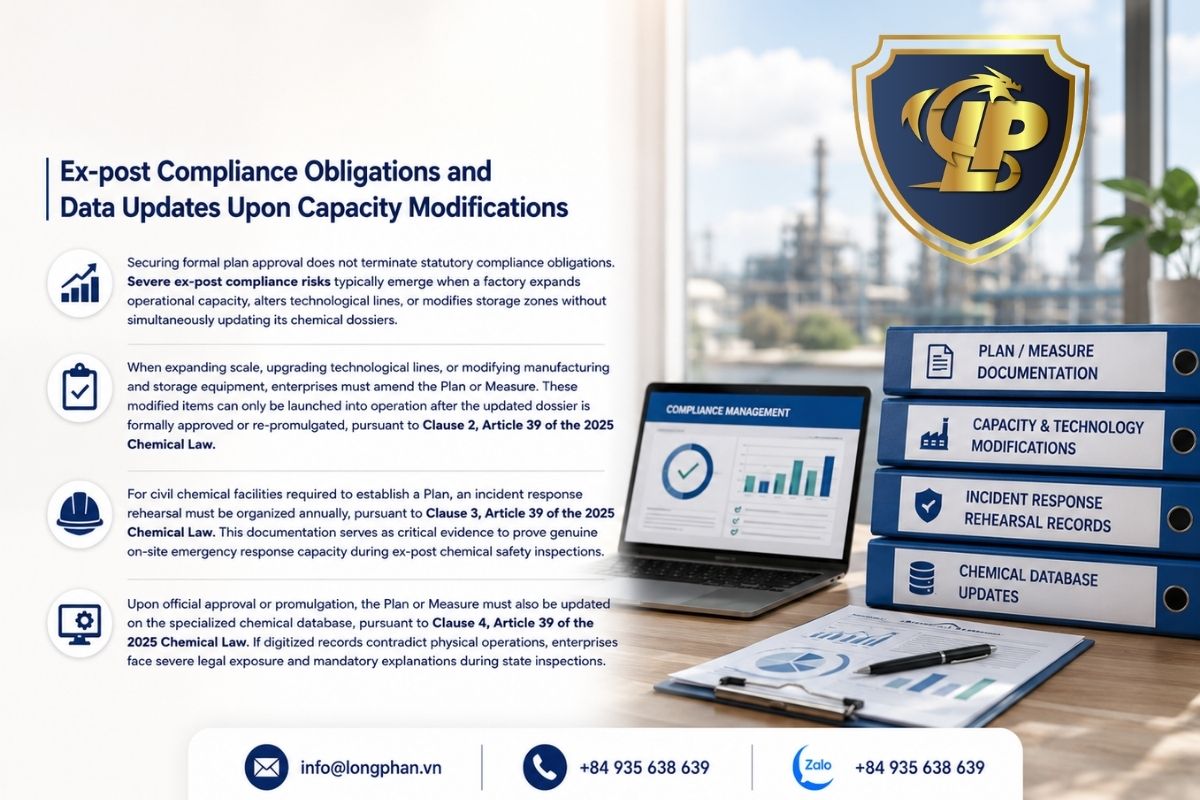
Securing formal plan approval does not terminate statutory compliance obligations. Severe ex-post compliance risks typically emerge when a factory expands operational capacity, alters technological lines, or modifies storage zones without simultaneously updating its chemical dossiers.
When expanding scale, upgrading technological lines, or modifying manufacturing and storage equipment, enterprises must amend the Plan or Measure. These modified items can only be launched into operation after the updated dossier is formally approved or re-promulgated, pursuant to Clause 2, Article 39 of the 2025 Chemical Law.
For civil chemical facilities required to establish a Plan, an incident response rehearsal must be organized annually, pursuant to Clause 3, Article 39 of the 2025 Chemical Law. This documentation serves as critical evidence to prove genuine on-site emergency response capacity during ex-post chemical safety inspections.
Upon official approval or promulgation, the Plan or Measure must also be updated on the specialized chemical database, pursuant to Clause 4, Article 39 of the 2025 Chemical Law. If digitized records contradict physical operations, enterprises face severe legal exposure and mandatory explanations during state inspections.
Securing a legally compliant Chemical Incident Prevention and Response Plan demands complex synchronization between corporate law, operational engineering, environmental regulations, and fire safety standards. Long Phan Consulting Company empowers foreign investors to aggressively control compliance risks from initial audits through state appraisals. We specialize in rescuing frequently rejected dossiers, ensuring your technical data perfectly aligns with your physical operations, and guaranteeing that your market entry remains entirely uninterrupted by regulatory bottlenecks.
To optimize state appraisals and minimize ex-post compliance liabilities, our legal team executes the following core services:
Foreign investors and plant managers are strictly advised to transmit their current legal dossiers and operational data via Email (info@longphanpmt.com) or Zalo/WhatsApp (+84 906 735 386) for an immediate preliminary risk evaluation by the legal experts at Long Phan Consulting Company.
With a Chemical Incident Prevention Plan, the biggest risks often lie in boundary situations: upcoming FDI projects, plant capacity changes, whether existing documentation is still valid, and incidents arising after approval. These questions help business leaders control submission timing, approval mechanisms, and legal liability before risks translate into operating costs.
Yes. FDI electronics manufacturing enterprises must develop a Chemical Incident Prevention and Response Plan if their chemical storage activities exceed the maximum storage volume threshold at any given time. If the storage volume does not exceed the threshold or the chemicals are not listed as requiring a Plan, the enterprise must still issue a Chemical Incident Prevention and Response Measure. This obligation is stipulated in Points a and b, Clause 1, Article 37 and Clause 1, Article 38 of the 2025 Chemical Law.
Yes. Transitional projects that do not yet have a Chemical Incident Prevention and Response Plan or Measures must complete the required documentation before the facility is officially put into operation. The Plan must be approved or the Measures must be issued prior to commencement of operations, pursuant to Clause 5, Article 48 of the 2025 Chemical Law.
Yes. Plans and Measures that were approved or issued before January 1, 2026, remain valid and continue to be implemented. Enterprises are not required to reapply solely because the 2025 Chemical Law takes effect. This transitional provision is provided in Clause 1, Article 47 and Clause 4, Article 48 of the 2025 Chemical Law.
Yes. Businesses must revise and update their Chemical Incident Prevention and Response Plan or Measures whenever there are changes involving production capacity, production lines, equipment, or the use and storage of chemicals. The revised contents may only be implemented after the updated Plan has been approved or the revised Measures have been issued, in accordance with Clause 2, Article 39 of the 2025 Chemical Law.
Yes. Chemical facilities that are required to prepare a Chemical Incident Prevention and Response Plan must conduct annual incident response drills. These drills serve as evidence of emergency preparedness and compliance during inspections or incident investigations. The requirement is stipulated in Clause 3, Article 39 of the 2025 Chemical Law.
Businesses may face administrative penalties for operating without a required Chemical Incident Prevention and Response Plan. The fine ranges from VND 20,000,000 to VND 25,000,000 for failing to develop a plan for the production, business, use, or storage of hazardous chemicals. If a plan has been prepared but not submitted for appraisal, the fine ranges from VND 15,000,000 to VND 20,000,000. These penalties are prescribed in Point c, Clause 2, Article 27 and Point b, Clause 2, Article 27 of Decree No. 71/2019/ND-CP.
Yes, individuals managing or responsible for safety may face criminal charges if they violate regulations on the management of flammable and toxic substances and cause consequences. The starting prison sentence for individuals committing this offense is from 1 to 5 years, according to Clause 1, Article 312 of the 2015 Penal Code. Commercial legal entities violating regulations on preventing, responding to, and remedying environmental incidents may be fined up to VND 10,000,000,000 or have their operations permanently suspended, according to Clause 5, Article 237 of the 2015 Penal Code.
A legally robust chemical incident prevention plan in Vietnam is a mandatory compliance checkpoint directly dictating your factory’s operational launch, ex-post inspection outcomes, and corporate liability. Project investors must accurately determine whether their hazardous chemical storage necessitates a formal Plan or an internal Measure, while strictly synchronizing this technical data with environmental licenses, FPF clearances, and physical warehouse capacities. Submitting dossiers with incorrect thresholds, flawed floor plans, or deficient emergency scenarios guarantees prolonged state appraisals, severe administrative fines, and forced operational suspensions. To eliminate these catastrophic commercial risks and secure a flawless regulatory submission, contact the senior corporate attorneys at Long Phan Consulting Company. immediately via Hotline 1900636389 for elite dossier appraisal and structural execution.
📚 This article is provided with professional consultation based on the following legal framework: