
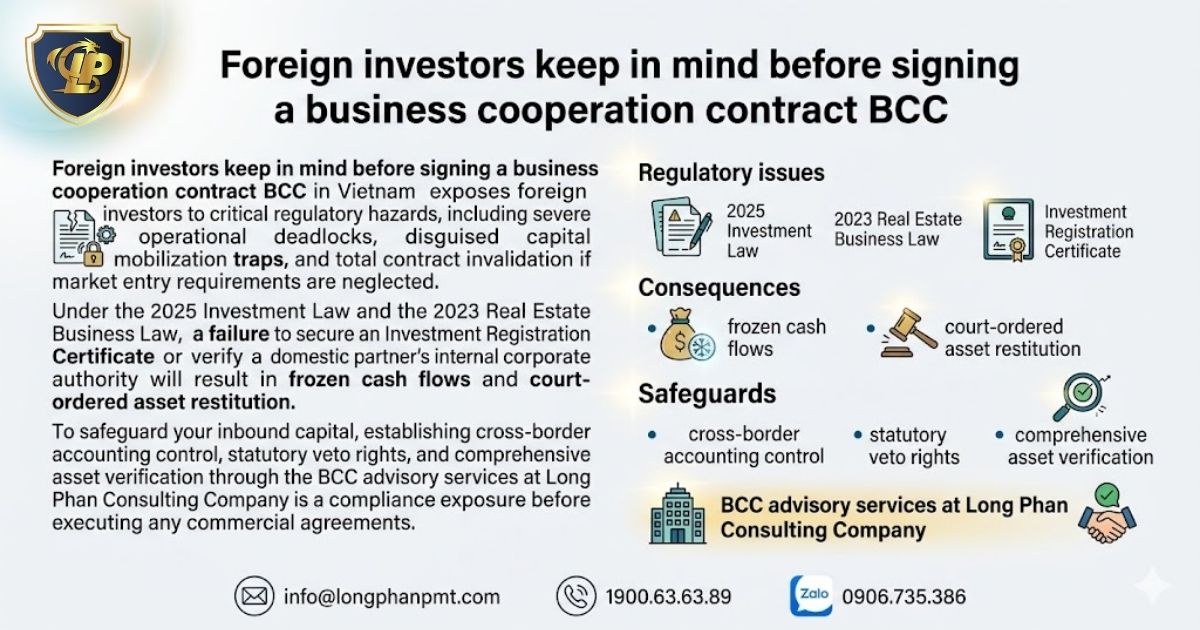
A Business Cooperation Contract BCC in Vietnam may expose foreign investors to major compliance risks, including management deadlocks, disguised capital-raising structures, and contract invalidation if market access conditions are not properly assessed. Under the Law on Investment and the real estate business framework, failure to obtain an Investment Registration Certificate or confirm the Vietnamese partner’s corporate authority may lead to frozen funds, disrupted operations, and asset recovery disputes. To protect inbound capital, investors should establish cross-border accounting controls, veto mechanisms, and asset verification procedures through BCC advisory support from Long Phan Consulting before signing commercial agreements.
Key legal notes:
Conducting rigorous legal due diligence (LDD) is the primary risk-mitigation mechanism for foreign investors prior to executing a Business Cooperation Contract (BCC). The objective extends beyond mere document verification; it requires a comprehensive compliance assessment of whether the domestic partner, the proposed business sector, and the overarching transactional structure fulfill all statutory requirements for lawful implementation.
Omitting this critical phase exposes foreign investors to the risk of contracting with unauthorized signatories, engaging in restricted business sectors, or injecting inbound capital into non-permittable projects. The most severe consequence includes structural contract invalidation, frozen operational cash flows, and the total disruption of your market-entry strategy in Vietnam.
Foreign investors must verify that the domestic counterparty possesses valid legal personality and that the signing representative holds \proper authorization. An ultra vires signature executed in excess of legal authority can trigger immediate validity disputes during the initial stages of the transaction.
The scope of the corporate governance review must encompass:
This corporate verification directly dictates the statutory validity of the transaction. Pursuant to Clause 1, Article 117 and Clause 1, Article 122 of the 2015 Civil Code, contracting parties must possess appropriate legal capacity, and any transaction violating these statutory validity conditions risks being declared legally void.
Market entry restrictions dictate whether foreign investors are permitted to participate in the targeted business sector. This evaluation constitutes a mandatory check before negotiating capital contribution ratios, management control, or profit-sharing mechanisms within the BCC.
| Market Entry Category | Prohibited Investment Sectors | Restricted/Conditional Sectors |
| Participation Capacity | Absolutely prohibited | Permissible subject to regulatory compliance |
| Regulatory Focus | Activities legally excluded from commercial exploitation | Ownership caps, investment forms, operational scopes, and partner capacity |
| Primary Risk Exposure | Automatic contract invalidation | Licensing rejection or severe operational constraints |
| Strategic Action Required | Immediate exclusion from the BCC structure | Restructuring of contractual terms and licensing dossiers |
Investors must cross-reference the proposed scope of cooperation against the statutory lists of prohibited and restricted sectors. Where market entry conditions apply, foreign direct investment (FDI) must strictly satisfy the statutory requirements regarding charter capital ownership ratios, investment forms, operational scopes, and domestic partner capacity pursuant to Article 6 and Clause 3, Article 8 of the 2025 Investment Law.
Under specific statutory frameworks, foreign investors may establish an economic organization prior to completing the procedures for an Investment Registration Certificate (IRC). However, satisfying all applicable market entry conditions remains an absolute prerequisite pursuant to Clause 2, Article 19 of the 2025 Investment Law.
Foreign investors must not treat project legal dossiers as a supplementary attachment to a BCC transaction. This documentation forms the legal foundation that determines whether the domestic counterparty possesses the valid rights to exploit, contribute, or implement the project within the scope of cooperation.
Substantial risks emerge when domestic partners rely solely on verbal commitments regarding “land banks,” “pending approvals,” or “regulatory relationships” without presenting verifiable legal titles. In real estate developments, the absence of foundational legal dossiers can trigger contract invalidation and severely delay your entire inbound capital deployment.
Investors must rigorously audit local land use rights (LUR) and land-attached assets before accepting them as valid capital contributions or commercial goodwill within the BCC structure. Verbal assurances concerning project exploitation rights offer zero legal protection for foreign direct investment (FDI).
The project’s legal framework must be fully verified prior to contract execution:
A real estate project is legally permissible for commercial exploitation only after fulfilling strict statutory conditions regarding state authorities’ approvals, land-use planning, construction zoning, and all land-related financial obligations. This regulatory mandate is explicitly enforced under Clause 1 and Clause 2, Article 11 of the 2023 Real Estate Business Law.
The law strictly prohibits engaging in real estate operations utilizing non-compliant assets. If a BCC is established upon a project that lacks legal completion, the transaction violates statutory prohibitions and faces being declared void by a court pursuant to Clause 1, Article 8 of the 2023 Real Estate Business Law and Article 123 of the 2015 Civil Code.
The financial fallout of a legally void contract extends far beyond operational suspension. Pursuant to Clause 2, Article 131 of the 2015 Civil Code, the contracting parties face mandatory restitution, requiring them to restore all assets to their original pre-contractual state and return any received properties or capital.
A Business Cooperation Contract (BCC) that lacks precise internal governance mechanisms will rapidly devolve into operational deadlocks and severe cash flow disputes. Foreign investors must look beyond simple profit-sharing ratios and prioritize absolute operational oversight, financial transparency, and systemic audit rights.
The critical clauses of the contract must be structured as an independent project governance framework. This architecture is vital for foreign direct investment (FDI) transactions that do not establish a new legal entity, where the domestic partner maintains day-to-day physical control over operations within Vietnam.
The primary risk exposure in a BCC structure is not the loss of the underlying asset, but the total loss of control over revenue, operating expenses, and cash flows. Severe commercial disputes routinely arise when the domestic partner exercises unilateral control over project bank accounts while withholding accounting data.
To mitigate this risk, the BCC must explicitly stipulate:
The underlying contractual structure must precisely delineate asset contribution values, mutual rights and obligations, implementation timelines, and executive management structures pursuant to Clause 4, Article 77 of Decree No. 96/2026/NĐ-CP.
To reinforce actual operational control, foreign investors should exercise their legal right to establish an independent operating office in Vietnam. This specialized vehicle is permitted to hold an official corporate seal, open dedicated commercial bank accounts, and directly hire operational staff pursuant to Clause 1 and Clause 2, Article 37 of the 2025 Investment Law.
The deployment of a compliant BCC operating office involves:
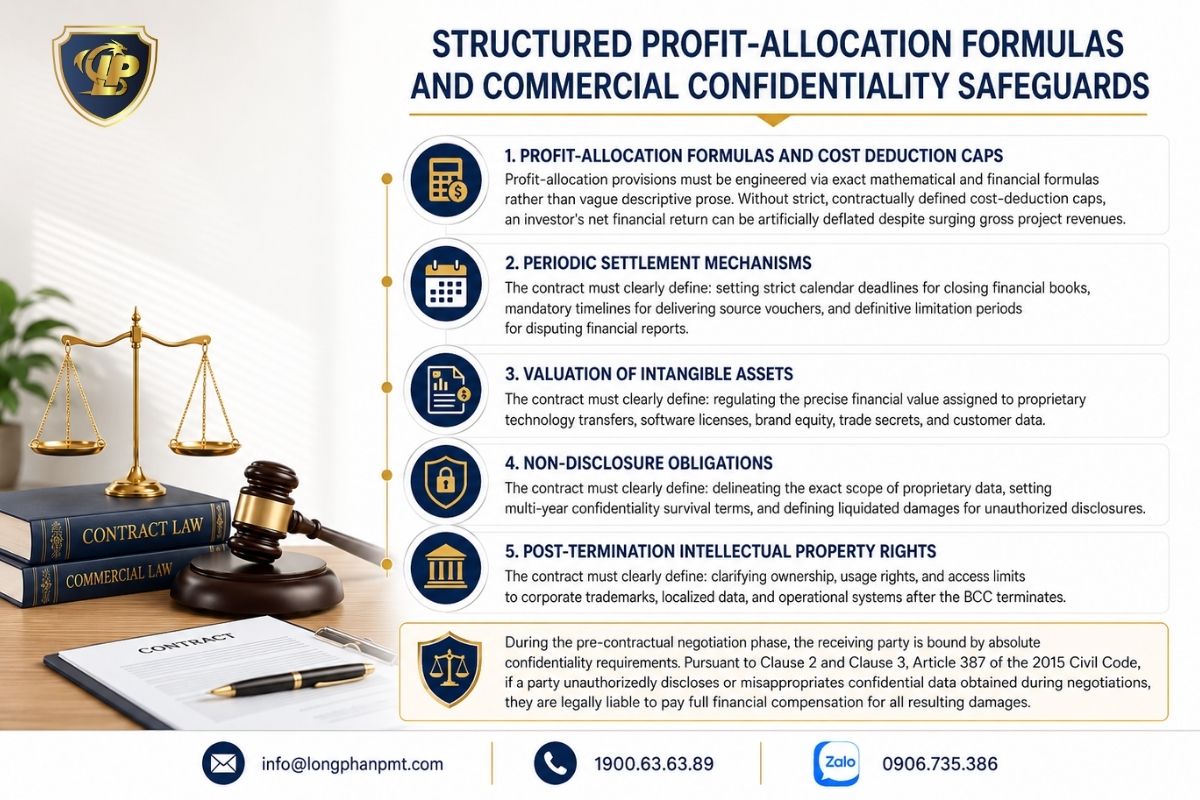
Profit-allocation provisions must be engineered via exact mathematical and financial formulas rather than vague descriptive prose. Without strict, contractually defined cost-deduction caps, an investor’s net financial return can be artificially deflated despite surging gross project revenues.
The contract must clearly define:
During the pre-contractual negotiation phase, the receiving party is bound by absolute confidentiality requirements. Pursuant to Clause 2 and Clause 3, Article 387 of the 2015 Civil Code, if a party unauthorizedly discloses or misappropriates confidential data obtained during negotiations, they are legally liable to pay full financial compensation for all resulting damages.
A Business Cooperation Contract (BCC) can be weaponized to conceal unauthorized capital mobilization, premature product distribution, or illicit commercial transfers before a project fulfills its licensing requirements. Foreign investors must scrutinize the underlying economic substance of the transaction rather than relying on the nominal “cooperation” title.
The regulatory risk intensifies when a domestic partner promises exclusive distribution rights, pre-sale collection privileges, or financial returns derived from a real estate development that lacks complete legal clearances. Under these conditions, the BCC risks becoming a primary source of civil liability, administrative sanctions, and protracted commercial litigation.
Foreign investors must maintain extreme vigilance against contractual structures framed as “strategic cooperation” that actually function to collect unauthorized pre-construction advances from consumers or illegally transfer project distribution rights. Pursuant to Clause 4, Article 17 of the 2023 Real Estate Business Law, a primary real estate developer is strictly prohibited from authorizing a BCC partner to sign reservation agreements, sales contracts, or lease-purchase agreements for future-formed housing units or commercial constructions.
To ensure strict financial compliance, investors must audit the following regulatory boundaries:
Foreign investors must demand clear documentary proof that all consumer cash flows managed by the domestic partner strictly adhere to these statutory thresholds. If the BCC is found to be a vehicle designed to circumvent capital mobilization laws, the foreign investor faces joint civil liability, mandatory restitution demands, and severe exposure to consumer class-action lawsuits.
Operational deadlock occurs when the contracting parties reach an absolute impasse on critical commercial decisions, yet the contract lacks a structural mechanism to break the gridlock. Within a BCC, this hazard is magnified because there is no independent joint-venture legal entity to insulate and manage corporate assets separate from the partners.
To preserve operational continuity, the BCC must incorporate:
Contractual penalties for non-compliance may be freely negotiated and agreed upon by the parties, except where specialized statutory laws impose mandatory maximum caps. These contractually defined penalties form the legal basis for enforcing financial remedies against capital contribution defaults, exclusivity breaches, or operational failures pursuant to Clause 2, Article 418 of the 2015 Civil Code.
A Business Cooperation Contract (BCC) executed without an explicit, pre-defined dispute resolution strategy exposes foreign investors to immediate asset freezes and protracted capital recovery delays. Foreign investors must treat jurisdictional and choice-of-law clauses as primary financial protection tools rather than secondary boilerplates tucked away at the end of the contract.
BCC disputes typically stem from conflicting management interpretations, asymmetric profit distributions, capital contribution defaults, or contested project exploitation rights. If the arbitration clause is poorly drafted or legally defective, your entire asset protection strategy risks total collapse.

Foreign investors can utilize distinct dispute resolution forums based on the total transactional value, the geographic location of the assets, and the practical enforceability of the final award within Vietnam.
The primary jurisdictional avenues comprise:
Pursuant to Clause 3, Article 13 of the 2025 Investment Law, disputes involving foreign investors or foreign-invested economic organizations may be resolved via Vietnamese Courts, Vietnamese Arbitration, Foreign Arbitration, or International Arbitration tribunals.
To guarantee complete procedural clarity, the contract must explicitly detail:
Contracting parties hold the statutory right to select foreign law to govern their contractual relations, provided such choice does not violate the fundamental principles of Vietnamese law pursuant to Clause 6, Article 4 of the 2025 Investment Law. Furthermore, the procedural language utilized within arbitral proceedings may be freely designated by the parties pursuant to Clause 2, Article 10 of the 2010 Law on Commercial Arbitration.
For foreign investors, obtaining a favorable award is meaningless without actual enforcement. Competent Vietnamese Courts maintain full statutory jurisdiction to formally recognize and enforce foreign arbitral awards within Vietnamese territory pursuant to Clause 5, Article 31 and Clause 1, Article 425 of the 2015 Civil Procedure Code.
Investors must identify the exact statutory timeline for securing an Investment Registration Certificate (IRC) and map out the competent licensing authorities. Any procedural deviation or filing delay can stall the project, strip away market-entry advantages, or force a complete restructuring of the transactional architecture.
For a BCC executed between a domestic partner and a foreign investor, obtaining a valid IRC is a mandatory statutory prerequisite before commencing any physical or financial project operations. This administrative obligation is strictly enforced pursuant to Clause 2, Article 22 of the 2025 Investment Law.
Enterprises must determine the competent licensing authority based on the geographic location of the project:
The operational duration of the project must be integrated into the investment model during the early negotiation phase. Pursuant to Clause 1, Article 31 of the 2025 Investment Law, the operational term for investment projects within economic zones must not exceed 70 years; meanwhile, projects outside economic zones are strictly capped at 50 years, though an extension up to 70 years may be granted under exceptional circumstances pursuant to Clause 2, Article 31 of the 2025 Investment Law.
Regarding transitional provisions, real estate commercial agreements executed prior to the effective date of the current real estate legislation may continue under the previous legal framework. However, any subsequent structural amendments or supplements executed after that date must strictly comply with the updated regulatory requirements pursuant to Clause 9, Article 83 of the 2023 Real Estate Business Law.
For investment projects that secured an IRC or an Investment Policy Approval prior to March 1, 2026, investors are exempt from retroactively performing the investment policy approval procedures. This stabilization mechanism is explicitly protected under Clause 1, Article 52 of the 2025 Investment Law and Clause 1, Article 101 of Decree No. 96/2026/NĐ-CP.
If newly enacted legislation imposes more stringent market entry restrictions, foreign investors are legally entitled to grandfathering protection to preserve the favorable conditions specified in their existing IRC. This statutory safeguard represents a critical asset protection mechanism for inbound capital pursuant to Clause 9, Article 52 of the 2025 Investment Law.
Cross-border Business Cooperation Contracts (BCC) require sophisticated legal architecture and airtight operational controls right from the pre-contractual negotiation stage. A singular oversight regarding market entry restrictions, land use rights validation, or cash flow management protocols can compromise your entire foreign direct investment strategy in Vietnam.
Long Phan Consulting Company provides specialized legal support to help foreign investors construct legally sound transactional frameworks that protect commercial objectives while eliminating risks of contract invalidation, management deadlocks, and regulatory non-compliance.
Our core legal capabilities include:
Foreign investors and multinational enterprises are invited to submit their project dossiers or draft agreements via Email (info@longphanpmt.com) or Zalo/WhatsApp (+84 906 735 386) for a preliminary risk evaluation by the expert legal team at Long Phan Consulting Company.
Navigating a cross-border business cooperation contract in viet nam requires foreign investors to systematically dismantle distinct regulatory barriers to secure their inbound capital. Implementing strict risk mitigation workflows from initial project due diligence to setting up operational management offices enables enterprises to preemptively neutralize complex corporate disputes. To optimize local compliance, executives must master the core legal principles governing this transactional structure.
Yes, foreign investors must complete mandatory administrative licensing procedures for this transactional structure. Every commercial BCC executed between an inbound investor and a domestic counterparty strictly requires the formal issuance of an Investment Registration Certificate prior to commencing operations, pursuant to Clause 2, Article 22 of the 2025 Investment Law.
Investment projects located outside economic zones are subject to definitive statutory lifespans to regulate land use allocations. Pursuant to Clause 2, Article 31 of the 2025 Investment Law, the operational duration for these projects is strictly capped at a maximum of 50 years, though state authorities may extend this timeline up to 70 years for projects implemented in socio-economically disadvantaged regions or those requiring massive capital expenditure.
Yes, the current statutory framework allows international investors to establish a legal entity before completing the licensing requirements for specific projects. Pursuant to Clause 2, Article 19 of the 2025 Investment Law, foreign investors may incorporate an economic organization prior to obtaining an Investment Registration Certificate, provided they fully satisfy all applicable market entry restrictions and capitalization requirements.
Foreign-invested developers must adhere to strict statutory collection ceilings designed to prevent excessive financial leverage. Pursuant to Clause 1, Article 25 of the 2023 Real Estate Business Law, the initial payment milestone must not exceed 30% of the total contract value, which strictly includes any pre-construction reservation deposits. Furthermore, the total cumulative collections must not exceed 50% of the contract value prior to the formal physical handover of the property.
Yes, injured parties hold the absolute statutory right to demand full financial restitution for breaches of commercial confidentiality. Pursuant to Clause 3, Article 387 of the 2015 Civil Code, if a receiving party unauthorizedly discloses or misappropriates proprietary trade secrets obtained during contract negotiations, they are legally liable to compensate the disclosing party for all resulting damages. To control data risks, investors should always execute a pre-contractual non-disclosure agreement.
A business cooperation contract in Vietnam remains commercially viable only when it is structured as a tightly controlled investment transaction underpinned by thorough legal due diligence, verified market entry compliance, transparent accounting controls, and explicit veto rights. Foreign investors must prioritize cash flow transparency, clear corporate divestment provisions, and the absolute statutory validity of the core BCC text before transferring capital or deploying proprietary technology. To eliminate the risk of total contract invalidation, structural asset freezes, and protracted litigation, contact the corporate Long Phan Consulting Company immediately via Hotline 1900636389 to secure a comprehensive pre-execution transactional review.
📚 This article is provided with professional consultation based on the following legal framework: