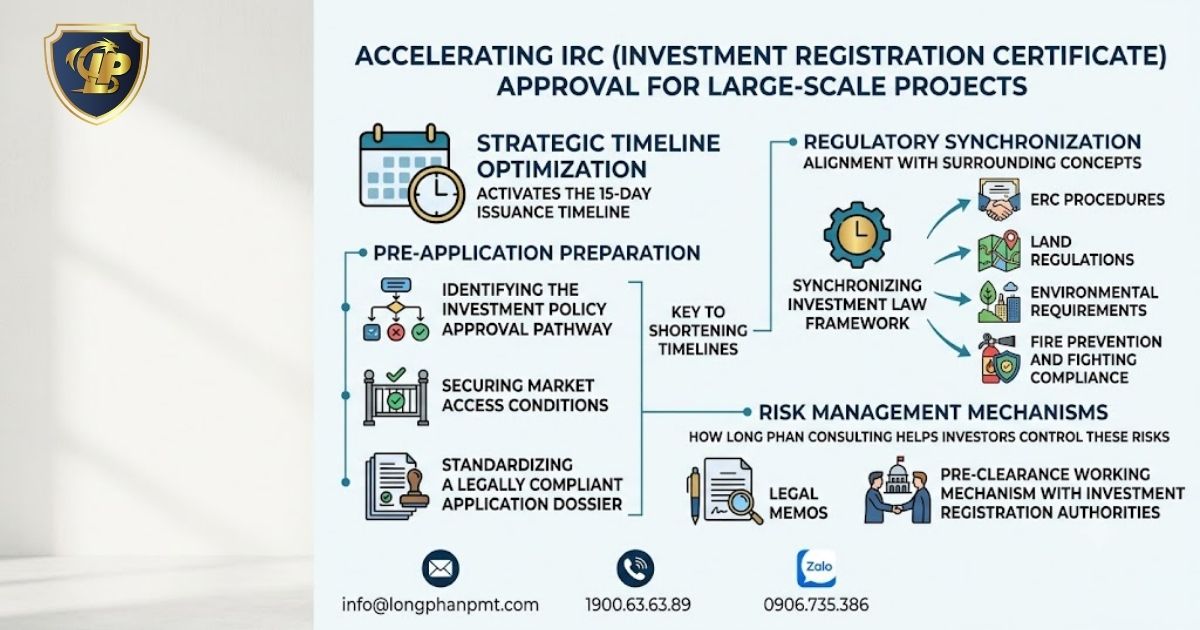
Accelerating IRC approval for large-scale projects requires investors to manage risks before filing, as delays may create substantial opportunity costs. The key is not merely submitting early, but correctly determining the investment policy approval route, satisfying market access conditions, and preparing a compliant dossier to trigger the statutory IRC issuance timeline. Investors must also align the Law on Investment with ERC procedures, land-use rules, environmental requirements, and fire prevention compliance. Long Phan Consulting supports this process through Legal Memos, dossier standardization, and pre-clearance coordination with investment registration authorities.
Key legal notes:
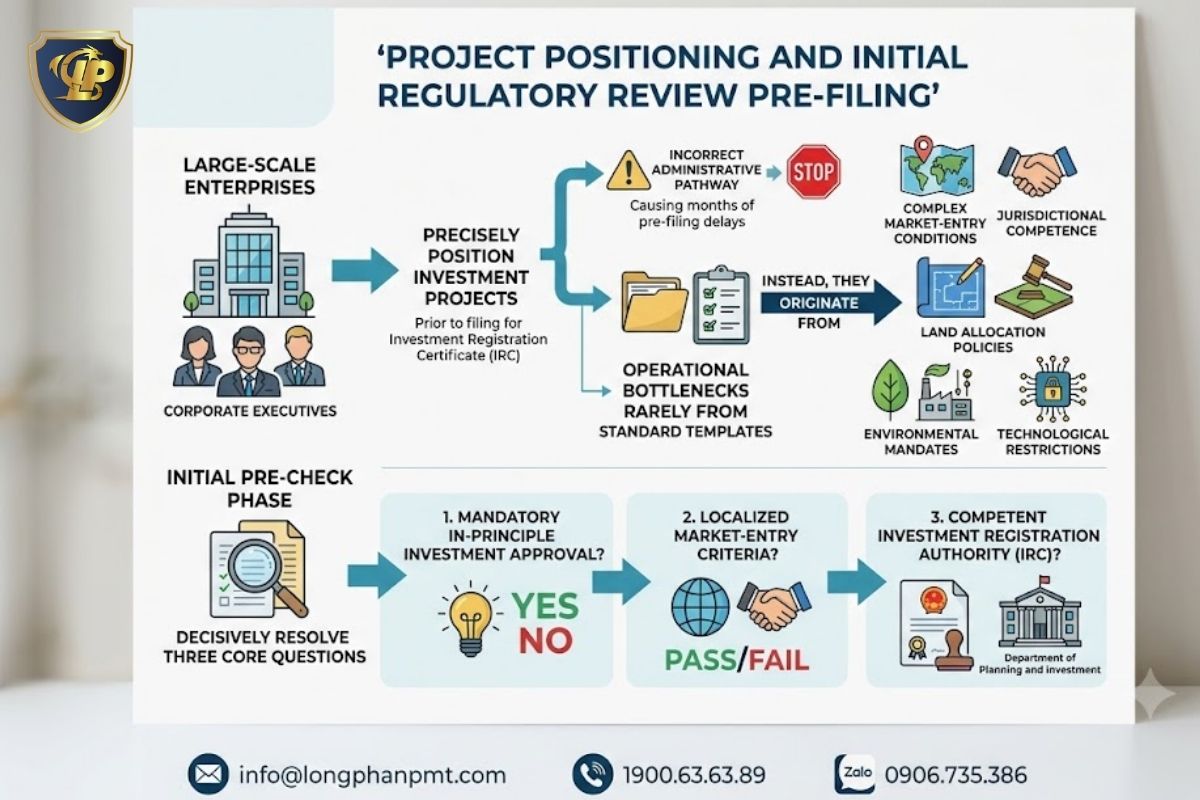
Large-scale enterprises must precisely position their investment projects prior to filing an application for an Investment Registration Certificate (IRC), as selecting an incorrect administrative pathway can cause months of pre-filing delays. For major projects, operational bottlenecks rarely arise from standard administrative templates; instead, they originate from complex market-entry conditions, jurisdictional competence, land allocation policies, environmental mandates, and technological restrictions.
The initial pre-check phase must decisively resolve three core regulatory questions: whether the project triggers a mandatory in-principle investment approval, whether the foreign investors fully satisfy localized market-entry criteria, and which specific investment registration authority holds the legal competence to issue the Investment Registration Certificate (IRC).
Enterprises should never bypass preliminary scaling and file directly for an Investment Registration Certificate (IRC) if the underlying project falls under the statutory scope of an in-principle investment approval. Misclassifying these procedural streams inevitably results in dossier rejections or mandatory transfers to alternative regulatory workflows, severely disrupting capital deployment timelines and commercial launch strategies.
Pursuant to the Law on Investment 2025, large-scale project categories requiring rigorous classification prior to dossier compilation include:
Accurate structural categorization allows C-level executives and internal legal counsels to lock in the licensing roadmap from the outset. This step establishes the operational foundation to control the licensing timeline, preventing the risk of repetitive dossier remediation after formal submission.
Large-scale Foreign Direct Investment (FDI) projects must undergo a comprehensive evaluation of market-entry conditions before drafting the formal application for investment project implementation. If the targeted business lines, equity ownership ratios, or operational scopes deviate from local statutory mandates, the investment registration authority maintains clear legal grounds to issue extensive requests for clarification.
Foreign investors must meticulously verify the following critical legal metrics:
For restricted or conditional business sectors, the submission dossier must include a dedicated legal brief justifying ownership structures, compliance with international treaties, and operational boundaries. Neglecting this analytical step guarantees that the statutory 15-day processing window for a valid dossier will not reflect the actual operational timeline.
Submitting a dossier to an incorrect regulatory body is a costly operational error for large-scale corporate ecosystems. Enterprises must verify jurisdictional competence based on the project’s physical location, geographic boundaries, and specialized functional zones before finalizing the Investment Registration Certificate (IRC) application.
| Project Classification | Competent Licensing Authority | Statutory Basis |
| Projects located outside industrial parks, export processing zones, high-tech zones, and economic zones | The Department of Finance is empowered to issue, amend, and revoke the Investment Registration Certificate (IRC) | Clause 2, Article 27 of the Law on Investment 2025 |
| Projects located within industrial parks, export processing zones, high-tech zones, centralized digital tech zones, and economic zones | The Management Board of the respective industrial park or economic zone is empowered to issue, amend, and revoke the Investment Registration Certificate (IRC) | Clause 1, Article 27 of the Law on Investment 2025 |
| Projects implemented across two or more provinces, or located simultaneously inside and outside functional zones | The investment registration authority where the project’s central operating office is established | Clause 3, Article 27 of the Law on Investment 2025 |
Securing the correct jurisdictional path prevents bureaucratic routing delays, mandatory refilings, or jurisdictional disputes. This step fulfills a critical operational requirement before the enterprise transitions into compiling the standardized dossier checklist for Investment Registration Certificate (IRC) issuance.
An Investment Registration Certificate (IRC) checklist must be structured as a comprehensive investment appraisal dossier rather than a basic set of administrative forms. For large-scale operations, the CFO and corporate legal department must simultaneously manage the investors’ legal documentation, capital structures, location verification, technical frameworks, and supporting explanatory briefs.
Standardizing this dossier in a methodical sequence minimizes the risk of multi-round regulatory requests for supplementary information. The core objective is not merely submitting a complete stack of papers, but explicitly demonstrating that the project satisfies all statutory, financial, and operational criteria required for Investment Registration Certificate (IRC) issuance.
Enterprises must standardize their core application documents from the very first draft. Using incorrect form variations or failing to establish the legal standing of foreign corporate entities will cause the dossier to be frozen during the initial regulatory completeness check.
Dossier preparation should follow this precise operational sequence:
For projects located within industrial parks or economic zones, the entire dossier must maintain strict consistency with localized zoning maps and the registered business lines. This alignment serves as the benchmark used by the investment registration authority to declare a dossier legally valid.
Financial capacity verification is a critical compliance check that directly impacts the overall timeline for Investment Registration Certificate (IRC) approval. If equity allocations, debt financing instruments, capital support commitments, or bank guarantees do not match the total investment capital, the investment registration authority will issue requests for formal clarification.
The corporate financial dossier must compile and verify the following records:
The project proposal must transparently validate the enterprise’s financial capacity and operational conditions pursuant to Clause 1, Article 33 of the Law on Investment 2025. For the CFO, this documentation forms the strategic basis required to defend the financing plan before the licensing authorities.
The project’s physical location and site allocation strategy must be legally locked in prior to formal Investment Registration Certificate (IRC) submission. If land lease agreements, location memoranda, or master planning documents diverge from the main project proposal, the dossier will face extensive inter-agency reviews.
Enterprises must organize their location and technological assets according to the following guidelines:
The dossier for Investment Registration Certificate (IRC) issuance must strictly contain valid legal documentation demonstrating a verified right to use the project location, pursuant to Point b, Clause 3, Article 36 of Decree No. 31/2021/NĐ-CP. Securing the location is therefore a binding statutory requirement necessary to prevent extensive pre-filing delays.
Accelerating the administrative timeline cannot be achieved by merely filing an incomplete dossier early. Large-scale enterprises must shift their operational focus from a reactive “submit and wait” approach to proactive pre-filing validation, dossier standardization, and the pre-emptive mitigation of inter-agency bottlenecks.
For major infrastructure and industrial developments, an effective legal strategy must secure three operational variables: the exact trigger date for statutory processing, the scope of specialized ministerial reviews, and the applicability of accelerated processing exemptions. This converts theoretical statutory windows into a predictable corporate timeline.
Corporate legal departments must not calculate the Investment Registration Certificate (IRC) approval timeline from the date of initial physical submission. The true regulatory benchmark begins exclusively when the investment registration authority formally issues a confirmation of dossier validity.
The competent authority shall issue the Investment Registration Certificate (IRC) to investors within 10 working days from the receipt of a valid dossier, pursuant to Clause 3, Article 39 of Decree No. 96/2026/NĐ-CP. A valid dossier is defined as a submission containing all statutorily mandated documents, with every entry completely and accurately filled out, pursuant to Clause 5, Article 2 of Decree No. 96/2026/NĐ-CP.
Consequently, internal compliance teams must implement a rigorous pre-submission audit matrix:
Formal filing should occur only when the dossier is structurally capable of passing the completeness review on the first attempt. Neglecting this audit step reduces the statutory 15-day window to a theoretical concept, as the true timeline becomes elongated by successive administrative rejections and remediation loops.
Pre-filing validation mechanisms allow multinational corporations to detect and neutralize regulatory alignment risks before entering formal administrative channels. This strategy is mandatory for large-scale operations involving complex land allocations, environmental footprints, proprietary technologies, integrated logistics, or energy generation.
Enterprises should structure their pre-filing optimization via the following phases:
There is no uniform statutory duration for cross-ministerial routing within raw legal databases, as the process depends heavily on project complexity and pre-filing dossier quality. The optimal strategy is reducing the overall number of clarification rounds rather than passively waiting for agency responses.
Large-scale projects established within industrial parks, export processing zones, high-tech zones, centralized digital tech zones, or free trade zones may qualify for accelerated special investment procedures. This specialized regulatory framework bypasses multiple layers of bureaucratic approvals if the project fulfills specific statutory criteria.
Pursuant to Clause 1 and Clause 2, Article 28 of the Law on Investment 2025, qualifying projects registered within these specialized functional zones can be exempted from undergoing formal in-principle investment approvals, technology appraisals, environmental impact assessment reports, and local building permits. In return, investors must execute a binding written commitment to comply with all applicable building codes, environmental benchmarks, and fire safety standards.
| Compliance Benchmark | Standard Administrative Routing | Special Investment Procedures |
| In-Principle Investment Approval | Mandatory if triggered by statutory thresholds or land-use criteria | Exempted subject to zone-specific compliance criteria |
| Technology Appraisal | Triggers independent ministerial reviews for specialized technologies | Exempted pursuant to Clause 1 and Clause 2, Article 28 of the Law on Investment 2025 |
| Environmental Impact Assessment | Represents a primary pre-filing administrative bottleneck | Replaced by binding compliance commitments and strict post-licensing audits |
| Building Permit (Construction) | Must be processed sequentially or in parallel with land approvals | Exempted within the defined scope of special investment frameworks |
| Primary Regulatory Focus | Sequential, decentralized administrative routing | Strict compliance commitments backed by rigorous post-licensing enforcement |
Utilizing these special procedures does not grant an exemption from ongoing compliance obligations. Enterprises remain legally bound to implement all building, environmental, and fire safety standards, facing intensified post-licensing audits during project execution.
Large-scale corporate ventures are rarely delayed solely by standard Investment Registration Certificate (IRC) administrative steps. In operational reality, critical bottlenecks emerge from unaligned land rights, conflicting local planning, environmental liabilities, unverified technology classifications, and a lack of baseline structural unity across the core corporate documentation.
Enterprises must systematically isolate and resolve these friction points prior to activating formal administrative channels. Failing to execute these pre-filing remediations provides the investment registration authority with direct legal grounds to halt processing, initiate indefinite inter-agency clarification rounds, or return the dossier.
The formal investment project proposal must maintain absolute legal consistency with location title documents, localized land allocation quotas, and master land use planning. If the submitted dossier contains conflicting data regarding project objectives, manufacturing capacities, or land development timelines, the risk of triggering multi-round regulatory clarifications is exceptionally high.
Internal project management teams must audit the following metrics before formal filing:
Land compliance risks extend far beyond delaying the Investment Registration Certificate (IRC). They directly impair corporate financing arrangements, capital drawdown timelines, infrastructure subleases, and binding commercial delivery commitments executed with global partners.
Environmental compliance represents a primary administrative bottleneck for large-scale industrial manufacturing, energy generation, logistics infrastructure, real estate developments, and high-tech ventures. If an enterprise compiles its Investment Registration Certificate (IRC) dossier without auditing its environmental licensing duties, the comprehensive licensing timeline will expand far beyond the statutory 15-day benchmark.
The corporate project roadmap must explicitly account for the following statutory evaluation windows:
Enterprises must determine their specific project classification, underlying EIA obligations, and eligibility for accelerated industrial zone exemptions during the pre-filing stage. This proactive step ensures that the core Investment Registration Certificate (IRC) dossier is not drawn into protracted environmental routing delays.
Utilizing statutory transitional provisions is a critical corporate strategy for large-scale projects caught in mid-filing cycles or those modifying pre-existing operations. Applying these legal mechanisms correctly isolates the project from mandatory refilings or retrospective compliance costs when local laws shift.
Internal legal departments must evaluate the applicability of the following transitional structures:
Corporate counsels must construct a comparative statutory matrix balancing legacy rules against incoming frameworks before finalizing their procedural route. An incorrect transitional selection can increase long-term compliance costs, delay land handover timelines, or disrupt cross-border capital disbursements.
Managing the Investment Registration Certificate (IRC) workflow for large-scale corporate ecosystems requires specialized, simultaneous control over foreign direct investment parameters, land planning, environmental metrics, industrial technology validations, and localized corporate licensing. Long Phan Consulting Company delivers an integrated, project-driven approach focused on pre-filing risk mitigation, comprehensive dossier standardization, and rigorous statutory timeline protection.
Our professional engagement is built entirely around corporate governance and risk management, moving far beyond basic document drafting. We ensure that CEOs, CFOs, and internal legal teams possess validated regulatory data before committing capital or engaging government entities.
Our legal specialists conduct comprehensive preliminary evaluations before your project enters formal administrative channels. This pre-filing audit uncovers and resolves hidden friction points regarding foreign equity caps, site zoning conflicts, and complex capital structures.
Long Phan Consulting Company provides strategic advisory across the following areas:
The resulting pre-filing audit report acts as a corporate decision-making tool, dictating whether to initiate immediate filing, modify the corporate investment structure, or reinforce baseline documentation before interacting with the regulators.
Executing targeted pre-filing consultations drastically lowers the risk of receiving sequential administrative rejections or demands for dossier remediation. For major operations, early alignment with licensing bodies clarifies the procedural track and establishes the required scope for technical justifications.
Long Phan Consulting Company delivers operational support by:
While pre-filing consultations do not replace formal licensing steps, they ensure that your documentation is structurally optimized to pass regulatory checks on the first attempt.
Securing the Investment Registration Certificate (IRC) is only the first milestone in the corporate market-entry lifecycle. Enterprises must maintain absolute synchronization across all subsequent corporate licenses; any variance between the IRC and secondary operational permits will trigger compliance shutdowns during project execution.
Long Phan Consulting Company ensures system-wide compliance by:
Foreign enterprises can submit their master project outlines, land location agreements, and proposed corporate capital structures via Email (info@longphanpmt.com) or Zalo/WhatsApp (+84 906 735 386) to secure a preliminary compliance evaluation from Long Phan Consulting Company.
Optimizing the legal risk control process at the pre-application stage plays a crucial role in helping investors establish a safe project roadmap. Understanding the transitional conditions regarding land, environment, and new approval jurisdictions will create a core strategic advantage. The in-depth analysis below thoroughly addresses practical issues to support businesses in achieving their goal of shortening the time required to obtain IRCs for large-scale projects.
The time limit for issuing an Investment Registration Certificate for projects not requiring investment policy approval is calculated from the date the competent authority receives a valid application, not from the date of initial submission. Investors need to be aware of the statutory processing timeframe of 10 working days from the date of receipt of a valid application, as stipulated in Clause 3, Article 39 of Decree No. 96/2026/ND-CP. An application is considered valid when it contains all the necessary documents and the content of those documents is fully declared in accordance with Clause 5, Article 2 of Decree No. 96/2026/ND-CP.
Investment projects requiring the conversion of land used for two or more rice crops per year, with a scale of 500 hectares or more, are required to obtain investment policy approval before applying for an Investment Registration Certificate. This regulation is strictly applied to control land planning in accordance with Clause 2, Article 24 of the 2025 Investment Law. Businesses are absolutely prohibited from submitting applications directly for permits if they fall under this category.
The Department of Finance is the competent authority to issue, amend, and revoke Investment Registration Certificates for large investment projects located outside industrial parks, export processing zones, high-tech zones, and economic zones. This is a crucial shift in authority that investors need to be aware of in order to submit applications to the correct agency as stipulated in Clause 2, Article 27 of the 2025 Investment Law. If the project is located within an industrial park, the authority rests with the Industrial Park Management Board as stipulated in Clause 1, Article 27 of the 2025 Investment Law.
Economic organizations with foreign investors holding more than 50% of their charter capital must meet market access conditions and follow investment procedures applicable to foreign investors. This regulation directly creates an obligation for businesses to comply when establishing their capital structure according to Clause 1, Article 20 of the 2025 Investment Law. Foreign investors are required to carefully review their ownership ratio and investment form according to Clause 3, Article 8 of the 2025 Investment Law.
The State will reclaim the land and will not provide compensation for the land or assets attached to it if the investor fails to put the land into use after the extended period. This sanction is applied when the investment project’s extended land use period of up to 24 months expires and the investor still has not put the land into use, as stipulated in Clause 8, Article 81 of the 2024 Land Law. This delay will pose serious risks to the financial plan.
Applications for valid Investment Registration Certificates that were received by state agencies before the effective date of the new Investment Law will continue to be processed according to the 2020 Investment Law. This transitional mechanism helps to mitigate risks and protect the licensing progress of projects in accordance with Clause 14, Article 52 of the 2025 Investment Law. At the same time, projects that were licensed before the effective date of the new law will continue to be implemented according to Clause 1, Article 52 of the 2025 Investment Law.
Accelerating the issuance of an Investment Registration Certificate (IRC) requires large-scale enterprises to prioritize pre-filing engineering rather than reactive administrative filing. The licensing authority will only approve an Investment Registration Certificate (IRC) within predictable timelines when the project uses the correct procedural path, fulfills all market-entry restrictions, uses standardized forms, and presents a financial model that matches verified site allocations. For major industrial and commercial projects, minor errors in capital calculations, land zoning maps, or environmental data will lead to prolonged inter-agency review delays. Contact Long Phan Consulting Company via our central Hotline at 1900636389 to deploy our pre-filing validation matrices and secure your investment timeline before executing your formal regulatory submission.
📚 This article is provided with professional consultation based on the following legal framework: