
Overseas Vietnamese Co-Own a House with Relatives is a question of great interest amidst increasingly diverse real estate transactions involving foreign elements. In reality, co-owning housing relates not only to property ownership rights but is also governed by numerous legal regulations regarding housing, land, and nationality. In the following article, Long Phan Consulting Company provides comprehensive information on these issues.
Housing co-ownership occurs when two or more owners share rights over a single house. In practical transactions, the question of “whether Overseas Vietnamese can co-own a house with relatives” frequently arises when establishing joint ownership. Pursuant to Clause 1, Article 207 of the 2015 Civil Code, joint ownership includes ownership by shares and consolidated joint ownership. This ownership right is clearly recorded on the Certificate of Land Use Rights, Ownership of Housing and Other Land-Attached Assets.
Joint owners have the right to possess, use, and dispose of the common property. However, disposal requires the consent of all parties. This regulation protects the lawful rights of every participating member. The parties must comply with land change registration procedures as prescribed.
Under Clause 2, Article 207 of the 2015 Civil Code, co-ownership forms include: ownership by shares and consolidated joint ownership. In practical legal application, especially when the situation of “Overseas Vietnamese co-owning a house with relatives” arises, correctly determining the ownership type is crucial to clarifying the rights and obligations of the parties.
The above content clarifies the concept and types of joint ownership. In practical application, the question of whether Overseas Vietnamese can co-own a house with relatives is usually raised when determining the legal status of the subjects participating in co-ownership. To answer this, you must examine specific subject conditions.
>>>See more: Overseas Vietnamese Buy Private Houses or Apartments
Under the 2023 Housing Law, the 2024 Land Law, and Decree 95/2024/ND-CP, Overseas Vietnamese are permitted to invest in real estate and have their names on a co-owned house in Vietnam if they meet the legal conditions. Practice shows that many cases regarding whether Overseas Vietnamese can co-own a house with relatives must be directly cross-referenced with these regulations to determine the lawful ownership scope.
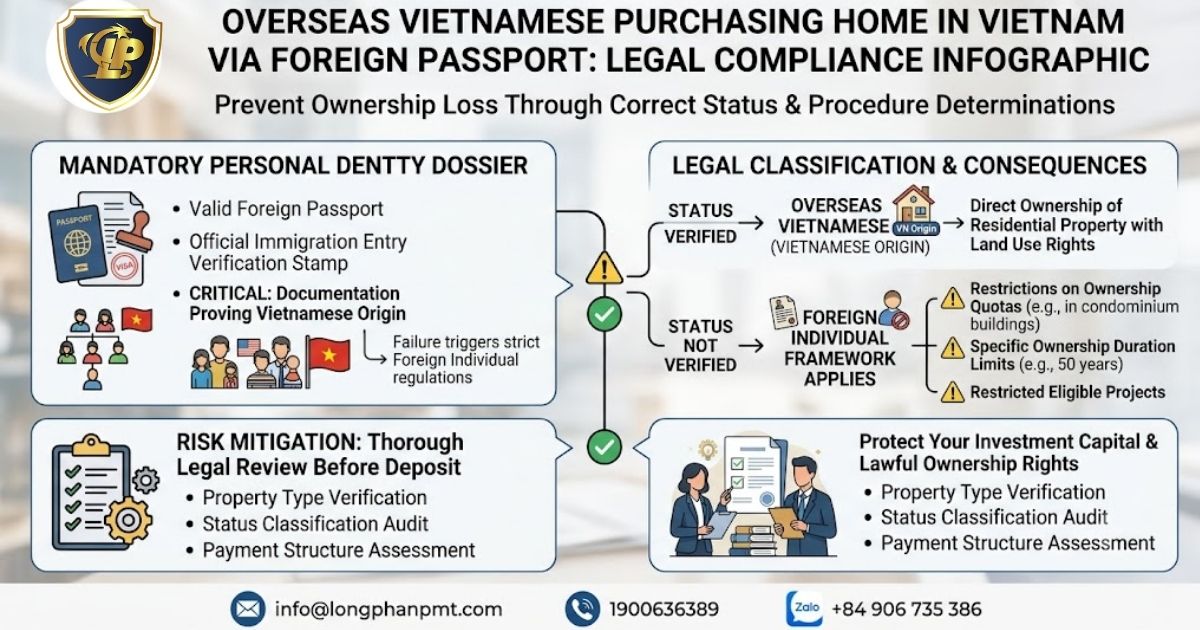
Overseas Vietnamese who still hold Vietnamese nationality enjoy many incentives when investing in housing in Vietnam. Pursuant to Point b, Clause 3, Article 3 of Decree 95/2024/ND-CP, to establish real estate ownership, this group needs:
People of Vietnamese origin without Vietnamese nationality can also invest and co-own houses in Vietnam but must comply with stricter conditions. Under Point b, Clause 2, and Point c, Clause 3, Article 3 of Decree 95/2024/ND-CP, specific conditions include:
Whether they hold Vietnamese nationality or not, investing in real estate and co-owning a house in Vietnam is legally permitted under specific conditions, including cases where overseas Vietnamese co-own a house with relatives. Understanding and complying with regulations on entry, identification documents, proof of origin, and financial requirements helps Overseas Vietnamese carry out lawful transactions and minimize legal risks.
>>>See more: What are the Conditions for Overseas Vietnamese to Invest in Real Estate Projects in Vietnam?
The regulations on ownership and joint-naming of real estate for people of Vietnamese origin residing abroad are strictly governed by the 2024 Land Law and 2023 Housing Law, including cases where overseas Vietnamese co-own a house with relatives under legally recognized conditions.
Vietnamese citizens residing abroad are permitted to jointly own land use rights certificates and property ownership certificates in certain cases. In practice, when considering the question “can overseas Vietnamese co-own a house with relatives,” each specific situation must be carefully assessed to determine whether it falls within the scope of permitted co-ownership under current legal regulations.
Current Vietnamese law imposes certain restrictions to protect national defense, security, and land management. Accordingly, overseas Vietnamese co-own a house with relatives is not permitted in the following cases:

Co-owning a house requires tight coordination between the owning subjects. In reality, the question of whether overseas Vietnamese co-own a house with relatives is often raised to clarify how to determine rights and obligations between parties.
The law allows you to co-own with any individual possessing full civil behavioral capacity, including arrangements where overseas Vietnamese co-own a house with relatives. Domestic individuals or people of Vietnamese origin residing abroad both have the right to establish joint ownership. Article 207 of the 2015 Civil Code does not limit the personal relationship between co-owners. You can choose parents, siblings, or spouses to co-own the asset, and this relationship is proven via valid civil status documents.
The real estate ownership ratio is determined based on financial contribution levels or voluntary agreement, including arrangements where overseas Vietnamese co-own a house with relatives. Pursuant to Article 209 of the 2015 Civil Code, common ownership by shares corresponds to the recorded ratio. You and your relative have the right to establish this ratio in a notarized document. If no other agreement exists, ownership shares are considered equal. Competent authorities will base the issuance of the Certificate of Land Use Rights on the content of the contract.
The co-ownership agreement establishes transparent rules for managing, using, and disposing of the common property, especially in cases where overseas Vietnamese co-own a house with relatives. This document must clearly detail the method of exploiting the housing’s commercial value. Both you and the co-owner are responsible for financial obligations and house maintenance. Article 217 of the 2015 Civil Code requires owners to manage the asset according to the agreement, and any transfer of an ownership share must comply with the other member’s right of first refusal.
Joint owners have the right to enjoy yields and bear responsibility for asset maintenance in proportion to their shares, including situations where overseas Vietnamese co-own a house with relatives. Pursuant to Article 218 of the 2015 Civil Code, each party has the right to dispose of their ownership share. Any change in structure or usage purpose requires the consensus of all co-owners. You are also obligated to pay land taxes and periodic management fees as prescribed by law. Failure to comply with these obligations may result in legal disputes and liability for compensation for actual damages.
Experts at Long Phan Consulting Company execute specialized operations to assist clients in resolving housing and land procedures, including cases where overseas Vietnamese co-own a house with relatives. We structure our professional support into the following key area:

Below are some frequently asked questions regarding whether Overseas Vietnamese Co-Own a House with Relatives. Please refer to the following information if you are interested:
According to Clause 2, Article 17 of the 2023 Housing Law, foreigners are allowed to own housing in Vietnam, including apartments and detached houses, through the following forms:
According to Clause 1, Article 19 of the 2023 Housing Law and Article 5 of Decree 95/2024/ND-CP, foreign organizations and individuals are allowed to own no more than 30% of the number of apartments in a condominium building; and no more than 250 houses (if they are detached houses, including villas and townhouses) in an area with a population equivalent to a ward-level administrative unit.
Furthermore, according to Clause c, Point 1, Article 10 of the 2023 Housing Law, overseas Vietnamese (Vietnamese citizens residing abroad) are entitled to be granted a land ownership certificate (Sổ đỏ) for their legally owned property in accordance with the 2023 Housing Law and land laws.
According to Clause 1, Article 26 of the 2024 Land Law, overseas Vietnamese are land users who are granted land use certificates when they meet the conditions stipulated by land law.
Overseas Vietnamese, who are Vietnamese citizens residing abroad and own construction works, are eligible for a land use right certificate (Sổ đỏ) if they possess one of the documents specified in Clause 1, Article 149 of the 2024 Land Law. Similarly, overseas Vietnamese who create construction works and possess documents that comply with the regulations of the law on construction are also eligible for a land use right certificate (based on Clauses 1 and 4, Article 149 of the 2024 Land Law).
Therefore, based on the above regulations, overseas Vietnamese who are land users/owners of houses and construction works/creators of construction works in Vietnam are granted land use rights certificates when they meet the conditions stipulated by the laws on housing and land.
No, Vietnamese expatriates have certain limitations on real estate ownership in Vietnam. People of Vietnamese origin who no longer hold Vietnamese citizenship are only permitted to own houses attached to land use rights in commercial housing development projects that allow for transfer, according to Article 44 of the 2024 Land Law. Vietnamese expatriates who still hold Vietnamese citizenship have broader ownership rights, equivalent to those of domestic citizens.
Co-owning a house with relatives is possible for Overseas Vietnamese, including cases where overseas Vietnamese co-own a house with relatives. You need a clear written agreement on ownership and contributions. Compliance with the 2024 Land Law and 2023 Housing Law helps avoid disputes. Our expert team is ready to resolve complex legal procedures related to real estate. You can connect via Hotline 1900636389 to receive direct consultation from the experts at Long Phan Consulting Company.