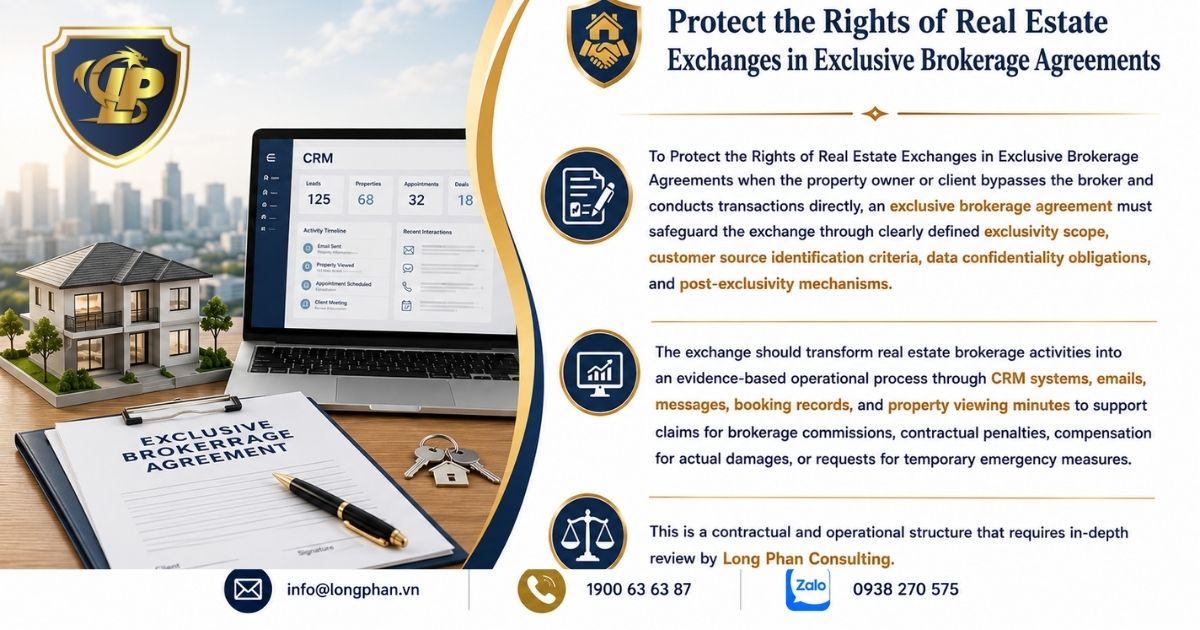
Understanding the Principles of Organization and Operation of Real Estate Trading Floors is essential for enterprises during the establishment and operation phases. Strict adherence to standards regarding operating conditions, management mechanisms, and related responsibilities contributes to enhancing transparency and building trust with customers and market participants. Long Phan Consulting Company analyzes the core principles below to help clients apply them effectively.
Rights and Obligations of Principles of Organization and Operation of Real Estate Trading Floors
Operating conditions for real estate exchanges
Based on Articles 54 and 55 of the Law on Real Estate Business 2023 (guided by Article 15 of Decree 96/2024/ND-CP), organizations and individuals must comply with the following conditions to establish and operate a real estate trading floor:
Establishment: Must establish a real estate service business enterprise.
Naming: The name must be selected according to the Law on Enterprises, must include the phrase “sàn giao dịch bất động sản” (real estate trading floor), and must not be identical to or cause confusion with other registered trading floors.
Licensing: Before operation, the dossier must be submitted to the Department of Construction where the trading floor is headquartered to obtain an Operation License.
Process: Must promulgate and publicize the process of real estate transactions through the floor.
Facilities: Must register a fixed operating location with material and technical facilities ensuring operational capabilities. Specifically, a stable transaction address for over 12 months and appropriate technical equipment.
Conditions for Managers: The manager/operator of the trading floor must:
Have the right to manage enterprises in Vietnam under the Law on Enterprises.
Complete a training course on management and operation of real estate trading floors and possess a Certificate of completion of such course.
Operating principles of a real estate exchange
According to Article 53 of the Law on Real Estate Business 2023, real estate trading floors must operate based on the following principles:
Transparency: Operations must be public, transparent, and based on free agreement respecting the legal rights of parties via contracts, without violating legal prohibitions.
Property Eligibility: Real estate put into business must meet legal conditions.
Prohibited Areas: Operations must be outside of protected areas defined by laws on national defense and security.
Process Compliance: Provide services according to promulgated regulations and transaction processes; enjoy remuneration as agreed in contracts.
Information Posting: Information about the trading floor must be posted on the housing and real estate market information system.
Broker Qualifications: When signing contracts with individual brokers, the brokers must be eligible to practice.
Transaction Forms: Conduct direct or electronic transactions. Electronic transactions must comply with the Law on Real Estate Business, Law on E-Transactions, and related laws.
Articles 57 and 58 of the Law on Real Estate Business 2023 define the boundaries for trading floors:
Rights of real estate exchanges
Request customers to provide files/information on real estate listed on the floor.
Refuse to list properties that do not meet business conditions.
Collect service fees as agreed.
Request compensation for damages caused by customer faults.
Responsibilities of real estate exchanges
Ensure listed properties are eligible for business.
Provide full and truthful information and take responsibility for it.
Ensure facilities and operating conditions.
Perform reporting regimes and submit to inspections.
Fulfill tax obligations.
Compensate for damages caused by the floor’s fault.
Manage brokers/employees and organize annual training for them.
Archive transaction files according to regulations.
Rights and obligations of real estate exchanges
Frequently Asked Questions
Below, Long Phan Consulting provides some frequently asked questions related to the organizational and operational principles of real estate exchanges. We invite interested clients to refer to them:
Is it mandatory to transact through a trading floor?
No. The Law on Real Estate Business 2023 encourages organizations and individuals to conduct transactions through trading floors to ensure transparency, but it does not mandate it.
Must the trading floor manager have a brokerage certificate?
No. The manager must have a Certificate of completion of a course on management and operation of real estate trading floors. However, if the manager directly performs brokerage tasks, they must also hold a Brokerage Practice Certificate. (Legal Basis: Clause 1, Article 55, Law on Real Estate Business 2023).
Can the trading floor collect deposits?
The trading floor can only perform services authorized in the contract. Collecting deposits requires legal authorization from the investor/seller. Without authorization, collecting deposits is a violation.
What is the value of the Transaction Confirmation?
It is proof that the transaction was appraised, listed, and conducted publicly. It serves as a basis for tax obligations, land variation registration, and legal evidence in disputes. (Legal Basis: Clause 8, Article 56, Law on Real Estate Business 2023).
Are employees working at the real estate trading floor required to hold a brokerage certificate?
Employees performing real estate brokerage operations at the floor are required to hold a real estate brokerage practice certificate. For employees performing other tasks (such as administration, reception, accounting, etc.), this certificate is not required. (Legal Basis: Clause 6 Article 53 and Clause 7 Article 58, Law on Real Estate Business 2023).
Conclusion
Strict adherence to the Principles of Organization and Operation of Real Estate Trading Floors is vital for sustainable business. Long Phan Consulting Company is ready to assist clients in reviewing legality and optimizing operational processes. Please contact Hotline 1900636389 for immediate support.
Facebook
Linkedin
Twitter
Pinterest
Phan Mạnh Thăng
Mr. Phan Manh Thang, CEO, is the founder of Long Phan Investment Consulting and Legal Services Company Limited. With over 13 years of experience in the fields of land and corporate law, CEO Phan Manh Thang has been advising and partnering with numerous clients throughout their business operations and enterprise expansion. Concurrently, he serves as the Managing Lawyer of Long Phan PMT Law Firm, established in 2019.
His specialized expertise and practical experience have consistently earned him the trust and high regard of his clients.