


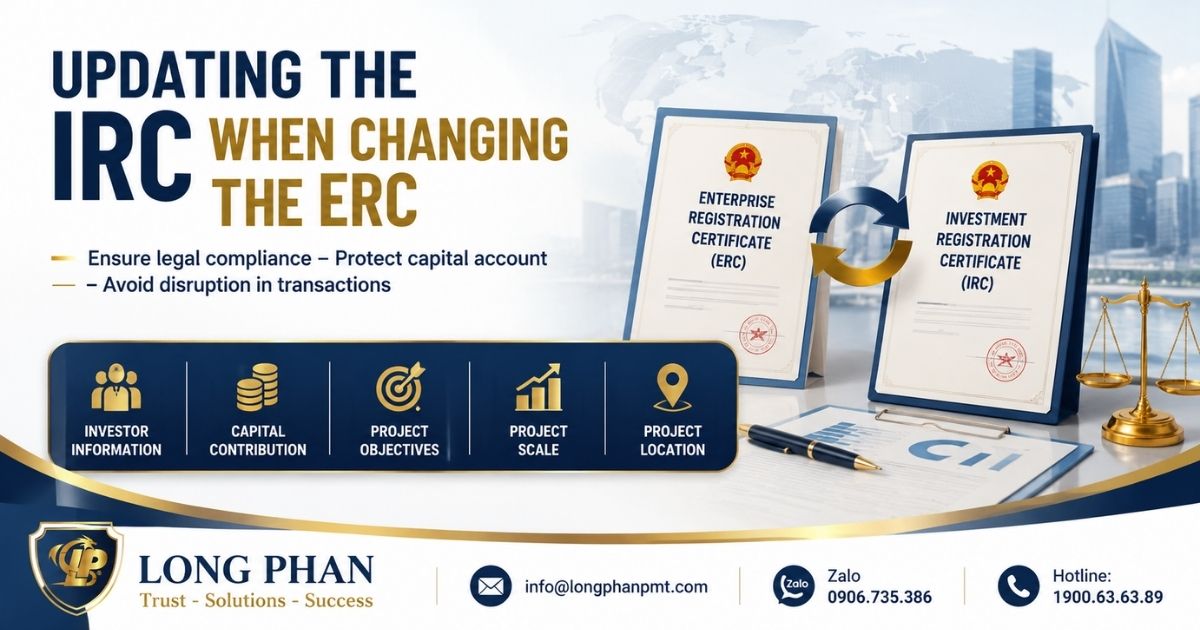
Long Phan Consulting notes that updating the IRC when changing the ERC is mandatory whenever the changed information affects the investor, the capital, the objectives, the scale, or the location of the project, and omitting this step can disrupt the capital account and transaction procedures. Enterprises must cross-check the Enterprise Registration Certificate against the entire content of the Investment Registration Certificate, the investment policy approval decision, and related M&A records under the Law on Investment. Changes that are purely internal governance matters may only need to be handled under the Law on Enterprises, but market-access conditions and specialized licenses must still be reviewed. Long Phan Consulting supports enterprises in identifying the correct procedural level and implementation roadmap.
Important Legal Notes:
Enterprises must separate legal entity status from the investment project before assessing any obligation to adjust a license. Treating the two certificates as equivalent can lead to unnecessary procedures or overlooked project content that should have been updated.
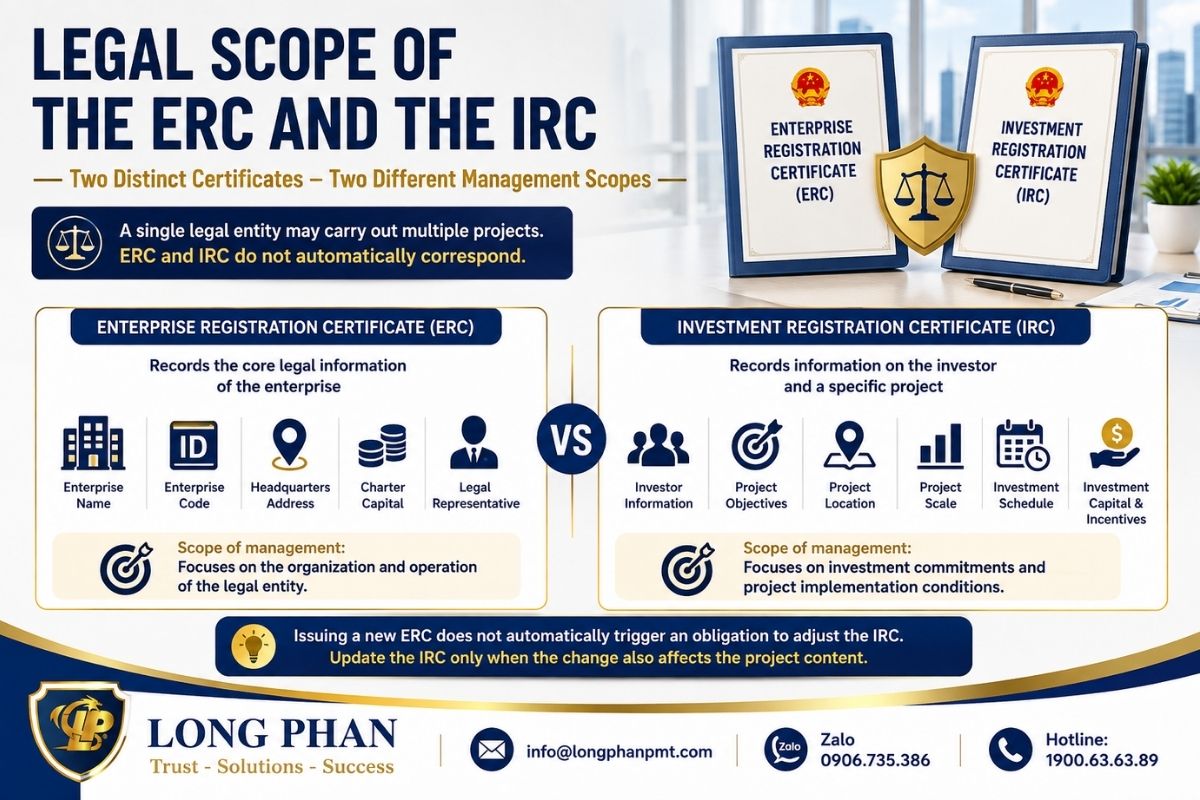
The Enterprise Registration Certificate and the Investment Registration Certificate govern two distinct management scopes. A single legal entity may carry out multiple projects, so information on the ERC and the IRC does not automatically correspond on a one-to-one basis.
Consequently, issuing a new ERC does not automatically trigger an obligation to adjust the IRC. Enterprises only need to update the IRC when the changed information is also recorded in, or alters, the project content.
Not every foreign-invested economic organization is required to hold an IRC. The obligation must be determined based on the investing entity, the foreign ownership ratio, and the form of project implementation.
Incorrectly determining the scope of application may cause an enterprise to prepare an unnecessary dossier or to implement a project before satisfying the required conditions. The legal department should verify the ownership ratio, the form of investment, and each independent project before setting the procedural roadmap.
Updating the IRC when changing the ERC cannot be determined solely from the name of the enterprise procedure just performed. The legal department must assess the extent to which that change affects the investing entity and the entire project content.
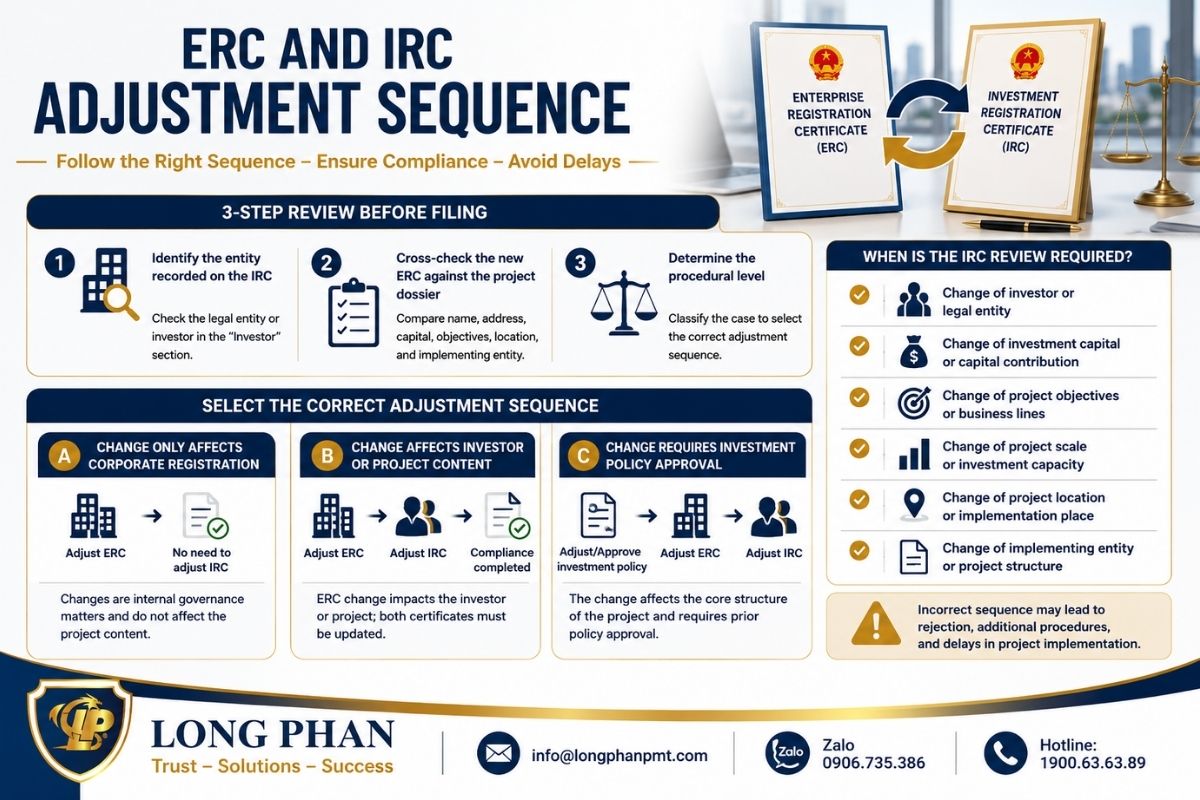
Enterprises should apply a three-step review process before submitting a dossier. This approach helps identify the correct procedural level and avoid an incomplete IRC adjustment.
The IRC must be reviewed whenever a change on the ERC affects investor information or the core structure of the project. Events that typically trigger this obligation include:
Information relating to shareholders that are foreign organizations or individuals must be updated within 03 working days, under Clause 1, Article 54 of Decree No. 168/2025/ND-CP. Enterprises established before July 1, 2025 must also supplement beneficial owner information at the time of their next ERC change, under Clause 1, Article 3 of the amending Law of 2025.
Changes that only affect corporate governance generally do not require an IRC adjustment. The deciding factor is whether the investing legal entity and the project content remain unchanged.
Even without changing the IRC, enterprises must still verify:
The business registration authority reviews a dossier on a change of members within 03 working days from receipt, under Clause 2, Article 47 and Clause 2, Article 48 of Decree No. 168/2025/ND-CP. Enterprises should only implement a new business line after confirming that the project objective and the applicable specialized conditions have been satisfied.
The legal department must cross-check the changed content on the ERC against the investor and project information recorded on the IRC. The table below supports a preliminary classification before building the procedural roadmap.
| Change on the Enterprise Registration Certificate (ERC) | Likelihood of Requiring an IRC Adjustment | Legal Decision Criteria |
| Change of the enterprise name that is the investor | Adjustment required | The investor name on the IRC no longer matches |
| Change of headquarters address | May require adjustment | The address is recorded in the investor information or the project location |
| Change of owner, member, or shareholder | Case-by-case | Whether it changes the investing entity or triggers M&A approval |
| Increase or decrease of charter capital | May require adjustment | Whether it changes the contributed capital or the total project capital |
| Addition of a business line | Case-by-case | Whether the new business line changes the project objective |
| Conversion of enterprise type | May require adjustment | Whether the identifying information or the successor entity of the project changes |
| Division, separation, consolidation, or merger | High likelihood of requiring adjustment | The implementing or successor entity of the project changes |
| Change of legal representative | Usually not required | The investing legal entity and project content remain unchanged |
| Change of phone number or email | Not required | Only contact information changes |
| Change of the parent company’s legal documents | IRC review required | The information or legal status of the foreign investor changes |
This table serves only as a preliminary reference. The final decision must be based on the IRC, its prior adjustments, the investment policy approval decision, and the related capital transaction dossier.
The order of implementation depends on the nature of the change, not merely on when the enterprise wants the new ERC issued. An incorrect sequence can cause the dossier to be rejected, prolong the capital transaction, or disrupt project implementation.
Enterprises typically adjust the ERC first when the change only concerns the legal entity’s identifying information. The new ERC then becomes the supporting document for the IRC update.
This sequence is appropriate when the investing entity, the objectives, the scale, and the core project structure remain unchanged. The legal department must still verify each IRC separately, as one enterprise may implement multiple projects.
Transactions that change the investor or the core project content must be processed at the investment registration authority first. Enterprises should not update members or shareholders before obtaining the necessary approval.
For projects not subject to investment policy approval, the time limit for adjusting the IRC is 10 working days from the date of receiving a complete, valid dossier, under Clause 3, Article 39 of Decree No. 96/2026/ND-CP. The actual transaction timeline may be longer if a prior approval procedure must first be completed.
Enterprises still operating under an old Investment Certificate or Investment License must distinguish between three scenarios. Separating the ERC and the IRC is only mandatory when a change falls within the scope of enterprise registration.
Correctly identifying the applicable scenario helps preserve license continuity and limits legal gaps. The dossier should clearly demonstrate the succession between the old license, the new ERC, and the adjusted IRC.
Enterprises must identify the correct receiving authority before scheduling procedures. Filing with the wrong authority, or allowing the ERC and IRC information to diverge, can prolong transactions, disrupt capital flows, and affect project operations.
Authority over the ERC is determined by the enterprise’s registered headquarters. For the IRC, the receiving authority depends on the project’s location.
| Procedure Type | Receiving Authority | Scope of Handling |
| Issuance or adjustment of the ERC | Provincial business registration authority | Enterprises headquartered in the locality |
| Issuance or adjustment of the IRC outside a zone | Department of Finance | Projects outside industrial parks, export processing zones, hi-tech zones, and economic zones |
| Issuance or adjustment of the IRC inside a zone | Relevant Management Board | Projects located within the zone’s management scope |
Authority over the ERC is set out in Clause 1, Article 21 of Decree No. 168/2025/ND-CP, while the Department of Finance receives projects outside a zone under Clause 2, Article 36 of Decree No. 96/2026/ND-CP. The Management Board handles projects inside a zone under Clause 3, Article 36 of Decree No. 96/2026/ND-CP.
For projects implemented across multiple localities, or partly inside and partly outside a zone, enterprises must identify the investment registration authority linked to the project’s operating office before filing the dossier.
A mismatch between the ERC and the IRC creates more than administrative risk. Inconsistent information can also delay disbursement, foreign exchange transactions, and import-export operations.
Enterprises are also not required to submit the IRC in a specialized dossier if the project falls within a case not requiring this certificate, under Clause 11, Article 52 of the Law on Investment 2025. Correctly identifying this scope helps avoid both missing documents and unnecessary document requests.
Receiving a new ERC or IRC does not complete the entire compliance process. Enterprises need to synchronize the project dossier, operating systems, and transaction records to avoid disruption at banks, tax authorities, or specialized licensing bodies.
This checklist should be applied per project, not merely per legal entity. A complete record allows the enterprise to respond quickly when a bank, tax authority, or investment registration authority requests a cross-check.
Adjusting the ERC and the IRC typically involves investment, corporate, foreign exchange, tax, and specialized licensing matters at the same time. Long Phan Consulting supports enterprises in building a unified roadmap that limits the risk of filing an incorrect procedure or disrupting project operations.
Enterprises, clients, or investors may send their ERC, IRC, and proposed change dossier via email at info@longphanpmt.com or Zalo/WhatsApp at +84 906 735 386 for a preliminary assessment.
The process of updating the IRC when changing the ERC often raises compliance questions for foreign-invested economic organizations. Correctly identifying the legal boundary between corporate governance procedures and project administration helps investors proactively avoid the risk of license revocation or capital account suspension. The following answers address the common blind spots that arise during corporate restructuring.
An adjustment to the investment project is not necessarily required. A foreign-invested economic organization only needs to notify the Business Registration Authority of the change in its enterprise registration information. The competent authority will review the validity of the application and issue a new Enterprise Registration Certificate within 03 working days from the date of receipt of the dossier in accordance with Clause 2 Article 47 and Clause 2 Article 48 of Decree No. 168/2025/ND-CP.
The enterprise is required to carry out the separation procedure where it needs to simultaneously adjust both its enterprise registration information and investment project details. The economic organization must first obtain an Enterprise Registration Certificate from the Business Registration Authority. It may then use this document as the basis for adjusting the investment project with the Investment Registration Authority in accordance with Clause 2 Article 110 of Decree No. 96/2026/ND-CP.
A foreign-invested economic organization must submit a notice updating the relevant information within 03 working days from the date of the change relating to foreign shareholders. Any fraudulent declaration in an application for registration of such changes is prohibited by law under Clause 1 Article 54 of Decree No. 168/2025/ND-CP and Clauses 4 and 5 Article 16 of the Law on Enterprises 2020, as amended and supplemented in 2025.
The authority to issue and adjust Investment Registration Certificates for projects implemented outside industrial parks, export processing zones, high-tech parks and economic zones currently belongs to the Department of Finance. The investor submits the application to the Department of Finance where the project’s operating office is located or expected to be located in accordance with Clause 2 Article 36 of Decree No. 96/2026/ND-CP.
The most significant risk is that the investment project may be suspended or the relevant license may be revoked. The competent authority may revoke the Investment Registration Certificate where the investor fails to comply with the contents recorded in the certificate, has already been sanctioned for an administrative violation, but continues to commit the violation, pursuant to Point d Clause 2 Article 35 and Point c Clause 2 Article 36 of the Law on Investment 2025.
Updating the IRC when changing the ERC must be assessed based on the extent of impact on the investor, the capital, the objectives, the location, and the project structure, not merely on the content just changed on the Enterprise Registration Certificate (ERC). A foreign-invested economic organization must cross-check the Investment Registration Certificate (IRC), the investment policy approval decision, the M&A dossier, and specialized licenses at the same time to determine the correct procedural sequence. A delay in synchronization can disrupt the capital account, stall transactions, and create the risk of project revocation. Contact Long Phan Consulting at Hotline 1900.63.63.89 for a dossier review and a tailored implementation roadmap.
📚 This article has been professionally reviewed based on the following legal documents:


