


The multi-level school license Vietnam process requires more than standard business registration and must be carefully structured to avoid licensing delays, additional investment costs, and disruptions to school opening schedules. Investors that follow the wrong regulatory pathway may face difficulties with site approval, facility standards, staffing conditions, and education authority assessments. Under the Law on Enterprises and Businesses, establishing the corporate entity is only the initial step, while specialized education approvals remain essential before operations begin. Before proceeding with Long Phan Consulting, investors should review the proposed school model, land and facility documents, investment conditions, staffing plans, and application dossiers required for licensing.
Important legal note:
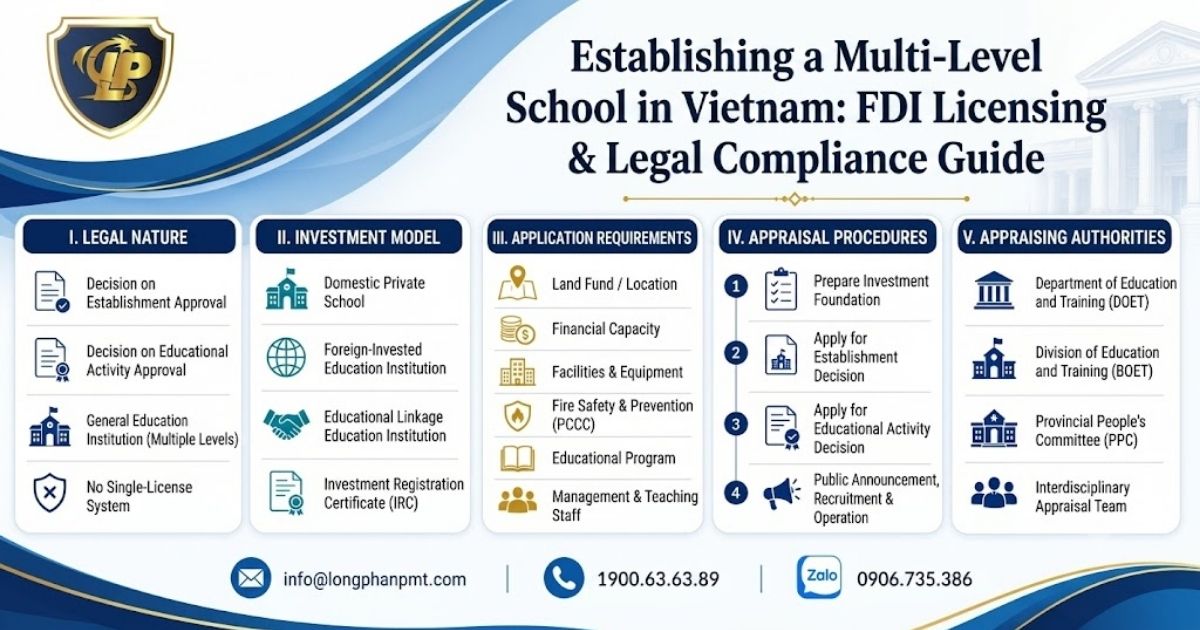
A multi-level school must be accurately classified as a multi-level general education institution rather than an independent “license” category. Misinterpreting this framework causes Foreign Investors to structure applications with missing corporate layers, inadequate infrastructure conditions, or incorrect educational licensing authorities.
Regarding investment strategy, Clients must finalize the legal model before committing land budgets, facility designs, and personnel recruitment. Each model dictates distinct licensing conditions, application dossiers, and regulatory risks:
Therefore, acquiring a school license fundamentally requires structuring the correct investment model first, followed by deploying the establishment and educational operation dossiers. This serves as the primary control point to mitigate capital overruns and severe project delays.
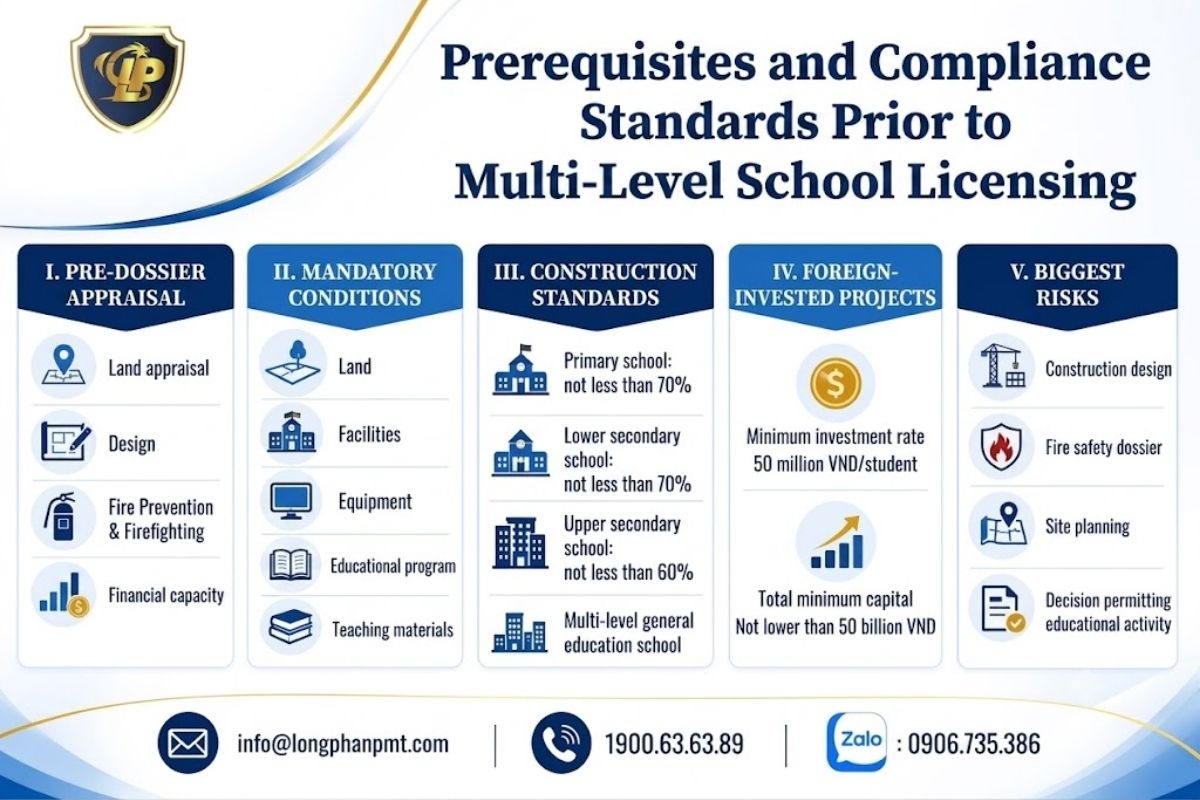
Foreign Investors must conduct thorough due diligence on land, structural design, Fire Prevention and Fighting (PCCC) compliance, and financial capacity before submitting educational dossiers. Regulatory bottlenecks rarely stem from the School establishment scheme itself. Instead, delays arise when land funds, permanent structures, and classroom blocks fail to meet practical operational prerequisites.
| Appraisal Category | Compliance Standard | Legal Basis |
| Primary school | Ratio of solid construction not below 70 percent | Clause 7, Article 10 of Circular No. 13/2020/TT-BGDDT |
| Lower secondary school | Ratio of solid construction not below 70 percent | Clause 7, Article 14 of Circular No. 13/2020/TT-BGDDT |
| Upper secondary school | Ratio of solid construction not below 60 percent | Clause 8, Article 18 of Circular No. 13/2020/TT-BGDDT |
| Multi-level school | Classrooms and functional rooms suitably allocated per level | Clause 2, Article 22 and Clause 1, Article 24 of Circular No. 13/2020/TT-BGDDT |
>> See more: Steps to apply for a Vocational Education Operation License
The process of applying for a license to operate a multi-level school should be managed as a multi-layered investment project, not a single administrative procedure. Each stage requires its own documentation, responsible person, and control points to avoid overlap between legal, construction, and educational operation.
In cases of serious violations or when the suspension period has expired but the cause has not been rectified, foreign-invested educational institutions may be subject to penalties dissolve as stipulated in Points b and c, Clause 2, Article 51 of Decree No. 86/2018/ND-CP, as amended and supplemented by Point b, Clause 30, Article 1 of Decree 124/2024/ND-CP.
Therefore, the licensing process needs to be designed in parallel with construction progress, recruitment, and student recruitment communication. Collecting reservation fees too early can create legal risks and erode market confidence.
Clients must identify the competent processing agency based on the project’s highest educational level. Submitting dossiers to the wrong appraisal authority strictly delays commercial opening schedules. This administrative error directly extends land lease durations and inflates pre-operational personnel costs.
The core dossier management principle dictates that the highest academic level determines the primary appraisal body. For models involving foreign elements, Foreign Investors must concurrently verify specific jurisdictions governing establishment and educational operations.
| Multi-Level School Model | Authority Approving Establishment | Authority Approving Educational Operations |
| Highest level is primary school | Chairman of Commune People’s Committee pursuant to Article 8 of Decree No. 142/2025/ND-CP | Chairman of Commune People’s Committee pursuant to Article 8 of Decree No. 142/2025/ND-CP |
| Highest level is lower secondary school | Chairman of Commune People’s Committee pursuant to Clause 1, Article 10 of Decree No. 142/2025/ND-CP | Chairman of Commune People’s Committee pursuant to Clause 1, Article 10 of Decree No. 142/2025/ND-CP |
| Highest level is upper secondary school | Chairman of Provincial People’s Committee pursuant to Clause 2, Article 10 of Decree No. 142/2025/ND-CP | Director of the Department of Education and Training (DOET) pursuant to Clause 3, Article 10 of Decree No. 142/2025/ND-CP |
| Foreign-invested general education institution | Chairman of Provincial People’s Committee pursuant to Clause 3, Article 40 of Decree No. 86/2018/ND-CP | Director of the Department of Education and Training (DOET) pursuant to Clause 2, Article 47 of Decree No. 86/2018/ND-CP |
In practice, the Department of Education and Training (DOET) or the Division of Education and Training rarely conducts independent appraisals. The appraisal committee routinely requires consultative opinions from competent authorities overseeing construction, finance, land, and health. They will also mandate clearance from the Fire Prevention, Fighting and Rescue Police Agency.
Therefore, Clients must proactively prepare an interdisciplinary explanatory dossier covering capital, zoning, permanent structures, and school safety. Ultimately, a robust educational dossier lacking infrastructure acceptance testing will inevitably delay the Decision on educational operation approval.
Foreign Investors must review their ownership structures prior to expansion, Mergers and Acquisitions (M&A) in education, or securing a multi-level school license. Transitional regulations can protect pending dossiers but simultaneously impose mandatory restructuring obligations on legacy legacy models.
Clients must integrate the following transitional milestones into their legal, financial, and internal governance plans:
For foreign-invested educational institutions or educational linkage programs approved before the effective date of Decree No. 86/2018/ND-CP, Foreign Investors are exempt from re-approval or re-licensing of operations. This is governed by Clauses 2 and 3, Article 66 of Decree No. 86/2018/ND-CP.
Therefore, prior to receiving transfers or injecting additional capital into a multi-level school, Clients must audit the license status, corporate structure, and dossier submission dates. Errors during this phase can severely devalue the transaction or trigger unforeseen restructuring obligations.
>> See more: Conditions and procedures for establishing a private preschool newest

Multi-level school projects demand rigorous synchronization across land use, investment, construction, fire safety, finance, and specialized educational conditions. Navigating this local legal complexity is critical to preventing costly delays. Long Phan Consulting Company empowers Foreign Investors by translating complex regulatory barriers into a streamlined licensing roadmap, distinct appraisal milestones, and actionable compliance solutions.
Before injecting capital or signing leases, Clients must verify land suitability for educational purposes. Zoning or PCCC discrepancies will stall the entire licensing plan.
The School establishment scheme is the central document proving necessity, financial capacity, and operational viability. Weak dossiers routinely face multiple supplementary requests from appraisal authorities.
The appraisal process generates inquiries from multiple state agencies beyond the education sector. Proactive explanation strategies prevent delays in securing the Decision on educational operation approval.
Clients, CEOs, or Chief Legal Officers are invited to send project dossiers via Email (info@longphanpmt.com) or Zalo/WhatsApp (+84 906 735 386) for a preliminary evaluation by Long Phan Consulting Company.
The following issues often determine the progress of obtaining a license for a multi-level school, especially when the project involves FDI capital, long-term land leases, or early enrollment preparations. Investors need to address each question as a risk control point before budgeting, signing lease agreements, or announcing operational plans.
Foreign-invested enterprises must prepare capital based on the largest projected student enrollment. Investment projects to establish general education institutions with foreign investment must have a minimum investment per unit.50 million VND per student, excluding land use costs. The minimum total investment capital shall not be less than 50 billion VND, according to Clause 2, Article 35 of Decree No. 86/2018/ND-CP.
Educational institutions with foreign investment may lease facilities if they can ensure the stability of educational operations. Investors need to specify the lease term in the site agreement, as the lease cycle must be at least…5 years. According to Clause 5, Article 36 of Decree No. 86/2018/ND-CP, a short lease term may result in the application being assessed as lacking operational stability.
Schools that include a high school level must be handled under the authority of the high school level. The Director of the Department of Education and Training issues a decision allowing the high school to operate educational activities in accordance with Clause 1, Article 28 of Decree No. 125/2024/ND-CP. Therefore, investors need to prepare explanatory documents for the Department of Education and Training right from the operational design phase.
Investors should not enroll students when the educational institution has not yet received a Decision authorizing its educational activities. For educational institutions with foreign investment, violations of educational regulations that warrant suspension may lead to further consequences. Suspend educational activities according to Point d, Clause 2, Article 50 of Decree No. 86/2018/ND-CP, this risk directly affects parental trust and commercial progress.
Foreign-invested educational institutions may be dissolved if they commit serious violations or fail to remedy the causes after the suspension period. This is a high-level operational risk that needs to be controlled within the internal compliance process. The applicable basis is Points b and c, Clause 2, Article 51 of Decree No. 86/2018/ND-CP.
The standard for structural integrity directly affects the likelihood of having facilities assessed. Primary and secondary schools must have a certain percentage of structurally sound buildings. A certain percentage of structurally sound buildings must be met not less than 70%According to Clause 7, Article 10 and Clause 7, Article 14 of Circular No. 13/2020/TT-BGDĐT, high schools must achieve a certain percentage not less than 60%, according to Clause 8, Article 18 of Circular No. 13/2020/TT-BGDĐT.
Groups of individuals who have directly established a private educational institution with two or more investors must form an economic organization. The maximum time limit for implementation is 12 months from January 1, 2026 according to Point e, Clause 3, Article 2 of the amended Education Law 2025, delays in restructuring could affect capital and asset management and subsequent licensing applications.
Securing a multi-level school license in Vietnam must be strategically planned as a multi-tiered legal project. It is inextricably linked to the Decision on establishment approval and the Decision on educational operation approval for the multi-level general education institution. Foreign Investors must proactively control the corporate model, land funds, fire safety compliance, capital, curricula, and personnel. This strict governance prevents delayed openings, inflated facility leasing costs, and the severe risks of premature enrollment. To construct a secure licensing roadmap, CEOs, Foreign Investors, and legal departments should contact Hotline 1900636389. Long Phan Consulting Company is prepared to support your dossier structuring and provide expert appraisal representation.
📚 This article has been professionally reviewed based on the following legal documents:


