


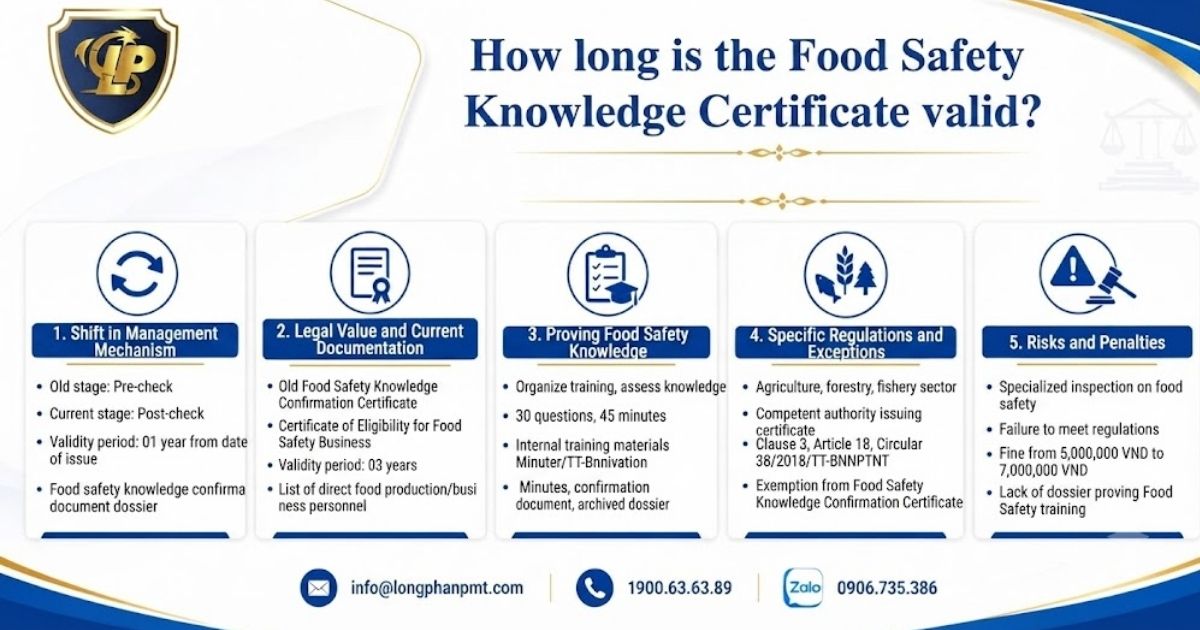
The Food Safety Knowledge Certificate is no longer treated as a recurring renewal requirement for many food business establishments under the management of the Ministry of Health and the Ministry of Industry and Trade. The main compliance risk now arises when businesses cannot present a proper food safety knowledge certification dossier during applications for a Certificate of Food Safety Eligibility or during specialized inspections. While the former framework referred to a one-year validity period, the current approach emphasizes training records, assessment results, updated personnel lists, and internal dossier retention.
Businesses should review Legal Updates with Long Phan Consulting to avoid preparing inaccurate or outdated compliance documents.
Important legal note:
F&B businesses should discontinue processing documentation with the mindset of “registering for an examination to receive a certificate” if their business sector has transitioned to a self-certification mechanism. Current risks do not stem from the absence of outdated documents, but from the inability to prove that personnel directly involved in food production and trading have been adequately trained and assessed on food safety knowledge.
Previously, many establishments were required to have their proprietors and direct production personnel participate in food safety knowledge examinations. Upon meeting the requirements, the individual was issued a Certificate of Training in Food Safety and Hygiene.
Pursuant to Section 11 of Official Dispatch No. 5845/BCT-KHCN in 2013, these certificates were valid for one year from the date of issuance. Consequently, enterprises were frequently burdened with tracking expiry dates and repeating administrative procedures to maintain validity. This mechanism reflected a pre-licensing model, wherein state agencies directly participated in verifying personnel competency before establishment operations. However, this administrative approach has been reformed in numerous sectors to reduce the procedural burden on enterprises.
Currently, for many establishments under the purview of the Ministry of Health and the Ministry of Industry and Trade, the focus is no longer on applying for new Food Safety Knowledge Certificates under the old mechanism. Instead, enterprises must organize training, conduct assessments, and maintain internal Food Safety Knowledge Certification dossiers on-site.
| Criteria | Former Phase: Pre-Check | Current Phase: Post-Audit |
| Management Approach | State agencies organize exams and issue certificates | Proprietors organize training, certify, and store dossiers |
| Validity | Previously recognized as 1 year | Focus on actual training records rather than renewal |
| Enterprise Responsibility | Send personnel to state-led exams | Proactive training, listing, and accountability |
| Primary Risk | Expired certificates requiring re-examination | Incomplete internal dossiers or mismatched personnel records |
For sectors under the Ministry of Health, personnel directly involved in production, trading, and food preparation must be trained in food safety knowledge and certified by the proprietor, pursuant to Clause 2, Article 4 and Clause 2, Article 5 of Decree No. 67/2016/NĐ-CP (as amended and supplemented by Decree No. 155/2018/NĐ-CP).
For sectors under the Ministry of Industry and Trade, the certificate of training in food safety for personnel directly involved in production and trading is confirmed by the proprietor, pursuant to Point d, Clause 1, Article 24a of Decree No. 77/2016/NĐ-CP (as amended and supplemented by Decree No. 17/2020/NĐ-CP).
This transition reduces external compliance costs but increases internal management responsibilities. During specialized appraisals or inspections, an establishment must present training records consistent with the list of personnel currently directly employed.
Enterprises must prioritize the following tasks:
If an enterprise only retains health check certificates without food safety training records, the personnel dossier remains incomplete. This is a common error in the F&B industry due to high personnel turnover and inconsistent filing processes.
Administrative reforms have altered the way businesses demonstrate personnel food safety knowledge. For establishments under the Ministry of Health and the Ministry of Industry and Trade, enterprises must focus on internal self-certification dossiers rather than seeking state-issued certificates under the old mechanism.
For food production, trading, and food service establishments under the Ministry of Health, the proprietor must ensure that personnel directly involved in production, trading, and food preparation have been trained in food safety knowledge. The confirmation is executed directly by the proprietor.
This obligation is stipulated in Clause 2, Article 4 and Clause 2, Article 5 of Decree No. 67/2016/NĐ-CP (as amended and supplemented by Decree No. 155/2018/NĐ-CP). The core point is that enterprises must maintain documentary evidence rather than relying on verbal explanations during inspections. Businesses in the restaurant, food service, and collective canteen sectors must control personnel dossiers from the point of recruitment, as untrained personnel represent a primary risk in appraisal minutes.
For establishments under the Ministry of Industry and Trade, the management mechanism has similarly shifted to internal self-certification. The certificate of food safety knowledge training for personnel directly involved in food production and trading must be confirmed by the proprietor.
This requirement is prescribed in Point d, Clause 1, Article 24a of Decree No. 77/2016/NĐ-CP (as amended and supplemented by Decree No. 17/2020/NĐ-CP). Enterprises can reference the examination question sets issued by the Ministry of Industry and Trade to design internal assessments. Legal and human resource departments must monitor two primary changes:
Consequently, internal dossiers must be established for each location, personnel group, and recruitment period. Relying on outdated forms without updating the actual personnel list may result in the establishment being assessed as lacking eligible food safety conditions.
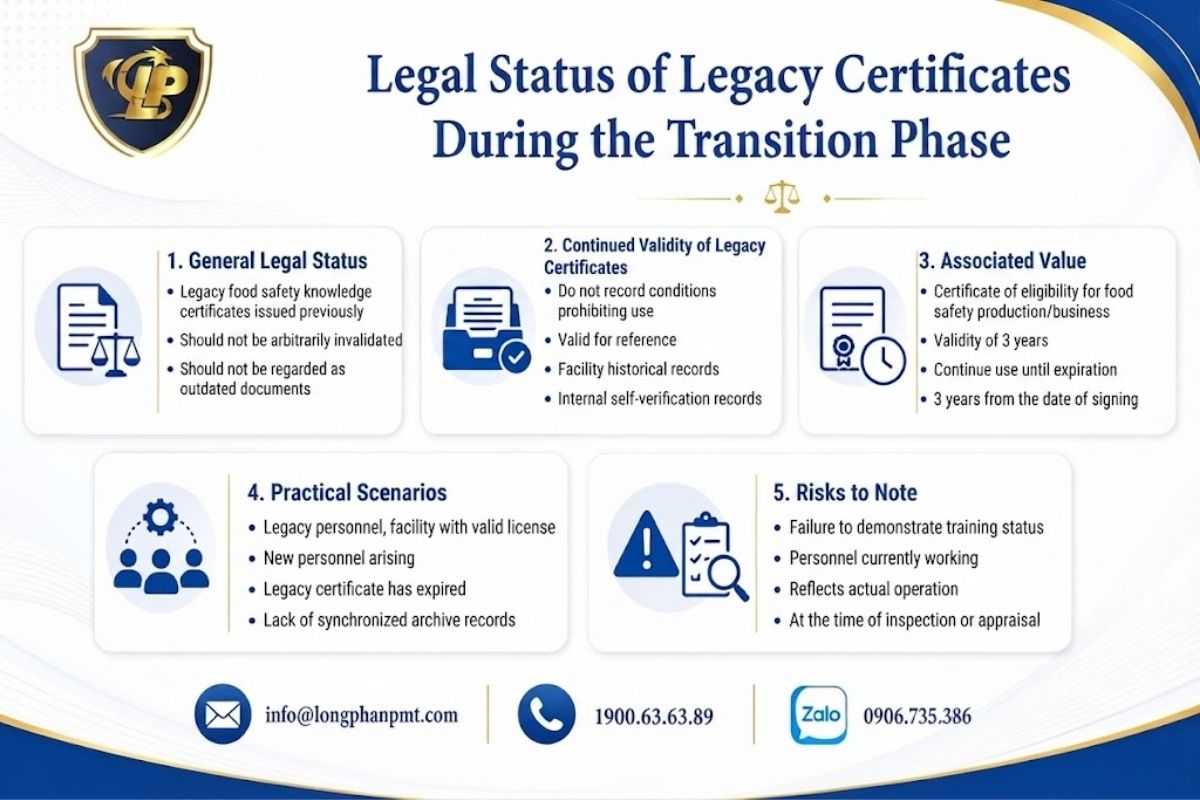
Legacy Food Safety Knowledge Certificates should not be arbitrarily discarded from corporate records. However, enterprises should not treat these legacy documents as the sole basis for proving personnel eligibility under current management mechanisms.
Current legislation does not explicitly prohibit the use of certificates issued under previous mechanisms. Therefore, legacy documents retain reference value in an establishment’s historical records, particularly when associated with previously appraised periods.
A critical note is that there are no specific transitional provisions for these certificates in the reviewed legal sources. Consequently, once a legacy certificate expires or personnel changes occur, enterprises should transition to establishing internal self-certification dossiers in accordance with the current mechanism. The recommended approach is to archive legacy certificates as supporting documentation while supplementing them with current training records. This ensures the enterprise can explain both the historical context and the actual status of current personnel.
A Certificate of Food Safety Eligibility is valid for three years, pursuant to Clause 1, Article 37 of the 2010 Law on Food Safety. During this cycle, personnel dossiers submitted at the time of initial licensing are typically considered part of the appraised eligibility package.
When working with specialized food safety inspection teams, enterprises should classify legacy documents based on specific management situations to avoid confusion between historical records and current obligations.
The primary risk is not the possession of legacy certificates, but the failure to prove the training status of currently active personnel. Valid dossiers must reflect actual operational reality at the time of inspection or appraisal.
Enterprises should not rely solely on a loose certificate to prove personnel food safety knowledge. A valid dossier must demonstrate a comprehensive process including training, assessment, confirmation, and archiving for every group of personnel directly involved in food production and trading.
For sectors under the Ministry of Industry and Trade, enterprises may utilize the question sets issued by management agencies to design internal assessments. These sets consist of 30 questions, encompassing both general and specialized knowledge.
Testing time is 45 minutes, pursuant to Articles 1 and 2 of Decision No. 1390/QĐ-BCT in 2020. This serves as critical reference data for establishments to construct evidence-based evaluation processes, replacing superficial training. Internal procedures should be standardized through these steps:
This process converts a legal obligation into an operational control mechanism. Without assessment evidence, assertions of personnel training will lack explanatory validity.
Documentation verifying food safety knowledge must accurately reflect the individuals currently employed. Using an outdated list while personnel have changed is a frequent error identified during surprise specialized inspections. Enterprises should prepare at least the following documents:
For establishments under the Ministry of Health, the list of individuals trained in food safety must be signed by the proprietor, pursuant to Point c, Clause 2, Article 6 of Decree No. 67/2016/NĐ-CP. Regarding risk management, food safety training records should be audited periodically alongside health records. Relying exclusively on health certificates while lacking food safety knowledge records remains a significant compliance gap.
Food safety training dossiers must be treated as dynamic legal records rather than one-time documents. Given the continuous turnover in the F&B industry, training lists can quickly diverge from operational reality without a periodic update mechanism.
Each establishment should maintain a distinct set of food safety training records corresponding to the business location, operational department, and actual labor list. Utilizing a unified list for multiple branches can complicate inspections at individual sites.
A health certificate only proves an employee’s physical eligibility; it does not replace food safety knowledge records. Enterprises must attach health records to training materials to form a complete personnel dossier for appraisals or post-audits. Required documentation includes:
Where establishments rely solely on health certificates, inspection teams retain the right to demand supplementary training records. This is a prevalent deficiency in restaurants, cafeterias, industrial kitchens, and food retail chains.
Enterprises must update dossiers immediately upon hiring new personnel, reassigning positions, or establishing departments that handle food. Untrained personnel should not be assigned to high-risk food safety roles. Internal control mechanisms should incorporate:
This management approach limits the risk of records being inconsistent with operational reality. During specialized inspections, the consistency between the list, signatures, and personnel on-site is the decisive factor in your ability to justify compliance.
Enterprises engaged in the production, primary processing, preparation, and trading of agricultural, forestry, and aquatic food products should not default to the self-certification mechanism applicable to the Ministry of Health or Ministry of Industry and Trade groups. This sector maintains specific requirements for verifying food safety knowledge, necessitating correct classification before dossier preparation.
For establishments within the agricultural, forestry, and fisheries sectors, competent authorities continue to issue Food Safety Knowledge Certificates. Verification is conducted through a knowledge examination process as part of the specialized appraisal procedure.
The authority responsible for issuing the Certificate of Food Safety Eligibility is also the authority empowered to issue the Food Safety Knowledge Certificate, pursuant to Clause 1, Article 18 of Circular No. 38/2018/TT-BNNPTNT. The examination is structured as a 30-question multiple-choice test with a 45-minute duration, pursuant to Clause 5, Article 18 of Circular No. 38/2018/TT-BNNPTNT. This represents a significant distinction from the internal self-certification mechanism prevalent in other industrial sectors.
Not every proprietor or employee in the agricultural, forestry, and fisheries sector is required to apply for a Food Safety Knowledge Certificate. Enterprises must verify professional qualifications prior to compiling the list of personnel subject to the examination.
Key considerations include:
Exemption criteria are recorded in Clause 3, Article 18 of Circular No. 38/2018/TT-BNNPTNT. If an enterprise cannot provide supporting documentation, citing an exemption during an inspection or appraisal will be legally insufficient.
Enterprises managing production, distribution, or retail chains involving multiple food categories must accurately delineate management scopes. A single establishment may simultaneously trigger requirements under Ministry of Health, Ministry of Industry and Trade, and Ministry of Agriculture and Rural Development regulations.
For multi-sector models, legal departments should conduct reviews based on individual products, processing stages, and business locations. Misclassifying authority can lead to missing mandatory certificates or the preparation of unnecessary documentation. A robust control method involves constructing a matrix aligning product categories, management agencies, and corresponding personnel documentation requirements. This is a vital step prior to applying for or renewing a Certificate of Food Safety Eligibility.
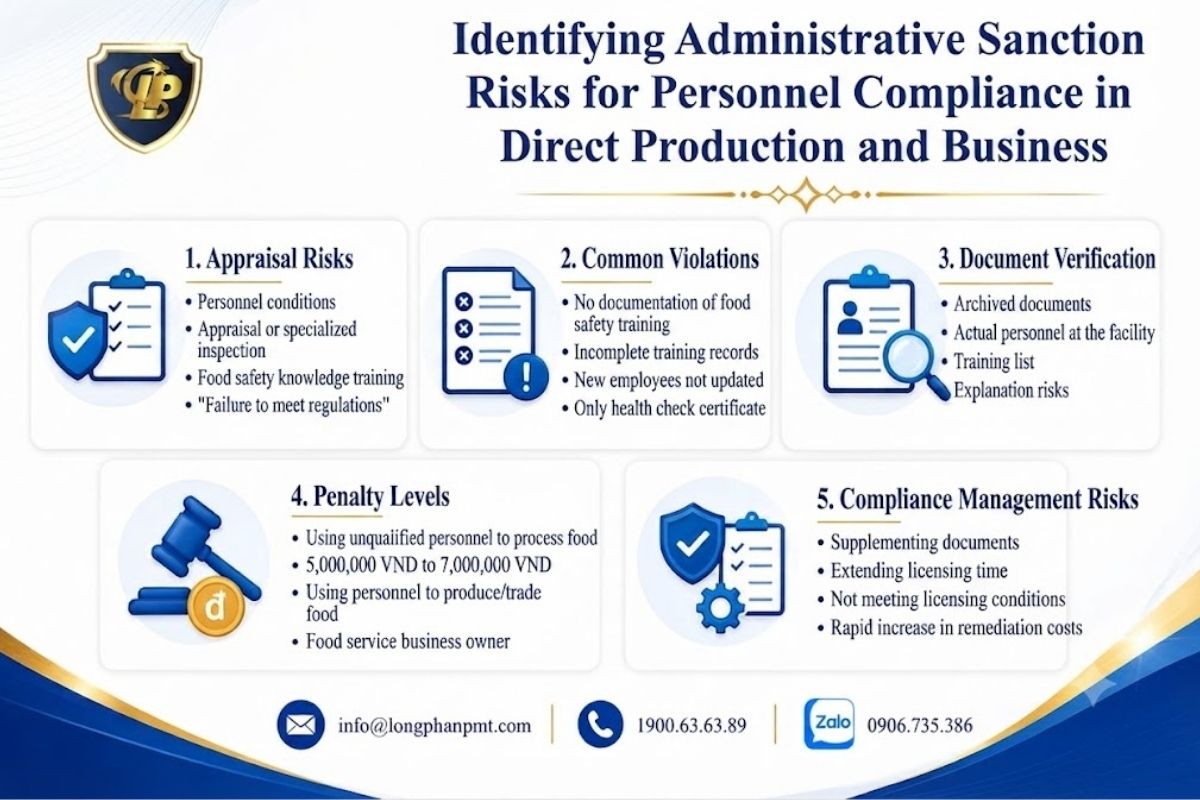
Personnel documentation is frequently underestimated, yet it is typically prioritized during appraisals and specialized inspections. Enterprises must not only ensure employees are healthy but must also prove that personnel have undergone food safety training appropriate to their operational roles.
Food safety is defined as the assurance that food will not harm human health or life, pursuant to Clause 1, Article 2 of the 2010 Law on Food Safety. Consequently, the competency of personnel directly involved in preparation, production, and trading is a core risk control condition.
During license appraisal, the absence of training confirmation may be recorded as “Non-compliant” in the appraisal minutes, pursuant to Section I, Form No. 23 of Appendix I of Decree No. 46/2026/NĐ-CP. In practice, enterprises may be required to supplement dossiers, experience prolonged licensing timelines, or fail to achieve the Certificate of Food Safety Eligibility. For operational F&B models, delayed licensing can disrupt sales plans, handover schedules, or branch expansion efforts.
Inspection teams typically cross-reference archived dossiers with personnel currently present at the establishment. If the training list does not align with the staff on duty, enterprises face justification risks even if they hold legacy certificates.
Key errors include:
These errors commonly occur in restaurants, collective kitchens, canteens, and food retail chains. Enterprises should audit dossiers by location, rather than relying solely on central office checks.
>>> See more: Identifying and Preventing Risks of Operating Without Required Licenses
Missing training records is more than an internal administrative oversight. Authorities may impose sanctions when enterprises utilize personnel for direct production, trading, or food preparation without certification of food safety knowledge training.
| Violation | Subject | Sanction |
| Utilizing untrained personnel for food preparation | Direct preparation staff | 5,000,000 to 7,000,000 VND (Clause 3, Art. 15, Decree 115/2018/NĐ-CP, amended by Decree 124/2021/NĐ-CP) |
| Utilizing untrained personnel for production/trading | Direct production/trading staff | Pursuant to Point dd, Clause 3, Art. 9, Decree 115/2018/NĐ-CP |
| Proprietor lacks training confirmation | Proprietor | Pursuant to Point d, Clause 5, Art. 9, Decree 115/2018/NĐ-CP |
| Food service proprietor lacks training confirmation | Food service proprietor | Pursuant to Point b, Clause 4, Art. 15, Decree 115/2018/NĐ-CP |
Regarding compliance management, enterprises should address deficiencies before they are discovered by inspectors. Once a violation record is established, justification capacity is narrowed and remediation costs escalate.
Food safety documentation currently functions not merely as a licensing procedure, but as a system of compliance evidence sustained throughout operational lifecycles. Long Phan Consulting assists enterprises in auditing personnel dossiers, identifying correct self-certification or licensing mechanisms per specialized sector, and standardizing documentation to mitigate risks during appraisals or inspections.
Enterprises must simultaneously audit personnel records, health certificates, training materials, and food safety knowledge confirmation lists. The absence of a single document group can stall applications for the Certificate of Food Safety Eligibility or trigger mandatory supplementary requests.
Long Phan Consulting provides expert support in the following areas:
These audit results enable enterprises to proactively identify vulnerabilities before document submission or scheduled inspection visits, significantly reducing the likelihood of being assessed as non-compliant.
During specialized food safety inspections, enterprises must justify compliance through concrete documentation, not mere verbal commitments. Risks frequently arise when establishments deploy new personnel, allow legacy records to expire, or present training lists that diverge from operational reality.
Long Phan Consulting assists enterprises in managing these scenarios:
Proactive justification control is essential. If records are misassessed or evidence is deemed insufficient, post-inspection resolution costs typically far exceed those of preventative auditing.
F&B enterprises with multiple branches, shift-based operations, and continuous personnel fluctuations require a sustainable food safety record control system. Training dossiers should not be contingent upon individual licensing rounds but must be updated per operational life cycles.
Long Phan Consulting supports the establishment of compliance management systems including:
A high-quality food safety dossier system proves personnel competency at all times. Correct management from the outset minimizes risks of sanctions, licensing interruptions, and impacts on business valuations. You may submit current dossiers via Email: info@longphanpmt.com or Zalo/WhatsApp: +84 906 735 386 for a preliminary compliance evaluation by Long Phan Consulting.
Food safety knowledge certification documents often present challenges when businesses hire new staff, open new outlets, or prepare for specialized inspections. The questions below focus on operational bottlenecks, the expiration of outdated documents, and the obligation of those directly involved in food production and sales to demonstrate food safety competence.
No, for many establishments under the Ministry of Health and the Ministry of Industry and Trade, businesses are no longer processed under the mechanism of periodically renewing Food Safety Knowledge Certificates. The old mechanism stipulated a validity period of one year from the date of issuance, according to Section 11 of Official Letter No. 5845/BCT-KHCN of 2013. Currently, individuals directly involved in the production, business, and processing of food must be trained and certified by the establishment owner, according to Clause 2, Article 4 and Clause 2, Article 5 of Decree No. 67/2016/ND-CP, amended and supplemented by Decree No. 155/2018/ND-CP.
While the old Food Safety Knowledge Certificate can be used as a historical document, businesses should still update their self-certification records according to the current regulations. The data provided does not include any specific transitional provisions for the Food Safety Knowledge Certificate. Regarding the Food Safety Compliance Certificate, previously issued certificates continue to be valid until their expiration date, as stipulated in Clause 5, Article 6 of Decree No. 67/2016/ND-CP, amended and supplemented by Decree No. 155/2018/ND-CP.
No, a health certificate cannot replace documentation proving an employee’s knowledge of food safety. Businesses under the Ministry of Health need a list of food producers and food service businesses that have received food safety training, with the signature of the business owner, as per Point c, Clause 2, Article 6 of Decree No. 67/2016/ND-CP, amended and supplemented by Decree No. 155/2018/ND-CP. Businesses under the Ministry of Industry and Trade need a confirmation certificate signed by the business owner, as per Point d, Clause 1, Article 24a of Decree No. 77/2016/ND-CP, amended and supplemented by Decree No. 17/2020/ND-CP.
Yes, businesses risk being penalized if they employ food processing staff who do not have a food safety training certificate. The fine ranges from VND 5,000,000 to VND 7,000,000, according to Clause 3, Article 15 of Decree No. 115/2018/ND-CP, amended and supplemented by Decree No. 124/2021/ND-CP. Individuals directly involved in food production and business are also subject to fines for lacking a training certificate, as stipulated in Point d, Clause 3, Article 9 of Decree No. 115/2018/ND-CP, amended and supplemented by Decree No. 124/2021/ND-CP.
Businesses can refer to the test question set issued by the regulatory agency to standardize their internal assessment process. The multiple-choice test for assessing food safety knowledge consists of 30 questions, including 20 general knowledge questions and 10 specialized knowledge questions. The test duration is 45 minutes, as stipulated in Clause 5, Article 18 of Circular No. 38/2018/TT-BNNPTNT and Article 2 of Decision No. 1390/QĐ-BCT of 2020. The records should include a list of participants, training minutes, and assessment results.
It is not mandatory for agricultural, forestry, and fisheries businesses to undergo inspections according to the specific mechanisms of their respective sectors. The competent authority issuing the Food Safety Certificate also has the authority to issue the Food Safety Knowledge Certificate, as stipulated in Clause 1, Article 18 of Circular No. 38/2018/TT-BNNPTNT. The test consists of 30 questions to be completed in 45 minutes, as stipulated in Clause 5, Article 18 of Circular No. 38/2018/TT-BNNPTNT. Business owners or those directly involved in production and business with relevant professional qualifications from intermediate level or higher may be exempted, as stipulated in Clause 3, Article 18 of Circular No. 38/2018/TT-BNNPTNT.
The food safety certificate is valid for 3 years. During this period, the business must maintain complete personnel records, training records, and food safety compliance records at the facility. The 3-year period is stipulated in Clause 1, Article 37 of the Food Safety Law No. 55/2010/QH12. If personnel records do not match actual operations, the business still risks being assessed as not meeting the requirements during inspections or re-assessments.
While Food Safety Knowledge Certificates are no longer subject to mechanical renewal procedures in many sectors, the Food Safety Knowledge Certification dossier remains mandatory for justifying personnel competency during licensing or inspections. Proprietors must accurately categorize their management sector, maintain updated lists of personnel directly involved in food production and trading, and archive comprehensive training, assessment, and internal confirmation records. Failure to maintain these documents can delay the issuance of Certificates of Food Safety Eligibility and trigger administrative sanctions. Contact our Hotline at 1900636389 for professional compliance auditing by Long Phan Consulting.
📚 This article has been professionally reviewed based on the following legal documents:


