

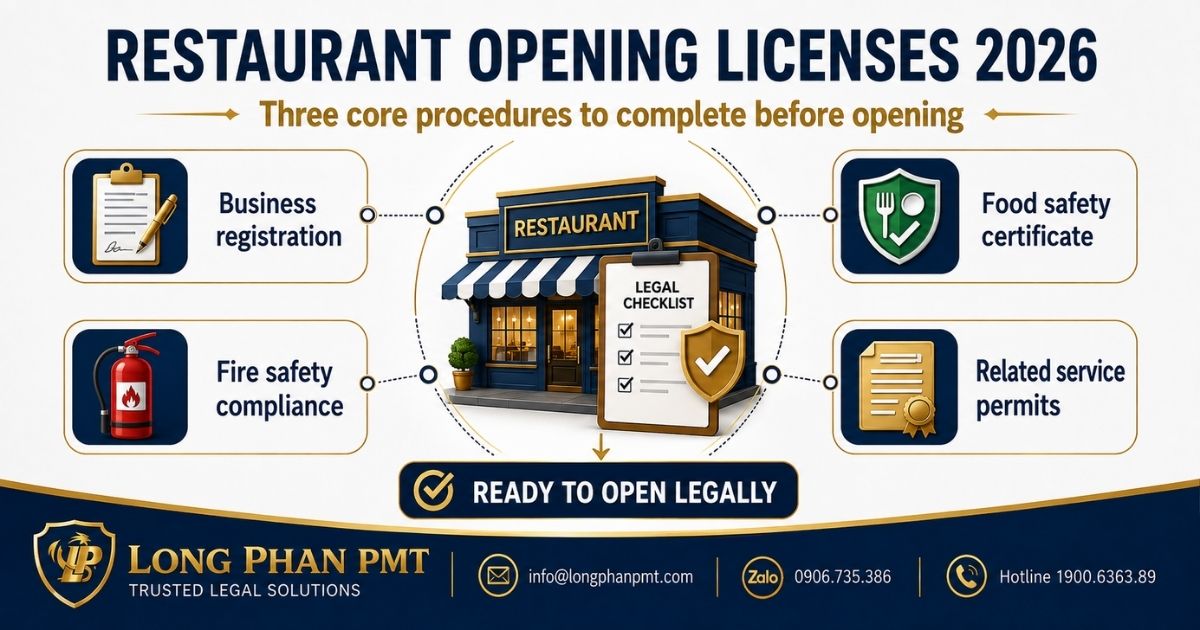
Long Phan Consulting regularly receives questions from investors preparing restaurant licenses 2026 who assume that business registration alone is enough to start operating. In practice, a restaurant serving food for on-site consumption generally needs to complete at least three mandatory groups of procedures: business registration, food safety, and fire safety; if the restaurant also serves alcohol, offers karaoke, or provides lodging, additional conditional licenses apply. This article sets out the full checklist, sequence, and timeline, with every point tied to a specific article and clause of the currently effective legal instruments, so investors can plan their opening schedule with confidence. For related business formation requirements, see Business Registration.
Important Notes:
The number of licenses required depends on three factors: the type of business entity (household business or enterprise), the scale of the facility (floor area, capacity), and the scope of accompanying services (whether alcohol, live music, or lodging is offered). For a restaurant providing ordinary food and beverage service, three procedures are mandatory: business registration, food safety, and fire safety; the remaining licenses only apply once the restaurant adds a conditional service. The sections below set out the specific legal basis for each mandatory procedure.
Business registration is carried out under Decree No. 168/2025/ND-CP, effective from 1 July 2025, which replaces Decree No. 01/2021/ND-CP and Decree No. 122/2020/ND-CP. Food safety is governed by Decree No. 15/2018/ND-CP implementing the 2010 Law on Food Safety, specifically Article 11 (obligation to hold a certificate), Article 12 (exempt cases), and Clause 1, Article 34 of the 2010 Law on Food Safety (issuance conditions); this remains the operative instrument, since Decree No. 46/2026/ND-CP is currently suspended under Resolution No. 15/2026/NQ-CP dated 6 April 2026. Fire safety is governed by the 2024 Law on Fire Prevention, Fighting, Rescue and Emergency Response (Law No. 55/2024/QH15) together with Decree No. 105/2025/ND-CP, whose Appendix I sets the floor-area threshold for full management and whose Article 6 sets out the content of design appraisal.
Beyond these three mandatory groups, a restaurant serving alcohol for on-site consumption additionally needs an on-site alcohol consumption license under Article 24 of Decree No. 105/2017/ND-CP (as amended by Decree No. 17/2020/ND-CP); a restaurant combined with karaoke, a dance hall, or lodging additionally needs a Security and Order Certificate under Article 3 of Decree No. 96/2016/ND-CP.
Before addressing each specific license, investors should understand three foundational conditions that govern the entire licensing process: who may register the business, what the location must satisfy, and how the registered business line is classified. These three conditions are prerequisites: if any one of them is not met, applications for subsequent conditional licenses will not be accepted by the competent authority.
Under Article 82 of Decree No. 168/2025/ND-CP, a household business is established by an individual or by members of a household, who are liable for the business’s operations with their entire assets. Vietnamese citizens with full civil act capacity have the right to establish a household business, except persons who are being prosecuted for criminal liability, are serving a prison sentence, or are prohibited by an effective court judgment from practicing a trade. If the enterprise model is chosen instead (limited liability company, joint stock company), the conditions on the founding entity apply under the 2020 Law on Enterprises, as amended and supplemented by Law No. 76/2025/QH15.
The business location must match the registered business line and must not fall within an area where food and beverage service is restricted under local planning. For food safety, the facility must satisfy the conditions set out in Clause 1, Article 34 of the 2010 Law on Food Safety, including a one-way kitchen layout, a food processing area separated from sanitation areas, a clean water source, and appropriate food storage equipment, and staff directly involved in food processing must undergo health examinations and food safety training under Chapter IV of the 2010 Law on Food Safety.
Food and beverage service is no longer classified as a conditional investment and business line managed specifically by the Ministry of Health, following successive amendments to Appendix IV of the 2020 Law on Investment. Nonetheless, a facility must still fully satisfy the food safety conditions under Clause 1, Article 34 of the 2010 Law on Food Safety and must register the appropriate business line code: level-2 code 56 (food and beverage service activities) under Decision No. 36/2025/QD-TTg, before commencing operations.
>>>See more: Conditions for overseas Vietnamese to buy property in Vietnam
Once the foundational conditions above are met, investors must identify the exact list of licenses applicable to their restaurant model. Each license below is tied to a specific legal instrument and provision, together with the circumstances in which it applies or is exempted, so investors can match each requirement to their actual facility.
Investors may choose between two models: a household business (registered at the commune-level business registration authority under Article 88 of Decree No. 168/2025/ND-CP) or an enterprise (registered at the provincial-level business registration authority under the 2020 Law on Enterprises and Decree No. 168/2025/ND-CP). Under Article 88 of this decree, the Household Business Registration Certificate simultaneously serves as the household business’s Tax Registration Certificate. This is the foundational procedure: without a business registration certificate, there is no basis to apply for subsequent conditional licenses.
Under Article 11 of Decree No. 15/2018/ND-CP, facilities producing or trading food must hold a Food Safety Certificate to operate, except in the cases listed under Clause 1, Article 12. The exempt list under Clause 1, Article 12 covers ten categories, including: small-scale initial production; food trading without a fixed location; small-scale preliminary processing; small-scale food trading (by individuals or households registered as a household business without an enterprise registration certificate); trading in pre-packaged food; street food vending; and restaurants located within hotels.
A key point to note: an independent restaurant that is not located within a hotel and does not meet the definition of small-scale food business under Clause 1, Article 12 must still apply for a Food Safety Certificate through the regular procedure; no exemption applies. Issuance conditions follow Clause 1, Article 34 of the 2010 Law on Food Safety.
Under Appendix I of Decree No. 105/2025/ND-CP, only restaurants and eateries with a total floor area of 3,000 m² or more fall under full fire-safety management, requiring a fire-safety dossier maintained under Form PC01 as set out in Clause 1, Article 4 of Decree No. 105/2025/ND-CP, a firefighting plan, and an on-site fire-safety force. Most small and medium-sized restaurants do not reach this threshold, but they must still comply with the general fire-safety requirements applicable to business facilities under the principle in Article 5 of the 2024 Law on Fire Prevention, Fighting, Rescue and Emergency Response: on-site firefighting equipment, fire-safety rules, escape routes, and safety measures for gas equipment and open-flame stoves.
From 1 July 2026 to 28 February 2027, under Part C, Section 2 of Appendix I.1 of Resolution No. 66.18/2026/NQ-CP, three fire-safety administrative procedures are abolished: inspection of fire-safety acceptance work; acceptance of works that already hold a design appraisal certificate but have not yet completed acceptance; and restoration of a facility’s operation. During this period, facility owners self-conduct acceptance and bear full responsibility for the fire-safety standard achieved, while the state management authority shifts its focus to post-inspection.
Under Clause 21, Article 3 of Decree No. 96/2016/ND-CP, the list of business lines requiring a Security and Order Certificate includes karaoke services, dance hall services, along with other lines such as lodging, massage, and security services, but does not include ordinary food and beverage service. A restaurant that serves food and beverages only does not need this certificate. Investors only need this procedure if the restaurant combines karaoke, a dance hall, or lodging within the same facility, and under Point l, Clause 1, Article 8 of Decree No. 96/2016/ND-CP, a facility operating such business lines must also have a security and order plan attached to its dossier.
Under Article 3 of Decree No. 105/2017/ND-CP, alcohol trading is a conditional investment and business line, and any organization or individual selling alcohol for on-site consumption must hold a license. A restaurant serving alcohol for on-site consumption must obtain an On-Site Alcohol Consumption License, with the application dossier set out in Article 24 of this decree. Following the adoption of the two-tier local government model from 1 July 2025 (removal of the district level), authority to receive and process applications for alcohol production and retail licenses under Article 25 of Decree No. 105/2017/ND-CP has transferred to the commune-level People’s Committee where the facility is located.
A large-scale restaurant generating significant wastewater or emissions should review its environmental registration obligations under the 2020 Law on Environmental Protection according to its actual scale; the applicable level (environmental registration, environmental license, or exemption) depends on wastewater volume and actual capacity, and therefore requires a case-by-case review. Restaurant signage follows the advertising rules under the 2012 Law on Advertising, and typically only needs to comply with size and content requirements without a separate license, except where a banner or large advertising panel is displayed beyond the scope of ordinary signage.

Once the applicable license checklist has been confirmed, investors need to understand the procedure and processing time for each license in order to plan their filing schedule ahead of the opening date. The timelines below are drawn from the processing-time provisions set out in each respective decree.
For a household business: the dossier is filed at the commune-level business registration authority under Clause 2, Article 99 of Decree No. 168/2025/ND-CP, comprising the household business registration application and a copy of the authorization document from household members (if any). If the dossier is valid and meets the conditions under Article 88 of this decree, the registration authority issues the Household Business Registration Certificate within 3 working days from receipt; if the dossier is invalid, the authority issues a written notice stating the reasons and requesting amendment within the same 3 working days under Clause 2, Article 85 of Decree No. 168/2025/ND-CP. Where registration is refused under Article 102 of this decree (for example, where the household business is found to be “not operating at its registered address”), the investor must remedy the violation before refiling.
For an enterprise: the dossier is filed at the provincial-level business registration authority. Decree No. 168/2025/ND-CP applies a uniform 3-working-day processing time to most enterprise registration procedures; where a dossier is invalid, the registration authority issues a single consolidated notice under Article 32 of this decree.
The facility owner prepares the dossier under Decree No. 15/2018/ND-CP and files it with the authority responsible for food safety management at the local level. Under Clause 1, Article 34 of the 2010 Law on Food Safety, the receiving authority conducts an on-site appraisal of the facility’s kitchen layout, processing area, and food storage conditions before issuing the certificate. The certificate has a fixed validity period, and a renewal application must be filed before expiry to avoid operational disruption.
For a restaurant below the 3,000 m² threshold under Appendix I of Decree No. 105/2025/ND-CP, the facility owner self-implements basic fire-safety measures under Article 5 of the 2024 Law on Fire Prevention, Fighting, Rescue and Emergency Response, maintains a fire-safety management dossier on-site, and presents it when inspected by the competent authority. For a restaurant that meets the fire-safety management threshold or is located within a work subject to design appraisal under Appendix III of Decree No. 105/2025/ND-CP, the investor must complete fire-safety design appraisal under Article 6 of this decree before construction, and during the period from 1 July 2026 to 28 February 2027, under Resolution No. 66.18/2026/NQ-CP, self-conducts acceptance of the work instead of waiting for state acceptance.
The restaurant owner prepares the dossier under Article 24 of Decree No. 105/2017/ND-CP and files it with the commune-level People’s Committee where the facility is located, under the authority set out in Article 25 of this decree. The competent authority appraises the dossier and actual conditions before issuing the license; the license has a fixed validity period, and a renewal application must be filed before expiry.
The table below summarizes the recommended sequence of tasks, working backward from the intended opening date, based on the processing times set out in each decree above: 3 working days for business registration under Decree No. 168/2025/ND-CP, the on-site appraisal period under Decree No. 15/2018/ND-CP for food safety, and the preparation time for the fire-safety dossier under Decree No. 105/2025/ND-CP. This is a reference framework to help investors sequence their filings sensibly; it is not a statutory deadline binding on the entire process.
| Stage Before Opening | Task to Complete | Legal Basis |
| 30–45 days before | Complete business registration (household business or enterprise); determine the food service business line code | Articles 82, 88, 99 of Decree No. 168/2025/ND-CP |
| 25–35 days before | Complete facility setup, including the one-way kitchen, under the food safety conditions; file the Food Safety Certificate application | Clause 1, Article 34, 2010 Law on Food Safety; Article 11, Clause 1 Article 12, Decree No. 15/2018/ND-CP |
| 20–30 days before | Review floor area to determine fire-safety obligations; complete on-site firefighting equipment and fire-safety rules | Article 5, 2024 Law on Fire Prevention, Fighting, Rescue and Emergency Response; Appendix I, Article 6, Decree No. 105/2025/ND-CP |
| 15–20 days before (if serving alcohol) | File the On-Site Alcohol Consumption License application with the commune-level People’s Committee | Articles 24, 25, Decree No. 105/2017/ND-CP |
| 10–15 days before (if combined with karaoke/lodging) | File the Security and Order Certificate application | Clause 21 Article 3, Point l Clause 1 Article 8, Decree No. 96/2016/ND-CP |
| Before opening | Review the full set of licenses, display signage correctly, and keep original licenses on file at the facility | Consolidation of the above instruments |

Long Phan Consulting assists investors in completing the required legal documentation to open a restaurant in compliance with applicable regulations, including the following services:
Clients may send their case documents via email at info@longphanpmt.com or via Zalo at 0906.735.386 for a preliminary assessment.
Below are common questions investors often raise when preparing to open a restaurant. Each answer refers to the relevant provisions of the applicable regulations discussed in the sections above.
A restaurant with a total floor area of less than 3,000 m² is not subject to full fire prevention and fighting management under Appendix I of Decree No. 105/2025/ND-CP and therefore is not required to obtain a design appraisal document or fire prevention and fighting acceptance certificate. However, the establishment must still be equipped with on-site firefighting equipment and comply with basic fire safety requirements under Article 5 of the 2024 Law on Fire Prevention, Firefighting, Rescue and Salvage.
Yes, unless the business falls within an exemption under Clause 1, Article 12 of Decree No. 15/2018/ND-CP, such as qualifying as a small-scale food business as defined by the Decree. Most household businesses operating restaurants at fixed locations and serving customers on-site are still required to obtain a Certificate of Eligibility for Food Safety under Article 11 of this Decree.
Yes. A restaurant serving alcoholic beverages for on-premises consumption must obtain an On-Premises Alcohol Sales License under Article 24 of Decree No. 105/2017/ND-CP. The application is submitted to the commune-level People’s Committee where the business establishment is located, in accordance with the authority prescribed in Article 25 of this Decree and the current two-tier local government model.
Yes. Karaoke services are included in the list of conditional business lines under Clause 21, Article 3 of Decree No. 96/2016/ND-CP and therefore require a Certificate of Eligibility for Security and Order before the service may be provided. This obligation still applies where karaoke is merely an ancillary service offered by the restaurant. The establishment must also have a plan for maintaining security and order in accordance with Point l, Clause 1, Article 8 of this Decree.
Operating without a Certificate of Eligibility for Food Safety under Article 11 of Decree No. 15/2018/ND-CP, failing to satisfy fire safety requirements under Article 5 of the 2024 Law on Fire Prevention, Firefighting, Rescue and Salvage, or operating without an alcohol sales license under Article 24 of Decree No. 105/2017/ND-CP constitutes a violation of applicable business conditions. The establishment may be subject to administrative penalties in the corresponding regulatory field and may be required to suspend operations until all required licenses and conditions are fully satisfied.
The list of licenses required to open a restaurant in 2026 extends beyond business registration under Decree No. 168/2025/ND-CP. It may also include food safety requirements under Decree No. 15/2018/ND-CP, fire prevention and fighting requirements under the 2024 Law on Fire Prevention, Firefighting, Rescue and Salvage and Decree No. 105/2025/ND-CP, as well as conditional licenses arising from ancillary services, such as alcohol sales under Decree No. 105/2017/ND-CP or karaoke services under Decree No. 96/2016/ND-CP. Properly sequencing the required procedures and timelines helps investors avoid last-minute delays before the scheduled opening date. Long Phan Consulting supports investors from the initial assessment of the business model through completion of the required compliance dossiers. For direct consultation, please contact Hotline 1900636389.
📚 This article has been professionally reviewed based on the following legal documents: