


A restaurant business license serves as more than a basic registration requirement; it helps enterprises manage risks involving opening schedules, rental costs, inspections, and potential operational suspension. Under the Law on Enterprises and Businesses, the operator must obtain an Enterprise Registration Certificate or Household Business Registration Certificate covering food and beverage services, together with a Certificate of Food Safety Eligibility before commencing business activities.
Long Phan Consulting supports investors in assessing premises, organizing functional kitchen areas, preparing food safety records, and coordinating fire prevention and firefighting compliance from the initial establishment stage.
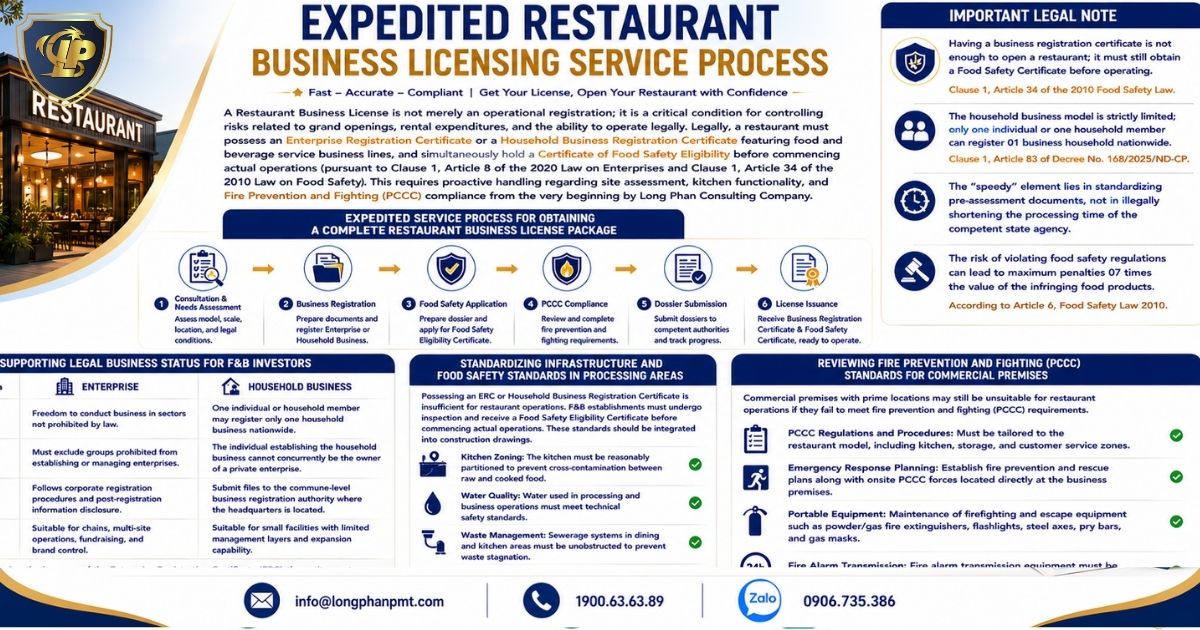
Key legal notes:
F&B establishments should only commence operations after concurrently controlling three pillars: business registration, food safety eligibility, and fire prevention and fighting (PCCC) compliance. Possessing a commercial lease or having completed renovations does not substitute for pre-operational legal requirements. For F&B investors, the greatest risk is not the initial registration procedure, but the potential for application rejection, failure to meet inspection standards, or operational suspension immediately following the grand opening.
Investors must select the appropriate legal model before signing leases, recruiting personnel, or initiating construction. Corporations are suitable for chain expansion, fundraising, or franchising strategies, while household businesses are appropriate for small-scale, single-point models with simplified management.
| Criteria | Enterprise | Household Business |
| Initial Legal Basis | Freedom to conduct business in sectors not prohibited by law. | One individual or household member may register only one household business nationwide. |
| Subject Limitations | Must exclude groups prohibited from establishing or managing enterprises. | The individual establishing the household business cannot concurrently be the owner of a private enterprise. |
| Processing Authority | Follows corporate registration procedures and post-registration information disclosure. | Submit files to the commune-level business registration authority where the headquarters is located. |
| Scalability | Suitable for chains, multi-site operations, fundraising, and brand control. | Suitable for small facilities with limited management layers and expansion capability. |
Following the issuance of the Enterprise Registration Certificate (ERC), the entity must publicly disclose its registration details on the National Portal. This disclosure must be completed within 30 days from the date of issuance.
Possessing an ERC or Household Business Registration Certificate is insufficient for restaurant operations. F&B establishments must undergo inspection and receive a Food Safety Eligibility Certificate before commencing actual operations. These standards should be integrated into construction drawings, as remediating issues after internal acceptance increases opening costs.
Establishments must strictly control the following conditions:
Commercial premises with prime locations may still be unsuitable for restaurant operations if they fail to meet fire prevention and fighting (PCCC) requirements. This risk is particularly significant for models featuring high-heat kitchens, heavy foot traffic, storage areas, basements, or restricted emergency exits. Business establishments must establish PCCC conditions appropriate to the specific risks of high-occupancy activities. This obligation includes establishing fire safety regulations, firefighting plans, onsite fire prevention forces, and operational equipment.
Key items to review before signing long-term leases include:
For premises where safety standards cannot be rectified through technical engineering solutions, the owner may be required to convert the facility’s functionality. This represents a significant commercial risk, as lease, design, and renovation costs may have already been incurred before the PCCC dossier is evaluated.
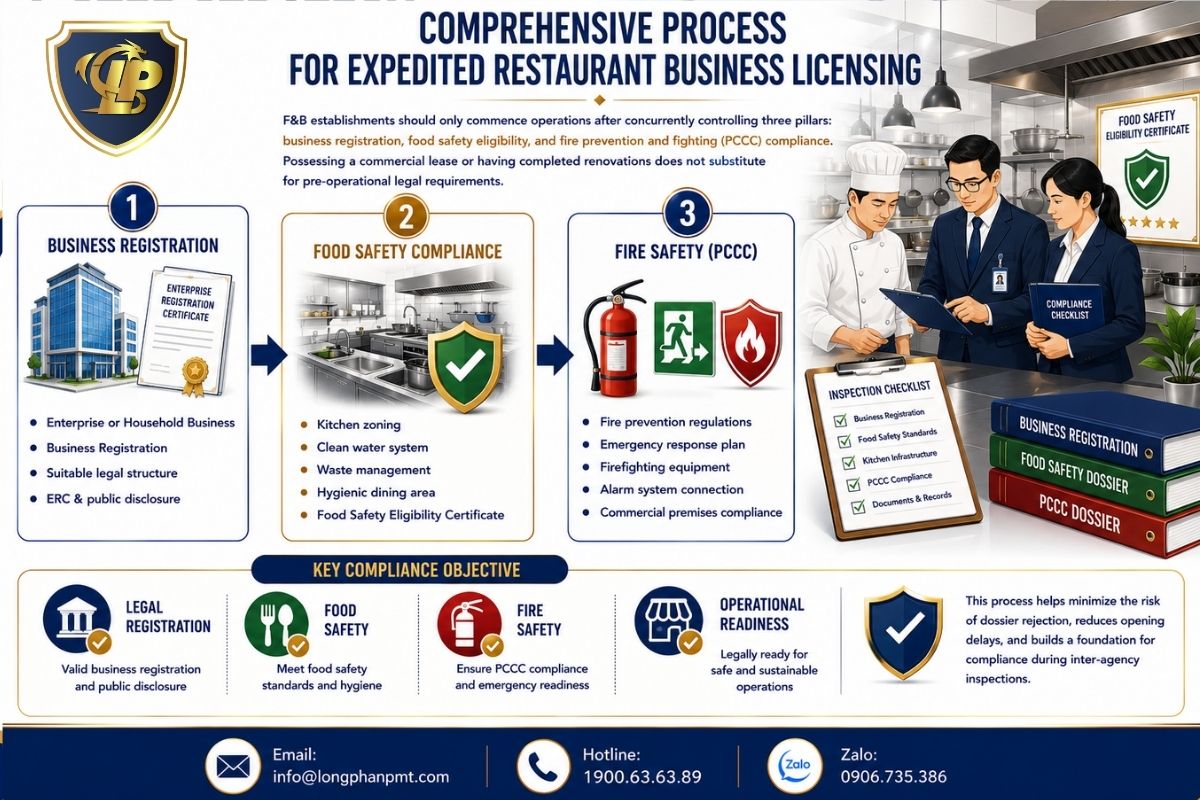
“Expedited” in the context of restaurant dossiers does not imply shortening the processing time of competent state agencies against the law. The true focus is shortening preparation time, reducing the risk of dossier rejection, and proactively resolving bottlenecks regarding premises, kitchens, food safety, and PCCC. For F&B investors, the dossier strategy must precede the opening plan. Each day of appraisal delay can incur accumulated costs in rent, personnel, raw materials, and scheduled media campaigns.
The site audit must be conducted before signing long-term leases or making significant deposits. Premises suitable for commercial use are not necessarily legally suitable if they lack preparation areas, storage, restrooms, emergency exits, or the capability for kitchen modification.
Preliminary procedures should be implemented in the following order:
The results of these reviews help investors decide whether to proceed with leasing, request improvements from the landlord, or select a different location. This step minimizes financial risk before substantial setup costs are incurred.
Expedited dossiers must be divided into specific groups to be processed in parallel. This methodology ensures enterprises do not have to wait for one procedure to be completed before beginning the next.
Standardized dossiers typically include:
Restaurants must possess a Food Safety Eligibility Certificate before actual operation. As this is a mandatory condition, the pre-appraisal dossier must be standardized prior to the expected opening date.
After submission, enterprises need to monitor both the documentation and the physical conditions at the business location simultaneously. Risks often arise when the dossier describes one layout, but the actual kitchen or operating flow is arranged differently.
The processing representation should include:
Representation does not change legal administrative timeframes. The practical value lies in reducing dossier errors, handling supplementary requests quickly, and ensuring the facility is ready when the appraisal team conducts inspections.
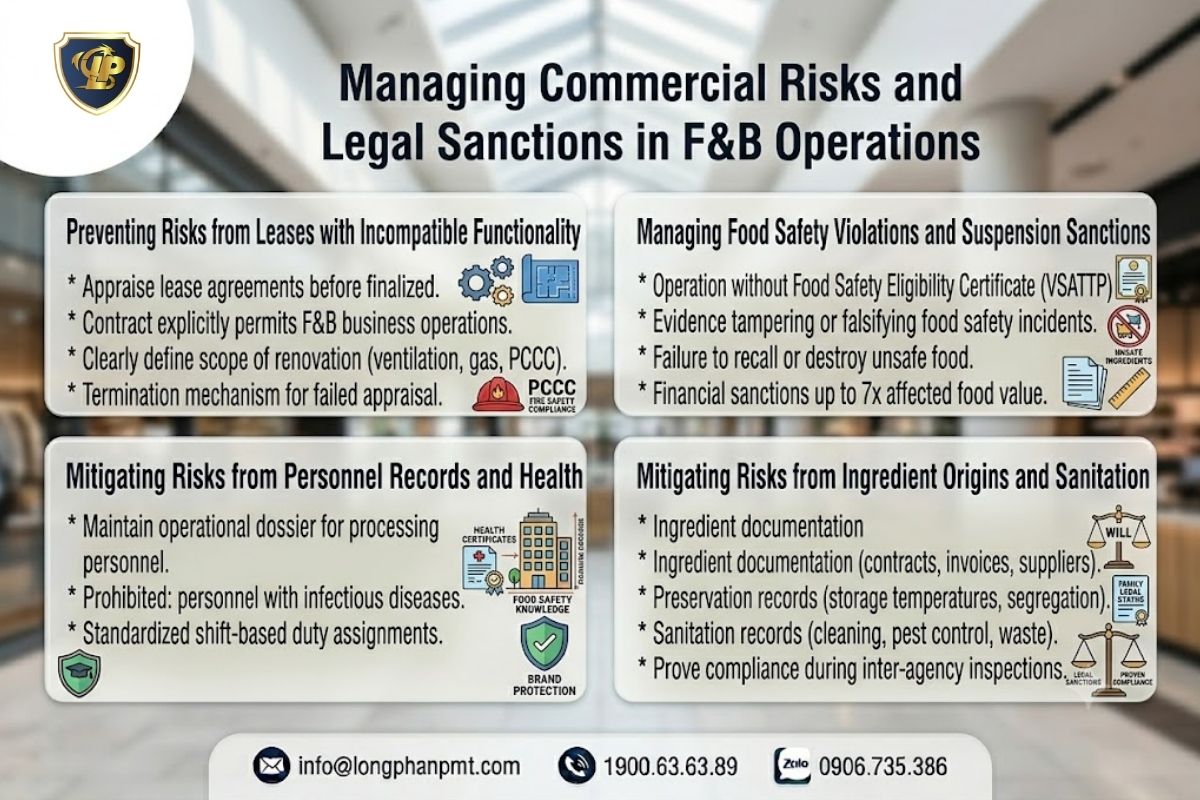
F&B operators often face legal risks after capital, personnel, and marketing budgets have been fully deployed. Compliance management must be integrated into the operational plan rather than handled as a reactive measure. For F&B chains, an error at a single location can compromise the entire brand. Requirements regarding conditional business sectors, food safety, and fire prevention (PCCC) must be maintained continuously throughout the operational lifecycle.
Lease agreements should be appraised before deposits or long-term commitments are finalized. A location with prime commercial value can still cause significant losses if the facility cannot be modified to accommodate kitchens, smoke extraction, emergency exits, or prep areas.
Critical contractual clauses to control include:
If the premises do not meet technical conditions, lease and renovation costs may become sunk losses. A more severe risk is the facility being forced to convert its functionality under Point d, Clause 6, Article 55 of the Law on Fire Prevention, Fighting, and Rescue 2024.
Restaurants operate as conditional businesses. Opening without meeting or maintaining sufficient conditions may be considered a prohibited act under Clause 6, Article 16 of the Law on Enterprises 2020.
Establishments must control the following critical violation groups:
Financial sanctions can be substantial if violations are linked to the value of the affected food. The maximum fine can reach up to 07 times the value of the non-compliant food under Article 6 of the 2010 Law on Food Safety.
Personnel records and ingredient provenance are frequently overlooked during the high-pressure opening phase. These are also the primary areas checked after a facility begins serving customers.
Enterprises should establish a minimum operational dossier including:
Standardizing this documentation not only serves certification procedures but also proves compliance during inter-agency inspections, customer complaints, or operational incidents.
Obtaining a restaurant business license requires coordinated action between business registration, food safety, PCCC, and premises documentation. Long Phan Consulting Company adopts a proactive approach by conducting pre-risk assessments, standardizing dossiers, and representing clients before competent authorities.
Locations must be inspected before deposits or long-term contracts are signed. For restaurants, incompatible kitchen functionality, lack of emergency exits, or failure to meet PCCC conditions can delay openings despite prime locations.
Long Phan Consulting Company supports the following tasks:
Proactive due diligence prevents investors from leasing unusable premises or those with non-convertible functionality, serving as a critical cost-control measure before construction begins.
Legal models should be designed based on actual business plans. Single-point restaurants, F&B chains, franchises, or those with external capital will have distinct management needs.
Long Phan Consulting Company assists with:
This certificate is a critical prerequisite for actual restaurant operation, requiring inspection by competent authorities per Clause 1, Article 34 of the 2010 Law on Food Safety.
Long Phan Consulting Company executes the following:
This approach minimizes the risk of dossier rejection, reduces opening delays, and builds a foundation for compliance during inter-agency inspections. Clients may submit site dossiers, subject documentation, and opening plans via Email: info@longphanpmt.com or Zalo: 0906.735.386 for preliminary evaluation.
Establishing a compliance control system and perfecting the “Restaurant Business License” requires managers to accurately address specific legal hurdles. A thorough understanding of transitional regulations and core financial penalties will help businesses optimize their investment capital. The following in-depth answers from a risk management perspective will protect the F&B operation chain from serious legal pitfalls.
No, individuals who own a private enterprise are absolutely not allowed to simultaneously hold the position of owner of a household business. Investors must choose a suitable legal form to meet the conditions for establishing an F&B establishment. This ownership restriction regulation is applied uniformly nationwide according to Clause 5, Article 84 of Decree No. 168/2025/ND-CP.
Businesses must publish information on the National Business Registration Portal within 30 days of its public disclosure. Delays in this process will result in serious administrative penalties. This deadline for publication is mandatory for all types of companies, as stipulated in Clause 3, Article 32 of the 2020 Enterprise Law.
Immediate installation is not mandatory, but businesses are required to complete the installation no later than July 1, 2027. The restaurant’s fire alarm communication equipment must be directly connected to the Fire Prevention and Fighting Database system. This safety technical requirement aims to ensure the continuous safe operation of the restaurant in accordance with Clause 4, Article 54 of the Law on Fire Prevention, Fighting and Rescue 2024.
The State imposes a maximum fine equal to seven times the value of the infringing food products on businesses that violate food safety regulations. This record-breaking financial penalty is applied in cases where the maximum fine under administrative law is less than seven times the value of the defective food products. This strict measure aims to deter illicit profiteering in the F&B industry, in accordance with Article 6 of the 2010 Food Safety Law.
The commune-level business registration agency where the restaurant is located will directly receive the application, check its validity, and issue the Business Registration Certificate. Small-scale investors need to submit their applications to the correct local administrative agency for prompt processing. This specific decentralization of authority simplifies the pre-approval procedures for F&B establishments in accordance with Clause 1, Article 22 and Clause 1, Article 99 of Decree No. 168/2025/ND-CP.
If the restaurant’s design was approved by the Public Security agency before the new law came into effect but has not yet been officially accepted, the old regulations will continue to apply. This transitional mechanism protects investment capital and avoids the risk of having to redesign already constructed infrastructure. This legitimate transitional right of food service businesses is guaranteed according to Clause 2, Article 55 of the Law on Fire Prevention, Fighting and Rescue 2024.
Securing a restaurant business license is a multifaceted legal process that encompasses enterprise registration, mandatory Food Safety Eligibility Certification, and strict adherence to fire prevention standards appropriate to your operational scale. For F&B investors, regulatory compliance is not merely an administrative hurdle but a critical risk management strategy to prevent delayed grand openings, avoidable rental overheads, and the threat of operational suspension during inter-agency inspections.
To ensure your establishment meets all statutory obligations, successfully synchronizes site infrastructure with legal requirements, and maintains full compliance throughout your operational lifecycle, reach out to the advisory team at Long Phan Consulting Company. Protect your investment authority and streamline your market entry by contacting our experts via our dedicated hotline at 1900636389.
📚 This article is provided with professional consultation based on the following legal framework:


