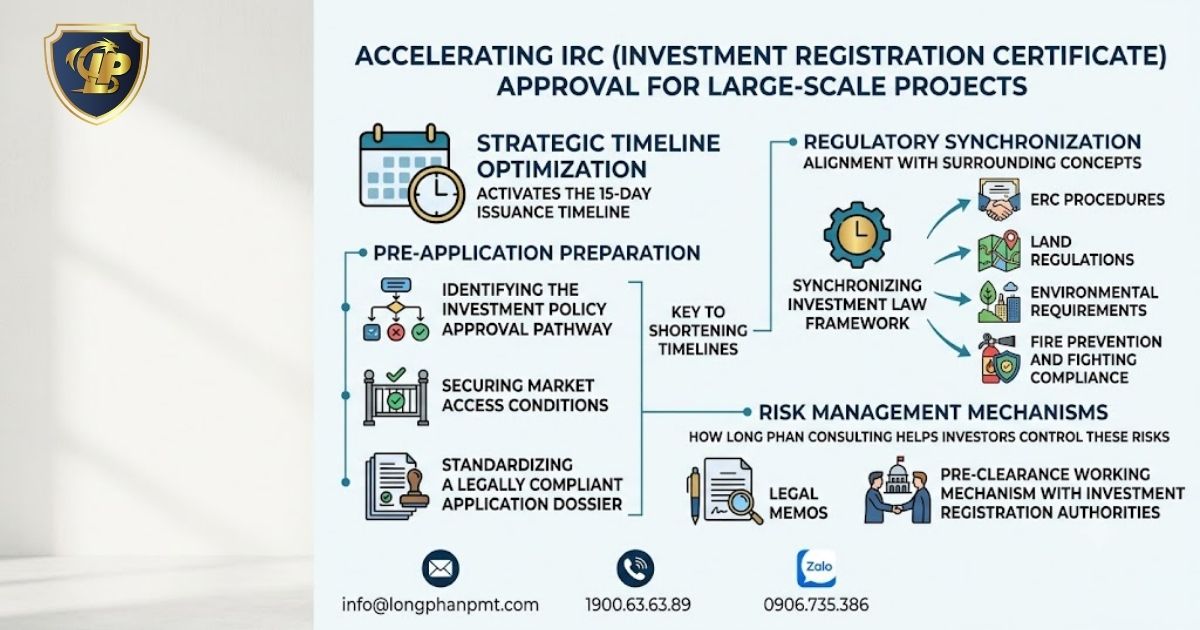

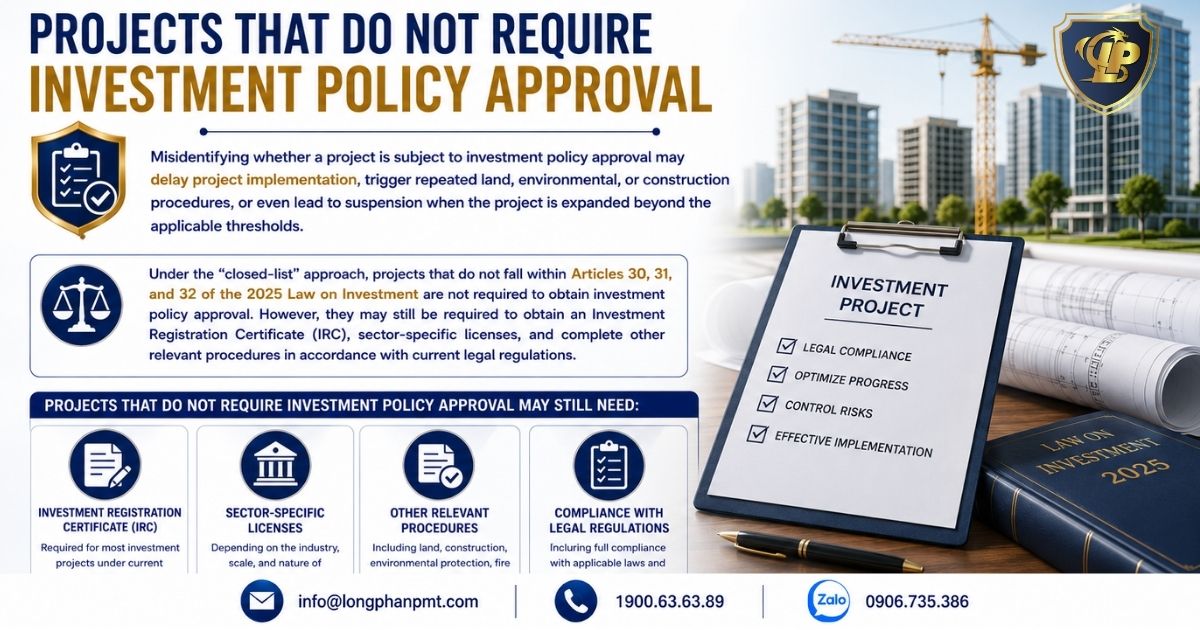
Incorrectly determining whether a project does not require investment policy approval may delay implementation, duplicate land, environmental, and construction procedures, or result in suspension when later expansion exceeds statutory thresholds. Under the closed-list mechanism of the Law on Investment, projects outside the categories specified in Articles 30, 31, and 32 are generally exempt from investment policy approval. Nevertheless, investors may still need an Investment Registration Certificate, specialized operating permits, and other project-specific approvals.
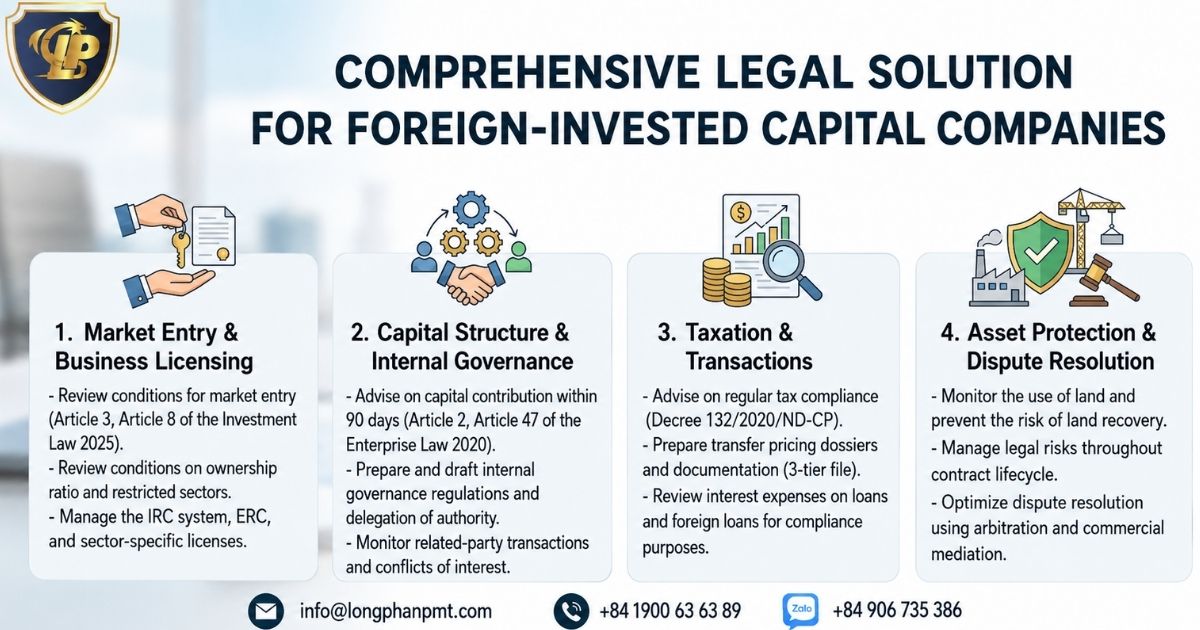
Long Phan Consulting assists investors in classifying projects accurately, shortening licensing schedules, controlling regulatory exposure, and maintaining efficient implementation from the initial planning stage.
Key legal notes:
Enterprises must determine their Investment Policy Approval (IPA) status by directly cross-referencing their specific project profile against the mandatory statutory list provided in the Law on Investment. If a project falls outside this prescribed list, the entity is exempt from the IPA procedure, though it must still undertake separate regulatory filings.
The guiding mechanism is a “closed-list” approach. The specific groups of projects requiring formal IPA are exhaustively defined in Articles 30, 31, and 32 of the 2025 Law on Investment. Consequently, standard manufacturing, commercial, logistics, or software projects may be exempt, provided they do not trigger the specific mandatory criteria.
However, IPA exemption does not grant an automatic waiver of all legal obligations. Enterprises may still be required to secure an Investment Registration Certificate (IRC), environmental licenses, construction permits, fire prevention and firefighting (FPF) design approvals, or industry-specific licenses before commencing operations.
Businesses should not default to the assumption that all investments require a Provincial People’s Committee decision. The accurate approach involves determining whether the project profile falls into the mandatory group requiring formal IPA.
Projects are typically exempt if they simultaneously satisfy the following fundamental conditions:
This framework serves as the primary filter for businesses to avoid filing in the wrong regulatory lane. If a project involves land, environmental risks, or special sectors, enterprises must conduct a deeper review before confirming exemption.
In practice, many projects do not require Investment Policy Approval (IPA) but must still fulfill specialized operational conditions. The determining factor is whether the project utilizes State-allocated land, requires land-use purpose conversion, or involves restricted business sectors.
| Project Type | Exemption Conditions | Practical Examples |
| Standard Manufacturing/Trade | No State-allocated land; no auction/bidding required. | Existing factory rentals, processing, e-commerce. |
| Industrial Zone (IZ) Projects | Aligned with master plans; no land conversion required. | Factories or logistics warehouses within IZs. |
| Existing Project Expansion | No target change; no threshold exceedance in land/capital. | Internal equipment upgrades, capacity scaling. |
| Self-Transferred Land Projects | Aligned with zoning; no State land recovery requested. | Valid acquisition of land-use rights. |
| Standard FDI Services | No restricted sectors; valid site; market access met. | Software development, consulting, import-export. |
For expansion projects, enterprises must strictly monitor adjustment thresholds. Changing land-use scale by more than 10% or over 30 hectares, or increasing total investment capital by 20% or more, alters the project’s essential nature and may trigger mandatory procedures for adjusting the Investment Policy Approval.
To determine if a project requires Investment Policy Approval, enterprises should execute a structured review sequence. This systematic approach allows legal, accounting, and investment departments to avoid overlooking land-use, sectoral, or foreign-investor-specific triggers.
If the review indicates the project lies outside the scope of Articles 30, 31, and 32 of the Law on Investment 2025, the enterprise may proceed to the appropriate procedural track. This generally involves IRC applications, land-use, environmental, construction, or industry-specific licensing.
The most frequent operational error is not the filing process itself, but the initial misclassification of the project’s essential nature. Many enterprises erroneously assume that small-scale projects or leased facilities are automatically exempt from Investment Policy Approval (IPA), overlooking how land-use factors, business sectors, or transaction structures can trigger mandatory obligations.
Risks typically manifest when businesses assess only capital scale while disregarding:
If misclassified, authorities may order an immediate cessation of activities to re-initiate investment procedures. This inevitably leads to stalled disbursements, construction delays, and disputes with contractors or financial partners.
Many businesses misunderstand that small-scale real estate projects under Clause 3, Article 9 of the 2023 Law on Real Estate Business are not automatically exempt from IPA under Article 52 of the 2025 Law on Investment. In reality, the determining factor extends beyond mere area or capital metrics.
The following criteria frequently trigger IPA obligations:
Pursuant to Clause 7, Article 255 of the Law on Land 2024, many project adjustments involving land require re-initiating investment procedures if the nature of land utilization or exploitation scale changes.
Enterprises scaling up operations must be particularly alert to:
These variables can shift a project from the “exempt” category into the mandatory adjustment track for Investment Policy Approval.
FDI enterprises frequently face risks when investing in sectors perceived as “standard services” that are actually subject to market-access conditions or national security controls.
High-scrutiny sectors include:
Under the 2025 Law on Investment, projects in areas impacting national defense or security are subject to heightened scrutiny, regardless of total capital scale. Actual risks often arise when businesses lease land near seaports, acquire infrastructure assets, manage user data, or operate logistics warehouses in sensitive regions. Failure to conduct proactive reviews may compel the enterprise to seek opinions from the Ministry of National Defense or the Ministry of Public Security before implementation.
Many M&A transactions do not create a new legal entity but remain subject to control equivalent to new investment activities. This group presents significant risk for investment funds and foreign firms acquiring Vietnamese companies with land-based assets.
Enterprises must audit:
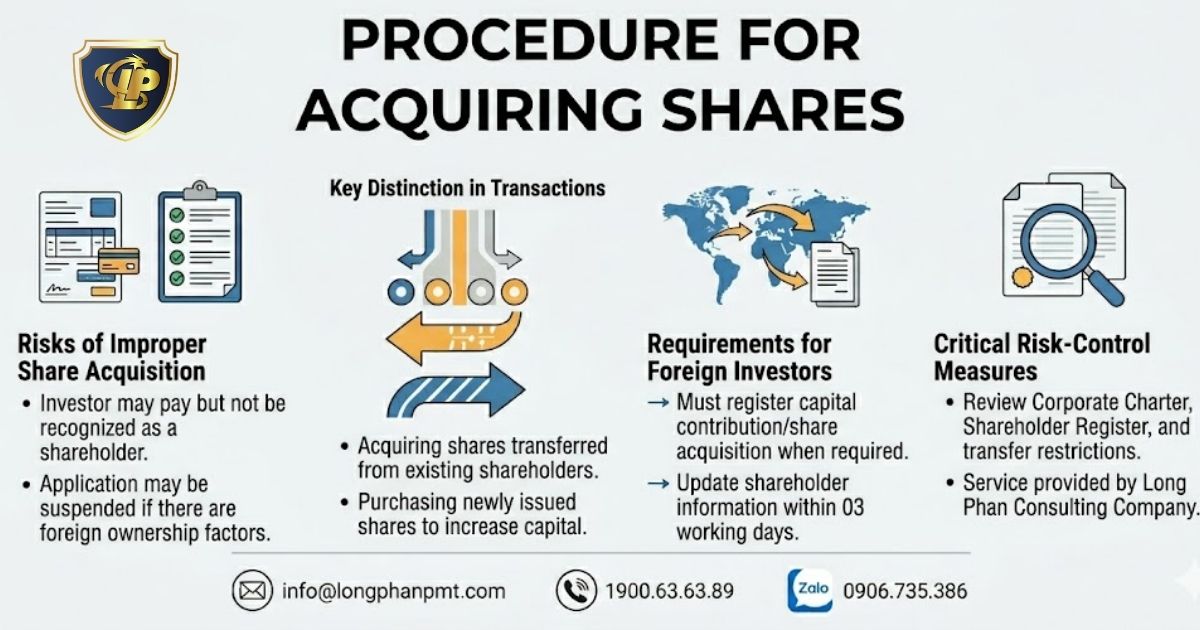
Under the Law on Investment 2025, capital contributions or share acquisitions by foreign investors must be registered if they increase foreign ownership ratios, involve land-use rights, or occur in national defense and security-impacted zones. The primary risk is treating M&A transactions solely as corporate or commercial matters without auditing investment obligations. Consequently, transactions may stall during shareholder updates or Investment Registration Certificate (IRC) adjustments.

Being exempt from Investment Policy Approval (IPA) does not grant an immediate “green light” for project implementation. In reality, many projects stagnate because they fail to finalize the Investment Registration Certificate (IRC), environmental filings, construction permits, or specialized industry licenses.
Enterprises must recognize that IPA is merely the first layer of compliance. Following an exemption, the project must still traverse a specialized licensing system corresponding to its scale, sector, and operational model. For FDI enterprises, IPA exemption does not waive the obligation to obtain an Investment Registration Certificate (IRC). Pursuant to Decree No. 96/2026/ND-CP, the processing time for a valid IRC application is 10 working days from the date the investment registration agency receives a complete dossier.
Foreign investors frequently confuse “IPA exemption” with “IRC exemption,” though these represent distinct mechanisms. FDI projects exempt from IPA must still secure an IRC before establishing a business entity, deploying capital, scaling investments, or engaging in foreign-invested commercial activities.
Common IRC dossier components include:
If the explanatory dossier lacks consistency across business sectors, capital scale, and project objectives, authorities will frequently mandate revisions, causing delays regardless of IPA exemption status.
Many enterprises focus exclusively on the IRC while neglecting real-world operational procedures. This oversight is a leading cause for projects failing to secure acceptance or launching behind schedule.
Mandatory obligations typically include:
Failure to finalize these environmental or FPF procedures prior to construction or operation can lead to immediate operational suspension or mandatory restorative actions.
Even when IPA-exempt, projects remain subject to rigorous post-investment control if they operate in conditional business sectors. Relevant sectors often include logistics, education, healthcare, e-commerce, real estate, energy, food production, and transportation.
Enterprises must concurrently audit:
Some projects, despite holding valid IRCs and ERCs, are barred from active operation until specialized industry licenses are secured. Consequently, businesses should build a “compliance roadmap” at the project outset rather than addressing permits piecemeal. This strategy prevents commercial exploitation delays and minimizes the risk of post-audit penalties.
Enterprises should not attempt to subdivide projects, split legal entities, or phase investments solely to force capital or land metrics below the Investment Policy Approval (IPA) threshold. Management agencies reserve the right to assess the project’s total essential nature rather than reviewing fragmented dossiers in isolation.
Actions indicating non-compliant project splitting often include:
If identified as an evasion tactic, businesses may be ordered to re-initiate the entire investment procedure. More severe consequences include the suspension, partial cessation, or total termination of project activities for persistent non-compliance.
State investment management agencies may order the suspension of project activities if an investor fails to adhere to the contents of their approved Investment Policy or Investment Registration Certificate (IRC). This risk escalates significantly if the enterprise continues violations after receiving administrative penalties.
Common operational consequences include:
For projects involving leverage, EPC contracts, or customer delivery commitments, halting a segment of the project creates a domino effect. Enterprises face not only administrative risks but also significant breaches of commercial obligations.
The highest-tier risk is the total termination of the investment project. The investment registration agency may terminate operations if an investor executes investment activities based on fraudulent civil transactions under civil law provisions.
Models frequently targeted for scrutiny include:
Once a project is terminated, the enterprise forfeits its developmental progress. Furthermore, restoring the necessary land, environmental, construction, and investment records entails costs far exceeding those of conducting an accurate compliance review from the outset.
Enterprises should design project structures based on actual commercial and technical reality. Project subdivision should only occur when there is a factual basis for independent operation, not to circumvent legal thresholds.
Before implementation, businesses should audit:
If these elements exhibit high interdependence, enterprises should evaluate the entire project chain as a unified structure. This approach minimizes the risk of being classified as an irregular project-splitting violation.
Many enterprises currently operating under previous frameworks fear that changes in investment law will necessitate a total re-initiation of procedures. However, not all projects are subject to retroactive enforcement or mandatory immediate adjustments.
Pursuant to Article 77 of the 2025 Law on Investment, investors may continue executing projects legally approved or licensed prior to the new law’s effective date. Nevertheless, when adjusting a project, increasing capital, or expanding scale, enterprises may be pulled into the new regulatory review mechanism.
The focus for enterprises is not merely “old versus new project status,” but rather the scope of the adjustment, capital increase margins, land-use changes, investment objectives, business sectors, and investor structure.
Enterprises currently operating legal projects possess the right to continue implementation according to the content already approved or licensed by competent authorities.
Transitional rights typically include:
This mechanism stabilizes the investment environment and prevents operational disruption for businesses that have already committed capital or established production systems. However, transitional rights do not imply an “exemption from obligation.” If an enterprise adjusts a project beyond statutory thresholds, authorities may still mandate compliance with the new investment regime.
Many enterprises treat project adjustments as simple administrative formalities. In reality, specific changes may trigger a mandatory re-application for Investment Policy Approval or the submission of an amended IPA dossier.
High-risk adjustments include:
Particularly, if changes to land-use area, investment capital, or project objectives cross established thresholds, enterprises must audit the entire investment mechanism. Pursuant to Clause 7, Article 255 of the 2024 Land Law, many modifications involving land and land-use purposes may necessitate corresponding adjustments to the investment project and land-use procedures.
Applying the existing mechanism is not always more advantageous for the enterprise. In certain cases, new regulations may offer:
Enterprises should evaluate project timelines, capital structures, M&A strategies, expansion needs, IPO readiness, and project transferability. For FDI enterprises, this strategy is critical when modifying foreign ownership ratios, expanding business lines, restructuring parent companies, or transferring shares to investment funds. Selecting the incorrect legal mechanism can result in the loss of investment incentives or the requirement to repeat completed procedures. Consequently, enterprises should perform Legal Due Diligence prior to every significant adjustment.
Determining whether a project requires Investment Policy Approval is no longer a isolated procedural task. Enterprises must concurrently control land-use rights, environmental compliance, construction, market-access conditions, and transaction structures to mitigate the risk of being forced back into the investment review process during post-inspection audits.
Long Phan Consulting Company supports enterprises with a “compliance-first” approach, standardizing dossiers and identifying legal thresholds early to prevent re-triggered procedures.
Enterprises are invited to submit project files, transaction structures, or investment documents via Email at info@longphanpmt.com or Zalo at +84 906 735 386 for a preliminary assessment by Long Phan Consulting Company prior to implementation.
Correctly identifying the “investment approval” category directly impacts the disbursement schedule, project expansion, and commercial viability of businesses. Many risks arise not at the application stage but at the capital adjustment, land use, or M&A phases involving foreign elements. The questions below focus on the legal “bottlenecks” that CEOs, investors, and legal departments often encounter when implementing investment projects.
Not all projects in industrial parks require investment policy approval. Production projects that conform to planning, do not require the State to allocate or lease land without auction or bidding, and do not involve land use conversion are usually exempt from this procedure under the “closed listing” mechanism in Articles 30, 31, and 32 of the Law on Investment 2025. The management board of industrial parks, export processing zones, and high-tech zones may carry out specialized investment procedures for projects within its management scope that conform to the approved planning.
Normally, it’s not required if the business only legally leases the factory and doesn’t request a change in land use. However, if the business is a foreign investor, it must still apply for an Investment Registration Certificate (IRC). The processing time for an IRC is 10 working days from the date of receipt of a complete and valid application for projects not subject to investment policy approval under Decree No. 96/2026/ND-CP. The project must still meet environmental, fire safety, and market access requirements.
Businesses are required to review procedures when expansion changes the project scale beyond the legally prescribed limits. Risk thresholds include changes in land use area exceeding 10% or 30 hectares, or an increase in total investment capital of 20% or more, thereby altering the project scale. This is defined in the group of conditions for adjusting investment projects in the Investment Law 2025 and Decree No. 96/2026/ND-CP. If the threshold is exceeded but the procedures are not followed, the project may be stalled or subject to post-audit procedures.
Yes. Transactions involving capital contributions, share purchases, or equity investments by foreign investors related to land use rights in islands, border communes/wards, coastal areas, or areas affecting national defense and security are required to be registered with the competent authority according to the Law on Investment 2025. Businesses need to review the Legal Due Diligence regarding land, asset location, and actual control after the transaction to avoid being required to halt M&A procedures or adjust the project.
Yes, if the project generates wastewater, dust, exhaust fumes, or hazardous waste. Group I, Group II, and Group III projects are required to obtain an environmental permit before official operation according to the 2020 Environmental Protection Law, regardless of whether the project has received investment approval or not. If a business commences operation without completing environmental procedures or fire safety approval, the project may be suspended or required to remedy the consequences.
The risks are very high. Improperly splitting an investment project can be considered a fraudulent transaction aimed at circumventing investment procedures. The state investment management agency has the right to suspend or partially halt the project’s operations if the investor continues to violate regulations after administrative penalties have been imposed. In serious cases, the investment registration authority may decide to terminate the investment project if it is discovered that the project was implemented based on a fraudulent civil transaction as stipulated by civil law.
It is not mandatory in most cases. An exception to the issuance of an Investment Registration Certificate applies to investment projects by domestic investors under the mechanism of the 2020 Investment Law. However, businesses must still complete all procedures related to land, environment, construction, and industry licenses if the project falls under the category of conditional investment or requires specialized management.
Accurately identifying whether a project requires Investment Policy Approval in Vietnam demands strict adherence to the “closed-list” mechanism, while concurrently managing IRC, land-use, environmental, and industry-specific filings. Projects that appear exempt remain vulnerable to compliance failures if expansion thresholds are breached, project splitting is suspected, or national security sensitivities are overlooked. Navigating these regulatory nuances is essential to avoid forced project suspension, costly re-initiations, or severe administrative penalties.
To minimize operational risk and secure a robust compliance roadmap for your investment, contact the senior legal team at Long Phan Consulting Company via our support hotline at 1900636389 for immediate professional consultation and strategic project oversight.
📚 This article is provided with professional consultation based on the following legal framework: