


Enterprises using labor outsourcing services must manage compliance carefully to avoid fines, backdated social insurance liabilities, and direct workplace disputes. This arrangement is valid only when the service provider has a lawful license, the outsourced positions are within permitted job categories, each assignment does not exceed 12 months, and the client properly monitors occupational safety, working time, and employee data obligations under labor regulations and the Law on Enterprises and Businesses. Long Phan Consulting assists companies in reviewing contracts, service providers, and internal compliance controls.

Important legal note:
Enterprises must accurately identify the legal nature of their model before signing personnel contracts. Misclassifying the structure can cause a standard service contract to be legally reassessed as an illegal labor subleasing operation.
Labor subleasing constitutes a tripartite model involving the labor subleasing enterprise, the subleasing party, and the employee. The critical identification point is that the employee signs a contract with the labor subleasing enterprise but works under the direct management and control of the subleasing party.
Administratively, the subleasing party holds the authority to assign daily tasks at the factory, store, warehouse, or construction site. However, the employment relationship remains exclusively with the labor subleasing enterprise. It does not convert into a direct labor contract with the subleasing party. This structure is established under Clause 1, Article 52 of the 2019 Labor Code.
Severe risks arise when the operations department confuses daily management authority with the power to terminate. The subleasing party may supervise, assign shifts, and evaluate violations. They must never arbitrarily issue disciplinary decisions or terminate the employment relationship.
The fundamental legal distinction lies in personnel management authority. If an enterprise directly manages the partner’s employees during daily operations, the model exhibits clear signs of labor subleasing.
| Criteria | Labor Subleasing | Outsourcing / Service Contract |
| Personnel Management Authority | The subleasing party directly manages the employee. | The service provider self-manages personnel to deliver the service output. |
| Work Output | Personnel are integrated into the subleasing party’s operational system. | The provider bears full responsibility for the final service deliverables. |
| Legal Requirements | Must possess a Labor Subleasing License. | Executed under standard commercial service contracts. |
| Scope of Work | Strictly confined to statutory permitted job categories. | Based on the service scope mutually agreed upon by the parties. |
Labor subleasing is a conditional business line. It mandates formal licensing and is strictly confined to specific jobs, pursuant to Clause 2, Article 52 of the 2019 Labor Code. Consequently, the contract title does not dictate the legal nature if actual operations involve the transfer of direct management authority.
Enterprises should begin with core governance questions. Who directs the personnel daily? Who is responsible for the final output? Who handles labor discipline? These three criteria distinctly separate a lawful service contract from a labor subleasing service.
Mandatory signs to review prior to signing include:
If the model is misclassified, enterprises face severe disputes regarding wages, social insurance arrears, occupational accidents, and administrative fines consistently advises executing a rigorous operational audit before choosing between service contracts, outsourcing, or a labor subleasing structure.
The subleasing party must rigorously audit legal conditions before integrating subleased personnel into their operations. The focal point is not merely the service price. Enterprises must verify the vendor’s license, permitted job categories, maximum subleasing terms, and statutory prohibited boundaries under labor laws.
Enterprises must exclusively partner with a lawful labor subleasing enterprise. The core prerequisite is possessing a valid Labor Subleasing License and maintaining the statutory escrow deposit.
The vendor must secure this license and complete a 2,000,000,000 VND escrow deposit, pursuant to Clause 1, Article 54 of the 2019 Labor Code and Clause 2, Article 21 of Decree No. 145/2020/ND-CP. This serves as the foundational condition to validate the vendor’s legality.
Licenses do not hold indefinite validity. The maximum term of a Labor Subleasing License is 60 months, with each extension strictly capped at 60 months, pursuant to Clause 3, Article 23 of Decree No. 145/2020/ND-CP.
Regarding jurisdiction, the Chairman of the Provincial People’s Committee holds the authority to issue, extend, and revoke this license, pursuant to Article 22 of Decree No. 145/2020/ND-CP. Therefore, buyers must verify the license copy against the issuing authority, validity period, and authorized scope before signing contracts.
The subleasing party cannot utilize subleased personnel for all corporate positions. The law strictly confines this model to a narrow scope to fulfill temporary or highly technical demands.
Enterprises may only utilize subleased labor within 20 specific job categories, pursuant to Appendix II of Decree No. 145/2020/ND-CP. Common operational roles include:
This statutory list must be cross-referenced against the actual job description, not merely the contract title. If personnel perform unlisted tasks, the enterprise will be penalized for illegal labor subleasing.
The subleasing term for each employee is strictly capped at a maximum of 12 months, pursuant to Clause 1, Article 53 of the 2019 Labor Code. Upon reaching this threshold, enterprises must either sign a direct labor contract, transition to lawful outsourcing, or terminate the usage properly.
The primary risk is not hiring short-term staff, but abusing this model to evade long-term labor governance obligations. Enterprises must verify the usage purpose during the initial HR approval phase.
The subleasing party may only use this service to address sudden personnel surges, replace employees on maternity leave or treating occupational accidents, or secure highly skilled labor, pursuant to Clause 2, Article 53 of the 2019 Labor Code.
The internal approval checklist must strictly block the following prohibited use cases:
These strict boundaries are established under Clauses 3 and 4, Article 53 of the 2019 Labor Code. If enterprises exploit this service to bypass formal workforce reduction procedures, they face severe administrative fines and joint labor disputes.

When subleased personnel operate within factories, warehouses, or retail stores, the subleasing party directly controls the operational environment. Consequently, compliance responsibilities extend far beyond the commercial contract with the vendor.
The subleasing party must notify, instruct on internal labor regulations, and guarantee equal working conditions for subleased personnel. This obligation arises because the employee operates under direct management at the subleasing party’s facility.
If overtime or night shifts are required, the subleasing party must negotiate directly with the subleased employee, pursuant to Clause 3, Article 57 of the 2019 Labor Code. Operations departments frequently overlook this critical step by solely communicating with the HR vendor.
Regarding safety, employers must implement comprehensive measures to ensure occupational safety and health (OSH) at the workplace for all active personnel, pursuant to Clause 1, Article 134 of the 2019 Labor Code. Enterprises must establish coordination protocols for shift work, safety training, and incident response to mitigate joint liability for occupational accident compensation.
The subleasing party holds daily management authority but lacks the right to issue direct disciplinary decisions. Disciplinary authority remains exclusively with the labor subleasing enterprise, as they maintain the formal employment relationship.
When workplace violations occur, the disciplinary protocol should strictly follow these steps:
This approach complies with Clauses 5 and 6, Article 57 of the 2019 Labor Code, which grants the subleasing party the right to return employees and provide violation evidence. Arbitrary dismissal immediately shifts dispute liabilities onto the subleasing party.
Subleased personnel often access client data, operational protocols, product codes, ERP systems, or internal manufacturing data. This presents a critical commercial risk independent of labor compliance.
The subleasing party must execute transparent personal data transfer agreements defining processing purposes, access scopes, and protection liabilities, pursuant to Clause 1, Article 17 of Decree No. 356/2025/ND-CP. Simultaneously, the receiving enterprise must formulate and archive a personal data processing impact assessment dossier, pursuant to Clause 1, Article 19 of Decree No. 356/2025/ND-CP.
For personnel accessing internal systems, enterprises must implement NDAs, strict account authorization, access logs, and revocation protocols upon term completion. In the event of a personal data breach, the statutory notification deadline is 72 hours from violation detection, pursuant to Clause 1, Article 29 of Decree No. 356/2025/ND-CP.
Labor subleasing risks typically originate from three critical failures: utilizing personnel for unlisted job categories, exceeding statutory time limits, and selecting unlicensed vendors. For manufacturing, logistics, F&B, or industrial zone operators, these violations instantly trigger severe administrative fines, the collection of social insurance arrears, and catastrophic operational disruptions.
The subleasing party can face severe penalties even without executing direct labor contracts with the personnel. The labor inspectorate strictly scrutinizes the usage purpose, subleasing term, and the vendor’s operating license.
| Risk Behavior | Principal Sanction | Legal Basis |
| Using subleased labor for unlisted job categories | 80,000,000 to 100,000,000 VND for organizations | Clause 1, Article 6 and Clause 2, Article 13 of Decree No. 12/2022/ND-CP |
| Subleasing labor from an unlicensed partner | 80,000,000 to 100,000,000 VND for organizations | Clause 1, Article 6 and Clause 2, Article 13 of Decree No. 12/2022/ND-CP |
| Using a single subleased employee exceeding 12 months | 80,000,000 to 100,000,000 VND for organizations | Clause 1, Article 6 and Clause 2, Article 13 of Decree No. 12/2022/ND-CP |
| Labor subleasing enterprise supplying personnel outside permitted categories or exceeding term limits | 160,000,000 to 200,000,000 VND for organizations | Clause 1, Article 6 and Clause 6, Article 13 of Decree No. 12/2022/ND-CP |
| Severe violations regarding labor subleasing operations | Revocation of the license from 06 to 12 months | Point a, Clause 8, Article 13 of Decree No. 12/2022/ND-CP |
These massive fines demonstrate that the subleasing party cannot rely on the vendor’s commercial warranties. Corporate legal departments must independently audit licenses, job categories, and individual personnel terms before authorizing operational demands.
Principally, the labor subleasing enterprise directly deducts and remits Social Insurance (SI) contributions for the subleased employee. This statutory obligation is established under Clause 4, Article 13 of the 2024 Social Insurance Law.
However, if the vendor evades or delays SI contributions, the subleasing party’s HR supply chain suffers immediate disruption. Late payments accumulate an interest penalty of 0.03% per day on the overdue amount, pursuant to Clause 1, Article 41 of the 2024 Social Insurance Law.
Enterprises must rigorously audit outstanding balances up to June 30, 2025. Pursuant to Clause 12, Article 141 of the 2024 Social Insurance Law, unpaid or insufficiently paid amounts will be penalized under the new statutory sanction mechanisms.
Regarding occupational accidents, the subleasing party must secure the scene, provide first aid, and coordinate incident declarations. Failing to execute first aid, declaration, or investigation protocols subjects the violating individual to fines of 20,000,000 to 25,000,000 VND, pursuant to Point c, Clause 1, Article 13 of Decree No. 12/2022/ND-CP.
When subjected to an inspection, enterprises must formulate defenses based on actual operational substance, rather than merely submitting service contracts. The dossier must explicitly prove that jobs are legally permitted, individual terms respect statutory ceilings, and vendors possess valid licenses.
The explanatory dossier must be structured in the following sequence:
If violations occurred during a transitional regulatory period, enterprises can invoke the favorable principle in administrative sanctions. Article 63 of Decree No. 12/2022/ND-CP permits the application of new regulations if they exempt liability or impose lighter penalties for behaviors under review before a sanction decision is issued.
A labor subleasing contract must function as a rigorous risk allocation instrument, not merely a personnel supply agreement. For the subleasing party, the contract dossier must be sufficiently robust to serve as primary explanatory evidence during labor disputes, specialized inspections, or occupational accidents.
Corporate legal departments must audit the contract from both commercial and labor compliance perspectives. Vague clauses severely handicap the enterprise’s ability to prove liability limitations when incidents occur at the workplace.
The appraisal checklist should comprise:
Clauses regarding wages, working conditions, and occupational accident compensation liabilities must be explicitly stated in the contract, pursuant to Clause 2, Article 55 of the 2019 Labor Code. Lacking these mechanisms guarantees joint dispute liabilities for the subleasing party.
When a subleased employee files a lawsuit, the subleasing party must not presume all liabilities default to the vendor. The Court will scrutinize actual daily management, working conditions, overtime execution, safety protocols, and workplace evidence.
Disputes between a subleased employee and the subleasing employer are exempt from mandatory conciliation procedures via a labor conciliator, pursuant to Point e, Clause 1, Article 188 of the 2019 Labor Code. The parties possess the right to directly petition the People’s Court for resolution, pursuant to Point e, Clause 1, Article 32 of the 2015 Civil Procedure Code.
Upon the emergence of a dispute, enterprises should immediately deploy the following steps:
This rapid response allows enterprises to strictly control evidence before the dispute escalates into massive compensation claims, arrears collections, or the forced establishment of a direct employment relationship.
As subleased personnel approach the 12-month threshold, enterprises must decide on the subsequent model before expiration. Continuing under the identical structure is categorized as a severe violation of statutory subleasing term limits.
Common transition strategies encompass:
Selecting the optimal model relies entirely on actual management authority, production demands, and Social Insurance risk levels Long Phan strongly recommends auditing the entire subleased personnel network by specific positions, rather than merely reviewing boilerplate contracts.
Labor outsourcing services require businesses to simultaneously control permits, contracts, terms of service, social insurance, occupational safety, and internal data. Long Phan Consulting Company assists businesses in establishing compliance structures that reduce operational risks, protect commercial interests, and prepare explanatory documentation when necessary.
The review process should begin with operational practices, not just standard contracts. The focus should be on determining whether the business is correctly using labor leasing, outsourcing, or service contracts.
Long Phan Consulting Company assists businesses in implementing:
The audit results help the Legal Department and HR Director identify errors before an inspection takes place. This also provides a basis for restructuring contracts with vendors or changing the personnel management model.
When inspections or disputes arise, businesses need to respond with consistent documentation, evidence, and legal arguments. Unstructured explanations can increase the risk of retroactive tax collection, administrative penalties, or the establishment of joint liability.
Long Phan Consulting Company provides support for the following specific tasks:
This approach helps businesses control evidence risk from the outset. In particular, operational records at the plant often determine the scope of liability for the lessee.
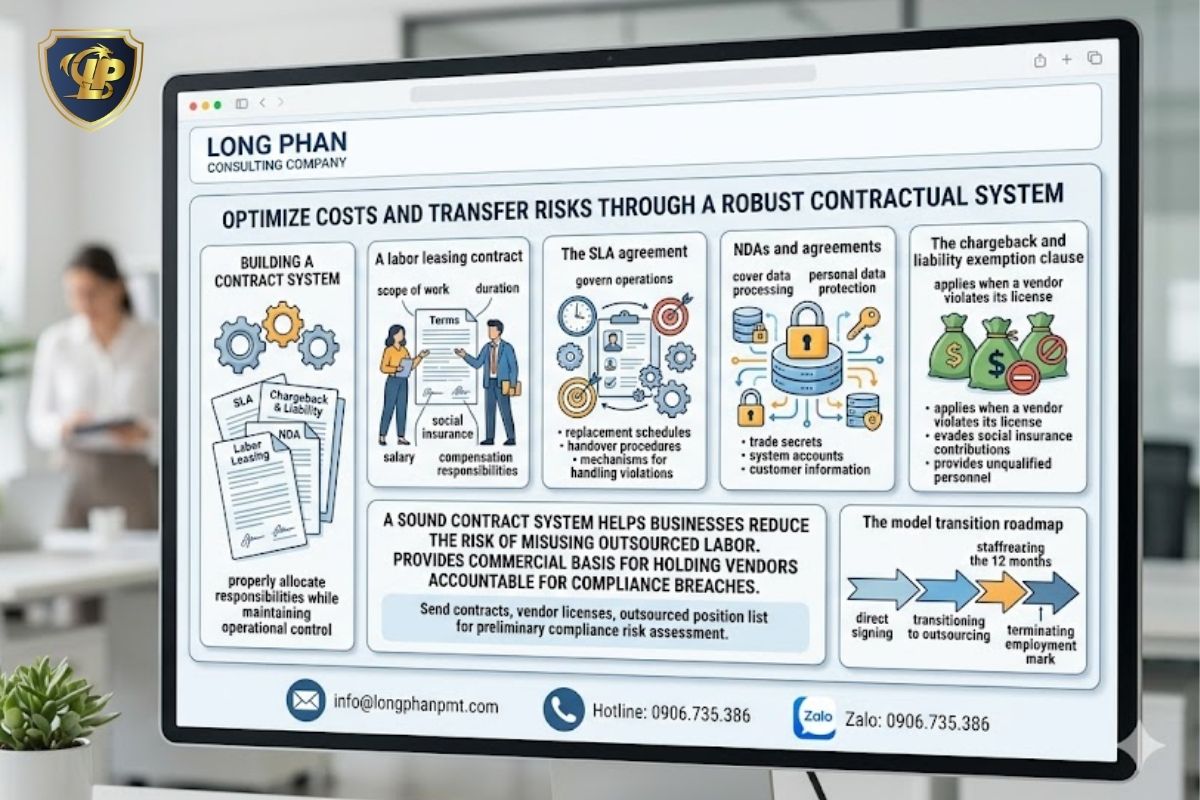
Optimizing personnel costs doesn’t mean shifting all risk to the vendor. Businesses need to design contracts that properly allocate responsibilities while maintaining operational control.
Long Phan Consulting Company provides consulting services for building a contract system, including:
A sound contract system helps businesses reduce the risk of being perceived as misusing outsourced labor. At the same time, it provides a commercial basis for holding vendors accountable for breaches of compliance.
Your company can send contracts, vendor licenses, and a list of outsourced positions via email: info@longphanpmt.com Or contact via Zalo: 0906.735.386 for a preliminary compliance risk assessment.
Controlling legal risks when using “labor outsourcing services” determines the continuity of the human resource supply chain and the operational safety of the business. Fluctuations in deposit conditions, time limits, and liability in case of accidents require managers to have strict compliance solutions. Understanding legal loopholes helps businesses proactively prevent administrative sanctions and optimize their labor utilization model.
Businesses are only permitted to employ one subcontracted worker for a period not exceeding 12 months. Upon expiration of this period, the subcontracting employer must convert the subcontracted worker to a direct employment contract to protect the worker’s rights. This time limit is stipulated in Clause 1, Article 53 of the 2019 Labor Code.
Businesses engaged in labor leasing are required to maintain a deposit of VND 2,000,000,000 at a bank as a condition for obtaining and maintaining their labor leasing license. This requirement demonstrates financial capacity and safeguards workers’ rights, pursuant to Clause 2, Article 21 of Decree No. 145/2020/ND-CP.
Businesses that employ outsourced workers for jobs outside the legally permitted categories may be fined from VND 80,000,000 to VND 100,000,000. Employers should carefully compare assigned positions with the approved list of labor leasing occupations to avoid compliance violations, in accordance with Clause 1, Article 6 and Clause 2, Article 13 of Decree No. 12/2022/ND-CP.
A labor leasing company that delays social insurance contributions must pay late-payment interest at a rate of 0.03% per day on the overdue amount. Businesses utilizing leased workers should periodically verify their labor supplier’s insurance compliance records. This obligation is prescribed in Clause 1, Article 40 and Clause 1, Article 41 of the 2024 Social Insurance Law.
A labor leasing license is valid for a maximum period of 60 months. Enterprises relying on leased labor should monitor the license validity of their labor suppliers to avoid workforce disruptions caused by license expiration. The licensing period is governed by Clause 3, Article 23 of Decree No. 145/2020/ND-CP.
A business processing personal data must notify the competent authority in writing within 72 hours from the time the data breach is discovered. Immediate containment measures should also be implemented to isolate compromised information and reduce further risks. This requirement is provided under Clause 1, Article 29 of Decree No. 356/2025/ND-CP.
A labor subleasing arrangement in Vietnam is only secure when the hiring enterprise directly controls vendor licensing validity, statutory job categories, maximum usage terms, social insurance obligations, occupational safety, and internal data security. Within this tripartite model, compliance failures do not rest solely with the HR vendor; they rapidly escalate into catastrophic joint liabilities for the subleasing party if operational records and B2B contracts lack rigorous structural integrity. Enterprises must preemptively audit every outsourced position, individual term limits, and compensation liability clauses before facing specialized labor inspections or joint disputes. To execute a comprehensive HR compliance audit and legally structure your subleasing operations, contact the senior corporate attorneys at Long Phan Consulting Company immediately via Hotline 1900636389.
📚 This article is provided with professional consultation based on the following legal framework:


