Issuing Land Use Right Certificates for Projects may delay capital deployment, property handover, and revenue recognition when land records, financial obligations, approved planning, cadastral documents, and construction acceptance files are not aligned. Under the Law On Land, certification should proceed only after clearly identifying the eligible land area, any portion subject to mandatory transfer to the State, and the competent authority under the applicable decentralization mechanism.
Long Phan Consulting assists enterprises in diagnosing procedural bottlenecks, standardizing supporting dossiers, and preparing petitions or substantiated complaints to accelerate certificate issuance and reduce transaction risks.
Key legal notes:
The process of securing a Land Use Right Certificate (LURC) for a real estate project should not commence with the mere filing of administrative paperwork. Enterprises must first conduct a preliminary audit regarding land legality, financial obligations, planning compliance, cadastral mapping, and technical acceptance.
For developers, project lenders, or entities acquiring projects, errors at this stage can result in the dossier being suspended for months. The primary risk is holding project documentation that appears formally complete but fails to satisfy the substantive requirements for the formal recognition of land use rights and assets attached to land.
The request for a Certificate of Land Use Rights and Ownership of Assets Attached to Land should only be directed toward areas that satisfy all legal eligibility criteria. Developers should not petition for a certificate covering the entire project boundary if it includes public land, technical infrastructure, or facilities serving public interests.
In urban or rural residential projects, areas designated for public facilities must be handed over to local management. Developers are not entitled to receive a certificate for these areas, pursuant to Point b, Clause 1, Article 143 of the Law on Land 2024.
| Land Area Category | LURC Eligibility | Risk Mitigation Action |
| Commercial, residential, or production land allocated/leased for intended use | May be eligible if all conditions are met | Reconcile land allocation decisions, planning, and current usage |
| Internal roads, parks, and technical infrastructure for community use | Not eligible for developer if subject to mandatory handover | Exclude from the area petitioning for LURC issuance |
| Interspersed public land, water channels, or State-managed land | Not eligible for inclusion in the master certificate | Map adjustments, handover, or boundary resolution |
| Actual surveyed area deviating from legacy records | May be resolved if boundaries remain stable and undisputed | Prepare cadastral extract, reconcile records, and verify current status |
A critical control point is that cadastral maps, cadastral extracts, and detailed planning records must clearly delineate which areas are eligible for issuance versus those that must be handed over. Failure to isolate these areas initially often leads to repeated requests for supplementation or outright dossier rejection.
Financial obligations represent the most common bottleneck in LURC issuance for projects. Enterprises must clarify whether the dossier is suspended due to unpaid amounts or a delay by competent authorities in issuing the formal financial notification.
Developers are required to fulfill all land-related financial obligations to the State. For projects granted exemptions, reductions, or payment deferrals, LURC issuance is only considered after an official confirmation decision is issued, pursuant to Clause 3, Article 135 of the Law on Land 2024.
| Financial Obligation Status | Risk to LURC Dossier | Resolution Path for Enterprises |
| No land use fee/rent notification | Insufficient basis to determine required obligations | Submit a formal request to determine obligations and processing milestones |
| Notification received but incomplete payment | Dossier may be halted due to unmet financial conditions | Plan to settle the principal and any applicable late payment interest |
| Pending land price unit appeal | Risk of significantly prolonged processing times | Segregate undisputed obligations and request processing for eligible portions |
| Planning adjustment causing price differential | Enterprise must supplement the difference | Reconcile the planning adjustment decision with the new financial notification |
| Eligible for exemption, reduction, or deferral | Official confirmation decision required | Retain the decision in the LURC dossier |
If detailed planning adjustments result in a discrepancy in financial obligations, enterprises must pay the additional land use fee along with any applicable late payment interest. The applicable basis is Clause 1, Article 14 of Decree No. 103/2024/NĐ-CP.
Pursuant to Point a, Clause 18, Article 1 of Decree No. 291/2025/NĐ-CP, if a land user was notified of land use fees payable under the law before the Law on Land 2024 took effect but has not yet completed these obligations, the user must pay the outstanding amount plus late payment interest calculated in accordance with the tax management laws of each period.
Financial risks must be quantified in the handling plan. Late payment interest is calculated at 0.03% per day on the unpaid amount, as stipulated in Form 01a of Appendix I to Decree No. 103/2024/NĐ-CP, as amended by Clause 21 and Clause 22, Article 1 of Decree No. 291/2025/NĐ-CP.
For residential, urban, industrial, or cluster projects involving transferable products, LURC issuance is inseparable from the status of the completion test. If infrastructure, construction, or handover documentation remains incomplete, buyers may experience delays in receiving titles even after taking possession of their assets.
Housing or construction works introduced to the market must complete the acceptance process for operation and usage in accordance with construction laws. Products must also be free of disputes and have their information publicly disclosed in a transparent manner, pursuant to Clause 2, Article 14 of the Law on Real Estate Business 2023.
Enterprises must verify the following document groups before submission or dossier escalation:
The precise legal terminology required is “housing and construction works that have completed construction and have been accepted for usage.” This concept is codified in Clause 4, Article 3 of the Law on Real Estate Business 2023.
If products are handed over but acceptance records or financial obligations are incomplete, enterprises may face complaints from buyers. This presents a direct risk to cash flow, project reputation, and the business plans for subsequent phases.
Dossiers requesting LURC issuance for projects must be standardized as a unified legal dataset. If the land allocation decision, planning, mapping, financial obligations, and acceptance records do not align, the dossier will likely be returned for supplementation.
For enterprises that have already sold products, the dossier directly impacts buyer rights. Developers must clearly distinguish between the dossier for the entire project and the registration procedures for issuing certificates to individual transferees.
Enterprises must verify the master dossier before filing. The goal is not merely to satisfy document counts but to ensure all records reflect a consistent boundary, usage purpose, and approved planning.
Essentially, land registration is the process by which land users declare their land use rights and ownership of assets attached to land to competent State authorities for formal recognition. This is defined in Clause 15, Article 3 of the Law on Land 2024.
The document group requiring review includes:
Without cross-referencing, enterprises may submit correct forms but contain incorrect core data. Risks typically arise when physical area, planning indicators, and land allocation decisions lack a common survey baseline.
Once a project has transferred products, the developer must manage customer-specific LURC dossiers separately. This procedure differs from the issuance of a master LURC for the developer’s entire project area.
Regarding real estate projects eligible for business under real estate laws where the developer has signed transfer contracts, the Land Registration Office shall issue the LURC to the transferee. The developer is responsible for ensuring housing and construction works meet business eligibility requirements. The Land Registration Office is responsible for verifying the transferee’s eligibility to exercise rights pursuant to Point b, Clause 5, Article 12 of Decree No. 49/2026/NĐ-CP.
The dossier sequence should be controlled as follows:
For projects with numerous customers, a single data error can stall bulk dossiers. Developers should standardize dossier templates at the handover stage to prevent post-sales complaints.
Projects that filed dossiers before the Law on Land 2024 took effect require scrutiny under transitional mechanisms. This is critical for dossiers that have received receipt notifications but remain incomplete.
Enterprises should note the following control points:
Transitional mechanisms reduce administrative burdens but do not waive compliance obligations. If the old dossier lacks financial fulfillment, contains boundary errors, or lacks acceptance records, the enterprise must resolve these bottlenecks before LURC issuance.
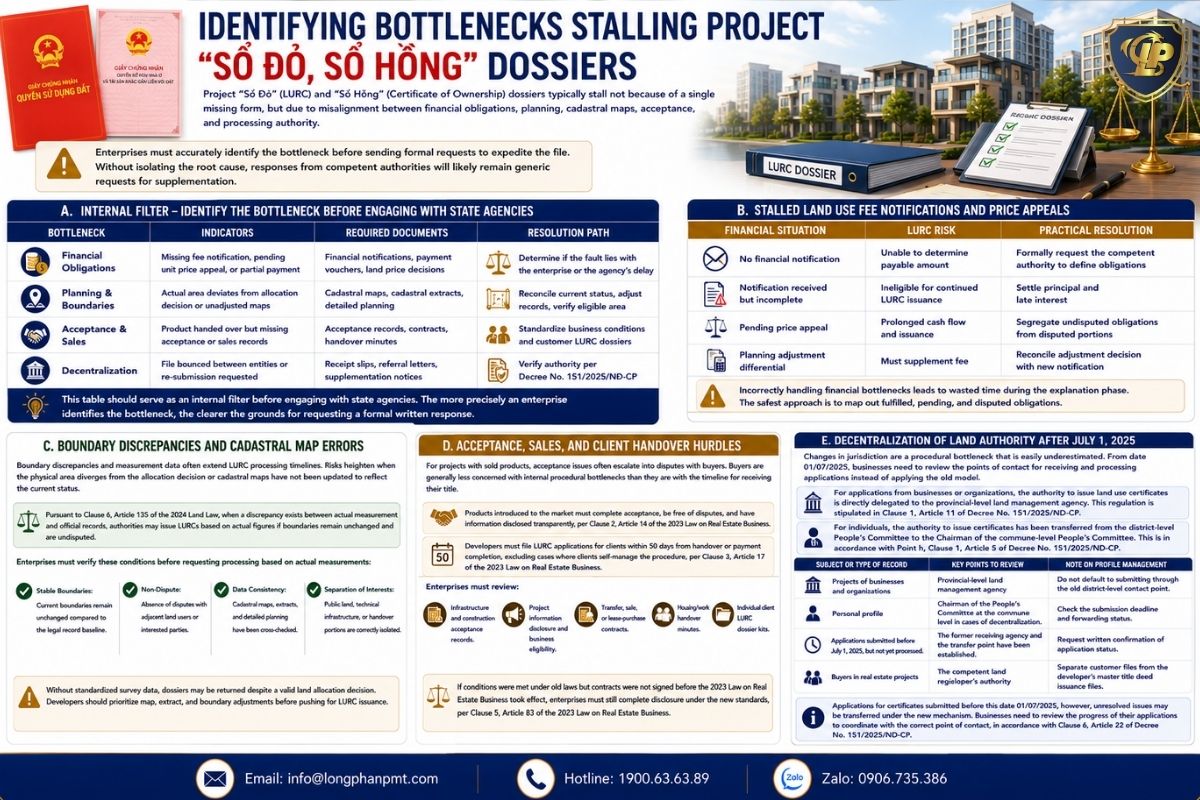
Project “Sổ Đỏ” (LURC) and “Sổ Hồng” (Certificate of Ownership) dossiers typically stall not because of a single missing form, but due to misalignment between financial obligations, planning, cadastral maps, acceptance, and processing authority.
Enterprises must accurately identify the bottleneck before sending formal requests to expedite the file. Without isolating the root cause, responses from competent authorities will likely remain generic requests for supplementation.
| Bottleneck | Indicators | Required Documents | Resolution Path |
| Financial Obligations | Missing fee notification, pending unit price appeal, or partial payment | Financial notifications, payment vouchers, land price decisions | Determine if the fault lies with the enterprise or the agency’s delay |
| Planning & Boundaries | Actual area deviates from allocation decision or unadjusted maps | Cadastral maps, cadastral extracts, detailed planning | Reconcile current status, adjust records, verify eligible area |
| Acceptance & Sales | Product handed over but missing acceptance or sales records | Acceptance records, contracts, handover minutes | Standardize business conditions and customer LURC dossiers |
| Decentralization | File bounced between entities or re-submission requested | Receipt slips, referral letters, supplementation notices | Verify authority per Decree No. 151/2025/NĐ-CP |
This table should serve as an internal filter before engaging with state agencies. The more precisely an enterprise identifies the bottleneck, the clearer the grounds for requesting a formal written response.
Land-related financial obligations directly impact cash flow and LURC eligibility. Enterprises must distinguish between projects that have not paid and cases where the State has delayed issuing the financial notification.
If detailed planning adjustments cause a financial discrepancy, the enterprise must pay the supplementary fee and applicable late payment interest, per Clause 1, Article 14 of Decree No. 103/2024/NĐ-CP.
For projects with land allocation or lease decisions before August 1, 2024, but with delayed land price decisions, enterprises may consider transitional valuation mechanisms, per Clause 2, Article 50 and Clause 9, Article 51 of Decree No. 103/2024/NĐ-CP.
| Financial Situation | LURC Risk | Practical Resolution |
| No financial notification | Unable to determine payable amount | Formally request the competent authority to define obligations |
| Notification received but incomplete | Ineligible for continued LURC issuance | Settle principal and late interest |
| Pending price appeal | Prolonged cash flow and issuance | Segregate undisputed obligations from disputed portions |
| Planning adjustment differential | Must supplement fee | Reconcile adjustment decision with new notification |
Incorrectly handling financial bottlenecks leads to wasted time during the explanation phase. The safest approach is to map out fulfilled, pending, and disputed obligations.
Boundary discrepancies and measurement data often extend LURC processing timelines. Risks heighten when the physical area diverges from the allocation decision or cadastral maps have not been updated to reflect the current status.
Pursuant to Clause 6, Article 135 of the Law on Land 2024, when a discrepancy exists between actual measurement and official records, authorities may issue LURCs based on actual figures if boundaries remain unchanged and are undisputed.
Enterprises must verify these conditions before requesting processing based on actual measurements:
Without standardized survey data, dossiers may be returned despite a valid land allocation decision. Developers should prioritize map, extract, and boundary adjustments before pushing for LURC issuance.
For projects with sold products, acceptance issues often escalate into disputes with buyers. Buyers are generally less concerned with internal procedural bottlenecks than they are with the timeline for receiving their title.
Products introduced to the market must complete acceptance, be free of disputes, and have information disclosed transparently, per Clause 2, Article 14 of the Law on Real Estate Business 2023.
Developers must file LURC applications for clients within 50 days from handover or payment completion, excluding cases where clients self-manage the procedure, per Clause 3, Article 17 of the Law on Real Estate Business 2023.
Enterprises must review:
If conditions were met under old laws but contracts were not signed before the Law on Real Estate Business 2023 took effect, enterprises must still complete disclosure under the new standards, per Clause 5, Article 83 of the Law on Real Estate Business 2023.
Changes in jurisdiction are a procedural bottleneck that is easily underestimated. From date 01/07/2025. Therefore, businesses need to review the points of contact for receiving and processing applications instead of applying the old model.
For applications from businesses or organizations, the authority to issue land use certificates is directly delegated to the provincial-level land management agency. This regulation is stipulated in Clause 1, Article 11 of Decree No. 151/2025/ND-CP.
For individuals, the authority to issue certificates has been transferred from the district-level People’s Committee to the Chairman of the commune-level People’s Committee. This is in accordance with Point h, Clause 1, Article 5 of Decree No. 151/2025/ND-CP.
| Subject or type of record | Key points to review | Note on profile management |
| Projects of businesses and organizations | Provincial-level land management agency | Do not default to submitting through the old district-level contact point. |
| Personal profile | Chairman of the People’s Committee at the commune level in cases of decentralization. | Check the submission deadline and forwarding status. |
| Applications submitted before July 1, 2025, but not yet processed. | The former receiving agency and the transfer point have been established. | Request written confirmation of application status. |
| Buyers in real estate projects | The competent land registration authority | Separate customer files from the developer’s master title deed issuance files. |
Applications for certificates submitted before this date 01/07/2025. However, unresolved issues may be transferred under the new mechanism. Businesses need to review the progress of their applications to coordinate with the correct point of contact, in accordance with Clause 6, Article 22 of Decree No. 151/2025/ND-CP.
The process for handling applications for certificates should be managed as a legal roadmap, not just a paper submission procedure. Each step must clearly define the input documents, the agencies to work with, and the bottlenecks that need to be addressed.
For real estate projects, residential areas, industrial parks, or industrial clusters, minor discrepancies in land, taxes, maps, or acceptance testing can halt the entire process. Businesses should implement the following control procedures.
This approach helps businesses shift from a passive response to a proactive evidence management approach. When additional documentation is requested, businesses have sufficient grounds to respond effectively and effectively.
The first step is to check if the project has sufficient legal basis to be granted a Certificate of Ownership. Submitting an application when the land is being used for the wrong purpose, has outstanding financial obligations, or the handover portion has not been determined may result in the application being suspended.
The investor must fulfill all financial obligations related to land with the State. For projects that are exempt, reduced, or deferred, the issuance of a Certificate of Land Use Rights will only be considered after an official confirmation decision, according to Clause 3, Article 135 of the Law on Land 2024.
Businesses need to review the following data groups:
The output of this step should be a project legal risk assessment table. This document helps businesses determine whether the application can be filed immediately or if certain background conditions need to be addressed beforehand.
Decisions on land allocation or lease must match the current land use status, cadastral maps, and planning documents. If the data sources are inconsistent, the processing agency may request corrections before issuing the Certificate.
When there is a discrepancy between actual measurements and documents, the state agency may issue the land use certificate based on the actual measurements if the boundary remains unchanged and there is no dispute. The applicable basis is Clause 6, Article 135 of the Law on Land 2024.
| Data sources to be compared. | Risk of misstatement | Practical approach |
| Decision on land allocation or land lease | The legal area differs from the actual area. | Compare with the land survey and handover records. |
| Cadastral map, cadastral survey extract | The map has not been updated to reflect the current situation. | Request for measurement, adjustment, and re-confirmation of boundaries. |
| Detailed planning documents | The planning indicators do not match the actual construction situation. | Review of planning decisions and adjustment documents. |
| Minutes of land handover in the field | Lack of basis for determining administrative boundaries. | Supplement with field verification reports or documents. |
| Public land, shared infrastructure | Mistakenly included in the area for which a permit was requested. | Break down and plan for local handover. |
This verification step is particularly important for projects that have undergone multiple revisions. If the underlying data is inconsistent, the application for a Certificate will have difficulty passing the content review stage.
Businesses need to simultaneously handle financial obligations and acceptance documents. These are two sets of conditions that directly affect the ability to issue a Certificate of Ownership and the ability to issue a land title deed to the buyer.
According to Clause 9, Article 13 of Decree 50/2026/ND-CP, the deducted expenses, support, and resettlement in cases where the State allocates land with payment of land use fees where the project implementer voluntarily advances the compensation, support, and resettlement costs to the unit or organization responsible for compensation, support, and resettlement as stipulated in Clause 2, Article 94 of the Law on Land 2024; this does not apply to additional land use periods due to extensions or adjustments to land use periods.
In cases where the land user requests and the competent state agency makes a decision adjust. Detailed planning of a project, as prescribed by law, that changes the land use structure or location of each land type or increases the land use coefficient falls under the cases for calculating land use fees as stipulated in Clause 1, Article 14 of Decree No. 103/2024/ND-CP, supplemented by Point a, Clause 3, Article 1 of Decree 291/2025/ND-CP.
Businesses should review the following groups of documents:
If a project has not yet received notification of land use fees but the handover deadline has passed, the business needs to separate the issue and address it accordingly. If the fault lies with the agency that delayed determining the obligation, the business should request a written response.
Submitting an application is only the starting point of the processing. Businesses need to manage the entire application lifecycle, from the receipt to requests for additional information, processing results, or rejection letters.
The monitoring process should follow these steps:
For projects of enterprises or organizations, the authority to issue Certificates is directly delegated to the provincial-level land management agency. The basis for application is Clause 1, Article 11 of Decree No. 151/2025/ND-CP.
The processing time for issuing the initial certificate is:no more than 3 working days. According to Clause 1, Section II, Part A, Appendix I of Decree No. 151/2025/ND-CP, for those receiving the transfer of houses and works in real estate projects, the time for registration and issuance of the Certificate is no more than 8 working days, in accordance with Clause 6, Section II, Part A, Appendix I of Decree No. 151/2025/ND-CP.
When a case is delayed, businesses shouldn’t send a generic letter. A more effective approach is to identify the agency holding the case, the specific issue, and whether the documentation is sufficient to request a response.
For applications received before the effective date of the Law on Land 2024 but not yet processed, businesses can consider a mechanism to choose the most favorable legal provision. This is stipulated in Clause 7 of Article 255 and Clause 2 of Article 256 of the Law on Land 2024.
The response roadmap should be structured as follows:
The goal is not to exert formal pressure. Businesses need to build a sufficiently strong evidence file to compel the competent authority to respond, take action, or clearly state the reasons for not issuing the Certificate.
Each type of problem requires a separate solution. Businesses should not use the same official letter template for financial errors, map errors, project transfer errors, and delays in issuing land titles to customers.
The most effective approach is to identify the root cause, the missing documents, and the appropriate agency to contact. The table below helps quickly categorize risk groups before preparing an explanation.
| Problem group | Identifying features | Priority course of action |
| Financial obligations not yet fulfilled. | No payment notification received, price dispute pending, or payment not yet made. | Determine whether the fault lies with the business or the agency that has not yet issued the obligation. |
| There is public land, canals, and internal roads. | The area for which the permit is requested includes infrastructure or the portion that needs to be handed over. | Separate the portion for which the investor will not be granted a Certificate of Ownership. |
| The project has been transferred multiple times. | The new developer’s documentation does not fully reflect the succession obligations. | Examine the transfer chain, financial obligations, and land use rights. |
| The product has been sold but the certificate has not yet been issued. | The buyer has received the goods or made full payment but has not yet received the documentation. | Separating the responsibilities of the developer, the registration authority, and the rights of customers to make requests. |
If a classification system isn’t established from the outset, businesses can easily misfocus their processing. As a result, the case continues to drag on even after submitting additional documents.
Projects that have not yet paid land use fees need to be categorized by the cause. If the business has been notified but has not paid in full, the risk lies in the payment obligation.
The investor received the notice to pay land use fees before the date 01/08/2024. However, those who have not yet paid must pay the full principal and late payment penalties. The change in law does not eliminate this financial responsibility, according to Clause 1, Article 50 of Decree No. 103/2024/ND-CP.
If the project has already received a decision on land allocation, land lease, or land use conversion before the date 01/08/2024. However, due to the slow issuance of land price decisions by state agencies, businesses need to consider a transitional mechanism. This mechanism is stipulated in Clause 2, Article 50 and Clause 9, Article 51 of Decree No. 103/2024/ND-CP.
Businesses should create a reconciliation statement including obligations already paid, obligations awaiting notification, and obligations under appeal. This serves as the basis for requesting a Certificate for the eligible portion if there are grounds for separation.
Public land, canals, internal roads, or technical infrastructure should not be included in the application for a Certificate of Land Use Rights as if it were the investor’s business area. This is a common mistake that leads to applications being rejected.
In urban or rural residential development projects, land used for public facilities serving the common good must be handed over to the local authorities for management. (Developer) Certificate not issued for this area, according to Point b, Clause 1, Article 143 of the Law on Land 2024.
Businesses need to handle this in the following way:
If not properly separated, the request for a master title deed for the entire project may be deemed inappropriate. This risk directly impacts plans for transfer, mortgage, and handover of the product.
Projects that undergo multiple transfers of ownership need to be evaluated as real estate M&A files. The new investor not only receives the right to develop the project, but may also inherit financial obligations, land records, and commitments to customers.
The first control point is the project’s financial fulfillment status. The issuance of the Certificate will only be considered when land-related financial obligations have been fulfilled or a decision confirming exemption, reduction, or debt recording has been issued, as stipulated in Clause 3, Article 135 of the Law on Land 2024.
The transferee needs to review:
Housing or construction projects put into business must have completed acceptance testing, be free from disputes, and have transparent information publicly available, according to Clause 2, Article 14 of the Law on Real Estate Business 2023. This is a point that needs to be checked before accepting the transfer of a project.
When a project has sold units but the issuance of ownership certificates is delayed, the business needs to clearly separate three groups of responsibilities: the developer’s responsibility for submitting the documents, the competent authority’s responsibility for processing, and the buyer’s right to request the certificate.
The developer must submit the application for a Certificate of Ownership for the customer within the maximum timeframe 50 days from the date of handover of the house or from the time the buyer or lessee has paid the full amount. An exception only applies when the customer voluntarily completes the procedure, according to Clause 3, Article 17 of the Law on Real Estate Business 2023.
The process should include:
The transferee, when carrying out the procedures themselves, needs to have an application for registration of changes, a legally valid transfer contract, a handover record of the house and land, and the Certificate of Ownership issued to the project investor. The applicable basis is Clause 1, Article 41 of Decree No. 101/2024/NĐ-CP.
The prolonged processing of land title applications is not just a procedural risk. For developers, the consequences can extend to sales revenue, disbursement conditions, collateral, customer disputes, and project transfer plans.
Businesses need to quantify risks by impact group. This approach helps management prioritize addressing bottlenecks that have the highest potential for financial damage.
| Risk group | Trade impact | Control measures |
| Delay in issuing certificates to customers. | Claims may arise, including requests for penalties, compensation, or withholding of payments. | Control filing deadlines and document delivery. |
| Delay in fulfilling financial obligations | Increased capital costs, resulting in late payment penalties, and prolonged processing times for land title issuance. | Compare the financial statement and the payment receipt. |
| Not yet inspected or lacking public documentation. | Impact of product sales and delivery conditions | Standardize acceptance testing, publicize information and legal documents. |
| Delayed land use or project progress | There may be a risk of land reclamation in cases stipulated by law. | Monitor land use progress and renewal applications, if any. |
If risks are not categorized, businesses tend to react on a case-by-case basis. A safer approach is to create a risk matrix linked to money, deadlines, responsible agencies, and contractual obligations.
Delays in issuing the Certificate of Ownership may lead banks to reassess the condition of the collateral. For projects currently borrowing funds, this poses a direct risk to disbursement limits and cash flow management.
The first control point is the financial obligation regarding land. The project is only eligible for a land use certificate when the investor has fulfilled all financial obligations or has a decision confirming exemption, reduction, or debt recording, as stipulated in Clause 3, Article 135 of the Law on Land 2024.
The second control point is the acceptance status and business conditions of the product. Housing or construction projects put into business must have completed acceptance testing, be free from disputes, and have transparent information publicly available, according to Clause 2, Article 14 of the Law on Real Estate Business 2023.
Businesses need to control the following trade impacts:
Project cash flow is only stable when land records, finances, and acceptance documents are synchronized. If any link is missing, the risk of land title issuance can turn into financing risk.
For projects where products have already been sold, the deadline for customers to submit documents is a legal milestone that needs to be strictly managed. This is a basis for potential complaints if buyers have already received the handover or have paid in full.
The developer must submit the application to the state agency for the issuance of a Certificate of Ownership to the customer within the maximum timeframe 50 days from the date of handover of the house or from the time the buyer or lessee has paid the full amount. An exception is made if the customer voluntarily completes the procedure, according to Clause 3, Article 17 of the Law on Real Estate Business 2023.
Businesses need to control milestones 50 days according to the following points:
Without individual customer monitoring, developers may be caught off guard when collective complaints arise. The risk is even greater if the project is in the sales phase or preparing to raise capital for the next stage.
Delays in fulfilling financial obligations increase the direct costs of the project. This risk extends beyond delays in obtaining the Certificate of Ownership; it also impacts profitability and the financial plan.
Investors who received notices to pay land use fees before August 1, 2024, but have not yet paid, must pay the full principal amount and late payment penalties. This responsibility is stipulated in Clause 1, Article 50 of Decree No. 103/2024/ND-CP, as amended by Point a, Clause 18, Article 1 of Decree 291/2025/ND-CP. Late payment penalties are calculated based on the unpaid land use fee or the outstanding land use fee. According to Point a, Clause 18, Article 1 of Decree 291/2025/ND-CP.
At a higher risk level, investment projects that fail to put the land into use for 12 consecutive months or are 24 months behind schedule may be considered for revocation under legally stipulated conditions. If administrative penalties have been imposed but the land is still not put into use, exceeding the maximum extension period of 24 months, the State will revoke the land without compensation for the land, assets attached to the land, and remaining investment costs, according to Clause 8, Article 81 of the Law on Land 2024.
| Risk | Legal thresholds to note | Impact |
| Late payment of financial obligations | 0.03% per day on the unpaid amount. | Increased project costs and extended processing time for certificates. |
| Do not put the land into use. | 12 consecutive months | It may be subject to revocation if the legally stipulated conditions are met. |
| Delays in land use | 24 months ahead of schedule | Increased risk of administrative penalties and revocation. |
| The extension deadline has passed. | Maximum 24 months | It may be revoked without compensation in cases stipulated by law. |
Businesses need to differentiate between the risk of late payment and the risk of late land use. One risk increases costs, while the other can directly affect the right to develop the project.
Delays in handing over the Certificate of Ownership can easily lead to contractual disputes with the buyer. Risks often arise when the contract includes clauses regarding the deadline for issuing the certificate, penalties for breach of contract, or compensation for damages.
The penalty for late payment or late handover of real estate is determined by mutual agreement between the parties and must be clearly stated in the contract. This rule is stipulated in Clause 3, Article 48 of the Law on Real Estate Business 2023.
Businesses need to review the following points in their contracts with customers:
If a dispute arises, the developer’s defense documentation must clearly demonstrate that the application was submitted on time or that a written request for processing was received. A lack of supporting documentation will put the business at a disadvantage in negotiations and complaint resolution.
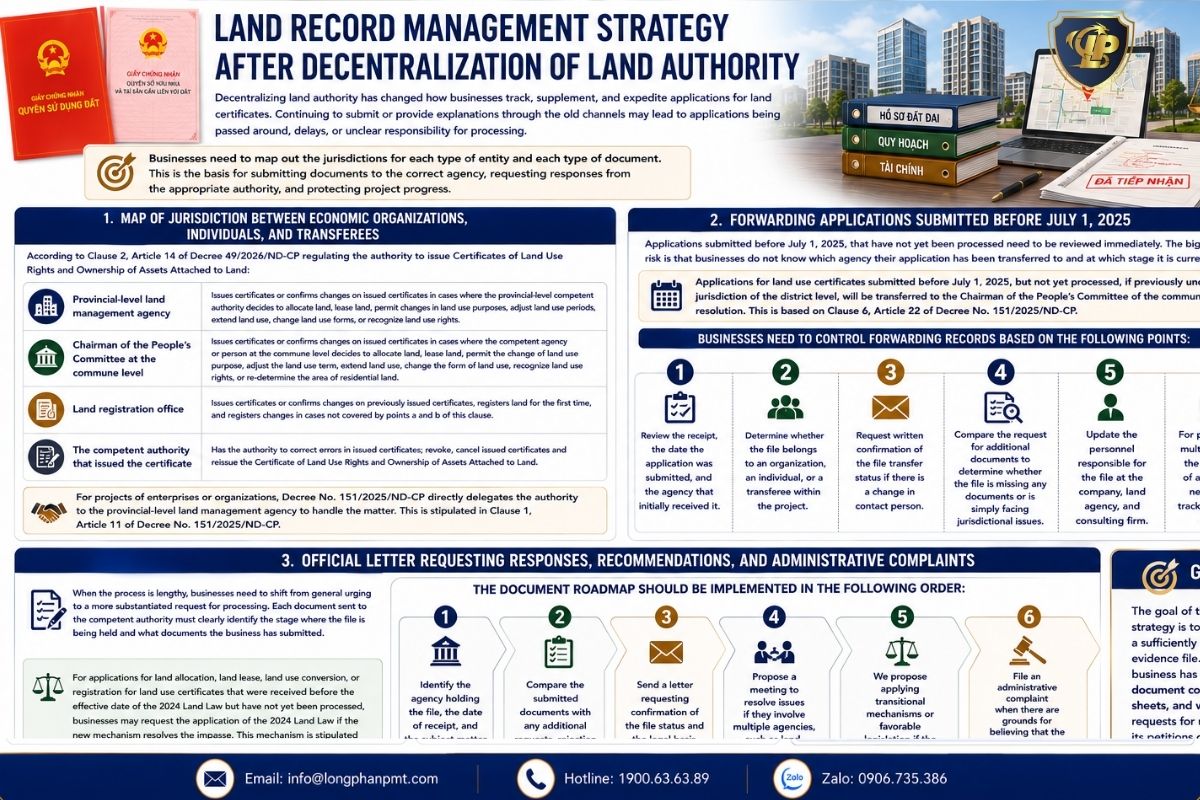
Decentralizing land authority has changed how businesses track, supplement, and expedite applications for land certificates. Continuing to submit or provide explanations through the old channels may lead to applications being passed around, delays, or unclear responsibility for processing.
Businesses need to map out the jurisdictions for each type of entity and each type of document. This is the basis for submitting documents to the correct agency, requesting responses from the appropriate authority, and protecting project progress.
The authority to issue certificates does not apply equally to all entities. Project investors, individuals, and transferees in real estate projects need to be separated in the file management plan.
According to Clause 2, Article 14 of Decree 49/2026/ND-CP regulating the authority to issue Certificates of Land Use Rights and Ownership of Assets Attached to Land:
The competent authority that issued the Certificate of Land Use Rights and Ownership of Assets Attached to Land as stipulated in points a, b, and c of Clause 2, Article 14 of Decree 49/2026/ND-CP has the authority to correct errors in issued certificates; revoke, cancel issued certificates and reissue the Certificate of Land Use Rights and Ownership of Assets Attached to Land.
For projects of enterprises or organizations, Decree No. 151/2025/ND-CP directly delegates the authority to the provincial-level land management agency to handle the matter. This is stipulated in Clause 1, Article 11 of Decree No. 151/2025/ND-CP.
Applications submitted before July 1, 2025, that have not yet been processed need to be reviewed immediately. The biggest risk is that businesses do not know which agency their application has been transferred to and at which stage it is currently stalled.
Applications for land use certificates submitted before July 1, 2025, but not yet processed, if previously under the jurisdiction of the district level, will be transferred to the Chairman of the People’s Committee of the commune for resolution. This is based on Clause 6, Article 22 of Decree No. 151/2025/ND-CP.
Businesses need to control forwarding records based on the following points:
For projects with multiple buyers, the processing of applications needs to be tracked by group of files. If only the project’s “master register” is used, businesses may miss out on eligible customer applications.
When the process is lengthy, businesses need to shift from general urging to a more substantiated request for processing. Each document sent to the competent authority must clearly identify the stage where the file is being held and what documents the business has submitted.
For applications for land allocation, land lease, land use conversion, or registration for land use certificates that were received before the effective date of the Law on Land 2024 but have not yet been processed, businesses may request the application of the Law on Land 2024 if the new mechanism resolves the impasse. This mechanism is stipulated in Clause 7, Article 255 and Clause 2, Article 256 of the Law on Land 2024.
The document roadmap should be implemented in the following order:
The goal of this strategy is to build a sufficiently strong evidence file. When a business has receipts, document comparison sheets, and written requests for responses, its petitions or complaints will be more focused.
The application for a project certificate typically involves land, taxes, planning, construction, acceptance testing, and post-decentralization authority simultaneously. Long Phan Consulting Company. We support businesses in identifying bottlenecks, standardizing documentation, and developing work plans with relevant authorities.
The focus of the consulting service is not just on completing forms. The goal is to help the investor, the project transferee, and the financing bank control legal risks before the application is prolonged and stalled.
The due diligence process helps businesses determine whether a project is eligible for submission or if certain hurdles need to be addressed. This is a necessary step before transferring the project, mortgaging assets, or launching the next phase of sales.
After this step, businesses have a basis to decide whether to submit an application, supplement documents, or request action based on each specific bottleneck.
Many applications are delayed because they involve multiple agencies simultaneously. Long Phan Consulting Company assists businesses in establishing a unified explanatory document, avoiding the sending of fragmented letters that fail to clarify responsibility for handling the matter.
This approach helps move files from a “pending” state to a state where they are ready for monitoring, response, and processing.
When a case is unusually prolonged, businesses need clear administrative evidence before filing a complaint or negotiating with the customer. The more complete the defense documentation, the better the risk of compensation and disputes is controlled.
The approach should prioritize evidence and deadlines. Simply providing verbal explanations to customers or government agencies will leave businesses without a solid basis to protect their rights when disputes arise.
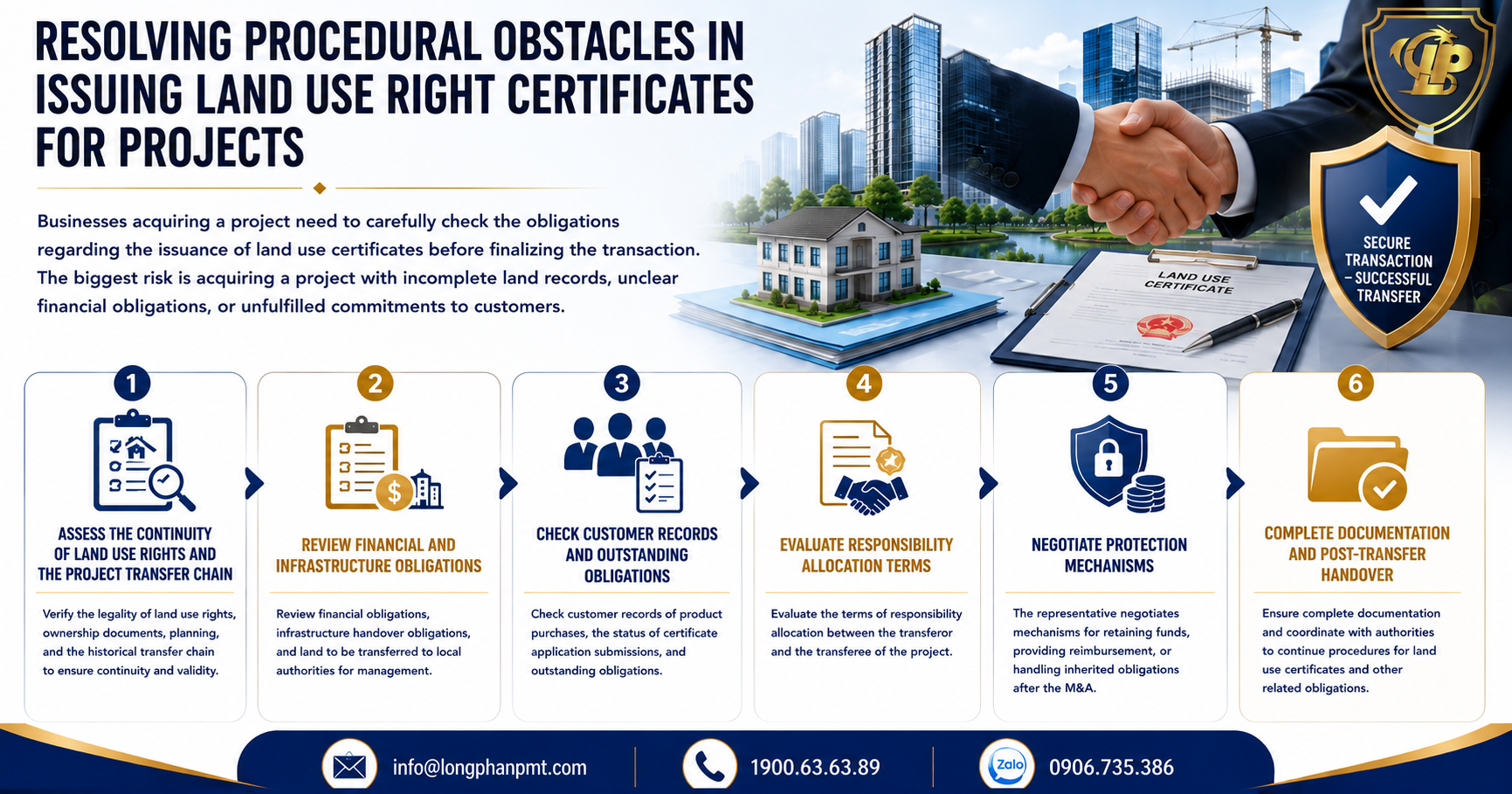
Businesses acquiring a project need to carefully check the obligations regarding the issuance of land use certificates before finalizing the transaction. The biggest risk is acquiring a project with incomplete land records, unclear financial obligations, or unfulfilled commitments to customers.
Businesses can send land allocation decisions, planning documents, cadastral surveys, financial obligation notices, acceptance documents, and current processing status via email: info@longphanpmt.com or Zalo: 0906.735.386 Long Phan Consulting Company Preliminary assessment.
The obstacles to obtaining land use rights certificates for projects often lie not in a single form, but in financial obligations, boundaries, acceptance testing, jurisdiction, and customer documentation. The following questions focus on situations where businesses risk losing cash flow, experiencing delays in handover, or facing prolonged administrative procedures.
No, the project has not yet fulfilled its financial obligations regarding land and is therefore not eligible for a land use certificate. The investor must complete all financial obligations to the State; if exempted, reduced, or deferred, an official confirmation decision must be obtained before processing the application. Businesses need to check the land use fee notice, land lease fee notice, and payment receipts in accordance with Clause 3, Article 135 of the Law on Land 2024.
No, the investor is not allowed to be granted a Certificate of Land Use Rights for public land serving the common good within an urban or rural residential project. This area must be handed over to the local authorities for management, so the business needs to separate it from the application for a master land title. This is a mandatory control point according to Point b, Clause 1, Article 143 of the Law on Land 2024.
The developer must submit the application for a Certificate of Ownership to the customer within a maximum of 50 days. This deadline is calculated from the date of handover of the house or from the time the buyer or lessee has paid the full amount, unless the customer voluntarily initiates the procedure. Late submission can easily lead to complaints, according to Clause 3, Article 17 of the Law on Real Estate Business 2023.
The application will not necessarily be rejected if the land use boundaries remain unchanged and there are no disputes with neighboring landowners. The state agency may issue a Certificate of Land Use Rights based on actual measurements when all conditions are met. Businesses need to standardize cadastral extracts, cadastral maps, and documentation explaining discrepancies in accordance with Clause 6, Article 135 of the Law on Land 2024.
Businesses need to review the transitional land valuation mechanism to avoid the indefinite wait for land price decisions. Projects that have received land allocation, land lease, or land use conversion decisions before August 1, 2024, but have delayed the issuance of land price decisions, may apply the transitional mechanism to determine costs and fulfill financial obligations, according to Clause 2, Article 50 and Clause 9, Article 51 of Decree No. 103/2024/ND-CP.
Businesses need to review the processing points for land-related applications following the decentralization of land management authority. For projects of businesses or organizations, the authority to issue land use certificates is directly delegated to the provincial-level land management agency. Submitting applications through the old channels may lead to delays, as stipulated in Clause 1, Article 11 of Decree No. 151/2025/ND-CP.
Projects that are late in paying land-related financial obligations may incur late payment penalties and prolong the conditions for issuing land use certificates. The late payment penalty is calculated by multiplying the number of days of delay by the daily penalty rate on the unpaid amount. Businesses need to quantify this amount in their project financial plan, in accordance with Clause 7, Article 51 of Decree 103/2024/ND-CP on land use fees and land lease fees (amended and supplemented by Point d, Clause 9, Article 1 of Decree 291/2025/ND-CP).
Successfully navigating Land Use Right Certificate issuance requires a strategic, unified legal approach that synchronizes land allocation, financial compliance, master planning, and technical infrastructure acceptance. Developers must proactively isolate public infrastructure from commercial areas and align cadastral data with current land use to prevent bureaucratic bottlenecks. Mismanaging these requirements or failing to adapt to post-decentralization authority risks stalled liquidity, protracted credit disbursement, and significant legal disputes with buyers.
To safeguard your investment, ensure your project’s legal dossier is robustly audited and synchronized with all statutory requirements by contacting the advisory team at Long Phan Consulting Company. Mitigate your operational risks and accelerate your project milestones by consulting with our experts via our hotline at 1900636389.
📚 This article is provided with professional consultation based on the following legal framework: