


Long Phan Consulting supports domestic and foreign investors with Investment Project Procedures Using Land, including investor selection, land access methods, and approval authority. These procedures involve the 2024 Law on Land, the 2025 Law on Investment, and Decree No. 96/2026/ND-CP, so incorrectly choosing between auction, bidding, or investor approval may cause dossiers to be returned. This article summarizes the applicable conditions, procedures, competent authorities, and security deposit obligations under current land law and the Law on Investment, helping investors prepare compliant dossiers from the outset.
Important Notes:
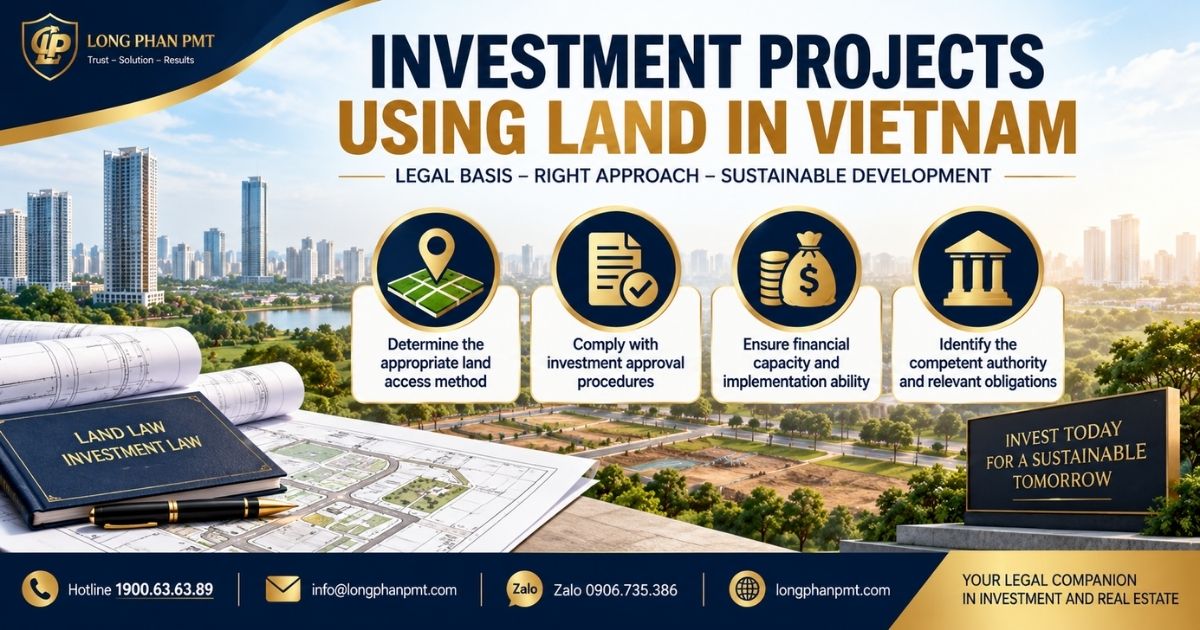
Before pursuing any of the three investor selection methods, organizations and individuals must satisfy the conditions on eligible recipients of land allocation or lease. They must also satisfy the conditions on project implementation capacity, all under Articles 119, 120, and 122 of the Land Law 2024.
Under Article 122 of the Land Law 2024, an investor must demonstrate sufficient financial capacity to ensure land use in accordance with the project schedule. The investor must also make an escrow deposit, or obtain a bank guarantee for the escrow obligation, where required under investment law. The investor must not have violated land laws in relation to any other project for which it currently uses land allocated or leased by the State.
Beyond financial capacity, the dossier must show project development experience in the same sector, or capacity commensurate with the registered project scale. This is a point that appraisal authorities commonly ask investors to supplement with further supporting documents.
A foreign-invested economic organization must satisfy additional land access conditions under Articles 119 and 120 of the Land Law 2024. These provisions set out the specific recipients and cases in which the State allocates or leases land to foreign investors. Where the project falls within a business line subject to conditional market access for foreign investors, the investor must also satisfy the corresponding conditions under investment law before being considered for land allocation or lease.
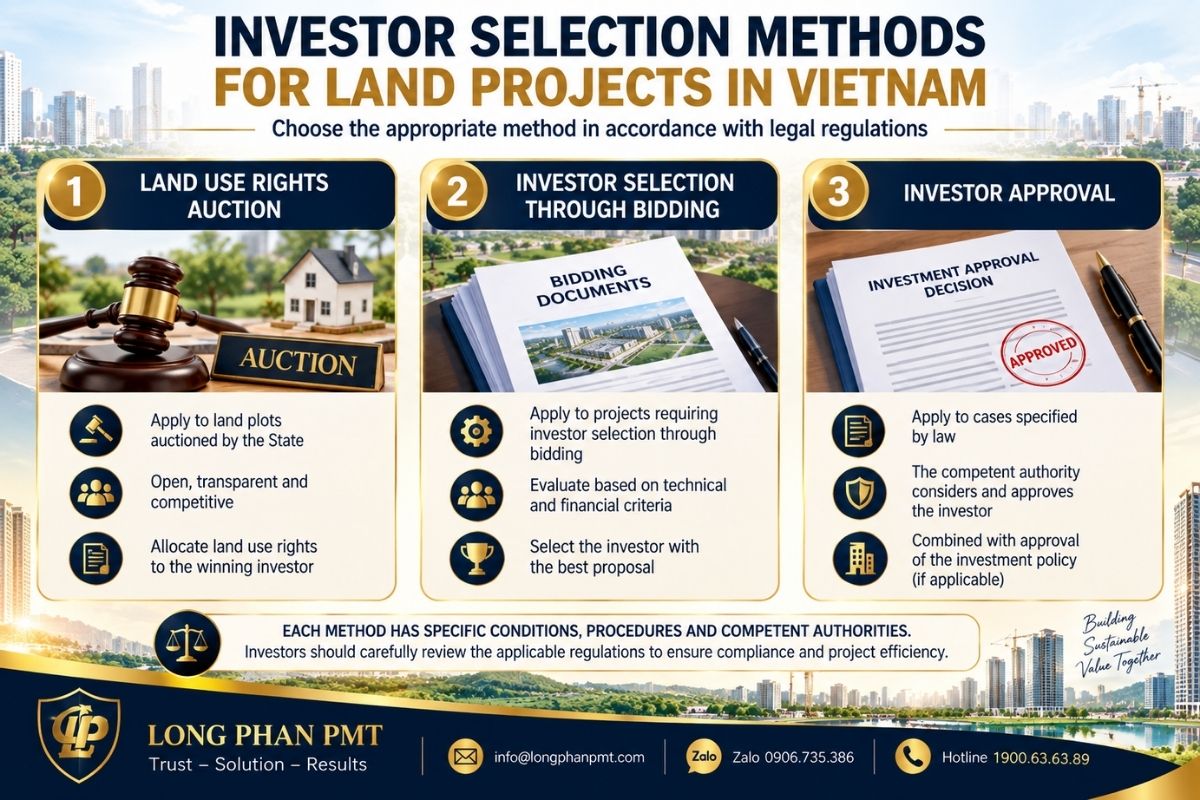
The Land Law 2024 and the Law on Investment No. 143/2025/QH15 set out three separate land access methods for investment projects using land. Correctly identifying these methods is a key part of Investment Project Procedures Using Land, as each method involves different conditions, documentation, and processing authorities.
Under Clause 1, Article 125 of the Land Law 2024, the State allocates land with land use fees, or leases land with a lump-sum rental payment, through auction of land use rights. This applies to projects using land funds managed by state agencies or organizations. It does not apply where the project falls under bidding pursuant to Article 126, or investor approval pursuant to Article 124, of the Land Law 2024.
An organization participating in the auction must be an eligible recipient of land allocation or lease under Articles 119 and 120. It must also satisfy the financial capacity and project experience conditions under Article 122 of the Land Law 2024.
Article 126 of the Land Law 2024 provides that land allocation or lease through bidding applies to projects subject to state land recovery under Article 79. It also applies where the project is subject to mandatory bidding under sector-specific management law. A project applying this method must satisfy the bidding conditions under Clause 3, Article 126 of the Land Law 2024. This is consistent with Clauses 1 and 3, Article 23 of the Law on Investment No. 143/2025/QH15 on investor selection.
The winning organization is responsible for advancing funds for compensation, support, and resettlement under the approved plan. If it fails to advance sufficient funds within six months of receiving the request, the competent authority will cancel the bidding result under Article 126 of the Land Law 2024.
Article 124 of the Land Law 2024 sets out the cases in which land is allocated or leased without auction or bidding. Article 127 of the Land Law 2024 adds the case where an investor uses land through an agreement on receiving land use rights, or already lawfully holds land use rights. This applies to projects not subject to state land recovery under Article 79 of the Land Law 2024.
Where the project area includes land managed by a state agency or organization that cannot be separated into an independent project, this area is incorporated into the overall project. The State then recovers it for allocation to the investor without auction or bidding. The investor selection mechanism in this case is set out in Clauses 3 and 4, Article 23 of the Law on Investment No. 143/2025/QH15.
Authority to approve the investment policy is allocated according to the scale, nature, and location of the project, under Article 24 of the Law on Investment No. 143/2025/QH15 and detailed guidance in Decree No. 96/2026/ND-CP.
The National Assembly and the Prime Minister approve the investment policy for projects of national importance and projects with special land, defense, or security requirements. This also covers other projects subject to the Prime Minister’s approval under applicable law, pursuant to Article 24 of the Law on Investment No. 143/2025/QH15. Dossiers for projects under the Prime Minister’s authority are submitted and appraised under the procedure in Article 34 of Decree No. 96/2026/ND-CP.
The Chairman of the provincial People’s Committee approves the investment policy for the remaining project groups under Clauses 8 to 18, Article 24 of the Law on Investment No. 143/2025/QH15.
This includes projects for which the investor requests state land allocation or lease without auction or bidding, and projects requesting a change of land use purpose. It also includes projects in areas affecting defense or security, or projects requesting allocation of a sea area.
The appraisal and decision-issuance procedure of the provincial People’s Committee Chairman follows Article 35 of Decree No. 96/2026/ND-CP. For projects in industrial parks, export processing zones, or economic zones, authority to receive and process the dossier rests with the industrial park or economic zone management board, as decentralized under Decree No. 96/2026/ND-CP.
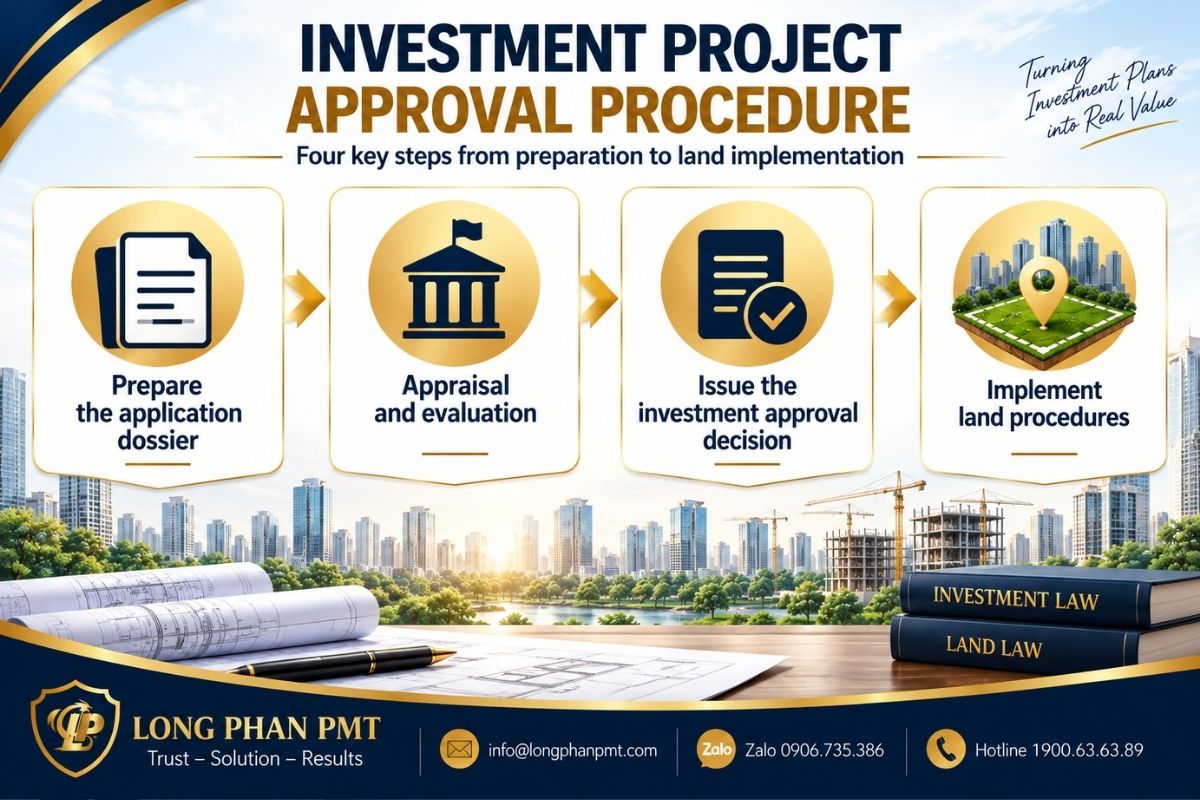
For projects using land, Investment Project Procedures Using Land typically include simultaneous investment policy approval and investor approval under Clause 4, Article 23 of the Law on Investment No. 143/2025/QH15. This shortens the timeline compared with two sequential procedures. The four-step procedure below applies uniformly to projects under the authority of the provincial People’s Committee, pursuant to Articles 32 and 35 of Decree No. 96/2026/ND-CP.
The investor prepares one dossier set together with an electronic copy under Article 32 of Decree No. 96/2026/ND-CP. The dossier comprises a written request to implement the project, an investment project proposal, and documents proving financial capacity. It also includes an explanation of the technology used, for projects subject to technology appraisal under technology transfer law, if any. Finally, it includes documents proving land use rights, or eligibility for state land allocation or lease, corresponding to the identified land access method.
The investment registration authority receives the dossier and conducts an appraisal on the matters set out in Clause 7, Article 32 of Decree No. 96/2026/ND-CP. This includes assessing the project’s consistency with the national planning system and land allocation or lease conditions, together with other matters covered by the submitted dossier. Within 14 working days of receiving a valid dossier, the investment registration authority prepares an appraisal report. The report is submitted to the Chairman of the provincial People’s Committee under Clause 8, Article 32 of Decree No. 96/2026/ND-CP.
Within three working days of receiving the dossier and appraisal report, the Chairman of the provincial People’s Committee issues the decision approving the investment policy and the investor simultaneously. This is done under Article 35 of Decree No. 96/2026/ND-CP. The decision is sent to the investment registration authority and the investor. For a project for which the National Assembly or the Prime Minister previously approved the investment policy, the investor approval decision is also sent to the Ministry of Finance for monitoring purposes.
After obtaining the decision approving the investment policy and the investor simultaneously, the investor contacts the natural resources and environment authority, or the competent local authority, to carry out land allocation and land lease. The investor also arranges issuance of the certificate of land use rights and ownership of assets attached to land, under the land registration procedure of the Land Law 2024. The investor must also complete the escrow deposit or bank guarantee obligation, if mandatory, before the land is physically allocated or leased.
>>>See more: The Prime Minister approved the investment policy for which projects?
The escrow obligation is a legal tool used to screen an investor’s financial capacity and bind the investor to the project schedule, under Article 30 of the Law on Investment No. 143/2025/QH15.
Under Article 30 of the Law on Investment No. 143/2025/QH15, an investor must make an escrow deposit or obtain a bank guarantee for the escrow obligation. This secures implementation of an investment project involving a request for state land allocation, lease, or permission to change the land use purpose, except for the cases exempted under the same article.
Article 30 of the Law on Investment No. 143/2025/QH15 sets out five cases exempted from the escrow or bank guarantee obligation:
Investors should check their project against these five cases before preparing their escrow financial plan.
Most dossiers for land-using investment projects are rejected not because of missing documents, but because of an incorrect legal basis identified from the outset. During Investment Project Procedures Using Land, correctly determining the applicable legal basis is therefore essential to avoiding unnecessary delays.
An investor submits a dossier under the investor approval method without auction or bidding, while the project is actually subject to state land recovery under Article 79. This places it within the mandatory bidding case under Article 126 of the Land Law 2024. This error requires the entire dossier to be redone under the correct method and significantly delays the project timeline.
Documents proving financial capacity sometimes fail to clearly demonstrate the ability to ensure land use in line with the project schedule. They may also lack documentation of project development experience commensurate with the registered scale. Both gaps cause the appraisal authority to repeatedly request supplementary documents under the conditions in Article 122 of the Land Law 2024.
The proposed project’s location and land use scale are sometimes inconsistent with the national planning system in effect when the dossier is submitted. This is a mandatory appraisal matter under Clause 7, Article 32 of Decree No. 96/2026/ND-CP. This inconsistency is a ground for the investment registration authority to decline to submit the dossier to the competent approval authority.
Before submitting an application dossier, investors should carefully review the appropriate method of accessing land and the applicable financial capacity requirements, as an incorrect determination at the outset may delay the entire project schedule. Long Phan Consulting assists investors with the following matters:
Clients may send their case documents via email at info@longphanpmt.com or via Zalo at 0906.735.386 for a preliminary assessment.
Below are common practical issues investors encounter when carrying out procedures for land-using investment projects under current regulations.
Yes. Foreign investors may apply this method if they satisfy the conditions under Article 127 of the 2024 Law on Land, including already having lawful land use rights or having an agreement to acquire land use rights, while also satisfying the specific land access conditions applicable to foreign investors under Articles 119 and 120 of the 2024 Law on Land.
Under Clause 8, Article 32 of Decree No. 96/2026/ND-CP, the investment registration authority has 14 working days from receipt of a valid dossier to prepare an appraisal report and submit it to the Chairperson of the provincial-level People’s Committee. The Chairperson then has an additional 03 working days to issue the approval decision under Article 35 of the same Decree.
The 2024 Law on Land and Decree No. 96/2026/ND-CP do not address this issue within the scope of this article. Where this situation arises, investors should contact the local auction-organizing authority or a consulting unit directly to determine the appropriate solution based on the specific auction dossier and procedures already carried out.
No. Under Article 127 of the 2024 Law on Land, where an investor already has lawful land use rights or has acquired land use rights through an agreement, the project may proceed through investor approval without an auction or bidding procedure, provided that the land is not subject to State recovery under Article 79 of the 2024 Law on Land.
No. Under Point a, Clause 1, Article 30 of the 2025 Law on Investment, an investor who wins an auction of land use rights falls within one of the 05 cases exempt from the obligation to provide a security deposit or bank guarantee for project implementation.
It depends on the delegation of authority under Decree No. 96/2026/ND-CP. Projects located in industrial parks or economic zones may fall under the authority of the Industrial Park or Economic Zone Management Board for receipt and processing. Investors should determine the applicable authority based on the delegation instruments in force in each locality and the specific type of project.
Investment Project Procedures Using Land require investors to correctly determine the method of accessing land, satisfy the financial capacity requirements under Article 122 of the 2024 Law on Land, and comply with the proper authority and procedures for investment policy approval under the 2025 Law on Investment and Decree No. 96/2026/ND-CP. Long Phan Consulting supports investors from selecting the appropriate land access method through completion of land allocation and land lease procedures. Please contact Hotline 1900636389 for direct assistance.
📚 This article has been professionally reviewed based on the following legal documents:


