
Necessary procedures to implement investment projects using land is a core factor that helps investors ensure legality throughout the entire project implementation process. Understanding and complying with planning regulations, approval of investment policies, land allocation or land lease will help the project be implemented on schedule, limit legal risks and create favorable conditions for mobilizing capital, applying for construction permits and sustainable development.

According to the provisions of Clause 1, Article 29 of the Law on Investment 2020, the selection of investors to implement projects using land is carried out through one of the following three forms:
Choosing the appropriate form to identify investors implementing projects using land not only ensures transparency and healthy competition but also contributes to improving land use efficiency and sustainable development in accordance with current law.

To implement investment projects using land, investors need to clearly understand the processes and procedures that need to be followed. Below are the specific processes when implementing an investment project using land.
The procedure for approval of investment policy is the first and most important step in the process of implementing an investment project using land. Determining the authority to approve investment policies depends on the scale and nature of the project.
According to the provisions of Clause 1a, Article 32 of the Law on Investment 2020, in cases where the investment project requests the State to allocate or lease land without going through auction, bidding or transfer, or the investment project requests permission to change the land use purpose, it falls under the authority to approve the investment policy of the Provincial People’s Committee.
According to the provisions of Article 36 of the Law on Investment 2020 and guided by Clause 4, Article 33, Decree 31/2021/ND-CP, investment project appraisal procedures are carried out through the following steps:
Step 1: Prepare documents and submit documents
The investor or competent state agency submits 04 sets of documents requesting approval of investment policies, documents requesting approval of investment policies proposed by investors specified in Article 33 of the Law on Investment 2020 include:
In cases where the law on construction stipulates the preparation of a pre-feasibility study report, the investor may submit a pre-feasibility study report instead of the investment project proposal.
Step 2: Appraise the policy
Within 35 days from the date of receiving the dossier, the investment registration agency must notify the investor of the results.
Within 03 working days from the date of receiving complete documents, the investment registration agency sends the documents to seek appraisal opinions from state agencies related to the appraisal content.
Within 15 days from the date of receiving the request from the investment registration agency, the consulted agency shall have an appraisal opinion on the content within the scope of its state management and send it to the investment registration agency.
In case the project is subject to a preliminary environmental impact assessment according to the provisions of law on environmental protection, the provincial-level specialized environmental protection agency shall carry out the responsibilities specified in this Clause for the content of the preliminary environmental impact assessment.
Within 25 days from the date of receipt of valid documents, the investment registration agency prepares an appraisal report including appraisal contents and submits it to the Provincial People’s Committee.
Step 3: Receive approval results
Within 07 working days from the date of receiving the dossier and appraisal report, the Provincial People’s Committee approves the investment policy. In case of refusal, it must be notified in writing and clearly state the reason.
Procedures for land allocation and land lease are the next step after the project has been approved for investment policy. According to the provisions of Article 49, Decree No. 102/2024/ND-CP and Clauses 2, 3, 4 and 6, Article 44, Decree 102/2024/ND-CP, procedures for applying for land allocation to implement investment projects are prescribed as follows:
Step 1: Submit documents to the competent authority
Organizations and individuals subject to land allocation or land lease shall submit 01 set of documents to the agency receiving documents and returning results specified in the One-Stop Department according to regulations of the Provincial People’s Committee on receiving documents and returning results of administrative procedures at the provincial, district and commune levels.
The dossier includes an application for land allocation according to Form No. 02a or an application for land lease according to Form No. 02b in the Appendix issued with Decree 102/2024/ND-CP and one of the following documents:
Step 2: Appraisal of documents
The agency with land management function assigns the Land Registration Office to provide information about the land database and prepare an extract of the cadastral map of the land plot in cases where the dossier is complete and valid; Instruct the person submitting the application to supplement the cadastral measurement of the land plot for the land plot in the area where there is no cadastral map according to regulations or re-do the application or supplement the application and resubmit it to the agency with land management function in case the application is incomplete or invalid; Review and check documents; field inspection.
The agency with land management function completes the dossier and submits it to the People’s Committee at the competent level to issue decisions on land allocation, land lease, and permission to change land use purposes, accompanied by a draft decision on land allocation and land lease, with content on land prices to calculate land use fees and land rents payable and the tax authority’s responsibilities in guiding land users to pay land use fees and land rents according to the provisions of law on land use fees and land rents.
Step 3: Consider issuing a decision
The People’s Committee at the competent level shall consider and issue decisions on land allocation, land lease, and permission to change land use purposes.
Step 4: Notify the tax authority
The agency with land management functions transfers cadastral information of the land plot to the tax authority.
Tax authorities determine land use fees and land rents payable according to regulations, issue notices of payment of land use fees and land rents to land users.
Step 5: Complete tax obligations
Land users pay land use fees and land rents according to the provisions of law on land use fees and land rents.
The tax authority confirms the completion of payment of land use fees and land rent and sends notification of results to the agency with land management functions.
Step 6: Update land information
The agency with land management function submits to the competent authority to sign and issue the Certificate and carry out the work specified in Clause 4, Article 228, Land Law 2024; In case of signing a land lease contract, follow the Form.
The Land Registration Office or Land Registration Office Branch is responsible for updating and adjusting the land database and cadastral records.
>>> See more: Procedures for applying for land allocation to implement enterprise investment projects.
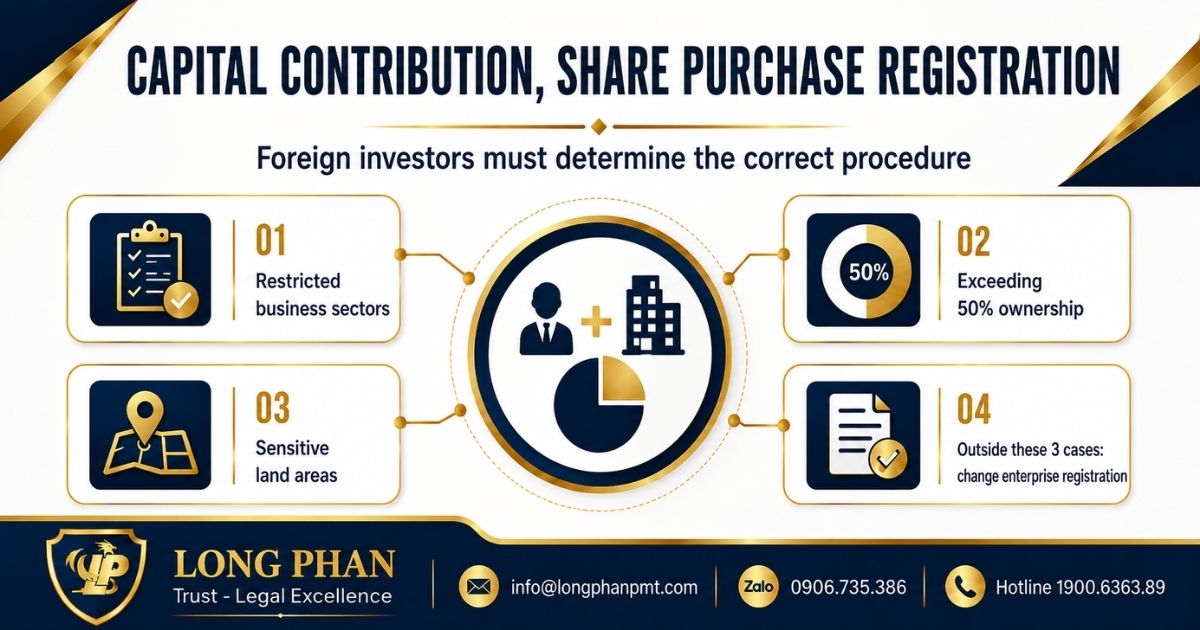
The procedure for applying for an Investment Registration Certificate is a mandatory procedure for foreign investors and economic organizations with foreign investment capital. For domestic investors, an Investment Registration Certificate is not a mandatory condition to carry out investment activities, except in cases where the project is granted land, leased land, or allowed to change land use purpose by the State, or the project is subject to investment policy approval.
According to the provisions of Article 35 and Article 36, Decree No. 31/2021/ND-CP, the procedure for granting an Investment Registration Certificate is carried out through the following steps:
For investment projects subject to investment approval, based on the Decision approving investment policies, Decision approving investment policy adjustments, the investment registration agency shall issue or adjust the Investment Registration Certificate within 05 working days from the date of receiving the Decision approving investment policies, Decision approving investment policy adjustments.
For investment projects not subject to investment approval, implementation is as follows:
Step 1: Prepare documents
Organizations and individuals preparing dossiers to apply for an Investment Registration Certificate include:
Step 2: Assess the conditions of the application
The investment registration agency conducts appraisal of the conditions for granting investment registration certificates, specifically as follows:
Step 3: Issue investment registration certificate
The investment registration agency carries out procedures for granting an Investment Registration Certificate within 15 working days from the date of receiving valid documents for projects not subject to investment policy approval.
The procedure for changing land use purpose is a mandatory procedure when an investment project needs to change the land use purpose from the current purpose to another purpose in accordance with the approved investment policy. Procedures for changing land use purposes are specified in Article 44, Decree No. 102/2024/ND-CP, including the following steps:
Step 1: Prepare documents and submit documents.
Investors submit applications to change land use purposes at the competent Natural Resources and Environment agency.
Application for change of land use purpose includes:
Step 2: Appraise documents and submit documents to competent authorities.
State agencies evaluate dossiers in cases where the dossiers are incomplete or invalid; Review and check documents; Conduct field inspection and then submit to the competent authority to decide on permission to change the land use purpose.
Step 3: Transfer information to the Tax authority.
The agency with land management functions transfers cadastral information of the land plot to the tax authority. The tax authority determines the land use fee and land rent payable according to regulations and issues a notice of payment of land use fee and land rent to the land user.
Step 4: Individuals and organizations complete financial obligations.
Land users pay land use fees and land rents according to the provisions of law on land use fees and land rents.
After that, the tax authority confirms the completion of payment of land use fees and land rent and sends notification of results to the agency with land management functions.
Step 5: Update and edit information.
The agency with land management function submits to the competent authority to sign and issue the Certificate and carry out the work specified in Clause 4, Article 228, Land Law 2024. The Land Registration Office or Land Registration Office Branch is responsible for updating and adjusting the land database and cadastral records.
>>> See more: Application for investment registration certificate and drafting consultation.

Long Phan Consulting Company provides in-depth consulting services on implementing investment projects using land, supporting investors in implementing complex procedures related to investment and land. With a team of highly experienced and specialized experts in the field of investment, Long Phan Consulting Company provides comprehensive services on investment procedure consulting.
Consulting services on investment policy approval procedures include:
Long Phan Consulting Company also provides consulting services on environmental impact assessment, site clearance, and construction procedures related to investment projects using land. With in-depth experience and comprehensive understanding of investment and land law, Long Phan Consulting Company is committed to supporting investors in completing legal procedures effectively and in accordance with regulations.
Below are frequently asked questions about procedures for implementing investment projects when using land.
The selection of investors for projects using land usually takes place through auction of land use rights, bidding for investor selection, or investor approval.
The first and most important step is the investment policy appraisal procedure.
The Provincial People’s Committee has the authority to approve when an investment project requests the State to allocate land, lease land without auction, bidding, or propose changing the land use purpose.
The investment registration agency must notify investors of the results within 35 days from the date of receipt of the dossier.
The next procedure is to apply for land allocation or land lease to implement an investment project.
Dossiers should be submitted at the One-Stop Department according to regulations of the Provincial People’s Committee on receiving dossiers and returning results of administrative procedures at all levels.
Documents usually include an application for land allocation or an application for land lease, along with related legal documents such as the investment policy approval decision or investor selection results.
Implementing investment projects using land requires compliance with many complex procedures. Please contact Long Phan Consulting Company immediately via the hotline: 0906735386 for comprehensive support from investment policy approval procedures to land, environment and construction procedures. Our team of experienced experts will help customers save time, costs and ensure investment projects comply with current legal regulations.