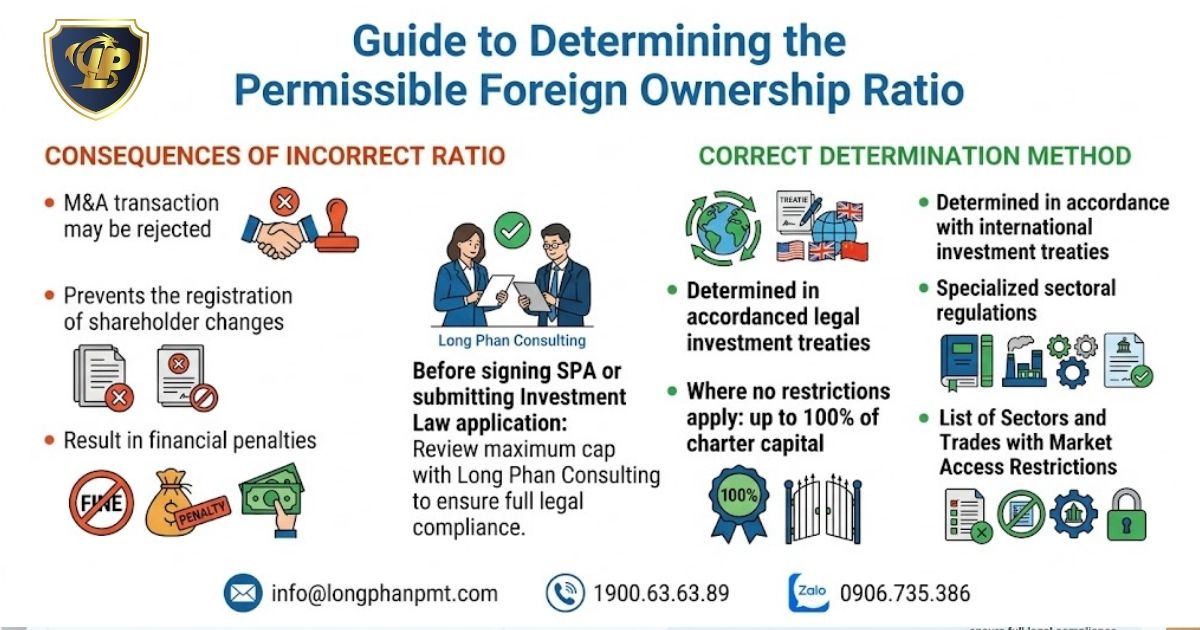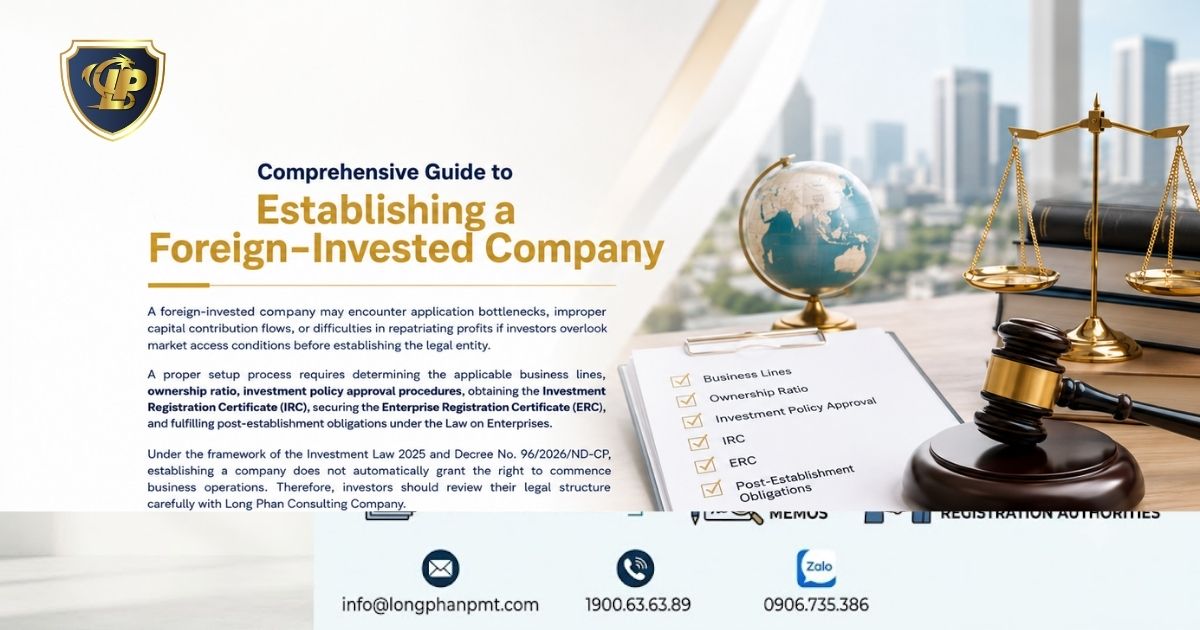

Long Phan Consulting addresses one of the most common questions investors raise when preparing M&A dossiers or establishing foreign-invested enterprises: what is the current maximum foreign investor capital contribution ratio, and which business sectors are subject to specific ownership caps? Under the 2025 Law on Investment, the general principle is full market access, with ownership ratios restricted only where the relevant business sector falls within the restricted market access list or where specialized legislation imposes a separate limit, such as in banking or securities. This article provides a comprehensive analysis of the applicable legal principles, ownership ratios for specific regulated sectors, and procedures for recording capital contribution ratios under current investment law.

Important Notes:
Before identifying the specific ratio for each industry, investors should understand three groups of principles that form the legal framework. These are the default open-market principle, the classification of business lines under Appendix I, and the order of priority applied when an international treaty or a legal gap exists.
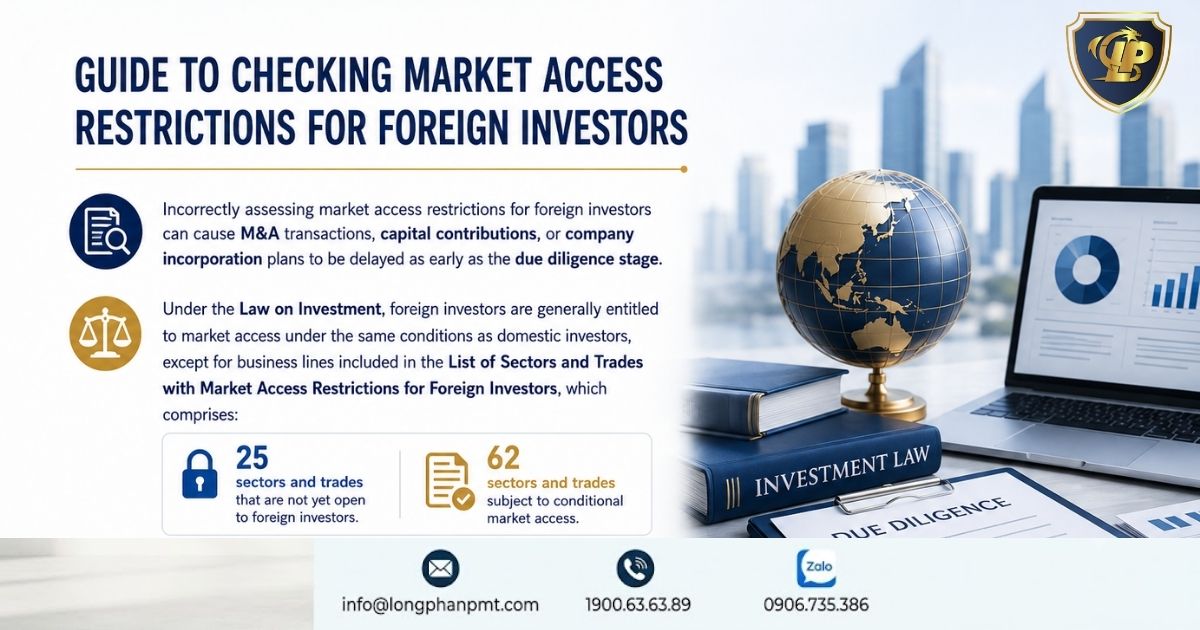
Clause 1, Article 8 of the Law on Investment 2025 provides that foreign investors apply the same market-access conditions as domestic investors. This applies except where the business line falls under the list of business lines with restricted market access. Article 17 of Decree No. 96/2026/ND-CP restates this principle and assigns the Ministry of Finance to publish the specific market-access conditions. A business line not named in the restricted list is, by default, fully open, with no cap on the foreign investor’s charter capital ownership.
Appendix I to Decree No. 96/2026/ND-CP divides business lines with restricted market access into two main sections. Section A lists business lines not yet open to market access, meaning foreign investors may not invest in any form. Section B lists business lines with conditional market access, where the ownership ratio condition is one of the conditions published under Article 18 of Decree No. 96/2026/ND-CP. A business line outside these two sections is considered unrestricted and follows the default open-market principle.
For business lines where Vietnam has made market-opening commitments under international treaties such as the WTO, CPTPP, or EVFTA, Clause 10, Article 17 of Decree No. 96/2026/ND-CP applies. This provision requires that the more favorable opening level between domestic regulations and the international commitment be applied. Investors from member countries of these trade agreements should check the specific services commitment schedule before determining the ownership ratio permitted.
For business lines not listed under Appendix I and without a specific international commitment, Article 17 of Decree No. 96/2026/ND-CP applies a presumption favorable to the investor. Without a basis for restriction, the ownership ratio is not capped. Investors should nonetheless check specialized law before reaching a conclusion, since certain specific sectors set their own ratio outside the scope of the Law on Investment.
>>>See more: What are the principal contracts? When should this contract be applied?

Certain sectors have specialized legal instruments setting a specific ownership ratio, entirely separate from the general framework of the Law on Investment and Decree No. 96/2026/ND-CP. Investors operating in the sectors below must apply the specialized law as a priority.
Article 7 of Decree No. 01/2014/ND-CP, as amended by Decree No. 69/2025/ND-CP, sets ownership limits for foreign investors in a Vietnamese credit institution. A foreign individual may not exceed 5% of charter capital. A foreign organization that is not a credit institution may not exceed 15%, and a single foreign investor together with related persons may not exceed 20%. The total ownership of all foreign investors may not exceed 30% of the charter capital of a commercial bank, and may not exceed 50% for a non-bank credit institution. For a commercial bank receiving a mandatory transfer, total foreign ownership may exceed 30% but must not exceed 49%, in line with the approved transfer plan.
Clause 1, Article 139 of Decree No. 155/2020/ND-CP, as amended by Clause 5, Article 2 of Decree No. 245/2025/ND-CP, sets the maximum foreign ownership ratio at a public company in order of priority. This amendment took effect from 11 September 2025. First, an international treaty applies if the business line has a specific commitment. If not, the relevant specialized law applies, and if the business line falls under the restricted market-access list, the ratio stated in that list applies. Decree No. 245/2025/ND-CP also abolishes the shareholders’ meeting’s authority to set a foreign ownership ratio lower than the statutory level, in order to maximize the opening of the securities market to foreign capital.
Clause 2, Article 21 of the Law on Investment 2025 governs capital contribution, share purchase, or purchase of contributed capital by a foreign investor into certain economic organizations. These are economic organizations holding land use rights on an island, or in a commune, ward, special zone, border area, or coastal commune or ward. Such a transaction must comply with separate land-related conditions, in addition to the market-access conditions under Article 8. An economic organization holding land use rights in these areas typically requires an additional step of obtaining the opinion of the national defense and security authorities before completing the capital contribution transaction.
>>>See more: The secret compliance with legal regulations for business
The table below summarizes the ratios above by sector, with the corresponding legal basis, for quick reference.
| Sector | Maximum Ratio | Legal Basis |
| Business lines outside Appendix I to Decree No. 96/2026/ND-CP | No cap | Clause 1, Article 8, Law on Investment 2025; Article 17, Decree No. 96/2026/ND-CP |
| Business lines under Section A of Appendix I (not yet open) | 0% | Articles 15 and 17, Decree No. 96/2026/ND-CP |
| Business lines under Section B of Appendix I (conditional access) | As published in the specific condition | Article 18, Decree No. 96/2026/ND-CP |
| Foreign individual at a credit institution | ≤ 5% of charter capital | Article 7, Decree No. 01/2014/ND-CP (amended by Decree No. 69/2025/ND-CP) |
| Foreign organization (not a credit institution) at a credit institution | ≤ 15% of charter capital | Article 7, Decree No. 01/2014/ND-CP (amended by Decree No. 69/2025/ND-CP) |
| One foreign investor and related persons at a credit institution | ≤ 20% of charter capital | Article 7, Decree No. 01/2014/ND-CP (amended by Decree No. 69/2025/ND-CP) |
| Total foreign ownership at a commercial bank | ≤ 30% of charter capital | Article 7, Decree No. 01/2014/ND-CP (amended by Decree No. 69/2025/ND-CP) |
| Total foreign ownership at a non-bank credit institution | ≤ 50% of charter capital | Article 7, Decree No. 01/2014/ND-CP (amended by Decree No. 69/2025/ND-CP) |
| Public companies, securities companies | International treaty → specialized law → restricted list | Clause 1, Article 139, Decree No. 155/2020/ND-CP; Clause 5, Article 2, Decree No. 245/2025/ND-CP |
| Economic organization with land in island, border, or coastal areas | As per separate land conditions | Clause 2, Article 21, Law on Investment 2025 |
Investment law distinguishes two legal situations when a foreign investor establishes an ownership ratio: contributing capital that increases charter capital, and purchasing contributed capital or shares from an existing owner. Each situation follows a different legal basis and procedure.
Clause 1, Article 74 of Decree No. 96/2026/ND-CP lists three forms of capital contribution. The first is purchasing shares issued for the first time or additionally issued by a joint stock company. The second is contributing capital to a limited liability company or a partnership, and the third is contributing capital to another economic organization.
Clause 2, Article 74 provides that purchasing shares or contributed capital from the company or from an existing shareholder or member is a capital transfer transaction. This transaction does not increase the charter capital of the economic organization.
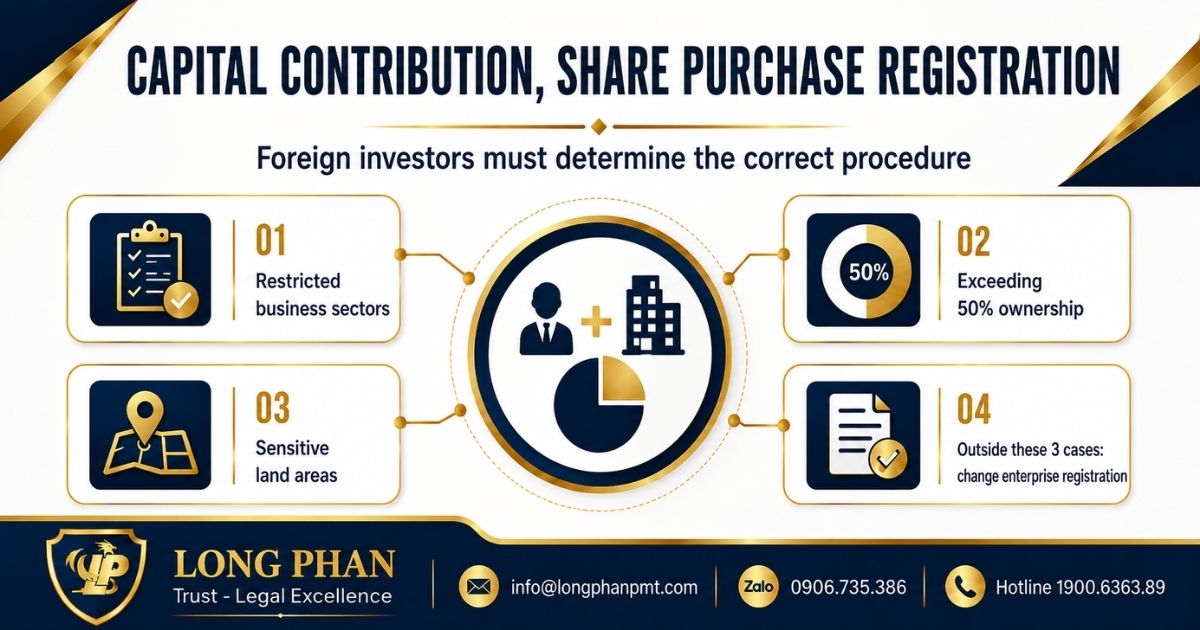
Clause 3, Article 21 of the Law on Investment 2025 requires a foreign investor to register capital contribution, share purchase, or purchase of contributed capital before a change of member or shareholder. This is required in one of three cases. The contribution increases the foreign ownership ratio in a business line with conditional market access, or it results in foreign ownership exceeding 50% of charter capital. Alternatively, the economic organization holds a land use rights certificate in an island, border, or coastal area.
Clause 4, Article 76 of Decree No. 96/2026/ND-CP requires the investment registration authority to review the contribution conditions and notify the result within 10 working days from receipt of a valid dossier. This review checks the market-access conditions and the conditions under Clause 4, Article 75 of Decree No. 96/2026/ND-CP.
Where the economic organization holds land in an area affecting national defense or security, a further step applies. Clause 5, Article 76 of Decree No. 96/2026/ND-CP requires the investment registration authority to seek the opinion of the provincial military command and the provincial police within 2 working days.
Outside the mandatory prior-registration cases under Clause 3, Article 21 of the Law on Investment, Clause 2, Article 76 of Decree No. 96/2026/ND-CP applies. It allows the economic organization to register the change of member or shareholder directly with the business registration authority, without going through the appraisal step at the investment registration authority. This is the common route where the share purchase does not raise sensitive issues concerning a restricted business line or land.
Following the abolition of the two-tier local government model, the Business Registration Division now sits under the Department of Finance. It receives dossiers for registering a change of member or shareholder for a foreign-invested economic organization by locality. For a dossier subject to prior registration with the investment registration authority, the investor files with the authority that issued the Investment Registration Certificate, or the authority with jurisdiction over the project’s locality.

Most dossiers are returned or face delayed appraisal not because documents are missing, but because the wrong legal basis is applied or a specialized condition is overlooked. Below are the five most common errors in practice when processing foreign capital contribution dossiers.
Applying the expired Decree No. 31/2021/ND-CP instead of Decree No. 96/2026/ND-CP, which has applied since 31 March 2026, resulting in an incorrect dossier basis and incorrect forms. Overlooking the ownership ratio condition under specialized law, such as Article 7 of Decree No. 01/2014/ND-CP for banking or Article 139 of Decree No. 155/2020/ND-CP for securities. This occurs where a business line is governed by both the Law on Investment and specialized law at the same time. Failing to redetermine the enterprise’s legal status once foreign ownership exceeds 50% of charter capital under Article 20 of the Law on Investment No. 2025. This causes the next investment dossier to be assessed under the wrong conditions. Confusing the form of capital contribution that increases charter capital (Clause 1, Article 74, Decree No. 96/2026/ND-CP) with the form of purchasing contributed capital or shares from an existing owner (Clause 2, Article 74). This confusion results in the wrong dossier and the wrong receiving authority. Skipping the step of seeking the opinion of the national defense and security authorities under Clause 5, Article 76 of Decree No. 96/2026/ND-CP. This step applies where the target economic organization holds land use rights in a sensitive area, and skipping it causes the appraisal period to be extended.
For transactions involving foreign investors, incorrectly determining the maximum permitted capital contribution ratio or overlooking sector-specific conditions may delay an M&A transaction or even require divestment after funds have already been transferred. Long Phan Consulting provides comprehensive support for the following matters, with each service tied to a specific legal basis to help ensure that the dossier is properly assessed from the outset:
Clients may send their case documents via email at info@longphanpmt.com or via Zalo at 0906.735.386 for a preliminary assessment.
Below are common questions raised by investors when preparing dossiers for capital contributions or share acquisitions involving foreign investors, together with the relevant legal basis for each answer.
There is no single percentage applicable to all business sectors. Sectors not listed in Appendix I to Decree No. 96/2026/ND-CP are generally not subject to a foreign ownership cap, while sectors listed in Section B of Appendix I are subject to the specific ratios published in accordance with Article 18 of Decree No. 96/2026/ND-CP. Long Phan Consulting can review the target sector and determine the applicable ownership ratio for each specific case.
Business sectors listed in Section B of Appendix I to Decree No. 96/2026/ND-CP, together with sectors governed by specialized legislation such as banking under Decree No. 01/2014/ND-CP and securities under Decree No. 155/2020/ND-CP, are subject to specific ownership limits. Long Phan Consulting’s sector review service helps investors determine from the outset whether the intended business sector is subject to foreign ownership restrictions.
Yes. Article 20 of the 2025 Law on Investment provides that an economic organization in which foreign investors hold more than 50% of the charter capital must satisfy the conditions and follow the investment procedures applicable to foreign investors when making further capital contributions or implementing other investment projects. Long Phan Consulting advises on ownership restructuring options to help enterprises proactively comply with this requirement.
Under Article 7 of Decree No. 01/2014/ND-CP, as amended by Decree No. 69/2025/ND-CP, the aggregate shareholding of all foreign investors in a commercial bank may not exceed 30% of its charter capital. Within this limit, a foreign organization may hold no more than 15%, while an individual foreign investor may hold no more than 5%. For banking M&A transactions, Long Phan Consulting reviews the existing ownership structure before signing to help avoid exceeding the statutory cap.
Clause 1, Article 139 of Decree No. 155/2020/ND-CP, as amended by Decree No. 245/2025/ND-CP, determines the applicable ratio in the following order: international treaties where specific commitments exist, then specialized legislation, and finally the list of restricted market access sectors where the company operates in such a sector. Long Phan Consulting assists investors in determining the correct order of application for each specific public company.
Not automatically. Article 100 of Decree No. 96/2026/ND-CP provides transitional rules for investment dossiers and projects submitted or implemented before the Decree took effect, helping preserve investors’ existing rights and ensure continuity. Long Phan Consulting reviews previously issued dossiers to determine the scope of the transitional provisions applicable to each specific case.
Only where the transaction falls within one of the three cases specified in Clause 3, Article 21 of the 2025 Law on Investment, for example, where the transaction increases foreign ownership above 50% of the charter capital. Outside these cases, Clause 2, Article 76 of Decree No. 96/2026/ND-CP allows registration to be carried out directly with the business registration authority. Long Phan Consulting prepares the required dossiers and works with the competent authorities in both situations.
Determining the correct foreign investor capital contribution ratio requires four steps: reviewing the target business sector under Appendix I to Decree No. 96/2026/ND-CP, checking applicable specialized legislation, identifying the maximum permitted ownership ratio, and preparing the appropriate dossier for the capital contribution or share acquisition transaction. An error at any of these stages may delay an M&A transaction or require the process to be redone. Long Phan Consulting supports investors throughout the entire review and registration process. Please contact Hotline 1900636389 for assistance.
📚 This article has been professionally reviewed based on the following legal documents: