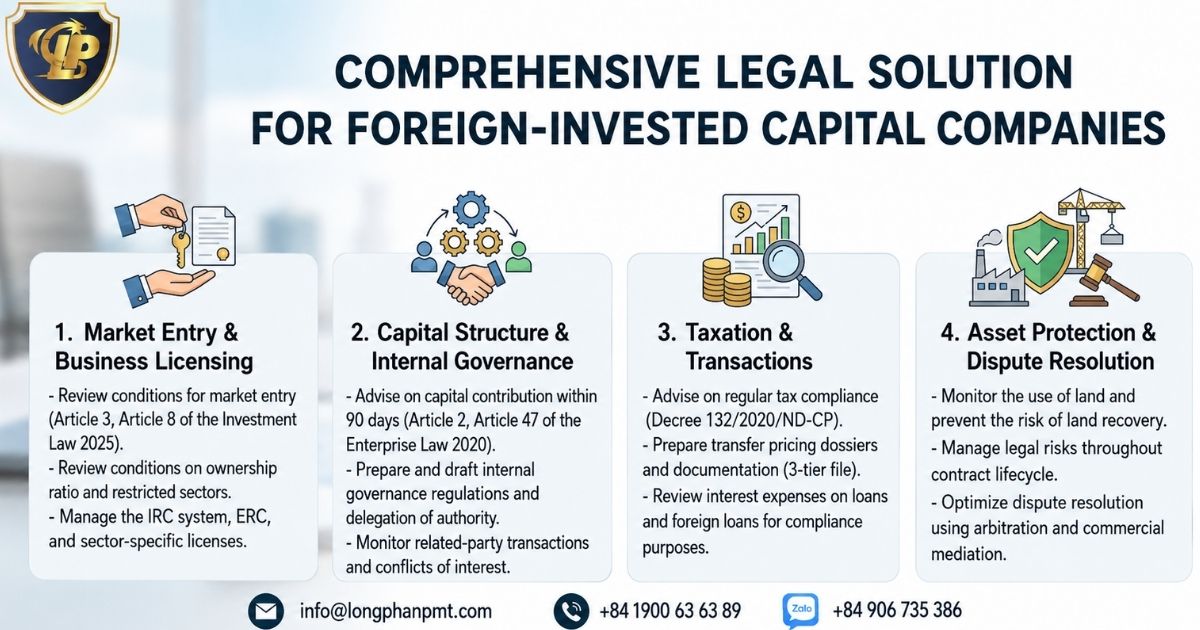
Comprehensive legal solutions for foreign invested capital companies may face licensing delays, tax arrears, or loss of control if their investment structure, capital, land, and contracts are not assessed comprehensively. Legally, a “foreign-invested economic organization” is an economic organization with foreign investors as members or shareholders, according to Clause 22, Article 3 of the 2025 Law on Investment. Therefore, businesses need to manage risks ranging from market access conditions to trade disputes. The protection strategy must be designed as an inter-sectoral compliance system Long Phan Consulting Company.
Important legal note:
The first risk for foreign-owned companies in Vietnam lies not in their documentation, but in their ability to gain market entry. If the industry, ownership structure, or investment model is unsuitable, the investor may be denied a license or required to restructure the transaction.
Before signing any contract for capital contribution, share purchase, or establishment of a legal entity, investors need to simultaneously review the following mandatory conditions:
This review helps management identify legal bottlenecks early on, avoiding investment in structures that cannot operate or scale after licensing.
Foreign investors can own 100% of the capital in a limited liability company in Vietnam if the business sector is not restricted and meets the market access requirements. Otherwise, the business must design an appropriate ownership ratio, Vietnamese partner, or scope of operation before submitting the application.
To minimize the risk of transactions being blocked after signing, the due diligence process should be carried out in the following order:
When businesses adjust projects, add new business lines, or conduct new M&A activities, existing conditions must be reviewed. This is a crucial control point to protect the legality of foreign capital flows.
IRC, ERC, and specialized licenses are not the same type of document. Risks arise when FDI companies expand their business activities, change locations, or implement project objectives that were not recorded in the licensing documents.
| Criteria | IRC | ERC | Specialized business license |
| Legal nature | Record the investment project, its objectives, scale, location, and investor. | Record the legal status, charter capital, legal representative, and business information. | Allowing businesses to operate in sectors and professions subject to conditional investment and business regulations. |
| Control time | Before or during the project setup and adjustment phase. | When establishing or changing business information | When operating in specialized sectors such as retail, education, healthcare, or logistics. |
| Significant risks | Activities outside the project objectives or changes to location that have not been adjusted. | False declarations, forged documents | The business is operating but lacks the necessary operating licenses. |
| Basis to note | Article 24 of the 2025 Investment Law | Clause 1, Article 69 of Decree No. 168/2025/ND-CP | Depending on the type of business investment specified in the project dossier. |
Businesses operating under an Investment License or Investment Certificate that also serves as a Business Registration Certificate may continue to operate according to the content already granted. This regulation ensures legal continuity, as stipulated in Clause 1, Article 119 of Decree No. 168/2025/ND-CP.
However, when adjusting projects, changing business lines, or expanding operations, businesses need to update their corresponding certification systems. Falsified declarations can lead to the risk of having their Business Registration Certificate revoked, according to Clause 1, Article 212 of the 2020 Enterprise Law.
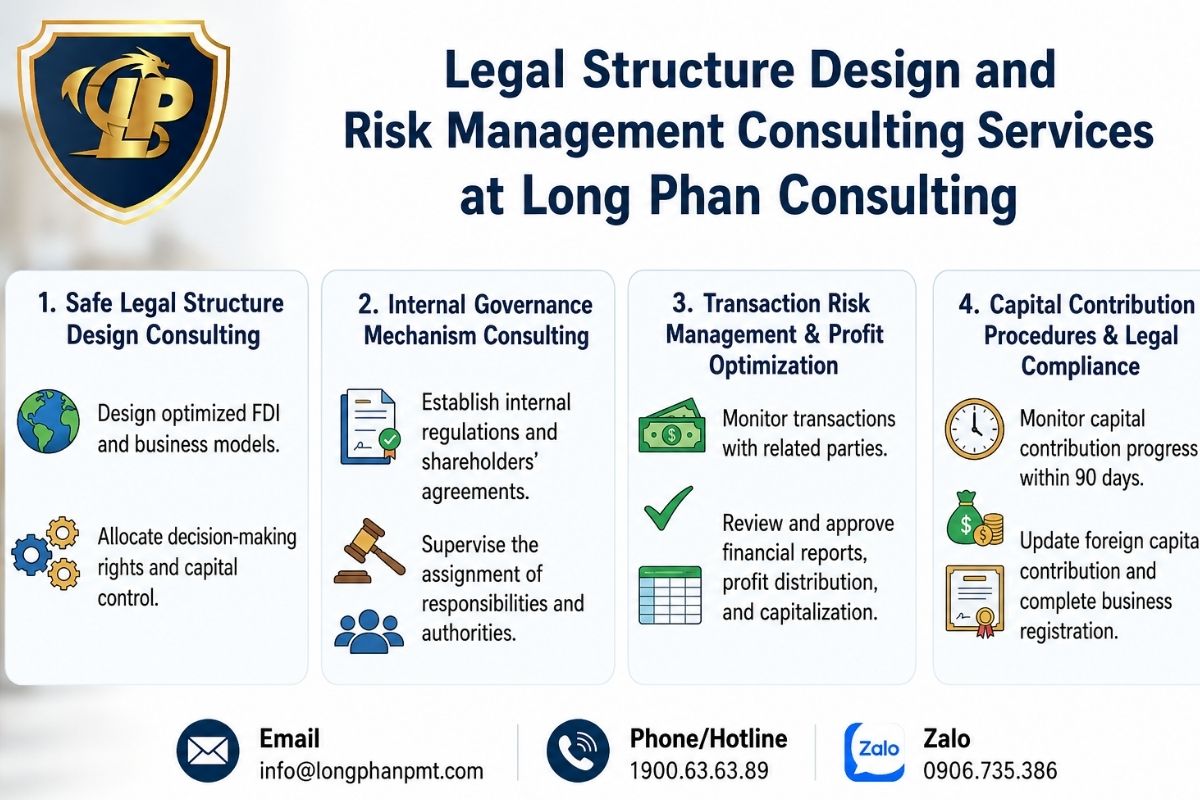
The legal structure of a Foreign-Invested Enterprise in Vietnam directly dictates capital control, veto rights, and the ability to protect investors during internal conflicts. Risk management must extend beyond simple ownership percentages to include the strategic allocation of power within the Charter, Shareholders’ Agreements (SHA), and governance regulations.
The Shareholders’ Agreement and Corporate Charter must address the following core control groups:
Failure to design these structures during the initial capital contribution phase can result in foreign shareholders holding significant capital while losing operational control. This risk frequently manifests in joint ventures, post-M&A target companies, and distribution structures within Vietnam.

Limited Liability Companies (LLCs) are generally suited for tight control structures with a limited number of members and internal restrictions on capital transfers. Conversely, Joint Stock Companies (JSCs) offer greater flexibility for fundraising, share transfers, and the design of diverse shareholder classes.
From an investor protection perspective, the choice of entity should not be based solely on incorporation costs. Enterprises must evaluate the capacity for voting control, personnel appointments, capital transfers, and exit mechanisms.
A secure structure must link economic rights with governance rights. Profits may only be distributed after the enterprise has fulfilled all tax and financial obligations and ensures the ability to pay all due debts, as stipulated in Article 69 of the 2020 Law on Enterprises. Therefore, profit distribution clauses should be coupled with rigorous approval processes for financial statements, auditing, tax compliance, and reserve thresholds. This approach prevents the risk of accounting profits failing to translate into legally repatriated cash flows.
Capital contribution is the primary control point following the incorporation of a Foreign-Invested Enterprise in Vietnam. Failure to meet payment deadlines can jeopardize the ownership structure, voting rights, and the enterprise’s regulatory standing.
The protocol for managing contribution obligations and updating foreign shareholder data should be executed as follows:
Monitoring capital contributions is more than a mere administrative formality; it serves as the legal foundation for proving ownership, the right to receive dividends, and the authority of foreign investors to manage the enterprise.
Tax risks for a Foreign-Invested Enterprise in Vietnam frequently stem from intra-group cash flows. Inter-company loans, management fees, royalties, or internal service charges may be subject to adjustment by authorities if they do not reflect the arm’s length principle.
The legal focus must be placed on related party transactions, beyond the mere threat of transfer pricing allegations. Pursuant to Clause 18, Article 4 of the 2025 Law on Tax Administration, “Related party transactions” refer to transactions arising between parties that maintain a related relationship.
Enterprises engaging in transactions with a parent company or affiliated parties must determine tax obligations based on the arm’s length principle. This mechanism is designed to prevent the shifting of profits out of Vietnam through inappropriate pricing, fees, or interest rates, according to Clause 1, Article 3 of Decree No. 132/2020/ND-CP.
Internal pricing policies must demonstrate the commercial justification for every intra-group fee. If internal service contracts lack evidence of performance, the associated costs may be disqualified for tax deduction purposes.
Enterprises must simultaneously control interest expenses and the specific purposes of foreign loans. The deductible interest expense in related party transactions is capped for Corporate Income Tax (CIT) purposes, as stipulated in Point a, Clause 3, Article 16 of Decree No. 132/2020/ND-CP.
Regarding foreign loans, a Foreign-Invested Enterprise in Vietnam may only utilize capital to implement investment projects, production and business plans, or debt restructuring, pursuant to Clause 2, Article 17 of Circular No. 08/2023/TT-NHNN. The total outstanding medium and long-term debt serving the project must not exceed the difference between the total investment capital and the contributed capital recorded on the licenses, according to Point b, Clause 1, Article 18 of Circular No. 08/2023/TT-NHNN.
| Tax Risk | Sanction or Limitation | Legal Basis |
| Exceeding short-term foreign debt limits | 30% of total equity for commercial banks; 150% for foreign bank branches and other credit institutions. | Article 15, Circular No. 08/2023/TT-NHNN. |
| Under-declaration of tax payable | Penalty of 10% to 20% of the under-declared tax amount. | Points a & b, Clause 3, Article 44, Law on Tax Administration 2025. |
| Tax Evasion | Penalty of 1 to 3 times the evaded tax amount. | Point c, Clause 3, Article 44, Law on Tax Administration 2025. |
| Corporate Tax Violations | Fines for organizations are double those applicable to individuals. | Clause 4, Article 44, Law on Tax Administration 2025. |
Transfer pricing documentation should not be prepared only after a tax audit decision has been issued. To protect the reasonableness of internal prices, fees, and interest rates, a Foreign-Invested Enterprise in Vietnam must establish its documentation prior to any tax inspection cycle.
The documentation must be organized according to the following three-tier structure:
Enterprises are required to prepare and maintain these files to provide them upon request by the tax authorities, pursuant to Clause 4, Article 18 of Decree No. 132/2020/ND-CP. The submission deadline is no more than 30 working days, with a one-time extension of up to 15 working days granted for justifiable reasons, as per Clause 7, Article 18 of Decree No. 132/2020/ND-CP.
Enterprises may be exempt from preparing this documentation if their annual revenue is below 200 billion VND and they achieve a minimum net profit margin of 5% for distribution, 10% for manufacturing, or 15% for toll manufacturing. These conditions are specified in Point c, Clause 2, Article 19 of Decree No. 132/2020/ND-CP.
Failure to maintain compliant records from the outset may lead to tax reassessments, the disqualification of deductible expenses, and prolonged disputes with tax authorities – posing a direct financial risk to profits intended for repatriation to the parent company.
The production assets of a Foreign-Invested Enterprise in Vietnam typically reside within three risk layers: land-use rights, manufacturing facilities, and supply chain contracts. A legal failure in any single layer can disrupt operational plans, financing, and export capabilities.
A comprehensive protection strategy must commence prior to signing land leases, factory rentals, or OEM and logistics agreements. Investors must maintain control over property rights, project timelines, environmental obligations, fire safety (PCCC), and contract breach resolution mechanisms.
For manufacturing projects, a sub-lease agreement for land or a factory within an industrial park is more than a simple property transaction; it is the legal basis for installing production lines, obtaining operational permits, securing assets, and maintaining a business location.
Foreign-invested economic organizations that lease land from the State with a one-time lump-sum payment for the entire lease term have the right to transfer land-use rights, sub-lease the land, and mortgage assets attached to the land at credit institutions authorized to operate in Vietnam, pursuant to Clause 3, Article 41 of the 2024 Law on Land. Furthermore, when operating within industrial parks or clusters, enterprises may sub-lease land with existing infrastructure from the developer to construct factories, a right recognized under Clause 2, Article 43 of the 2024 Law on Land.
The most significant risk is the progress of land use. The State may recover land if a project fails to put the land into use for 12 consecutive months or is 24 months behind the land-use schedule specified in the investment project, according to Clause 8, Article 81 of the 2024 Law on Land.
For existing projects, land-use rights must be reviewed under transitional provisions. Foreign-invested economic organizations that were allocated land with land-use fees prior to the effective date of the new law may continue to use the land for the remainder of the term, pursuant to Clause 2, Article 255 of the 2024 Law on Land. For transactions involving the transfer of real estate projects with incomplete land procedures, state agencies will continue procedures to allocate or lease land to the transferee, as regulated in Clause 16, Article 255 of the 2024 Law on Land.
Supply, distribution, agency, OEM, and logistics contracts should be designed as operational risk control tools. Provisions regarding payment, quality, confidentiality, intellectual property, force majeure, and compensation must be sufficiently clear for enforcement.
Enterprises must also avoid clauses that could be construed as anti-competitive. Agreements to fix prices, share customers, or abuse a dominant market position to impose unfavorable conditions are strictly controlled, pursuant to Articles 11 and 27 of the 2018 Law on Competition. In M&A transactions or supply chain restructures, enterprises must evaluate economic concentration notification obligations. Transactions reaching thresholds in assets, revenue, transaction value, or combined market share must be notified to the National Competition Commission before execution, according to Clause 1, Article 33 of the 2018 Law on Competition and Clause 1, Article 13 of Decree No. 35/2020/ND-CP.
The maximum fine for anti-competitive agreements or abuse of a dominant position can reach 10% of the total revenue in the relevant market for the preceding financial year, pursuant to Clause 1, Article 111 of the 2018 Law on Competition.
When entering contracts with foreign elements, enterprises should select a dispute resolution mechanism within the contract terms. For contracts where at least one party is a foreign investor or a Foreign-Invested Enterprise in Vietnam, the parties may agree to apply foreign law or international investment practices if they do not contravene Vietnamese law, as per Clause 6, Article 4 of the 2025 Law on Investment.
Commercial arbitration is often preferred for its confidentiality, expertise, and the clarity of award enforcement. Selection criteria should be based on:
For investment-related disputes with Vietnamese state agencies, foreign investors may choose Vietnamese Arbitration or Vietnamese Courts under Clause 4, Article 13 of the 2025 Law on Investment. Dispute resolution clauses must therefore be designed proactively before any breach occurs.
Foreign direct investment (FDI) companies need a comprehensive legal system that operates in a coordinated manner, not just handling individual licenses. Long Phan Consulting focuses its services on protecting capital, controlling compliance, and preventing disputes for foreign investors in Vietnam.
Clients can submit project files, contracts, or documents via email:info@longphanpmt.com Or contact us via Zalo: 0906.735.386 for a preliminary legal assessment.
Compliance management for foreign-owned companies in Vietnam requires management to closely monitor risks arising during actual operations. A lack of synchronization between ownership structure, related-party transactions, and land use regulations can lead to serious consequences such as license revocation or penalties for commercial violations. Thoroughly resolving complex legal situations will help investors protect their capital and maintain project continuity.
Yes, businesses may be granted a temporary exemption by the state authorities for prohibited anti-competitive agreements. Foreign-invested economic organizations must demonstrate that the agreement benefits consumers and promotes technological progress, as stipulated in Clause 1, Article 14 of the 2018 Competition Law.
Yes, foreign investors are allowed to hold 100% of the charter capital if the business sector is not on the List of Sectors Restricted to Market Access. The enterprise must meet the conditions regarding ownership ratio and investment form before registration, as stipulated in Clause 3, Article 8 of the 2025 Investment Law.
The mandatory deadline for submitting transfer pricing documentation to the tax authorities is no more than 30 working days. For justifiable reasons, businesses may be granted an extension of up to 15 working days, as stipulated in Clause 7, Article 18 of Decree No. 132/2020/ND-CP.
Yes, the state agency will revoke the Business Registration Certificate in cases of violations of the truthfulness of the documents. This penalty applies when the declared content is falsified or the business is managed by a person prohibited from establishing a business according to Clause 1, Article 212 of the 2020 Enterprise Law.
Foreign investors have the right to choose the dispute resolution body appropriate to the nature of the case to protect their interests. Disputes concerning investment activities in Vietnam are resolved through Vietnamese arbitration or Vietnamese courts in accordance with Clause 4, Article 13 of the 2025 Investment Law.
Yes, the state will apply land reclamation sanctions to investment projects that violate the committed land use schedule. Project land will be reclaimed if it is not operational for 12 consecutive months or is behind schedule by 24 months, according to Clause 8, Article 81 of the 2024 Land Law.
Businesses that violate antitrust regulations will face very heavy financial penalties based on the scale of their business operations. The maximum penalty for this offense is 10% of the total revenue in the relevant market in the immediately preceding fiscal year, according to Clause 1, Article 111 of the 2018 Competition Law.
Foreign-invested companies in Vietnam are only sustainably protected when “economic organizations with foreign investment” are simultaneously controlled at multiple levels: market access conditions, capital structure, IRC/ERC, taxation, related party transactions, land, contracts, and disputes. A deviation in any control point can lead to licensing delays, tax arrears, loss of management rights, or reduced capital recovery. To establish a secure legal structure before investing, M&A, or expanding operations in Vietnam, your company should contact our Hotline 1900636389 To receive strategic support from Long Phan Consulting Company.