


Fire fighting, rescue, and emergency response plan that does not accurately reflect the actual conditions may leave the facility unprepared during inspections, increase the risk of temporary suspension or shutdown, and expose the head of the facility to legal liability. From July 1, 2025, facilities subject to fire prevention and fighting management are required to develop, approve, and implement response plans in accordance with the 2024 Law on Fire Prevention, Firefighting, Rescue, and Emergency Response, while also ensuring compatibility with internal governance documentation and the Law on Enterprises and Businesses. An appropriate solution is to standardize documentation, response scenarios, on-site emergency teams, and drill records with Long Phan Consulting Company.

Important legal note:
A fire prevention, fighting, and rescue plan operates as a mandatory risk management condition rather than a mere administrative formality. When a physical site is classified among the facilities subject to FPF management, the head of the facility must organize and maintain safety conditions, assuming direct legal liability pursuant to Clause 11, Article 2 of the 2024 Law on Fire Prevention, Fighting and Rescue.
Enterprises must audit their facilities based on actual functional use, operational scale, and the inherent risk of fire and explosion. Pursuant to Clause 7, Article 2 of the 2024 Law on Fire Prevention, Fighting and Rescue, managed facilities encompass buildings, structures, and sites utilized for residential, manufacturing, commercial, or business operations listed under the official Government schedule.
Foreign investors must specifically review the following asset classes:
Misclassifying a facility immediately triggers severe budgetary, personnel, and compliance risks. Enterprises must cross-reference Appendix I and Appendix II of Decree No. 105/2025/ND-CP prior to designing their rescue operations plan and deploying grassroots personnel.
The Board of Directors must initiate compliance reviews by evaluating core operations. They must verify whether the premises serve manufacturing, lodging, commercial, or office functions. If classified among facilities subject to FPF management, the enterprise must maintain a verified fire prevention, fighting, and rescue plan alongside a designated on-site grassroots firefighting team, pursuant to Points d and e, Clause 1, Article 23 of the 2024 Law on Fire Prevention, Fighting and Rescue.
This mandatory audit extends far beyond the registered business lines on an Enterprise Registration Certificate (ERC). Enterprises must physically verify square footage, regular headcount, warehoused inventory, heat sources, electrical grids, escape routes, and existing firefighting equipment. Decree No. 105/2025/ND-CP serves as the exact legal basis for categorizing the site into standard management groups or high-risk fire and explosion classifications.
For mixed-use facilities, severe compliance risks arise when legacy dossiers fail to reflect the actual architectural reality. Expanding warehouse capacities, adding lodging quarters, or executing a change of functional use fundamentally alters the underlying infrastructure. This triggers an immediate shift in statutory compliance obligations.
Possessing a superficially flawless dossier that fails in practical execution creates catastrophic liability for the head of the facility. Competent state authorities evaluate true compliance capacity by auditing on-site command structures, physical escape routes, firefighting equipment functionality, water supplies, and the rapid mobilization capabilities of the grassroots firefighting team.
The most pervasive legal vulnerability occurs when the FPF management dossier contradicts the actual physical facility clearances. Critical errors include copying generic templates, failing to assign specific personnel duties, listing non-existent equipment, or neglecting to update escape route diagrams. These failures completely destroy the enterprise’s ability to defend its compliance position during an unannounced ex-post enforcement inspection.
Foreign investors must pivot from a purely documentary mindset to a strict framework of maintaining continuous safety conditions. Article 23 of the 2024 Law on Fire Prevention, Fighting and Rescue rigidly focuses on the absolute statutory obligation to proactively organize, maintain, and operate a verifiable safety system directly at the physical site.
A fire prevention, fighting, and rescue plan only possesses compliance value when it accurately reflects the actual physical premises, functional usage, active personnel, and available firefighting equipment. The head of the facility holds the exclusive statutory authority to organize the drafting and official approval of this plan, utilizing the mandatory Form No. PC06, pursuant to Clause 1, Article 15 of Decree No. 105/2025/ND-CP.
A legally compliant plan must be engineered as an active internal operational manual, not a superficial descriptive document. The core contents must clearly delineate the facility’s capacity for early detection, alarm activation, safe evacuation, initial firefighting, and the coordinated mobilization of external forces when an incident surpasses on-site capabilities.
A compliant corporate dossier must explicitly integrate:
If a rescue operations plan omits any of these mandatory informational layers, the dossier will immediately lose its legal validity during a physical state inspection. The greatest corporate risk occurs when a plan is theoretically correct on paper, but the operational team lacks the capacity to execute it.
A firefighting scenario must originate directly from the actual risks present at the specific facility; it cannot be copied from a generic template. Whether managing a manufacturing plant, warehouse, hotel, or mini-apartment complex, each zone possesses distinct ignition points, combustible material loads, and specific escape routes.
Enterprises must engineer customized response scenarios for incidents occurring during working hours, after working hours, at night, or during peak occupancy periods. Clause 1, Article 15 of Decree No. 105/2025/ND-CP rigidly requires that the plan detail the hypothetical scenario, the organization of the evacuation, and the specific mobilization of forces and equipment.
The physical floor plan, escape routes, and the exact placement of FPF equipment must perfectly match the current architectural reality. When an enterprise expands a warehouse, alters walkways, installs new partitions, or changes a production line, the legacy plan immediately loses its legal capacity to protect the corporate entity.
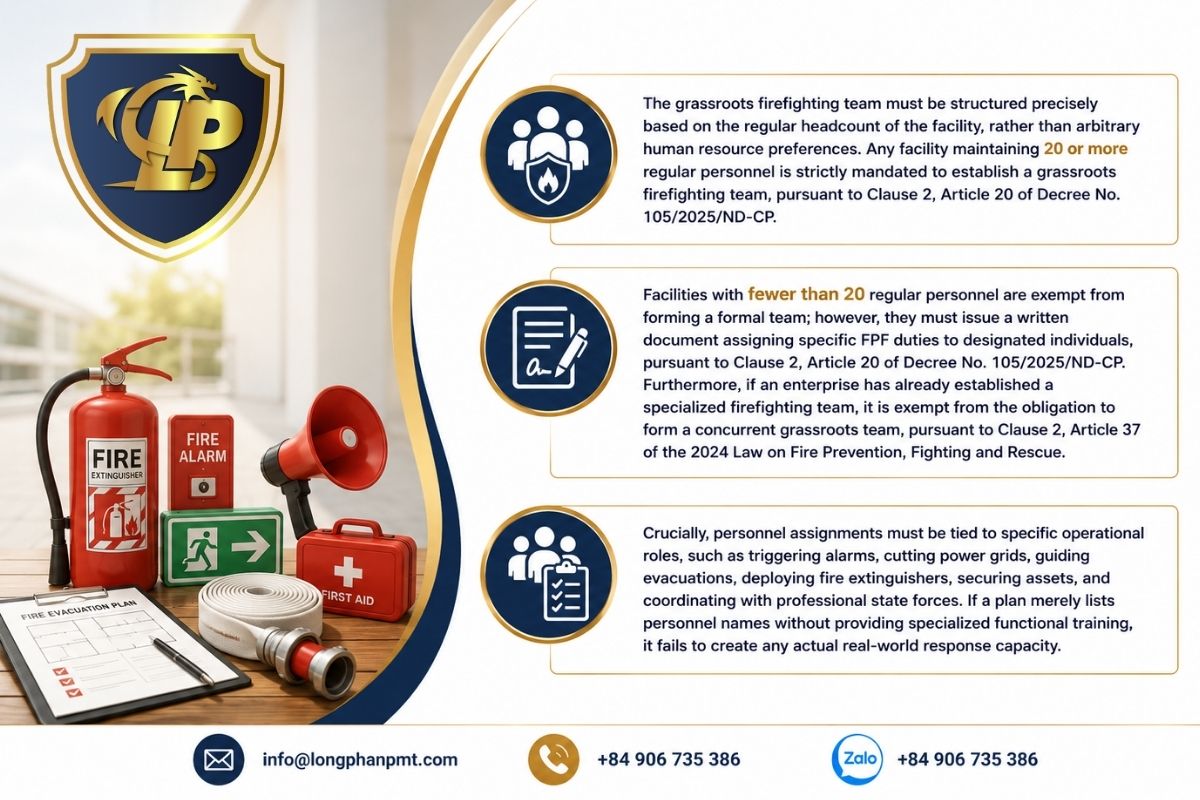
The grassroots firefighting team must be structured precisely based on the regular headcount of the facility, rather than arbitrary human resource preferences. Any facility maintaining 20 or more regular personnel is strictly mandated to establish a grassroots firefighting team, pursuant to Clause 2, Article 20 of Decree No. 105/2025/ND-CP.
| Regular Headcount | Minimum Statutory Quota for the Grassroots Firefighting Team | Legal Basis |
| From 20 to 50 persons | 10 persons, comprising 01 Captain and 01 Deputy Captain | Point a, Clause 5, Article 20 of Decree No. 105/2025/ND-CP |
| Over 50 to 100 persons | 15 persons, comprising 01 Captain and 02 Deputy Captains | Point b, Clause 5, Article 20 of Decree No. 105/2025/ND-CP |
| Over 100 persons | 25 persons, comprising 01 Captain and 03 Deputy Captains | Point c, Clause 5, Article 20 of Decree No. 105/2025/ND-CP |
Facilities with fewer than 20 regular personnel are exempt from forming a formal team; however, they must issue a written document assigning specific FPF duties to designated individuals, pursuant to Clause 2, Article 20 of Decree No. 105/2025/ND-CP. Furthermore, if an enterprise has already established a specialized firefighting team, it is exempt from the obligation to form a concurrent grassroots team, pursuant to Clause 2, Article 37 of the 2024 Law on Fire Prevention, Fighting and Rescue.
Crucially, personnel assignments must be tied to specific operational roles, such as triggering alarms, cutting power grids, guiding evacuations, deploying fire extinguishers, securing assets, and coordinating with professional state forces. If a plan merely lists personnel names without providing specialized functional training, it fails to create any actual real-world response capacity.
The fire prevention, firefighting, and rescue management record does not end at the time the plan is approved. Businesses must implement the plan through inspections, drills, reporting, and data updates according to the risk management cycle.
The proper procedure should begin with the current state of affairs, then be translated into documentation, drills, and evidence recording. Circular No. 36/2025/TT-BCA is an important basis for businesses to organize record management, inspection, and practice of plans according to the new standards.
Without proper record-keeping, businesses struggle to demonstrate that they have maintained safe conditions. This risk often arises when records are complete but lack internship reports, training transcripts, or updated data following renovations.
Firefighting, rescue, and emergency response drills are tests of operational capability, not just demonstrations. Businesses must organize firefighting, rescue, and emergency response drills periodically, at least once a year, in accordance with Point a, Clause 1, Article 16 of Decree No. 105/2025/ND-CP.
The drill should alternate between the simulated scenarios outlined in the plan. The facility can test its ability to sound alarms, cut off power, guide evacuation, use initial firefighting equipment, and coordinate with external forces.
The head of the facility must also organize regular self-inspections of fire safety with a maximum frequency of once a month, in accordance with Clause 1, Article 14 of Decree No. 105/2025/ND-CP. Periodic self-inspections are conducted every six months for high-risk facilities listed in Appendix II and annually for other facilities listed in Appendix I, in accordance with Clause 2, Article 14 of Decree No. 105/2025/ND-CP.
Periodic reports must be submitted.before June 15th and December 15th. Annually, where applicable. This is crucial evidence for the legal department, HSE, or building management to demonstrate ongoing compliance.
The original design may become obsolete when businesses change the function of their buildings, increase warehouse space, add accommodation areas, or adjust emergency exits. This is a risk often overlooked in factories, hotels, mini-apartments, and office buildings.
Businesses must update fire safety data within 3 days of any changes to the information compared to before, according to Clause 2, Article 26 of Decree No. 105/2025/ND-CP. Facilities under management must also complete the equipping and connection of fire alarm communication devices no later than July 1, 2027, according to Clause 4, Article 54 of the Law on Fire Prevention, Fighting and Rescue 2024 and Clause 2, Article 27 of Decree No. 105/2025/ND-CP.
For existing facilities put into operation before July 1, 2025, but which do not meet safety standards, businesses need to assess the feasibility of applying supplementary technical solutions. If the issues cannot be resolved, the facility may be forced to change its function according to Point d, Clause 6, Article 55 of the Law on Fire Prevention, Fighting and Rescue 2024.
The final audit report must explicitly structure settled amounts, payment shortfalls, official incentives, retroactive collection risks, and administrative mitigation schemes. This precision is required because the baseline parameters for calculating all land use fees and land rental values remain strictly tied to land area, specific land valuation methodologies, statutory durations, payment structures, and state incentive policies, pursuant to Clauses 1 and 2, Article 155 of the 2024 Land Law.
When executing a change of land use purpose, the corporate entity must immediately remit land use fees or land rental differentials calculated strictly against the specific land classification applied post-conversion. Similarly, when an enterprise secures an official land use term extension or duration adjustment, the land user falls within an immediate enforcement scope requiring the calculation and payment of land use fees or land rental fees for the exact duration of the extension or adjustment, pursuant to Clauses 1 and 2, Article 156 of the 2024 Land Law.
Furthermore, if a project executes a 1/500 detailed master plan modification that alters the underlying land use structure, relocates internal plot functionalities, or increases the approved land use coefficients—resulting in an escalation of baseline land values—the enterprise is legally required to remit the supplementary financial differential to the State, pursuant to the enforcement mechanisms of Decree 103/2024/ND-CP. For projects operating under leasing structures, any detailed planning modification altering land use compositions, positions, or density metrics mandates an immediate, comprehensive re-calculation of land rental obligations, pursuant to Article 36 of Decree 103/2024/ND-CP.
Navigating the intricate intersection of Vietnam’s evolving land laws, project-specific master plan adjustments, and real estate asset tracking requires highly specialized local expertise to insulate foreign corporate investments. Long Phan Consulting Company delivers comprehensive, inter-agency legal due diligence and land financial risk management specifically designed to safeguard foreign direct investment (FDI) and streamline cross-border corporate operations.
Our senior partners and FDI compliance experts execute the following core legal and administrative tasks:
Foreign investors, CFOs, and multinational executives are invited to transmit current project dossiers, historical land financial notifications, or draft M&A contracts via Email (info@longphanpmt.com) or Zalo/WhatsApp (+84 906 735 386) for an immediate preliminary evaluation.

Problems with fire fighting, rescue, and emergency response plans often arise during the operational phase, functional renovation, and preparation for inspections. Businesses need to correctly identify personnel responsibilities, update milestones, and suspension risks to avoid turning fire fighting/rescue plans into mere “perfunctory” documents. The following content focuses on situations that directly impact cash flow, assets, and the responsibilities of the facility’s head.
Businesses must update fire safety records and data within 3 days of any changes to the information. Increasing warehouse space, adding accommodation areas, or adjusting escape routes may render the old plan ineffective. The 3-day deadline is mandatory to ensure that management data accurately reflects the current state of the facility, as stipulated in Clause 2, Article 26 of Decree No. 105/2025/ND-CP.
Facilities with fewer than 20 employees on a regular basis are not required to establish a fire prevention and fighting team, but must have written assignments specifically designating individuals to perform this task. Businesses should not interpret personnel exceptions as exemption from all fire prevention and fighting/rescue management obligations. The requirement for written assignments is specified in Clause 2, Article 20 of Decree No. 105/2025/ND-CP.
Establishments with 20 or more regular employees must set up a fire fighting team according to the mandatory staffing levels. Establishments with 20 to 50 employees must have a minimum of 10 members, including one team leader and one deputy team leader, as per Point a, Clause 5, Article 20 of Decree No. 105/2025/ND-CP. Establishments with 50 to 100 employees must have a minimum of 15 members, as per Point b, Clause 5, Article 20 of Decree No. 105/2025/ND-CP.
Businesses that have established a specialized fire fighting team are exempt from the obligation to establish a basic fire fighting team. This exemption only applies to the organization of the force and does not eliminate the obligation to develop, practice, and update fire fighting, rescue, and relief plans. The exemption mechanism is stipulated in Clause 2, Article 37 of the Law on Fire Prevention, Fighting, and Rescue 2024.
The facility’s fire fighting, rescue, and emergency response plan must be practiced periodically, at least once a year. Businesses need to rotate simulated scenarios to test command, alarm systems, power outages, evacuation, and initial firefighting. The minimum frequency of once a year is stipulated in Point a, Clause 1, Article 16 of Decree No. 105/2025/ND-CP.
The head of the establishment must organize regular fire safety self-inspections with a maximum frequency of once a month. For periodic self-inspections, high-risk establishments listed in Appendix II must conduct them every six months, while other establishments listed in Appendix I must conduct them once a year. Businesses must submit reports before June 15th and December 15th of each year, in accordance with Clause 1, Article 14 and Clause 2, Article 14 of Decree No. 105/2025/ND-CP.
A facility currently under temporary suspension will be permanently suspended if the violations are not rectified or cannot be rectified by the expiration of the suspension period. The risk of suspension directly impacts contracts, cash flow, labor, and asset exploitation. The penalty for suspension is defined in Point a, Clause 5, Article 46 of Decree No. 105/2025/ND-CP.
A fire prevention, fighting, and rescue plan must be engineered as an active operational risk control mechanism rather than a static administrative dossier. Enterprises must accurately determine their management scope, deploy grassroots forces, execute periodic rehearsals, and continuously update records following any change of functional use to legally insulate the head of the facility with verifiable evidence. Operating with outdated architectural blueprints or lacking rehearsal logs directly jeopardizes your fire prevention and rescue compliance in Vietnam, triggering immediate operational suspensions, paralyzing corporate cash flow, and severely depreciating asset value. To systematically standardize your safety dossiers and prevent unannounced enforcement shutdowns, contact the senior legal experts at Long Phan Consulting Company immediately via Hotline 1900636389.
📚 This article is provided with professional consultation based on the following legal framework:


