
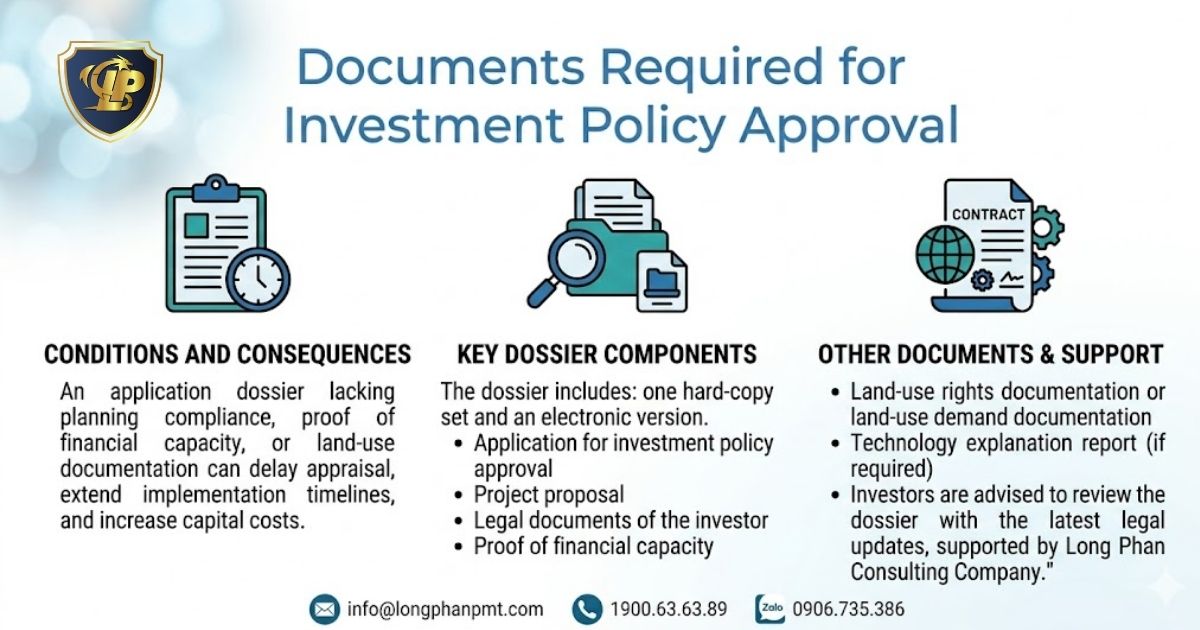
Incomplete documents required for Investment Policy Approval may prolong project appraisal, disrupt implementation schedules, and increase financing costs when planning compatibility, financial capacity, or land-use evidence is missing. Under the Law on Investment, the dossier should include one physical set and an electronic copy containing the application for approval, investment project proposal, investor identification documents, proof of funding capacity, land-use rights or demand records, and a technology explanation where applicable.
Long Phan Consulting assists investors in reviewing and standardizing submissions under the latest regulatory requirements.
Key legal notes:
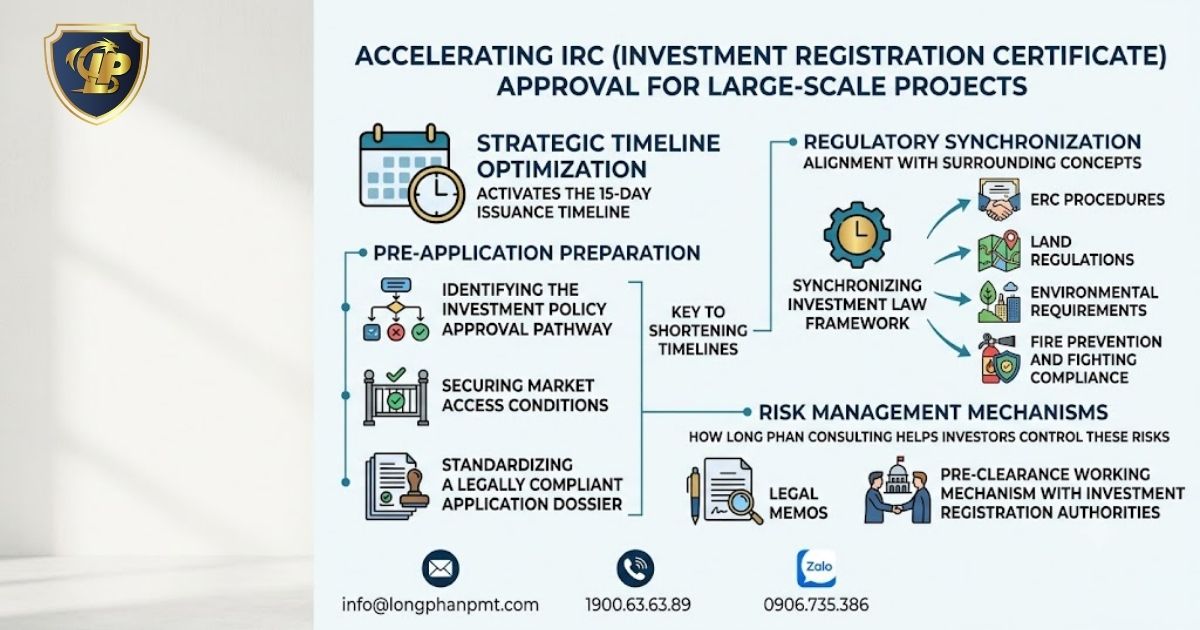
Businesses should not prepare documents out of habit by simply “applying for an investment project license” without first determining whether the project requires approval. Essentially, the procedure for requesting approval of the investment policy is a step where the competent authority reviews the application, project objectives, location, scale, schedule, and implementation deadline and the investor selection mechanism, as stipulated in Clause 1, Article 3 of the Law on Investment 2025.
Project teams typically need to seek investment policy approval, including:
In cases where the law on administrative procedures requires the submission of a document approving the investment policy, but the actual project does not fall under the category requiring approval according to the Investment Law, the investor is allowed to exempt from submitting this document. This exemption mechanism helps businesses avoid unnecessary procedures, according to Clause 11, Article 52 of the Law on Investment 2025.
The compilation of an investment dossier requires more than gathering basic administrative paperwork. It stands as a comprehensive legal blueprint designed to demonstrate the project’s compliance, commercial viability, and the developer’s execution capacity before competent regulators.
The project developer or competent state organ must prepare exactly one physical filing set paired with an identical electronic digital copy. This requirement forms the core baseline for managing documentation responsibilities during investment procedures pursuant to Clause 6, Article 2, Clause 5, Article 6, and Clause 3, Article 32 of Decree No. 96/2026/ND-CP.
An online electronic submission remains contractually secure only if its digital data matches the physical dossier and is validated through appropriate authorization tracks. If an investor logs an online application but fails to submit the physical paperwork within ten working days, the electronic file automatically loses legal validity under Clause 1, Article 41 and Clause 3, Article 42 of Decree No. 96/2026/ND-CP.
An error in verifying the legal status of the investing entity constitutes a fundamental defect that triggers immediate dossier rejection during preliminary administrative screening. For multinational buyers, regulatory exposure centers on corporate incorporation files, professional translations, and the validation path of documents executed outside Vietnam.
The required legal verification files must be organized based on investor classifications:
All files drafted in a foreign language must be accompanied by an authorized Vietnamese translation. The investing entity bears sole legal responsibility for the validity, completeness, and accuracy of every document enclosed within the filing dossier pursuant to Clause 13, Article 2, Clause 2, Article 5, and Point a, Clause 1, Article 6 of Decree No. 96/2026/ND-CP.
Financial capacity validation requires the developer to prove long-term capability to implement the complete project lifecycle, rather than merely presenting a transient cash balance at the exact moment of filing. For large-scale real estate, industrial infrastructure, or complex foreign direct investment (FDI) projects, a weak equity structure significantly reduces approval probability.
Vietnamese regulations allow developers to deploy a combination of financial instruments to verify capital capability. Evaluating authorities are strictly prohibited from enforcing arbitrary documentation requirements beyond the statutory components listed in the regulations pursuant to Point c, Clause 1, Article 32 and Point b, Clause 1, Article 6 of Decree No. 96/2026/ND-CP.
| Financial Validation Instrument | Statutory Operational Value | Compliance Vulnerability Controls |
| Two Most Recent Corporate Financial Statements | Demonstrates historical financial performance and verified equity structures. | Extended balance sheet losses can undermine project commercial viability. |
| Certified Bank Account Statements or Balance Confirmations | Proves immediate liquid cash reserves are available for project launch. | Short-term deposits are often flagged for lacking capital stability over the project lifecycle. |
| Financial Capacity Credit Comfort or Guarantee Letters | Accelerates approval for large-scale developments requiring major funding. | The instrument must detail explicit value limits, scopes, and active durations. |
| Corporate Parent or Institutional Funding Commitments | Fits corporate group restructuring or backed subsidiary setups well. | Non-binding or loose funding text is flagged as an insufficient financial structure. |
Corporate financial statements are not automatically required to be audited unless mandated by specialized industry legislation. However, the developer must conclusively demonstrate complete alignment between the total project investment capital, the minimum required equity allocation, and the structured external debt financing plan.
The Investment Project Proposal must look past basic compliance forms. It functions as the core analytical document used by inter-agency appraisal committees to evaluate project objectives, economic performance, environmental footprints, land-use footprints, and regional zoning compatibility.
Pursuant to Point d, Clause 1, Article 32 of Decree No. 96/2026/ND-CP and Circular No. 55/2026/TT-BKHĐT, the Investment Project Proposal must be drafted using Form I.1.3 and explicitly detail the following essential items:
An incomplete project proposal can lead evaluating authorities to flag the project as commercially unviable, even if all other administrative papers are valid. For complex infrastructure projects, urban planning parameters, land allocations, infrastructure ties, and environmental protections must be synchronized before filing.
Land access represents the primary administrative bottleneck for modern investment policy approval applications. The investing entity must establish a clear legal path showing whether the project controls existing land-use rights, requires direct state land allocations or leaseholds, or must pass through competitive investor selection tracks.
Land utilization scenarios must be classified into the following statutory categories:
For projects subject to mandatory policy approval, competent state authorities can grant simultaneous investor approval without a public auction or tender if the developer holds valid land-use rights or has successfully completed a compliant transfer of agricultural land titles under Clause 4, Article 23 of the 2025 Law on Investment.
Not every investment application requires a technological explanation report. This technical file becomes a mandatory statutory requirement only when the proposed development utilizes technology from restricted transfer lists or falls under specialized national technology reviews.
For manufacturing plants, FDI projects transferring industrial assembly lines, or developments that carry environmental risks, the technological explanation allows technical appraisal boards to evaluate process safety, risk control mechanisms, and alignment with national industrial objectives. This structural component is mandated under Point e, Clause 1, Article 32 of Decree No. 96/2026/ND-CP.
Omitting this technological explanation when mandatory will halt the inter-agency review process. Consequently, international developers must identify technical technology classifications early during the initial project formulation phase.
Corporate developers must route their investment dossiers through correct administrative channels from the outset, as the responsibility for processing investment entry procedures has shifted significantly toward the financial sector. Relying on legacy workflows such as assuming all project applications are filed exclusively with the Department of Planning and Investment can delay project launch timelines.
Within the framework of investment policy approvals, the “Investment Registration Authority” operates as the primary body responsible for receiving dossiers, executing initial compliance checks, and coordinating multi-agency evaluations. This regulatory group includes the Ministry of Finance, the provincial Department of Finance, or specialized Management Boards of industrial parks, export processing zones, high-tech zones, and economic zones, depending on the physical location and statutory dimensions of the project.
Filing an investment application with an incorrect administrative organ is more than a simple clerical error. For projects bound to rigid cross-border financial disbursements, M&A closing schedules, or land acquisition timelines, routing errors can miss critical commercial windows.
The statutory authority to grant investment policy approvals is decentralized based on project scale, zoning nature, and strategic importance among the National Assembly, the Prime Minister, the Chairman of the Provincial People’s Committee, and specialized Management Boards pursuant to Clauses 1, 2, 3, and 4 of Article 25 of the 2025 Law on Investment.
| Authorized Approving Jurisdiction | Direct Document Receiving Organ | Statutory Governing Basis |
| National Assembly or The Prime Minister | The Ministry of Finance | Point a, Clause 6, Article 32 of Decree No. 96/2026/ND-CP |
| Chairman of the Provincial People’s Committee (For projects implemented outside industrial, export, or economic zones) | The provincial Department of Finance | Point b, Clause 6, Article 32 of Decree No. 96/2026/ND-CP |
| Specialized Regional Management Boards (For projects located within industrial parks, export zones, high-tech zones, or economic zones) | The corresponding Management Board of that specific zone | Point a, Clause 6, Article 32 of Decree No. 96/2026/ND-CP |
Corporate compliance teams must finalize jurisdictional determinations before generating physical printouts, uploading digital tokens, or executing technical project briefs. Mapping this administrative route correctly limits compliance costs before the dossier enters the formal inter-agency consultation phase.
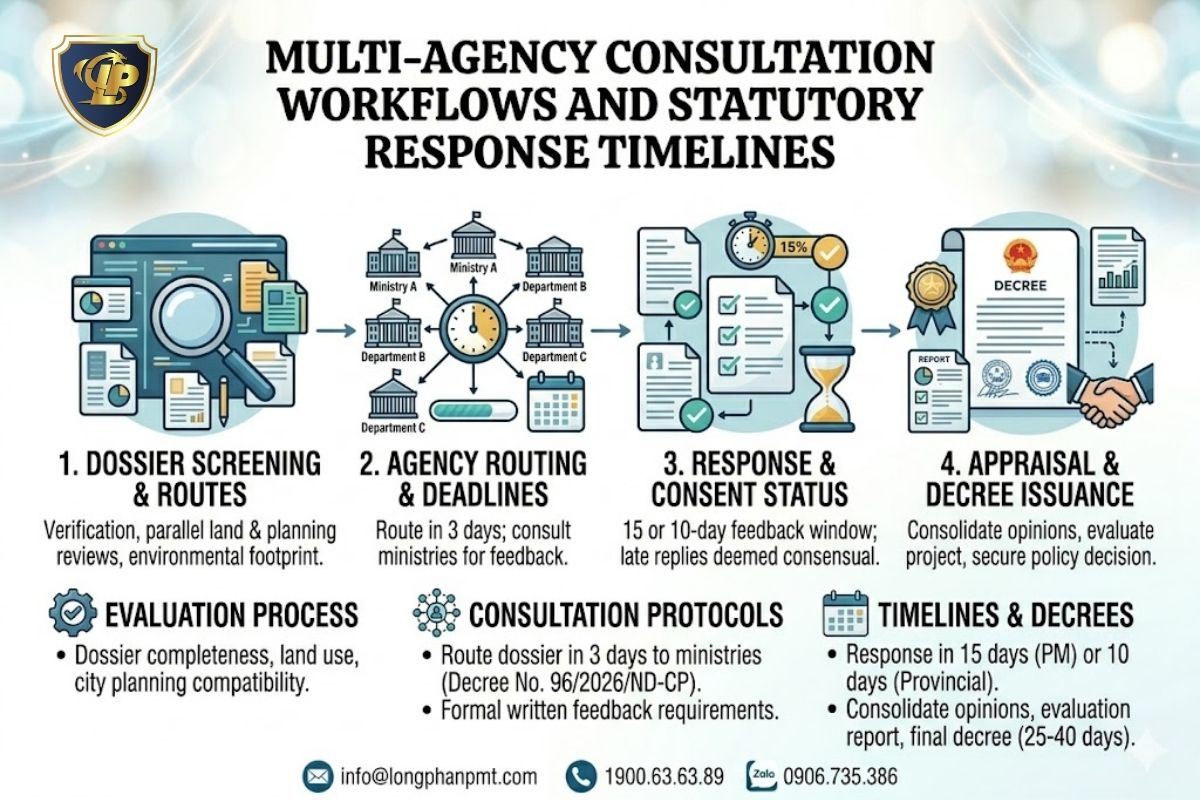
Once an investment dossier passes initial verification, project risks shift from simple document checklists to the substantive quality of the technical explanations. The coordinating registry will launch parallel reviews assessing land utilization, municipal planning compatibility, environmental footprints, national defense impacts, and foreign market entry conditions.
The administrative evaluation process follows this statutory sequence:
The cumulative timeline required to engineer the appraisal report and secure a formal decree generally ranges from 25 to 40 working days, depending on project scale and the approving jurisdiction. This processing window is anchored within the administrative enforcement rules of Clause 2, Article 34 and Clause 2, Article 35 of Decree No. 96/2026/ND-CP.
An investment application is rarely rejected because of missing document checklists alone. Real structural risks arise when a project fails to demonstrate alignment with local urban zoning plans, clear land acquisition pathways, foreign market access conditions, or corporate capital capabilities.
For international developers, relying on a simple “document checklist” mindset is insufficient to guarantee project entry. Dossiers must be built with the rigor of an independent project legal due diligence review, ensuring that investment structures, land positions, engineering codes, environmental limits, and capital resources are aligned before formal filing.
An investment dossier containing complete administrative paperwork can be rejected if the proposed location conflicts with local zoning structures. This mismatch represents a costly error, as the developer may have already incurred major expenses for field surveys, land acquisitions, engineering designs, and corporate capital allocations.
Appraisal committees evaluate project proposals against urban master plans, neighborhood zoning layouts, and provincial land-use allocations. Applications are routinely rejected if they fail to satisfy market entry conditions or lack a valid mechanism for land allocation or leaseholds under Points a, b, and c, Clause 7, Article 32 of Decree No. 96/2026/ND-CP.
A more severe enforcement risk arises if a developer submits fraudulent information regarding zoning, land titles, or capital capacity. Discovering fraudulent data will lead evaluating authorities to revoke the decision on investment policy approval, cancel any issued Investment Registration Certificates (IRC), and dissolve secondary operating permits pursuant to Clause 1 and Clause 2, Article 7 of Decree No. 96/2026/ND-CP.
Insufficient financial verification represents a fatal structural defect rather than a minor accounting omission. For major infrastructure developments, investment registries evaluate real capital mobilization schedules, equity commitments, and the legal enforceability of backing funds.
Evaluating bodies routinely flag investment applications for lacking financial feasibility due to the following structural defects:
When an investment registry issues a formal request for information, modification, or technical explanation, the developer must submit its response within the designated statutory window. Failing to provide a compliant explanation within the deadline will cause the authority to reject the dossier or halt review proceedings under Points d and đ, Clause 1, and Point a, Clause 2, Article 6 of Decree No. 96/2026/ND-CP.
Enterprises that launched valid investment projects prior to the effective date of the current regulatory framework are not automatically required to re-execute their initial approvals. However, regulatory exposure arises when an existing project modifies its operating objectives, expands construction scale, or changes its land-use footprint.
International developers must classify their active project profiles into three statutory transitional tracks to determine ongoing compliance obligations:
Corporate legal teams must integrate these transitional timelines into their regional expansion schedules. Failing to anticipate a mandatory modification review can stall capital drawdowns, land transfers, and engineering works.
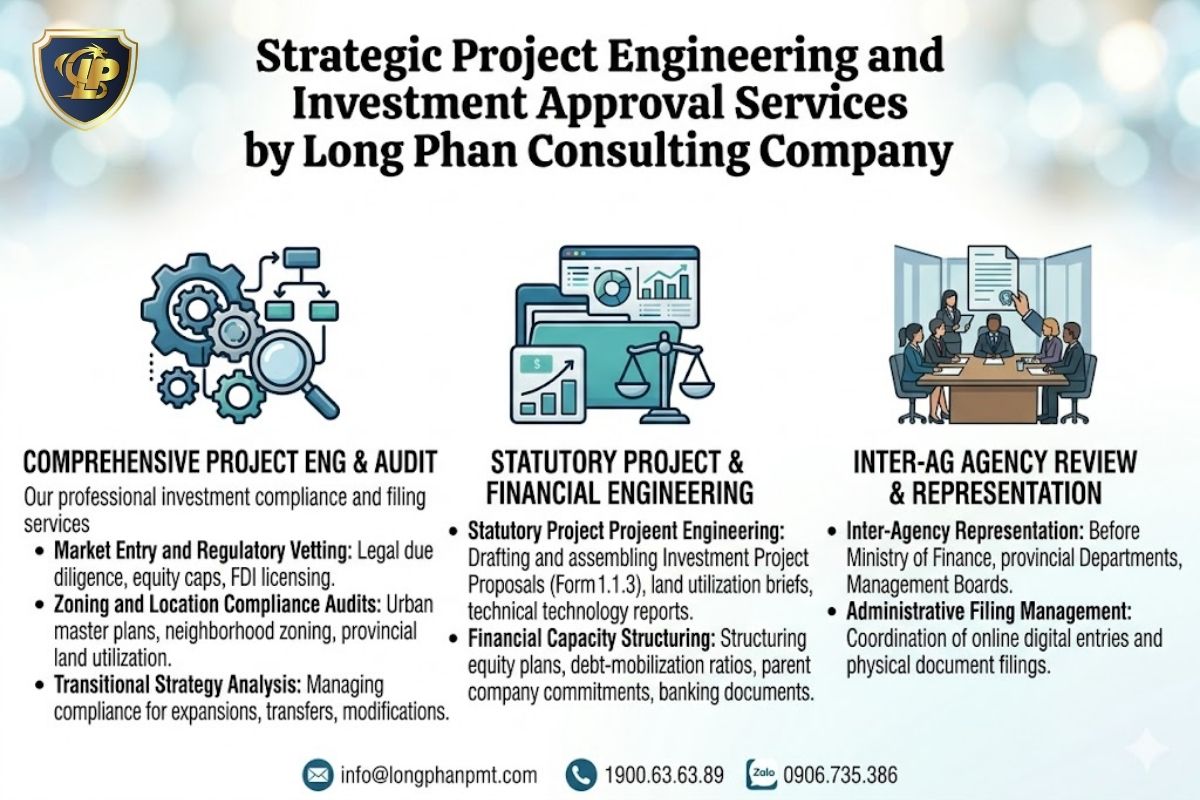
Securing a formal investment policy approval requires unified management across investment law, land regulations, urban planning, environmental codes, and corporate financial structuring. Long Phan Consulting Company delivers end-to-end regulatory solutions to help international corporate buyers, infrastructure funds, and foreign-invested enterprises audit project locations, build compliant filing dossiers, and clear multi-agency appraisal tracks before capital is committed to the field.
Our professional investment compliance and filing services include:
To review your project descriptions, evaluate your capital mobilization instruments, or map the provincial zoning compatibility of an investment project before entering binding commitments, please route your core transaction files via Email at info@longphanpmt.com or through Zalo at 0906.735.386 for an authoritative preliminary evaluation by our senior legal partners.
Investment approval applications often fail due to “blind spots” regarding planning, capital, land, and receiving authority. For FDI, real estate, or infrastructure projects, even minor discrepancies can prolong the inter-agency review process. The following FAQs focus on common pitfalls businesses face when preparing procedures for investment approval.
Financial statements are not automatically required to be audited unless specifically mandated by relevant laws. Businesses can demonstrate their financial capacity through financial statements for the two most recent years, a commitment of financial support from the parent company, a commitment from a financial institution, or a guarantee of financial capacity. State agencies are not permitted to impose additional requirements beyond the required documentation, as stipulated in Point c, Clause 1, Article 32 and Point b, Clause 1, Article 6 of Decree No. 96/2026/ND-CP.
Even loss-making businesses can demonstrate financial capacity by providing additional legitimate and binding capital. The documentation should clearly show equity capital, capital raising plans, and commitments to provide financial support or guarantees commensurate with the total investment capital. Financial capacity not matching the total committed capital is a risk factor during the assessment, according to Points b and c, Clause 7, Article 32 of Decree No. 96/2026/ND-CP.
Projects that do not conform to the planning regulations are at high risk of being rejected or requiring site adjustments. The appraisal agency will check compliance with the urban master plan, zoning plan, and land use plan before considering feasibility. Planning inconsistencies are grounds for rejecting the application, according to Point a, Clause 7, Article 32 of Decree No. 96/2026/ND-CP.
Foreign investors must prepare legal documents with valid Vietnamese translations if the documents are written in a foreign language. The dossier typically includes a passport for individuals or a business registration certificate, establishment decision, or equivalent documents for organizations. Requirements regarding foreign language documents and legal status are stipulated in Clause 13, Article 2 and Clause 2, Article 5 of Decree No. 96/2026/ND-CP.
Online applications must still be submitted in paper form for verification by the investment registration authority. Investors must submit the paper application within 10 working days from the date of online declaration. If the investment registration authority does not receive the paper application within this period, the online application will no longer be valid, according to Clause 1, Article 41 of Decree No. 96/2026/ND-CP.
The inter-agency consultation process typically begins within 3 working days of receiving a valid application. The consulted agency has 15 days for projects approved by the Prime Minister or 10 working days for projects approved by the Provincial People’s Committee or Management Board. If no opinion is received within this timeframe, it is considered as consent, according to Point b, Clause 6, Article 6 of Decree No. 96/2026/ND-CP.
Using forged documents can invalidate all legal results granted to the project. The competent authority may revoke the Investment Policy Approval Decision, the Investor Approval Decision, the Investment Registration Certificate, and related documents if forged content is determined. This legal consequence is stipulated in Point b, Clause 1, Article 7 of Decree No. 96/2026/ND-CP.
Compiling an documents for Investment Policy Approval requires a structured regulatory framework that balances investment codes, urban zoning alignments, land tenure confirmations, and capital capability verifications, moving past a simple document checklist approach. To protect project capital and clear multi-agency evaluation tracks without delays, international developers must verify corporate legal standings, secure binding capital confirmations, map municipal zoning lines, and align electronic filings with physical documents. Omitting these core validation layers can result in immediate review halts, administrative fine notices, and the loss of the investment opportunity. Contact our specialized investment desk via Hotline 1900636389 to secure formal project evaluations and compliance structuring from Long Phan Consulting Company.
📚 This article is provided with professional consultation based on the following legal framework: