
Understanding the Conditions for Opening an Elderly Care Center involves more than business registration; it also requires effective control of licensing, fire safety, staffing, and compensation risks. Elderly social assistance facilities must satisfy standards on location, functional areas, qualified personnel, and registration certification. A facility that remains inactive for 12 months after licensing may face license revocation. Under the Law on Enterprises and Businesses, investors should assess these requirements before leasing premises, renovating facilities, or admitting residents, with professional guidance from Long Phan Consulting.
Important legal note:
The conditions required for opening an elderly care center must be evaluated as a specialized operational compliance standard rather than a standard corporate registration procedure. From a legal perspective, “social protection facilities comprise public social protection facilities and non-public social protection facilities”; therefore, private nursing home models must still satisfy the conditions applicable to social protection facilities.
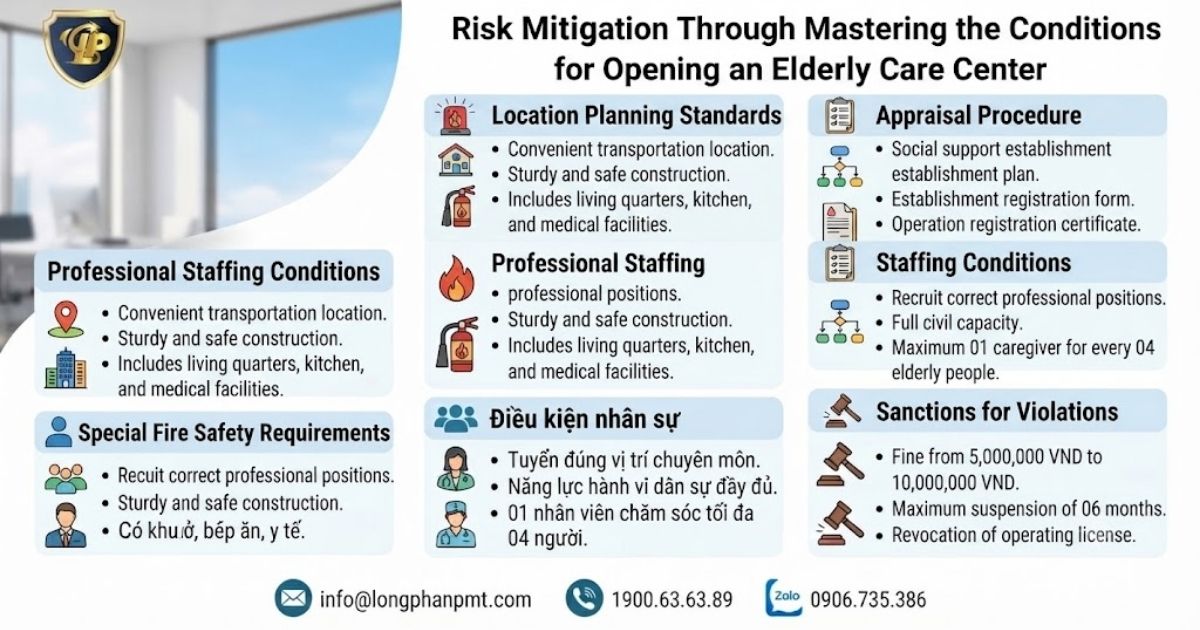
For investors, the primary group of conditions requiring review includes locations, architectural design, and safe operational capacity. Facilities must ensure:
Consequently, legal due diligence regarding locations must be executed prior to signing lease agreements, purchasing properties, or renovating structures. Errors at this stage frequently increase repair costs, prolong physical inspections, and delay the project’s break-even milestone.
>>> See more: Vietnam Property Due Diligence: A Technical Guide
The most significant risk during the pre-licensing stage is selecting an improper location or designing a layout missing mandatory functional compartments. This represents a category of conditions typically subject to direct inspection prior to approving facility operations.
| Condition Group | Operational Requirement | Legal Basis |
| Location | Convenient traffic access, secure living environment, and proper electricity, water, drainage, and waste treatment systems | Clause 1, Article 23 and Clause 1, Article 7 of Circular No. 33/2017/TT-BLĐTBXH |
| Structural Design | Solid, safe structures suitable for elderly demographics | Point a, Clause 2, Article 7 of Circular No. 33/2017/TT-BLĐTBXH |
| Functional Zoning | Presence of residential areas, kitchens, medical spaces, rehabilitation zones, and common rooms | Points d, e, g, h, and i, Clause 2, Article 7 of Circular No. 33/2017/TT-BLĐTBXH |
| Accessibility | Guaranteed accessibility for elderly persons and individuals with disabilities | Point l, Clause 2, Article 7 of Circular No. 33/2017/TT-BLĐTBXH |
Operating facilities failing to meet these standards must complete remediation within one year; otherwise, they risk merger or dissolution pursuant to Clause 5, Article 50 of Decree No. 103/2017/NĐ-CP. This serves as a critical warning for projects retrofitted from old residential houses, villas, or legacy accommodations.
Fire prevention and fighting represents a condition exerting direct impact on licensing viability, ongoing operational maintenance, and the protection of capital investments. Within senior care models, fire explosion risks face strict evaluations because resident populations typically possess limited self-evacuation capabilities.
Investors must control the following legal milestones and thresholds:
Fire safety expenditures must be integrated into financial planning starting from the project inception phase. Delaying resolution until the physical inspection stage risks paralyzing grand openings, generating major retrofitting costs, or forcing functional conversions.
Personnel conditions represent more than a mere licensing criterion; they form a crucial legal defense line when health incidents, falls, delayed emergency responses, or fatalities occur. Social protection facilities providing elderly care must structure their caregiving teams according to the professional competence and dependency levels of each target group.
Regarding enterprise risks, legal entities must compensate for damages caused by employees during the performance of assigned tasks, pursuant to Article 597 of the 2015 Civil Code. Consequently, errors made by nurses, caregivers, or medical staff can transform into the facility’s liability for compensation.
Key personnel control points that must be established from the outset include:
If personnel conditions are neglected, risks extend beyond administrative penalties. Instead, facilities may face compensation claims, public relations crises, and operational suspensions following an incident.
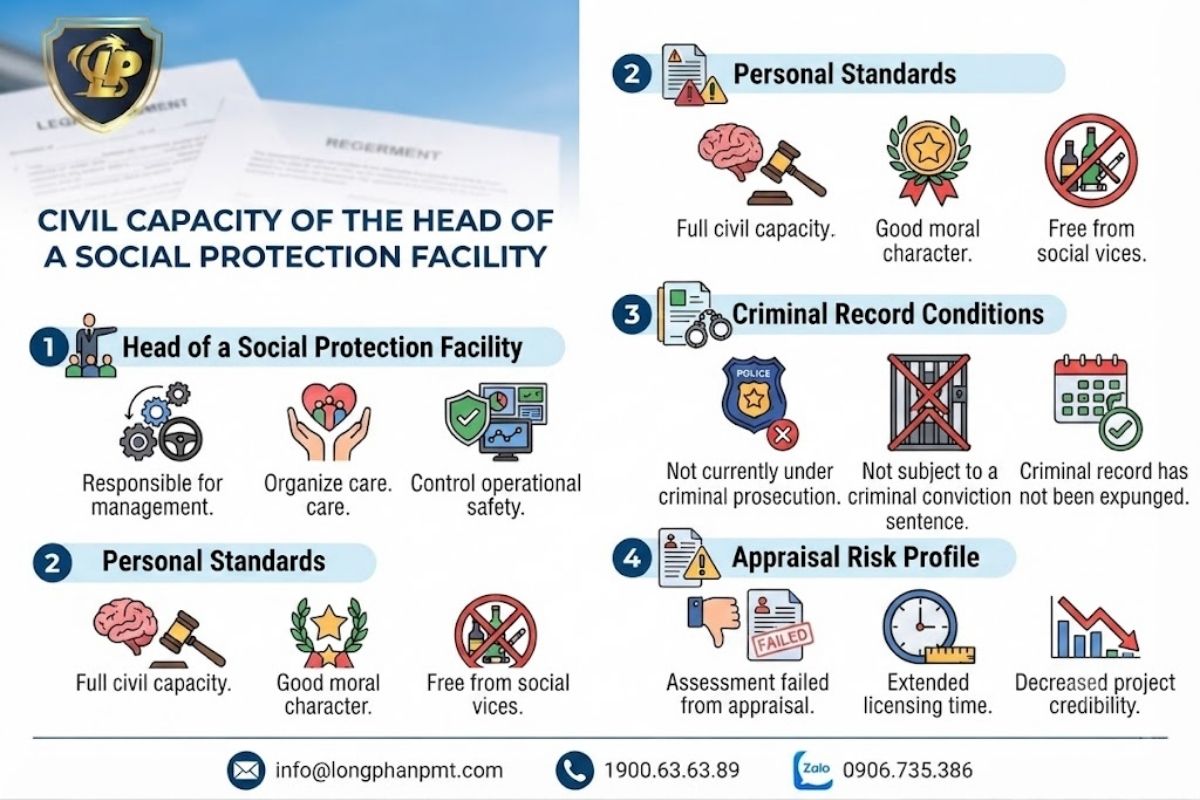
The head of a social protection facility is the position responsible for executive management, care organization, and operational safety control. Selecting an improper representative can cause licensing dossiers to be evaluated as non-compliant right from the appraisal stage.
Personal standards requiring verification prior to appointment comprise:
For investors, these standards must be reviewed as foundational legal conditions prior to signing management contracts. A weak personnel profile can prolong licensing timelines and diminish the reliability of the establishment proposal.
Staffing quotas represent a variable directly impacting operating costs, care capacity, and the facility’s civil liability. If staff allocations are insufficient, enterprises will struggle to prove they maintained safety conditions when incidents occur.
| Elderly Group | Care Staff Quota | Legal Basis |
| Elderly individuals unable to self-serve | Maximum of 04 elderly persons per 01 caregiver | Point c, Clause 7, Article 5 of Circular No. 33/2017/TT-BLĐTBXH |
| Elderly individuals capable of self-servicing | Maximum of 10 elderly persons per 01 caregiver | Point c, Clause 7, Article 5 of Circular No. 33/2017/TT-BLĐTBXH |
| Medical, rehabilitation, and social work requirements | Corresponding specialized personnel must be arranged | Points b, c, and d, Clause 1, Article 25 of Decree No. 103/2017/NĐ-CP |
Enterprises must cross-reference this quota table to translate it into recruitment plans, shift schedules, labor contracts, and job descriptions. This serves as the foundation for businesses to control costs, mitigate risks of compensating for life and health damages, and safeguard compliance records during inspections.
The procedure for opening a senior care center should be understood as a specialized procedure of a social assistance facility. In addition, it should be noted that Business registration certificate. This only acknowledges the business status, it does not replace it. Certificate of registration for social assistance facility.
The authority to issue licenses has now been transferred to a single point of contact, the Chairman of the People’s Committee of the province/city, as stipulated in the regulations Article 12 of Decree 147/2025/ND-CP.
Submitting to the wrong authority can delay the opening date, increase rental costs, and prolong the recruitment process. This is an operational risk that needs to be addressed before budgeting for the project.
The licensing application must simultaneously demonstrate the establishment status, right to use the site, operational plan, and care capacity. Among these, the Social Assistance Facility Establishment Plan is the central document for the state agency to assess feasibility.
Registration documents for establishment. This includes: the registration form for establishment, the operational plan, the draft operating regulations, documents proving the legal right to use the facilities, and the criminal record certificate of the founder, as per Article 15 of Decree No. 103/2017/ND-CP.
Application for an Operating License. The application for a license must be accompanied by a copy of the establishment registration certificate, as stipulated in Clause 1, Article 29 of Decree No. 103/2017/ND-CP.
The standard procedure should be administered in four stages:
This timeline should be included in the opening, recruitment, and admission plans for the elderly. If patients are admitted before the operating license is finalized, the facility may be considered to be operating outside its designated professional scope.
Following authorization, a social protection facility providing elderly care remains subject to post-licensing inspections concerning medical conditions, personnel, physical infrastructure, and care workflows. The greatest commercial risk is that the facility has invested in premises, staff, and brand equity, yet faces mandatory remediation, suspension, or license revocation.
Enterprises must establish a periodic internal audit mechanism for the following obligation categories:
These sanctions demonstrate that a license represents merely a starting point. The protective value of the project lies in the capacity to maintain continuous operational conditions.
Misconduct in elderly care typically generates two layers of damage. First are administrative fines and remedial measures. Second are reputational losses, civil compensation liabilities, and the risk of expanded inspections.
| Violation Behavior | Penalty Level and Remedial Measure | Legal Basis |
| Failing to ensure medical conditions, personnel, infrastructure, or service provision workflows | Fines ranging from VND 5,000,000 to VND 10,000,000 | Clause 3, Article 10 of Decree No. 98/2026/NĐ-CP |
| Physical infrastructure and personnel failing to meet conditions | Mandatory repair and supplementation of infrastructure and personnel | Point b, Clause 4, Article 10 of Decree No. 98/2026/NĐ-CP |
| Unlawful collection of service fees | Mandatory refund of all improperly collected monies | Point c, Clause 4, Article 10 of Decree No. 98/2026/NĐ-CP |
| Maltreating or coercing elderly individuals to live in toxic or dangerous environments | Fines up to VND 20,000,000 and mandatory coverage of medical examination and treatment costs if health damage occurs | Clause 2 and Point d, Clause 3, Article 20 of Decree No. 98/2026/NĐ-CP |
Pursuant to Clause 2, Article 6 of Decree No. 98/2026/NĐ-CP, for legal entities, monetary fine levels can create double pressure because the same violation is applied at twice the level specified for individuals for violations under Chapter II of this Decree, except for Articles 10, 11, 14, 15, 16, 34, Clauses 1 and 2 of Article 35, and Clause 2 of Article 37 of Decree No. 98/2026/NĐ-CP. Therefore, compliance budgets should be regarded as preventive expenditures rather than incidental administrative costs.
The most severe risk is not monetary fines, but the loss of operational rights after fixed assets have been deployed. Enterprises must specifically avoid “shelving licenses” without bringing facilities into actual operation.
Legal red lines that require control comprise:
Investors must manage licenses according to actual operating schedules rather than merely finalizing dossiers to secure business rights. A delayed opening plan lacking measures to maintain operational conditions can result in the complete forfeiture of established legal advantages.

Opening an elderly care center requires seamless coordination across investment law, real estate regulations, fire safety standards, labor compliance, and civil liability mitigation. Long Phan Consulting Company assists enterprises in building structured licensing roadmaps tailored to social protection facilities rather than limiting support to basic commercial registrations.
Our scope of advisory services addresses the specific operational bottlenecks of your project:
Foreign investors may submit site documentation, architectural drawings, and operational blueprints via Email: info@longphanpmt.com or Zalo/WhatsApp: +84 906 735 386 for a preliminary assessment by Long Phan Consulting Company.
A thorough understanding of the legal framework regarding “Social Assistance Facilities” is crucial for businesses to optimize their investment roadmap and protect their legal rights when operating elderly care centers. Through careful review of regulations concerning personnel, facilities, and fire safety, investors can proactively prevent legal risks arising during long-term operation. Below are the core issues that help businesses establish sound social welfare projects.
Yes, businesses are required to have a “Certificate of Registration for Social Assistance Facilities” to be allowed to provide elderly care services. A business registration certificate cannot replace this specialized license in the field of social welfare. Operating without this specialized license will expose businesses to the risk of suspension and administrative penalties as stipulated in Clause 3, Article 10 of Decree No. 98/2026/ND-CP.
Yes, all social assistance facilities are required to equip themselves with fire alarm communication devices and connect directly to the state agency’s fire prevention and fighting database. The mandatory deadline for completing this is no later than July 1, 2027, according to Clause 2, Article 27 of Decree No. 105/2025/ND-CP. Businesses need to pay special attention to this regulation to avoid the risk of having their operations suspended due to failure to meet fire safety standards.
Legal entities are liable for full compensation for damages outside of contract if employees cause harm while performing their assigned work. Businesses have the right to demand reimbursement from the offending employee after compensation has been paid to the victim, as stipulated in Article 597 of the 2015 Civil Code. Furthermore, businesses may face fines ranging from VND 10,000,000 to VND 20,000,000 if they allow mistreatment of the elderly, as per Clause 2, Article 20 of Decree No. 98/2026/ND-CP.
The facility is only permitted to temporarily suspend operations for a maximum period of 6 months to improve its operating conditions. If, after this period, the business still fails to meet the required standards, the competent state agency will permanently revoke the operating license in accordance with Clause 1, Article 32 of Decree No. 103/2017/ND-CP. Therefore, maintaining personnel and physical infrastructure standards must be done regularly and continuously.
Yes, operating licenses will be permanently revoked if businesses do not put their facilities into operation within 12 months of the license issuance date. This is specifically stipulated in Clause 2, Article 32 of Decree No. 103/2017/ND-CP to avoid the situation of “suspended licenses” that waste social resources. Businesses need to develop a feasible operating plan before proceeding with specialized licensing procedures.
Establishing an elderly care center requires strict control across locations, fire prevention and fighting, personnel, licensing dossiers, and post-licensing monitoring mechanisms. A social protection facility providing elderly care cannot operate legally by relying solely on an enterprise registration certificate. Investors must perform early reviews of zoning plans, architectural structures, staffing quotas, and licensing roadmaps to prevent delayed openings, penalties, temporary suspensions, or license revocations. Contact Long Phan Consulting Company via Hotline 1900636389 for dossier evaluation and the formulation of a safe implementation plan.
📚 This article has been professionally reviewed based on the following legal documents: