
Long Phan Consulting notes that business cooperation in real estate investment projects is becoming an increasingly common option for investors to share capital, land resources, and project implementation capabilities. However, each form of cooperation, including BCC agreements, joint ventures, capital contributions using land use rights, or project transfers, is subject to specific legal conditions under land law, the current Law on Investment, and the Law on Real Estate Business. This article analyzes each form of cooperation, mandatory conditions, and common legal risks to help investors select an appropriate structure before entering into an agreement.

Important Notes:
Each cooperation form has a different legal mechanism, advantages, and risks. Investors should correctly determine the legal nature of the transaction before drafting the contract, to avoid confusing “cooperation” with “transfer,” which can render the contract void.
Under Clause 14, Article 3 of the Law on Investment 2025, a BCC contract is an agreement between investors to cooperate in business and share profits or products without establishing a new economic organization. Article 22 of the same Law requires the parties to a BCC to set up a coordination board to implement the contract. They may also agree to use assets formed from the cooperation to establish a business under enterprise law.
Also under Article 22, a BCC contract between domestic investors follows civil law and does not require an Investment Registration Certificate. A BCC involving a foreign investor, however, must go through the procedure to obtain an Investment Registration Certificate.
Under Article 19 of the Law on Investment 2025, the parties may contribute capital to establish a new company that acts as the project owner. This form creates an independent legal entity in which each party bears limited liability within its capital contribution, suited to long-term cooperation or large-scale projects requiring significant resources. The establishment procedure and capital-contribution structure follow the Law on Enterprises 2020.
Compared with a BCC, a joint venture separates each investor’s asset liability from the project’s obligations, but it adds the enterprise-establishment procedure and more complex internal governance.
One party contributes land use rights, or LURs, while the other contributes capital or construction work, forming a new economic organization or adding to the charter capital of an existing business. This is a cooperation form specific to real estate, used when one party holds land but lacks the capacity to develop it.
Contributing LURs as capital is lawful only when the land plot meets the conditions under Clause 1, Article 45 of the Land Law 2024. These conditions are: a valid land use right certificate, no dispute or a dispute that has been resolved, and no distraint or judgment-enforcement security measure over the land use right. This condition does not depend on any separate agreement between the parties.
In practice, many transactions labeled “cooperation” are, in substance, project transfers under Article 39 of the Law on Real Estate Business No. 29/2023/QH15. In such cases, the transferee becomes the new project owner and inherits all rights and obligations. Confusing the two forms causes parties to overlook the mandatory transfer conditions under Article 40 and the approval procedure under Article 41 of the same Law, leading to dossier rejection.
These conditions apply simultaneously to three groups: the business entity, the project, and the land use rights. If any one group is missing, the cooperation transaction risks being void or suspended when a state authority reviews the dossier.
Under Clause 2, Article 9 of the Law on Real Estate Business 2023, an organization participating in real estate business cooperation must be a business or cooperative with a registered real estate business line. It must also not be under a ban, suspension, or cessation of operations under a judgment or decision of a competent authority.
Also under Point c, Clause 2, Article 9, a business conducting real estate business through a project must maintain a minimum equity level. This is no less than 20% of total investment capital for projects under 20 hectares, and no less than 15% for projects of 20 hectares or more.
Under Points a, b, and c, Clause 1, Article 40 of the Law on Real Estate Business 2023, a project entering cooperation in the form of a transfer must meet three conditions. It must already have investment policy approval from a competent authority, an approved detailed plan, and completed compensation and resettlement support for the transferred portion of the project.
In parallel, under Points d and e, Clause 1, Article 40, together with Clause 1, Article 45 of the Land Law 2024, the project’s land use rights must not be barred from transactions. They must also not be suspended or temporarily suspended from transactions. If mortgaged, they must be released before proceeding.
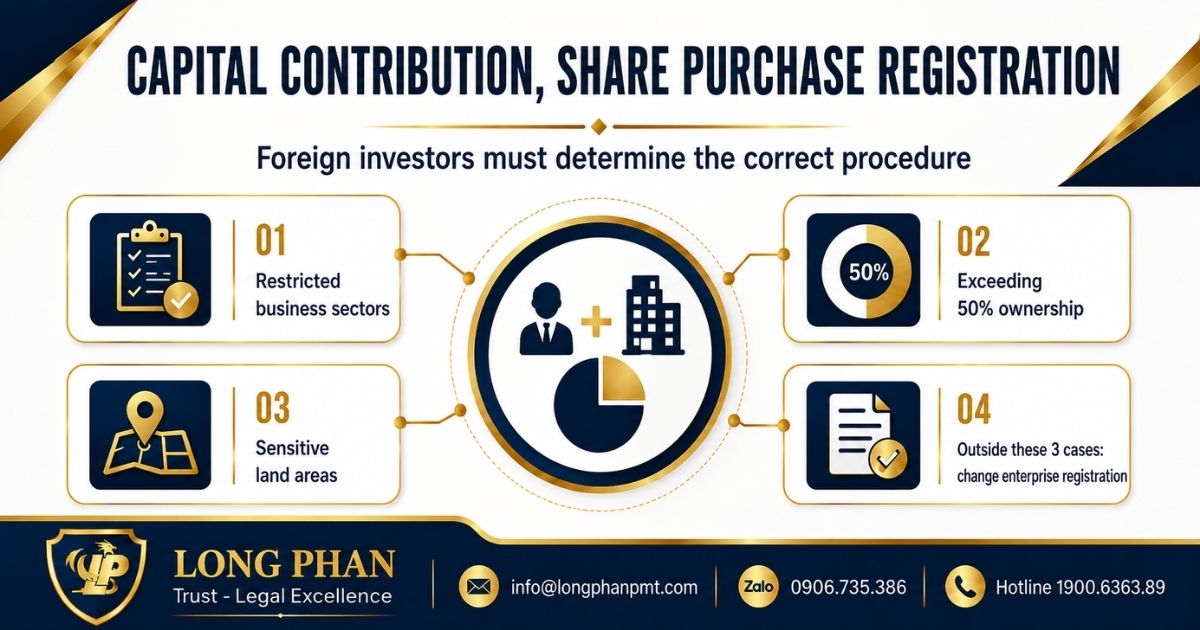
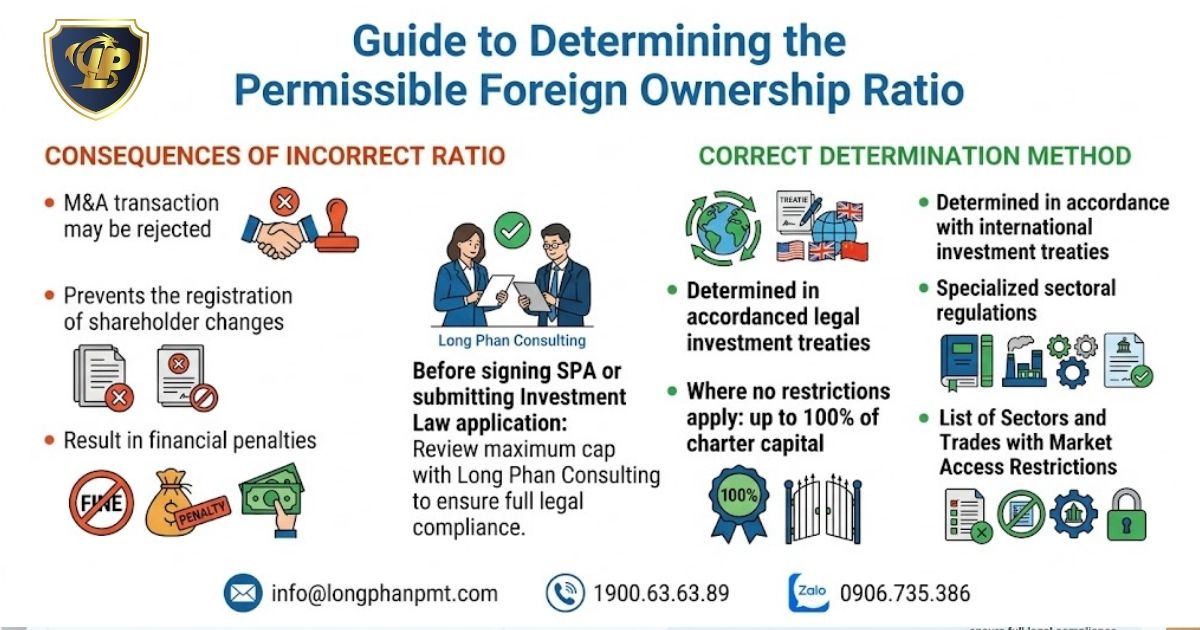
Under Article 10 of the Law on Real Estate Business 2023, a foreign-invested economic organization cooperating in real estate business is subject to a narrower form and scope of business than domestic investors. Clause 2, Article 8 of the Law on Investment 2025 also requires this organization to satisfy market-access conditions if its business line falls within the list of restricted market-access sectors.

Cooperation that changes the project owner or the project’s content must go through an administrative procedure, not merely a civil agreement between the parties. Skipping this step means the cooperation contract has no effect against the managing authority.
Under Article 41 of the Law on Real Estate Business 2023, for a project with an approved investor or an Investment Registration Certificate, the authority and procedure for approving a transfer follow investment law. This applies to a full or partial project transfer alike. This corresponds to the authority that approved the original investment policy, either the Prime Minister or the provincial People’s Committee, depending on the project type.
Clause 7, Article 51 of the Law on Investment 2025 confirms that Article 41 continues to apply to projects with an approved or adjusted investment policy. It also applies to projects with an issued or adjusted Investment Registration Certificate under current investment law.
Under Clause 3, Article 33 of the Law on Investment 2025, cooperation may change the content of a project whose investment policy has already been approved, such as a change of investor, objective, or schedule. In that case, the investor must complete the procedure for approving an adjustment to the investment policy before carrying out the work related to that change.
These are the risks investors should note most carefully before signing a cooperation contract, since the legal consequences can range from a civil dispute to the entire transaction being void.
Cooperating on a project without an approved detailed plan or with incomplete compensation and resettlement violates the conditions under Clause 1, Article 40 of the Law on Real Estate Business 2023. This risks voiding the contract or having the state authority refuse to recognize it when processing an adjustment or ownership transfer.
Article 505 of the Civil Code 2015 requires the main content of a cooperation contract to clearly state the method for sharing yields and profits, and the rights and obligations of the members. A BCC or cooperation contract lacking this clause is the most common cause of prolonged disputes, particularly once a project is partly under way. The same is true when the contract lacks a voting mechanism and a process for handling late capital contributions.
If the cooperation takes the form of a civil cooperation contract rather than a BCC under the Law on Investment, Article 509 of the Civil Code 2015 applies. It provides that members bear joint civil liability using common assets. If the common assets are insufficient, each member must bear liability with personal assets in proportion to their contribution.
Accepting a capital contribution or cooperating on land that has not been released from mortgage, is under dispute, or is under distraint violates the law. This breaches Points d and e, Clause 1, Article 40 of the Law on Real Estate Business 2023 and Clause 1, Article 45 of the Land Law 2024. It prevents the transaction from being registered, even after the cooperation contract has been signed and the parties have actually contributed capital.
A partner who fails to maintain the minimum equity ratio under Point c, Clause 2, Article 9 of the Law on Real Estate Business 2023, or who delays capital contribution, can stall project progress. This brings an obligation to explain to the state management authority and the risk of investment-policy revocation if the project is delayed for a prolonged period.
Cooperation involving a foreign investor adds the procedure for obtaining an Investment Registration Certificate. It also limits the scope of business under Article 10 of the Law on Real Estate Business 2023. This includes the list of restricted market-access sectors under Clause 2, Article 8 of the Law on Investment 2025. Skipping this review can push the project beyond its permitted conditions.
>>>See more: Foreign investors keep in mind before signing a business cooperation contract BCC

Each real estate business cooperation option has a different legal mechanism, procedure, and level of liability. The table below compares the common forms to help investors choose the option that fits their goals and resources.
| Criteria | BCC Contract | Joint Venture (New Legal Entity) | LUR Capital Contribution | Project Transfer |
| Legal basis | Article 22, Law on Investment 2025 | Article 19, Law on Investment 2025; Law on Enterprises 2020 | Article 45, Land Law 2024 | Articles 39-41, Law on Real Estate Business 2023 |
| New legal entity formed | No | Yes | Depends on agreement (may contribute to an existing business) | No (transferee becomes the new project owner) |
| Level of liability | As agreed in the BCC contract and coordination board | Limited to the capital contribution | In proportion to the value of the contributed LUR | Full obligations of the transferring project owner |
| Administrative procedure | No Investment Registration Certificate needed if only domestic investors | Enterprise establishment and investment registration procedures | Land-change registration and valuation of the contributed asset | Transfer approval procedure under Articles 41-42, Law on Real Estate Business 2023 |
| Best suited for | Short- or medium-term cooperation, sharing risk on a specific project | Long-term, large-scale projects requiring significant resources | A party with land cooperating with a party that has capital or construction capacity | An investor wanting to take over the entire project-owner position |
Identifying risk is only the first step; investors need to translate it into concrete action before signing the cooperation contract.
Check the project’s legal status, including investment policy, detailed planning, and compensation status, the land use right status in the land registration system, and the partner’s financial capacity and track record on prior projects.
The contract should clearly set out the capital-contribution ratio, contribution schedule, voting mechanism, profit- or product-sharing method, and the conditions for withdrawing from the cooperation. Article 510 of the Civil Code 2015 allows a member to withdraw from a cooperation contract under agreed conditions, or for a legitimate reason with the consent of more than half of the members. This mechanism should be spelled out in the contract to avoid disputes if a party wants to end the cooperation early.
Complete notarization of the LUR capital-contribution contract, land-change registration, and related financial obligations before starting the project. This avoids a situation where capital has actually been contributed but the transaction has no legal effect against third parties.
Long Phan Consulting supports investors from the due diligence stage through the signing and implementation of cooperation agreements, including:
Clients may send their case documents via email at info@longphanpmt.com or via Zalo at 0906.735.386 for a preliminary assessment.
Below are several common questions investors raise when considering business cooperation in a real estate project.
No. Where domestic investors cooperate through a BCC agreement, the parties are not required to establish a new legal entity and only need to establish a coordination board to implement the agreement under Article 22 of the 2025 Law on Investment.
A BCC agreement between domestic investors does not require registration and is generally governed by civil law. In contrast, a BCC involving a foreign investor must complete the procedure for obtaining an Investment Registration Certificate under Clause 2, Article 22 of the 2025 Law on Investment.
Contributing land use rights as capital means using the value of the land use rights as a capital contribution, while the contributor retains an interest corresponding to the contributed value in the resulting asset or project. A transfer, by contrast, terminates the transferor’s rights to the land. Both transactions must satisfy the conditions prescribed in Article 45 of the 2024 Law on Land.
Yes, but they are subject to restrictions on the permitted forms and scope of real estate business under Article 10 of the 2023 Law on Real Estate Business. They must also satisfy the applicable market access conditions under Clause 2, Article 8 of the 2025 Law on Investment where the relevant business sector is subject to restricted market access.
The parties should first apply the provisions agreed in the cooperation agreement regarding breaches of capital contribution obligations. If the agreement does not contain such provisions, Article 509 of the 2015 Civil Code applies, under which liabilities are first discharged using common property and then, where necessary, using each member’s separate property in proportion to their contribution.
A joint venture may be more appropriate for large-scale projects, long-term cooperation, or where the parties want to clearly separate asset liability through an independent legal entity under Article 19 of the 2025 Law on Investment. A BCC is generally more suitable for short- or medium-term cooperation on a specific project and may involve lower corporate governance costs.
Yes, if the withdrawal conditions agreed in the cooperation agreement are satisfied, or where there is a legitimate reason and more than half of the total cooperation members consent, pursuant to Article 510 of the 2015 Civil Code.
Business cooperation in real estate investment projects can help parties share capital requirements and risks, but it is only effective when the parties, project, and land use rights fully satisfy the applicable legal conditions and the cooperation agreement clearly regulates capital contributions, profit distribution, and termination mechanisms. Before signing, investors should conduct legal due diligence on both the project and the proposed partner and correctly identify the true nature of the transaction to avoid confusing cooperation with a transfer. Long Phan Consulting supports investors throughout this process. Please contact Hotline 1900636389 for assistance in assessing the cooperation structure most suitable for your project.
📚 This article has been professionally reviewed based on the following legal documents: