


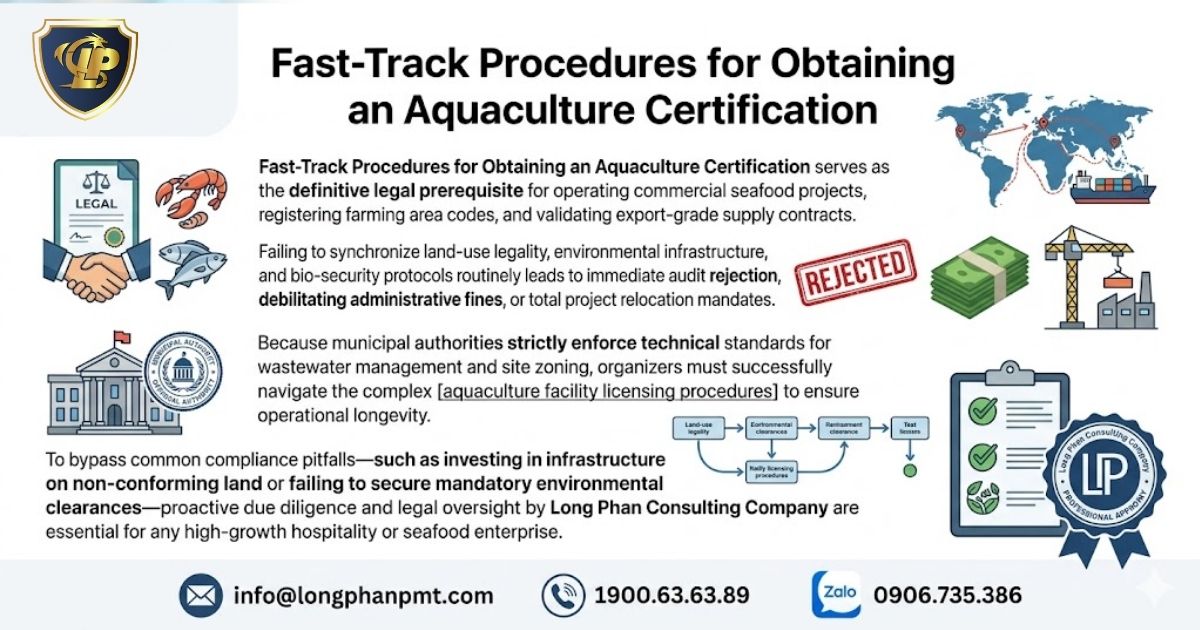
Aquaculture Certification is a core regulatory requirement for launching commercial seafood farming projects, obtaining farming area codes, and supporting export-oriented supply agreements. Misalignment between land-use conditions, environmental systems, and biosecurity measures may result in failed inspections, substantial administrative penalties, or compulsory project relocation. As local authorities closely review wastewater treatment, site planning, and technical infrastructure, enterprises must structure their operations in accordance with the Law on Enterprises and Businesses.
Long Phan Consulting assists investors in conducting early compliance reviews, avoiding infrastructure investment on unsuitable land, and securing required environmental approvals before project implementation.
Key legal notes:
To obtain an aquaculture certification, businesses must do more than prepare administrative documents. The core assessment focuses on the facility’s legal operational capacity, including land use rights, technical infrastructure, environmental compliance, veterinary requirements, and food safety standards.
For commercial projects, compliance reviews should be conducted before leasing land, excavating ponds, installing cages or floating rafts, or signing off-take agreements. If legal foundations are flawed from the outset, the facility may fail to obtain a Certificate of Eligibility for Aquaculture Operations, be unable to register a farming area code, and face significant obstacles in meeting export standards.
One of the most common bottlenecks in aquaculture projects is investing in infrastructure before verifying zoning compliance. Investors should clearly determine land use rights, permitted land-use purposes, and consistency with local land-use planning before implementation.
Key issues requiring review include:
If the farming area is inconsistent with provincial planning or the district-level annual land-use plan, the facility may not qualify for farming area code registration. This represents a significant financial risk, as investments in pond excavation, embankment construction, and wastewater systems are often difficult to recover.
Intensive aquaculture operations must be designed as controlled production facilities. Application dossiers should not merely describe pond areas but must also demonstrate the capacity to manage water resources, waste, production inputs, and disease risks.
Technical infrastructure components that should be standardized include:
Site layout drawings should clearly identify farming ponds, settling ponds, drainage systems, material storage areas, and waste treatment facilities. If actual infrastructure differs from the submitted technical documentation, inspection authorities may require corrective measures before issuing the certificate.
Aquaculture facilities must operate under a biological and environmental risk management framework. Mandatory requirements include compliance with environmental protection laws, veterinary regulations, occupational safety standards, and food safety regulations in accordance with Clause 1, Article 38 of the Law on Fisheries 2017.
Businesses should clearly distinguish between the Certificate of Eligibility for Aquaculture Operations and environmental approvals such as an Environmental Permit or Environmental Registration. Obtaining fisheries-related approvals without completing environmental compliance procedures may create substantial legal exposure during interdisciplinary inspections.
One important exemption applies to aquaculture facilities used for ornamental, recreational, handicraft, or cosmetic purposes. These facilities are exempt from food safety requirements under Clause 2, Article 38 of the 2017 Law on Fisheries.
Accordingly, businesses should accurately define the intended farming purpose from the project planning stage. Any inconsistency between the registered purpose, operational model, and actual commercial activities may result in certificate revocation risks or administrative penalties.
The application for an aquaculture certificate must demonstrate compliance across three layers: facility status, infrastructure conditions, and the ability to control the environment and diseases. For businesses or cooperatives, the application needs to be consistent between land information, farming area drawings, and technical specifications.
A common mistake is preparing the administrative forms correctly, but the technical data does not match the actual pond, cage, or wastewater discharge system. In such cases, the facility is likely to be required to make corrections, additions, or undergo re-inspection before being granted the permit.
Businesses need to prepare a set of documents, including mandatory documents and documents verifying site conditions. The focus is not just on submitting all the necessary paperwork, but on demonstrating that the facility meets the farming requirements during on-site inspections by relevant authorities.
| Document name | Applicable document template | Preparation notes |
| Application for a Certificate of Eligibility for Aquaculture Establishment | Form No. 20.NT Appendix I issued with Decree No. 41/2026/ND-CP | The facility name, location, species being raised, and farming method need to be consistent with the technical documentation. |
| A description of the facilities and technical infrastructure of the breeding facility. | Form No. 21.NT Appendix I issued with Decree No. 41/2026/ND-CP | Integrate descriptions of infrastructure, environmental protection measures, and disease control. |
| A diagram showing the location of the cages or a diagram of the farming area. | According to the document structure in Decree No. 41/2026/ND-CP | The rearing pond, settling pond, water treatment area, materials storage area, and drainage system should be clearly shown. |
| Documents proving the right to use land or water surface | Not an independent seafood form | Preparations are needed to demonstrate that the aquaculture site complies with regulations regarding land use and marine areas. |
| Relevant environmental documents | According to the environmental law requirements applicable to each project. | It is necessary to compare the information with the Environmental Permit or Environmental Registration to avoid half-hearted legalization. |
From a risk management perspective, businesses should review their land and environmental records before completing Form 21.NT. If the description of infrastructure exceeds the scope of legally owned land or water, the application may encounter bottlenecks during the assessment process.
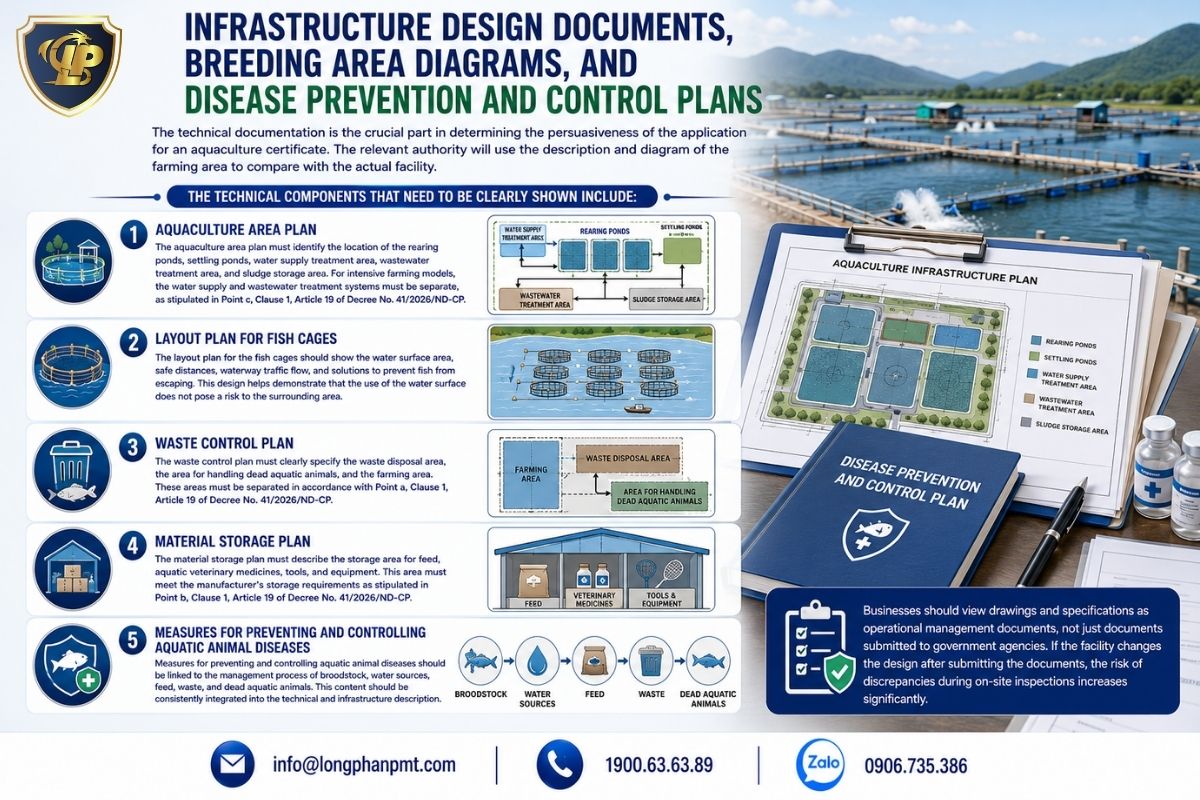
The technical documentation is the crucial part in determining the persuasiveness of the application for an aquaculture certificate. The relevant authority will use the description and diagram of the farming area to compare with the actual facility.
The technical components that need to be clearly shown include:
Businesses should view drawings and specifications as operational management documents, not just documents submitted to government agencies. If the facility changes the design after submitting the documents, the risk of discrepancies during on-site inspections increases significantly.
An application for the Certificate of Eligibility for Aquaculture must demonstrate three layers of compliance: institutional eligibility, infrastructure adequacy, and capacity for environmental and disease control. For enterprises and cooperatives, the dossier must reflect total alignment between land-use records, technical site maps, and explanatory narratives.
A recurring operational failure is preparing compliant administrative forms while submitting technical data that contradicts the actual site layout of ponds, cages, or wastewater systems. Such inconsistencies frequently force agencies to request modifications or re-inspections, significantly delaying project timelines.
Enterprises should prepare a dossier set comprising mandatory templates and site-verification documents. Success hinges not just on submitting the required papers, but on proving that the facility satisfies aquaculture conditions during the professional on-site audit.
| Document Title | Applicable Template | Preparation Notes |
| Request for Certificate of Eligibility | Form No. 20.NT (Appendix I, Decree 41/2026/ND-CP) | Ensure the facility name, location, target species, and farming method match technical records. |
| Technical Explanatory Report | Form No. 21.NT (Appendix I, Decree 41/2026/ND-CP) | Must integrate infrastructure descriptions, environmental protection, and bio-security measures. |
| Site Map and Cage Layouts | Pursuant to Decree 41/2026/ND-CP | Must clearly show farming ponds, sedimentation zones, water treatment, and drainage. |
| Land Use/Water Rights Proof | N/A (Standard legal records) | Essential to prove site alignment with land-use regulations and maritime area usage rules. |
| Environmental Documentation | Sector-specific regulatory requirements | Cross-check with Environmental Licenses to avoid fragmented compliance. |
From a risk management perspective, enterprises should audit land-use and environmental records prior to completing Form No. 21.NT. If the technical narrative describes infrastructure exceeding the scope of legal land or water rights, the application will encounter immediate bottlenecks during appraisal.
Technical documentation is the defining factor in the application’s persuasiveness. Professional authorities use these explanatory reports and site maps as the primary baseline to benchmark the facility during on-site inspections.
Core technical requirements include:
Enterprises should treat these site maps and reports as active operational management documents. If a facility alters its infrastructure design after submission, the risk of non-conformance during field audits increases significantly.
Businesses that were operating or in the process of filing applications before the new law came into effect need to review their transitional rights. This mechanism helps businesses avoid reapplying for all necessary paperwork.
Licenses, certificates, confirmations, and certifications in the fisheries sector that have been previously issued continue to be valid until their expiration date. This principle is stipulated in Clause 2, Article 105 of the Law on Fisheries 2017.
For applications that have been submitted but not yet processed, organizations and individuals will continue to be handled according to the law in effect at the time of application receipt. Businesses can also proactively request the application of new regulations if they are more advantageous, as stipulated in Clause 1, Article 55 of Decree No. 41/2026/ND-CP.
For agricultural land, businesses that were previously allocated land by the State with land use fees may continue to use it until the remaining term. Upon extension, the business must switch to land lease in accordance with Clause 2, Article 255 of the Law On Land 2024.
The transitional mechanism is highly valuable for projects that have already invested in aquaculture infrastructure. However, if the component environmental permit expires, the facility must submit an application for an integrated environmental permit according to the new regulations.
Legal risk in aquaculture rarely stems from a single isolated error. The systemic issue often involves a lack of synchronization between land-use rights, environmental compliance, technical infrastructure, and the registered aquaculture species list.
For enterprises, the cost of non-compliance extends far beyond administrative fines. More severe consequences include mandatory site relocation, infrastructure demolition, operational suspension, or disqualification from the aquaculture farming area codes required for international export.
Internal self-audits should be a mandatory gatekeeping step before formal submission. Even if administrative forms are perfectly filed, non-compliant physical infrastructure will trigger application delays or outright rejection.
Key error clusters to mitigate include:
If any of the above defects exist, enterprises must rectify the physical site status before filing. Attempting to “test” an application while awaiting guidance from authorities often exposes compliance vulnerabilities and stalls project progress.
Fisheries sanctions are tiered according to the severity of the violation. The further an enterprise operates from its registered dossier, the higher the risk of mandatory restorative enforcement measures.
| Infraction Category | Administrative Fine | Mandatory Restorative Measure |
| Unauthorized Site/Registration Errors | VND 2M – 3M | Mandated adjustment to registered site/contents. |
| Infrastructure/Species Violations | VND 7M – 10M | Mandated infrastructure rectification. |
| Unauthorized Marine Farming | VND 10M – 20M | Mandated relocation or infrastructure demolition. |
| Illegal Species Cultivation | VND 20M – 30M | Mandated species conversion or destruction. |
| Severe Fisheries Violations | Up to VND 1B (Individual) / 2B (Org) | Possible license revocation or operation suspension. |
Unauthorized marine farming carries “double risks.” Facilities face fines ranging from VND 10M to 20M, concurrently with mandatory orders to relocate or demolish infrastructure under Clause 3 and Point a, Clause 5, Article 17 of Decree No. 38/2024/ND-CP.
For violations occurring prior to the current regulations but detected later, enterprises must analyze the “favorable law” principle. Pursuant to Clause 1, Article 61 of Decree No. 38/2024/ND-CP, if the new regulation provides for no liability or a lesser penalty, the new provision shall apply.
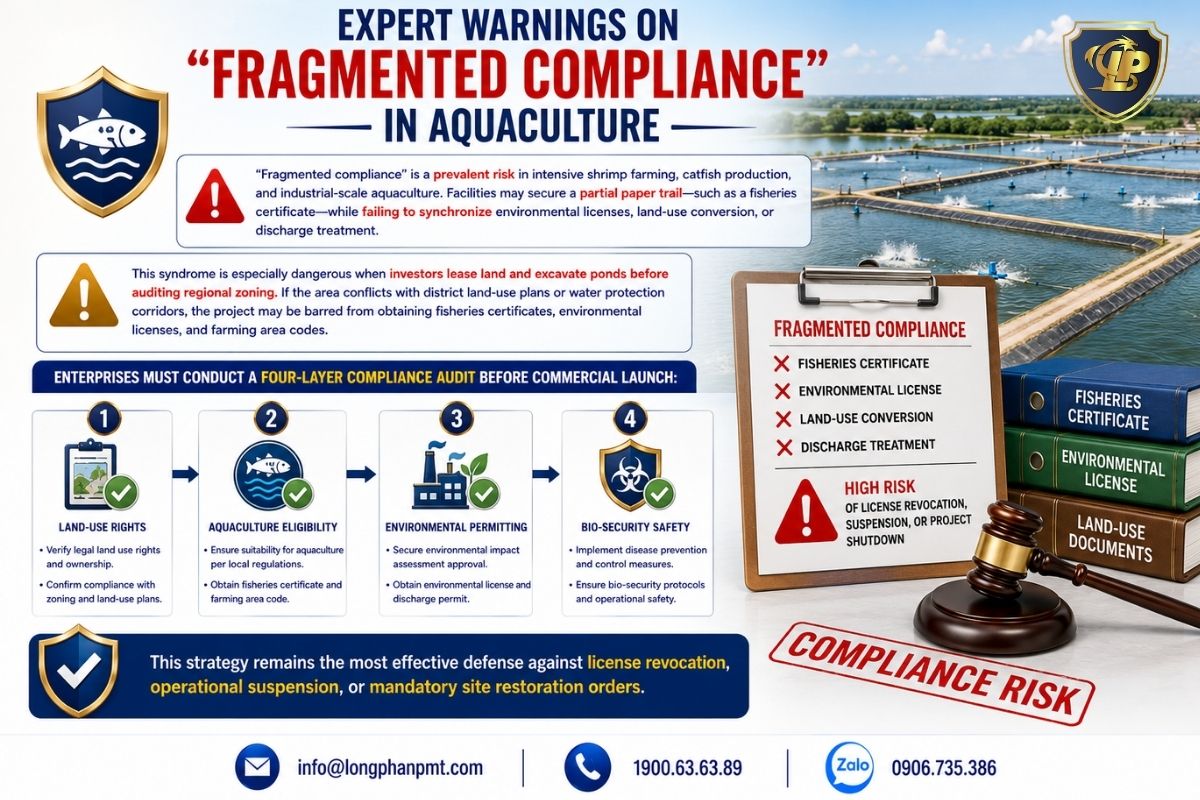
“Fragmented compliance” is a prevalent risk in intensive shrimp farming, catfish production, and industrial-scale aquaculture. Facilities may secure a partial paper trail such as a fisheries certificate while failing to synchronize environmental licenses, land-use conversion, or discharge treatment.
This syndrome is especially dangerous when investors lease land and excavate ponds before auditing regional zoning. If the area conflicts with district land-use plans or water protection corridors, the project may be barred from obtaining fisheries certificates, environmental licenses, and farming area codes.
Enterprises must conduct a four-layer compliance audit before commercial launch: (1) Land-use rights, (2) Aquaculture eligibility, (3) Environmental permitting, and (4) Bio-security safety. This strategy remains the most effective defense against license revocation, operational suspension, or mandatory site restoration orders.
The aquaculture licensing procedure requires simultaneous oversight of land-use legality, fisheries management, environmental compliance, and site-specific technical operational standards. Long Phan Consulting Company provides specialized B2B solutions to assist enterprises in auditing risk from the initial land-acquisition phase through to final certificate issuance and inter-agency engagement.
Our comprehensive legal advisory services include:
To evaluate your land-use documentation, site infrastructure maps, or environmental records, please route your core project files via Email at info@longphanpmt.com or through Zalo at +84 906 735 386 for an authoritative preliminary assessment by our senior legal counsel.
For commercial aquaculture projects, the risk lies not in the lack of a form, but in the mismatch between land, environment, infrastructure, and registration of farmed species. The following questions focus on situations that can easily delay the process of obtaining aquaculture certificates, leading to remedial costs or impacting export plans.
No, if the land use purpose is not suitable for aquaculture activities, the application risks not meeting the site requirements. The facility must comply with regulations on land use and sea areas, and meet environmental, veterinary, occupational safety, and food safety requirements as stipulated in Clause 1, Article 38 of the Law on Fisheries 2017. Aquaculture land is land used exclusively for aquaculture purposes as defined in Clause 4, Article 9 of Decree No. 102/2024/ND-CP.
The competent authority must conduct an on-site inspection within 6 working days from the date of receiving all valid documents. If the facility meets the requirements, the Certificate will be issued within 1 working day after the inspection is completed. If the inspection is unsuccessful, the facility has a maximum of 30 days to rectify the deficiencies according to Point b, Clause 3, Article 20 of Decree No. 41/2026/ND-CP.
The certificate of eligibility for aquaculture facilities is valid for 24 months from the date of issuance. Businesses need to monitor the validity period to avoid disruptions to operations, off-take contracts, or export documents. The 24-month period is determined according to Clause 4, Article 20 of Decree No. 41/2026/ND-CP
The application dossier must include a diagram showing the location of the cages or the farming area for the specialized agency to compare during on-site inspections. Businesses also need to submit an Application Form (Form No. 20.NT) and a Description of Facilities and Technology (Form No. 21.NT) in Appendix I issued with Decree No. 41/2026/ND-CP. The description should detail the facilities, environmental protection measures, and disease control measures.
Establishments that fail to register for cage farming or farm in locations other than those registered may be fined from VND 2,000,000 to VND 3,000,000 according to Clause 1, Article 17 of Decree No. 38/2024/ND-CP. If the establishment fails to register its main aquaculture species or does not meet the physical infrastructure requirements, the fine will be VND 7,000,000 to VND 10,000,000 according to Clause 2, Article 17 of Decree No. 38/2024/ND-CP.
Businesses engaged in aquaculture at sea without a license may be fined and forced to dismantle their structures. The fine ranges from VND 10,000,000 to VND 20,000,000, along with measures such as forced relocation or demolition of the structures, as stipulated in Clause 3 and Point a, Clause 5, Article 17 of Decree No. 38/2024/ND-CP. This poses a direct risk to infrastructure costs, cages, and operational progress.
No, licenses, certificates, confirmations, and certifications in the fisheries sector issued before the new law came into effect will continue to be valid until their expiration date. This principle of preserving validity is stipulated in Clause 2, Article 105 of the Law on Fisheries 2017. For pangasius farming facilities, the certificate of identification code for commercial pangasius ponds continues to have equivalent validity according to Clause 3, Article 55 of Decree No. 41/2026/ND-CP.
Securing an Aquaculture Facility Certificate in Vietnam serves as a strategic compliance cornerstone rather than a mere administrative formality. Enterprises must proactively synchronize land-use legality, regional zoning, environmental infrastructure, and bio-security protocols to prevent operational disruptions or export disqualification. Failure to align these technical requirements before launching commercial operations frequently triggers project suspension, severe administrative fines, or mandatory site demolition. Mitigating these systemic risks requires rigorous due diligence and expert legal engineering throughout the investment lifecycle. To optimize your facility licensing dossiers and ensure full regulatory alignment, contact the senior legal team at Long Phan Consulting Company via our support hotline at 1900636389 for immediate professional consultation.
📚 This article is provided with professional consultation based on the following legal framework:


