

Developing a Standardized Real Estate Transaction framework enables enterprises to limit deposit losses, cash-flow delays, and contract invalidation risks. This workflow must coordinate Real Estate Brokerage, legal, and accounting functions to control asset eligibility, signing authority, deposit terms, payment schedules, notarization, and ownership registration. For off-plan housing and construction projects, businesses should examine market entry conditions, deposit limits, and bank guarantee requirements under the strategic advisory support of Long Phan Consulting.
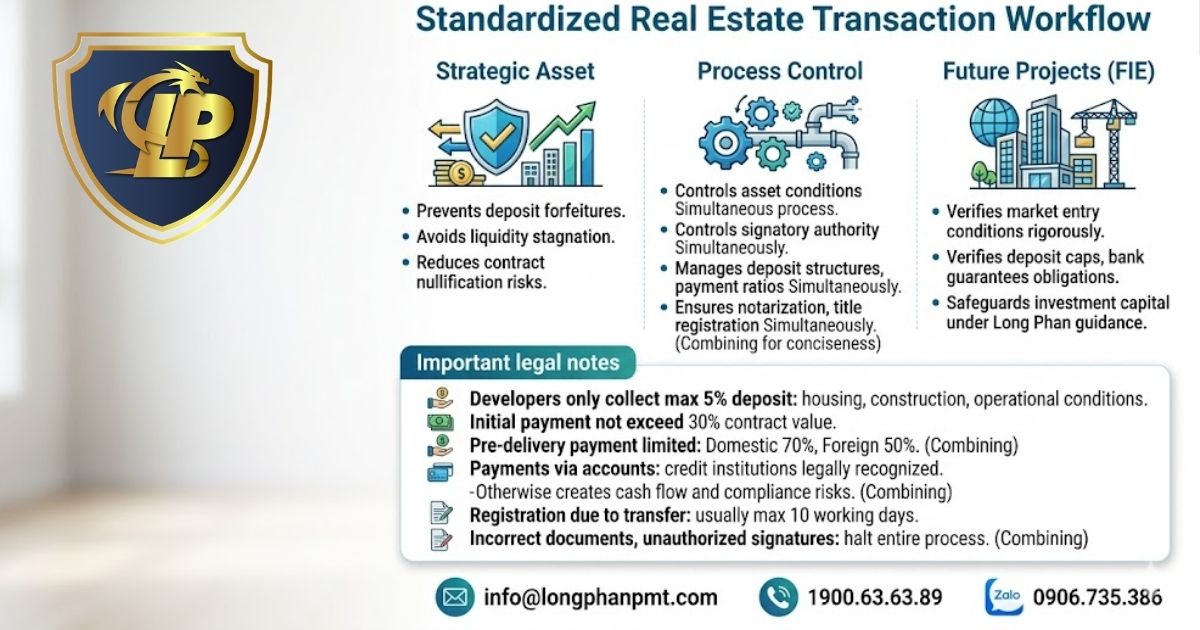
Important legal note:
A standardized workflow serves as a legal shield protecting an enterprise’s cash flow, ownership rights, and contractual validity. Under the Law on Real Estate Business 2023, each transaction must be designed as a chain of compliance control procedures, rather than a single commercial closing step. Long Phan Consulting Company supports enterprises in managing these critical barriers by:
Enterprises must accurately categorize transactions before designing control workflows, as each category operates under a distinct legal regime. Under Clause 8, Article 3 of the Law on Real Estate Business 2023, a real estate business contract is a written agreement between qualified entities to conduct the sale, lease, or transfer of housing, construction works, or projects. Long Phan Consulting Company optimizes this classification phase by:
| Transaction Group | Primary Legal Focus | Principal Governing Law |
| Existing Housing/Construction | Ownership rights, handover conditions, and title registration history. | Law on Real Estate Business 2023, Law on Land 2024 |
| Future-Formed Housing | Market entry eligibility, bank guarantees, and strict deposit/payment caps. | Law on Real Estate Business 2023, Decree 96/2024/ND-CP |
| Infrastructure-Ready Land Use Rights | LURC verification, zoning compliance, and usage terms. | Law on Land 2024, Law on Real Estate Business 2023 |
| Entire/Partial Project Transfer | Project status, financial obligations, and transfer approvals. | Law on Real Estate Business 2023, Decree 96/2024/ND-CP |
Misclassification can lead to the application of incorrect contract templates or unauthorized capital mobilization. For complex transactions, particularly the transfer of an entire or partial project, the workflow must be meticulously designed before any commercial commitment is signed.
Legal due diligence (LDD) serves as the primary risk interceptor before an enterprise executes any deposit, disbursement, or formal contract. This process must verify asset eligibility, project compliance, and the developer’s capacity to fulfill contractual commitments. Long Phan Consulting Company executes this critical review through three professional pillars:
The LDD dossier should be standardized for each transaction type. Enterprises must prioritize the following document groups:
Verifying land-use zoning must precede any disbursement decision. Long Phan Consulting Company manages this verification by:
The results of this audit must be documented in a checklist with designated accountability. This serves as critical internal evidence in the event of disputes regarding appraisal errors, delayed handovers, or the inability to register ownership rights.
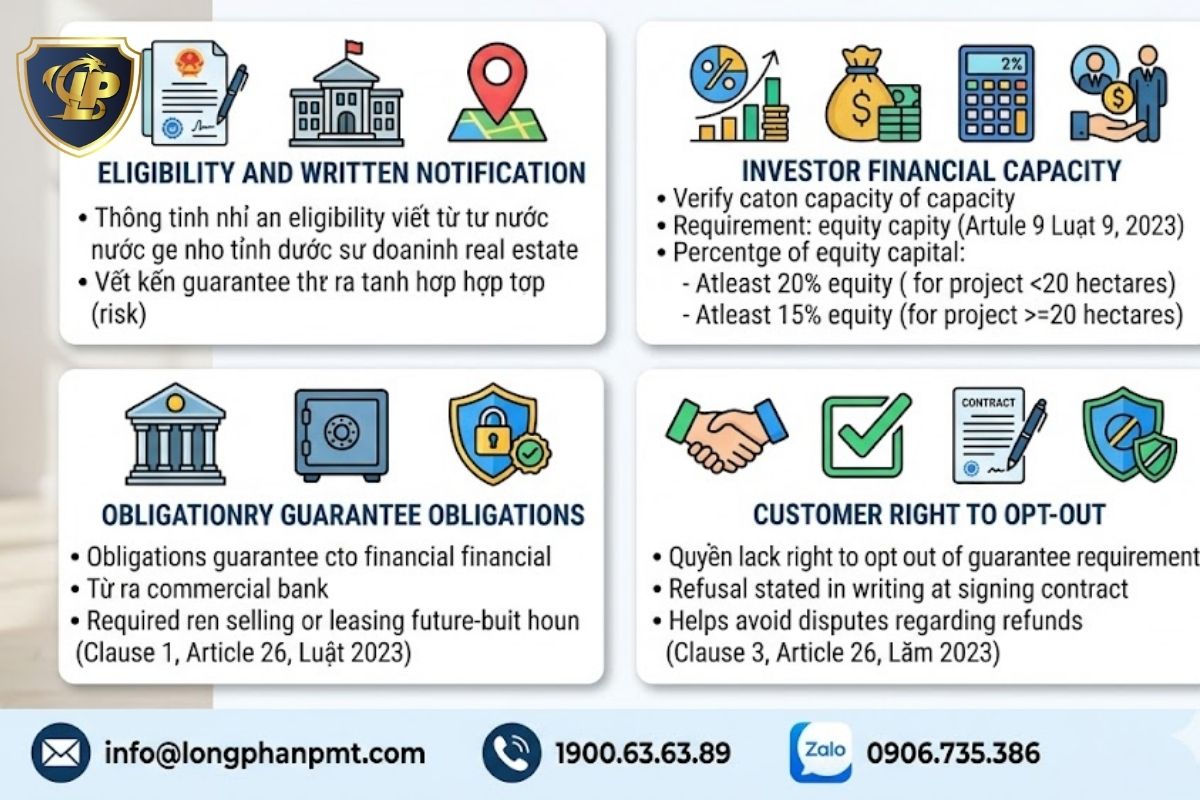
For housing and future construction projects, the biggest risk is that businesses disburse funds before the product is eligible for sale. The investor must have a written notification of eligibility from the provincial-level state management agency for real estate business and appropriate guarantee documents.
Businesses need to verify the financial capacity of the investor before signing a commitment. The equity capital of a real estate business must not be less than 20% of the total investment capital for projects under 20 hectares and not less than 15% for projects of 20 hectares or more (Point c, Clause 2, Article 9 of the 2023 Law on Real Estate Business).
The guarantee obligation is also a mandatory control point. The investor must obtain a guarantee from a commercial bank for financial obligations before selling or leasing future-built housing (Clause 1, Article 26 of the 2023 Law on Real Estate Business).
Customers have the right to opt out of requiring a guarantee, but this refusal must be clearly stated in writing at the time of signing the contract. This condition helps avoid disputes regarding the responsibility for refunds when the developer fails to deliver as promised (Clause 3, Article 26 of the 2023 Law on Real Estate Business).
Signatory authority is the decisive control point for the validity of a real estate contract. Even if an asset is legally eligible, the contract can be voided if the signatory lacks proper status or exceeds their authorized scope. Long Phan Consulting Company mitigates this risk by:
For joint-stock companies, the legal department must look beyond the signatory’s title and analyze internal financial regulations and threshold-based approval mechanisms. A standardized workflow requires the legal team to approve the signatory’s authority dossier before any deposit, principle agreement, or formal contract is executed.
Cash flow represents the most sensitive vulnerability in corporate real estate transactions. If deposits or disbursements occur at the incorrect legal milestone, the transaction may shift from a commercial agreement into a high-risk, illegal capital mobilization scheme. Long Phan Consulting Company ensures financial security by:
Deposit agreements must be controlled to reflect their true nature as a guarantee for contract execution. Labels such as “priority registration” or “reservation fees” do not change the legal essence of the funds if the intent is to secure purchase rights. Long Phan Consulting Company manages this stage by:
Post-deposit, enterprises must monitor payment progress against specific legal milestones. Long Phan Consulting Company supervises the following mandatory payment matrix:
| Payment Milestone | Statutory Limit | Legal Basis |
| First Installment | Max 30% (including deposit) | Clause 1 & 2, Art. 25, Law on Real Estate Business 2023 |
| Pre-Handover (Domestic) | Max 70% of contract value | Clause 1, Art. 25, Law on Real Estate Business 2023 |
| Pre-Handover (FIEs) | Max 50% of contract value | Clause 1, Art. 25, Law on Real Estate Business 2023 |
| Prior to LURC Issuance | Max 95% of contract value | Clause 3, Art. 25, Law on Real Estate Business 2023 |
| Payment Method | Must use Vietnamese Credit Institution accounts | Clause 2, Art. 48, Law on Real Estate Business 2023 |
For high-value transactions, the finance department must cross-reference each installment with handover certificates and legal project dossiers. This mechanism protects corporate liquidity and mitigates the risk of litigation arising from over-payment beyond legal progress.
Contracts are tools that transform the results of the assessment into rights, obligations, and trade defense mechanisms. If the terms are not sufficiently stringent, a business may win during the negotiation phase but lose its advantage when disputes arise.
The contract process must be linked to notarization, authentication, payment, tax declaration, and registration of changes. This is the crucial stage in determining whether property rights will be recognized by the state authorities.
Real estate contracts need to be designed according to the classification of the transaction type. Key clauses must clarify the subject matter, legal status, price, payment schedule, handover conditions, tax and fee obligations, and contract termination mechanism.
Businesses need to control the following groups of clauses:
If the parties only agree on a penalty for breach of contract without specifying that both the penalty and compensation will be borne, the breaching party will only be liable for the penalty. Furthermore, a separate compensation mechanism should be clearly stated in the contract to protect the right to claim actual damages (Clause 3, Article 418 of the 2015 Civil Code).
For transactions involving a large number of customers, businesses need to review the standard contract and general terms and conditions before implementation. The contract must not arbitrarily exclude the business’s liability or restrict the customer’s legitimate right to complain or sue under the 2023 Law on Consumer Protection.
After the contract is agreed upon, the business needs to move on to the stage of completing the procedures for establishing ownership. This is a series of tasks that require a clearly defined person in charge, as a small oversight can prolong the transfer of ownership.
The process should be controlled according to the following steps:
The time limit for registering changes in land use rights and ownership of assets attached to land is no more than 10 working days (Point a, Clause 2, Article 22 of Decree No. 101/2024/ND-CP). This timeframe is only valid if the application is complete and no additional documents are required.
Regarding the authority to issue land use certificates, the Provincial People’s Committee issues them to organizations, religious organizations, and economic organizations with foreign investment; the Commune People’s Committee issues them to individuals and residential communities (Clause 1, Article 136 of the 2024 Land Law). Businesses need to correctly identify the transferee to prepare the appropriate documents.
The post-transaction phase is often overlooked by businesses, but it is crucial in determining their ability to protect their interests in the event of a dispute. Handover records, payment documents, tax notices, and registration documents must be managed as long-term legal evidence.
The investor is responsible for submitting the application for a Certificate of Ownership to the buyer or lessee within 50 days from the date of handover of the house or from the time the customer makes full payment as agreed, except in cases where the customer carries out this procedure themselves (Clause 3, Article 17 of the 2023 Law on Real Estate Business). This deadline should be included in the post-handover monitoring process.
Businesses should establish post-transaction archives based on the following document groups:
This archive helps businesses proactively handle disputes related to deposits, handovers, construction quality, or project transfers. This content is standardized into a checklist of mandatory archived documents to be checked after the completion of a real estate transaction.
Under the transitional regulations, real estate businesses that are currently operating but have not yet met the new conditions have a limited timeframe 6 months since the date 01/01/2025To supplement the competency standards (Clause 1, Article 83 of the 2023 Law on Real Estate Business). Businesses should not consider this as a formal extension period.
Real estate business contracts legally signed before the date 01/01/2025The old regulations remain in effect. However, if an amendment or supplement is issued after this date, the adjusted content must comply with the new legal system (Clause 9, Article 83 of the 2023 Law on Real Estate Business).
For projects that were eligible for sale under the old law but had not signed contracts before this date 01/01/2025. However, the investor can still continue selling according to the old procedure. Before signing the contract, the business must still publicly disclose project information according to the new standard on the housing and real estate market information system (Clause 5, Article 83 of the 2023 Law on Real Estate Business).
Therefore, post-transaction management is not just about keeping records after the procedure is completed. It is an early warning system that helps businesses identify unfulfilled obligations, approaching deadlines, and risks that could compromise property rights.
The synergy between legal expertise and standardized workflows creates a total safety shield for corporate investments. The legal experts at Long Phan Consulting Company perform the following critical tasks:
Contextual CTA: For a preliminary evaluation of your transaction safety or to review a draft project transfer agreement, please contact our specialists via Email (info@longphanpmt.com) or Zalo/WhatsApp (+84 906 735 386).
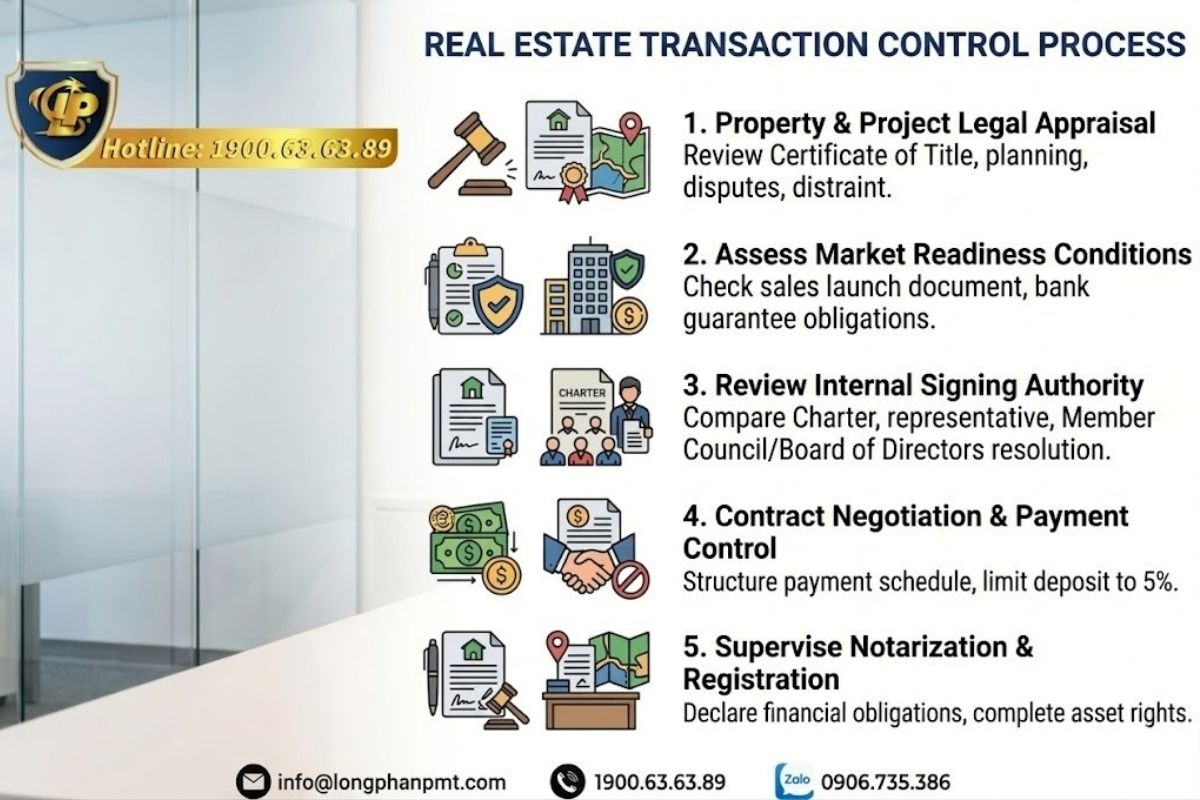
In practice, the implementation of “real estate transaction procedures” always gives rise to legal blind spots related to payment boundaries, transitional provisions, or bank guarantee limits. Understanding these exceptional situations helps real estate businesses proactively structure secure transactions and optimize appraisal time. Business leaders need to closely monitor specific risks to protect profit margins and maintain legal compliance.
Foreign-invested economic organizations are only allowed to collect a maximum of 50% of the contract value before handing over future housing units. For products not yet handed over, businesses must strictly adhere to the disbursement schedule to avoid the risk of violating the capital mobilization limit. Specifically, the total amount collected before handover must not exceed 50% of the contract value as stipulated in Clause 1, Article 25 of the 2023 Law on Real Estate Business.
Customers have the full right to refuse a financial guarantee request from the developer. When a customer purchasing or leasing a property decides not to require a bank guarantee, the business must ensure that this refusal is clearly stated in writing at the time of contract signing. This exception is recognized by law and clearly stipulated in Clause 3, Article 26 of the 2023 Law on Real Estate Business.
Developers are absolutely prohibited from collecting 100% of the purchase price if customers have not yet received the Certificate of Land Use Rights. Businesses need to restructure the payment schedule pending the issuance of the certificate, ensuring that the payment limit complies with the legal ceiling. Businesses are absolutely prohibited from collecting more than 95% of the contract value when customers have not yet been granted the Certificate of Land Use Rights and ownership of assets attached to the land, as stipulated in Clause 3, Article 25 of the 2023 Law on Real Estate Business.
Foreign-invested economic organizations will have land allocation and lease procedures directly handled by state agencies according to the new regulations. This helps create a more favorable legal framework for foreign capital flows that have not completed procedures before January 1, 2025. The competent state agencies will directly carry out land allocation and lease procedures and issue land use certificates to the project transferee based on Clause 4, Article 83 of the 2023 Law on Real Estate Business and Clause 16, Article 255 of the 2024 Law on Land.
Real estate businesses have 7 working days to provide customers with a copy of the contract. The business’s record-keeping system needs to be ready for quick document retrieval to ensure compliance with consumer rights. Businesses must provide a copy of the contract in the agreed-upon format within 7 working days from the date of receiving the customer’s request, as stipulated in Clause 2, Article 26 of the 2023 Law on Protection of Consumer Rights.
Businesses are required to complete the amendment and re-registration of standard contracts with the state agency before December 31, 2024. For standard contracts and general terms and conditions of transactions that were publicly disclosed and applied before the new law came into effect, businesses must urgently review their content. The amendment, supplementation, and re-registration of contracts must be completed on time to ensure legality, based on Points a and b, Clause 2, Article 80 of the Law on Protection of Consumer Rights 2023.
A standardized real estate transaction workflow is not merely a formality; it is a comprehensive legal control system encompassing LURC due diligence, signatory authority audits, and strict adherence to payment ceilings. Enterprises operating without these standardized controls risk contract nullification, liquidity freezes, and the failure to establish legal title. To secure your assets and ensure absolute compliance with the Law on Land 2024, contact Long Phan Consulting Company at Hotline: 1900636389 for professional strategic support.
📚 This article is provided with professional consultation based on the following legal framework: